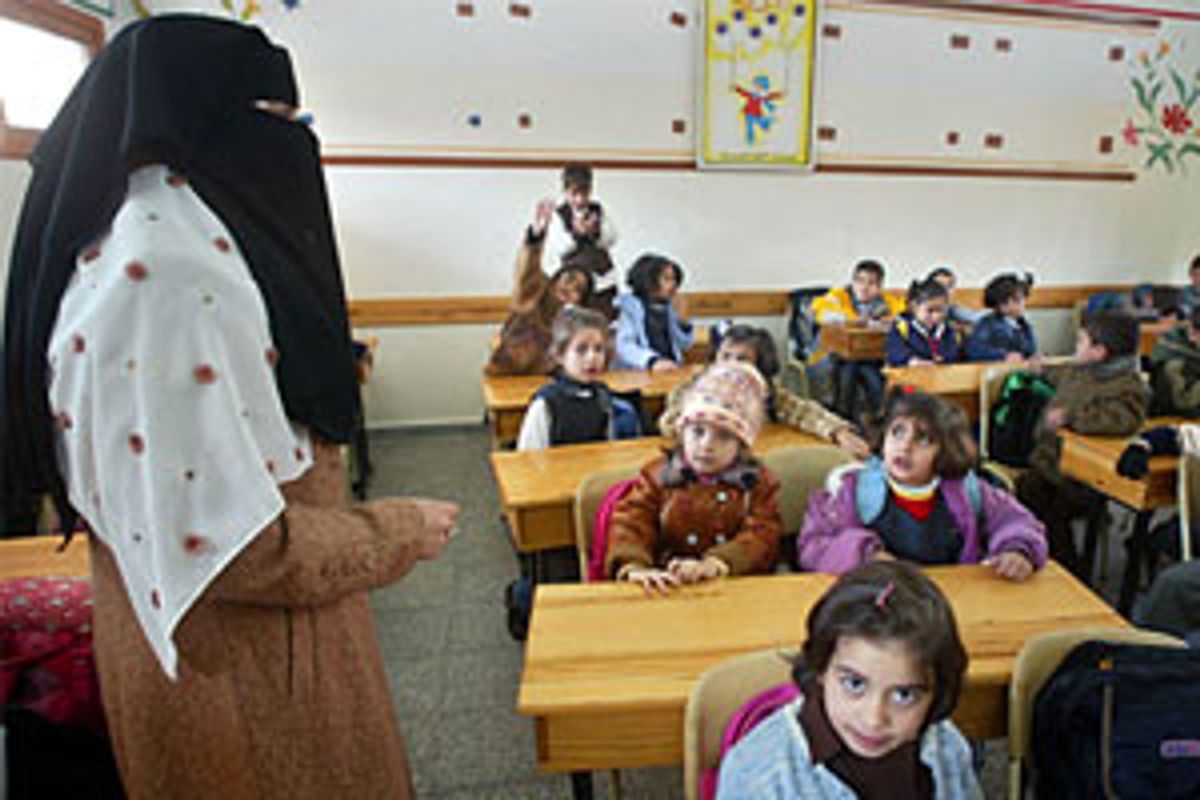
The preschool's iron gate clangs behind us, shutting out the dust and concrete-block ugliness of Jabaliya, the largest Palestinian refugee camp in the world (population 120,000). In here, around the paved schoolyard, everything is clean, freshly painted and orderly. An energetic young woman in full Islamic coverup is leading two dozen 4-year-olds in some vigorous phys ed. Tiny voices echo out through the open classroom windows.
In one room, a dozen kids are working on computers, "coloring" the national flag of Palestine on their screens. In another, two teachers behind an ingenious puppet theater have puppets act out an interactive skit about the virtues of brushing your teeth. In a third room, it's time for English instruction. "Where is the orange?" the teacher asks as 22 kids look at objects arrayed on a table. "This is the orange!" some overachievers yell as they race to grab it.
Forget about old-fashioned Islamic madrasas and rote learning. This is an Islamic preschool, Hamas-style. It is part of a dense network of social-service institutions that Hamas and its precursor organizations have built up over the past 30 years in the Israeli-occupied territories of Gaza and the West Bank. These institutions have provided some much-needed humanitarian aid to the hard-pressed Palestinian population. They have also served a number of political purposes.
First and foremost, they helped increase the ability of the Palestinians to withstand the many collective punishments that Israel has imposed on them. Second, they have kept alive a generally (but not completely) maximalist view of how the Palestinian-Israeli conflict should be resolved. Third, they have incubated the development of a broad range of professional and management skills among the Palestinians who have run them. Finally, in the Palestinians' legislative elections of Jan. 25, these institutions, with their track record of effectively delivering vital services, provided the springboard for Hamas' surprise victory over the secular Fatah Party.
Today, a large proportion of the staffs, affiliated with Hamas, that run the health centers, social-work departments, preschools and emergency food banks are women. And many of the beneficiaries of the services are women -- women trying to raise families in trying conditions in the refugee camps, towns and villages of the occupied territories. Indeed, one of the secrets of the Hamas electoral win that has gone largely unrecognized in the West is the strength of Hamas' well-organized networks of empowered and politically engaged women.
During my recent 20-day reporting trip to Israel, the West Bank and Gaza, several people in Gaza even told me that one reason Hamas won so strongly on Jan. 25 was that in many families where the husband voted for Fatah, his wife voted for Hamas. Gaza journalist Laila El-Haddad covered the elections quite closely. "The Hamas women made sure the women voters understood that their votes would be secret," she says. "They assured them their husbands could never find out how they'd voted. I saw it happening."
It's not clear how widespread this phenomenon was. But women freeing themselves from the traditional expectations of patriarchy are now clearly shaping Palestinian society. Tough and well-disciplined, these women espouse political views that are often to the hard-line end of Hamas' (admittedly narrow) political spectrum. As participants and leaders in Palestine's social networks and organizations, this engaged sisterhood represents a women's activism that few of the world's Islamist movements have seen.
In Jabaliya, I am accompanied by Sister Maha, head of women's affairs for the Jabaliya Islamic Society, and Sister Samah, the vivacious, 24-year-old head of the local Young Muslim Women's Association. The women routinely call each other "sister" and it feels quite familiar to me to do so too. Their large head scarves, drawn in tight around their faces with no wisp of hair showing, and their plain-colored, shapeless, full-length coats make them look eerily similar to the wimpled Anglican nuns I once studied under.
We look in on a meeting of the Islamic Society's (women) social workers as they discuss the cases of some of the 800 fatherless children whom they help support. "Yes," says Sister Maha, "some of these kids' fathers were our fighters who were killed, or who died in martyrdom operations [suicide bombings]. But some are children whose fathers just died, or were killed by the Israelis."
We also visit a family where two brothers had died in suicide bombings, and a woman whose husband has been in an Israeli jail since 1991. Sister Maha makes these kinds of home visits frequently. As we enter each home, she carefully peels off the black cotton gloves that, in a mark of particular piety, she always wears when she's in the street. To mark the end of the visit, she starts putting them on again.
When we visit the prisoner's wife, Sister Samah and Sister Maha each use our hostess's prayer rug to say their noon prayers. Each perform the kneeling, bowing and low-voiced praying of the ritual in an unself-conscious way in one part of the room, while the rest of us continue our conversation a few feet away.
At the preschool, Sister Asmahan, the tall, impressively articulate director, sits with us in her office to talk about the program. She says that she and her team provide four hours of preschool education to 160 children each day. She brings out a pile of notebooks and shows me how the teachers, without a copier, painstakingly create fun and engaging workbooks for the kids. The bright, well-decorated classrooms and the activities attest to the technical excellence of the program and the strong preparation of the teachers.
We talk mainly about the school, but Sister Asmahan also wants to talk about politics. She tells me firmly that all the Palestinian refugees should be allowed to return to the homes their forefathers had left, or been forced to leave, in 1948. "And the Jews who are there now should go back to where they came from," she says.
This is one of seven preschools run by the Islamic Society in Jabaliya. These preschools are important in preparing children to enter schools the United Nations runs for the refugees who make up 75 percent of the Gaza Strip's 1.4 million people. The Islamic preschools, where the average class size is around 24, educate children ages 4 and 5. The U.N.'s schools do not take children in until age 6 -- and there, the average class size is 50. If a child has not learned to read and write before getting into the U.N'.s classrooms, there is little chance she will a get a chance to do so there.
The day before my tour of Jabaliya, I sat down in a corner of a busy office in the Gaza "satellite" seat of the Palestinian parliament with two of the six women legislators who were elected on the Hamas list. Most of these women are professionals; three are from Gaza and three from the West Bank.
Jamila Shanty is a robust, good-natured woman with a well-defined, expressive face who bustles into our meeting toting a large, tattered briefcase. Formerly a professor of psychology and philosophy at Gaza Islamic University, she relishes her new role in the parliament where, she tells me, she hopes to sit on the political and legal-affairs committees.
"We need to strengthen our internal front and restore some discipline to Palestinian society," she says of Hamas' imminent priorities. "We must not give Israel the chance to come in here and bomb. We had an ambitious election platform that we now need to implement. Our economy is very difficult, our social conditions are very difficult. So many things need to be done! And we need to protect this project. Everyone is asking us about recognizing Israel. But this is not our focus right now."
In describing how she became involved in Hamas-related activities, Shanty says she was inspired mainly by Sheik Ahmed Yassin. In 1973, Yassin founded the key Hamas precursor organization -- the Gaza-based "Islamic Center," which focused on educational and social-work activities -- and then, in 1987, Hamas itself. He was one of many Hamas leaders assassinated in 2004.
"Sheikh Yassin always paid such a lot of attention to women's affairs!" Shanty says. "He made sure the mosques all provided enough space for the women to pray in, and that they offered lectures and other activities for women. He told us that the work we do in our homes is important because it has real political value. But he also strongly encouraged women to become engaged in causes outside the home. Whenever he visited a mosque he would make sure to have a meeting with the women there, and he would urge all the women to finish their education and contribute what they could to society. He was an example not just to Palestinians but all Muslims."
As we talk, we are joined by Shanty's controversial colleague, Mariam Farhat. Farhat is a pale-faced, demure, older woman who is the mother of three young men who engaged (and lost their lives) in suicide operations against Israelis, killing maybe 10 Israelis in total. I ask her how she feels about her sons' activities. She says she had encouraged the young men to sign up for the "martyrdom operations."
"Even though I'm a mother and I love them so much, still there is a priority which is to fight for our rights," she says. "So though it was painful when they died, still I also felt happy because I am convinced both that they went to heaven and would have a life so much better than our life here, and that their sacrifice helped our Muslim cause. Anyway, how do American mothers feel when they send their boys off to fight and perhaps die as they launch attack operations in Iraq -- or Israeli mothers when they send their sons against us here?"
Farhat's firm, if demurely stated, defiance of Israeli power has made her famous in Palestinian society. Hamas' politically savvy campaign managers even put her face -- along with those of Ahmed Yassin and a couple of other well-known Hamas male leaders -- onto the main election posters the party used in the election. A woman of insistent piety, she spends some time during our interview trying to convert me to Islam, saying that because she loves me she wants to "save me from the fire." I resist her entreaties.
The participation of Farhat, Shanty and their Hamas colleagues in January's parliamentary election marks the latest phase in a long and slow transformation of Hamas into a national political organization, albeit one that has a 5,000-man militia force that is still dedicated to "resisting the Israeli occupation." Hamas did not participate in the first round of elections to the legislative and executive branches of the Palestinian Authority back in January 1996. At that point, and until recently, they criticized the P.A. project as an offshoot of the 1993 Oslo accord, which they judged a sellout of Palestinian interests. But by mid-2003, Hamas leaders felt the time had come to enter the P.A.-related political arena.
A first attempt to enter into a P.A. "national unity government" under then-Prime Minister Mahmoud Abbas was blocked when an ever-vindictive Yasser Arafat nixed the plan. After Arafat died in late 2004, Hamas negotiated a new agreement with Abbas, who was elected as new P.A. president in January 2005. Under this deal, Hamas and Fatah agreed to abstain for one year from undertaking any military operations inside Israel. In return for Hamas' cooperation with the cease-fire, Abbas agreed to allow them to enter the next round of legislative elections. Hamas has stuck to the cease-fire, with only one exception, and has agreed to its continuation -- for now. Some small Fatah offshoots have refused to observe it.
Hamas' first step into electoral politics came when it competed in the three rounds of long-overdue municipal elections that the P.A. organized in late 2004 and early 2005. "We got good practice in campaigning during those elections," veteran Hamas leader Mahmoud Zahhar tells me. And the Hamas candidates did much better than expected, winning control of many of the new local councils.
One of the new municipal bosses to emerge was Ahmed Kurd, elected as mayor of the central-Gaza city of Deir al-Balah (population 35,000) in late January 2005. His history illustrates the long campaign that Yassin's followers pursued to build grass-roots social-service organizations, and indicates how, when the Hamas people entered the political arena, they used the management and professional expertise they had acquired in those projects in their new tasks of governance.
Before Kurd ran for mayor, he worked for many years to establish and run a number of well-respected social-service projects. A genial, bespectacled man in his late 50s, he takes me on an after-hours tour in Deir al-Balah. We visit a brace of side-by-side Islamic schools -- one for girls and one for boys -- each of which now educates 500 children, grades 5 to 12.
As with the Jabaliya preschool, there is a strong contrast between the dust and chaos outside the school walls and the calm and order inside them. On the girls' campus, immaculately manicured gardens edge a broad concrete sports "field," beside which rises a long set of high-rise bleachers. Along two sides of the campus are three-story buildings housing airy, bright-looking classrooms and at one end stands an imposing building containing the girls' cafeteria, mosque and library. The boys' campus is broadly similar.
Kurd says he has worked as a teacher in the U.N.'s school system for 35 years. For many of those years, he worked with his Islamist friends to establish the charity that would build these schools, which serve orphans and children from low-income families throughout the Gaza Strip. The Salah Benevolent Society (as it is called) finally opened the schools in 1999.
We drive along the area's prodigiously rutted and untarred streets. They jerk us between areas dotted with date palms and market gardens that speak to the area's long past as a center of cultivation -- Deir al-Balah means "Date-palm Monastery." Other roads are jammed with two-, three- and four-story buildings built according to no apparent plan.
The next philanthropic project we visit is a compact, five-story hospital called the Jaffa Medical Center, located next to a mosque. The bottom three floors are devoted to various outpatient clinics. In the women's dental room, I find a long-gowned female dentist saying goodbye to a patient, filling out a payment voucher for her, and telling her where to take it for settlement. She tells me in excellent English that she had trained in Pakistan.
Kurd proudly shows us around the lab, the X-ray room and five or six of the outpatient departments. Upstairs, on the top two floors, surgical and medical wards are being prepared, along with two impressively equipped operating rooms. About one-third of the staff members I see in the hospital are women.
When Kurd and his Hamas colleagues took over the city council a year ago, he says, "there was no system of administration in place at all. There were some capable employees but no one to supervise and organize their work. Our first tasks were to put in place such a supervisory system and to rebuild the trust of the citizens in the city council. Our operations are financed mainly through user fees, and people had become so angry with the old council that they had simply stopped paying. We had a big budget crisis to resolve, and we've made a little progress."
Now, just one year after Hamas got its first taste of governance by winning two dozen Palestinian municipalities, it is on the brink of taking over the national government. It still faces a tough political road before it can use its parliamentary majority to form a government. It cannot afford to get into a complete showdown with Fatah, whose leader, President Abbas, is the P.A.'s main channel to the international community on which the whole P.A. project is completely dependent; and so far, both Abbas and the Hamas bosses have shown themselves to be tough negotiators. The government-formation negotiations may -- in Palestine, as in Iraq -- prove to be a long, drawn-out process.
Regarding external politics, there is a parallel standoff between Hamas and the international community; all the members of the diplomatic "quartet" -- the United States, United Nations, European Union and Russia -- still insist that Hamas recognize Israel, renounce violence, and promise to continue compliance with the P.A.'s previous international agreements, while Hamas refuses to meet these demands. That puts both sides in a tough bind. Hamas leaders feel they cannot summarily turn their back on their political base, even if they want to.
For the international community, the destruction of the Palestinian economy of the West Bank and Gaza, as a result of nearly 39 years of Israeli military occupation, has left 3.6 million Palestinians the wards of that community. As a result, it cannot allow the humanitarian situation to deteriorate any further. It must provide basic relief and economic development services.
Whether this aid is delivered through the institutions of the quasi-governmental P.A. or non-governmental groups, the fact remains that nearly all of the Palestinians who have the experience, skills and organization to deliver these services are people and groups associated with Hamas. Fatah and its secular allies had a decade to show what they could do. But it was their long record of inefficiency and corruption while in power that -- just as much as the notable lack of success, from the Palestinian viewpoint, of their peace diplomacy -- persuaded so many Palestinians to vote for Hamas in January.
One way or another, then, the networks of grass-roots activists that fueled Hamas' recently established political machine will continue to be important. And many of them are staffed and led by women. "We are not afraid," Jamila Shanty says. "Our religion supports us. Our people support us. The Arab people support us. And all the world supports democracy."
Shares