

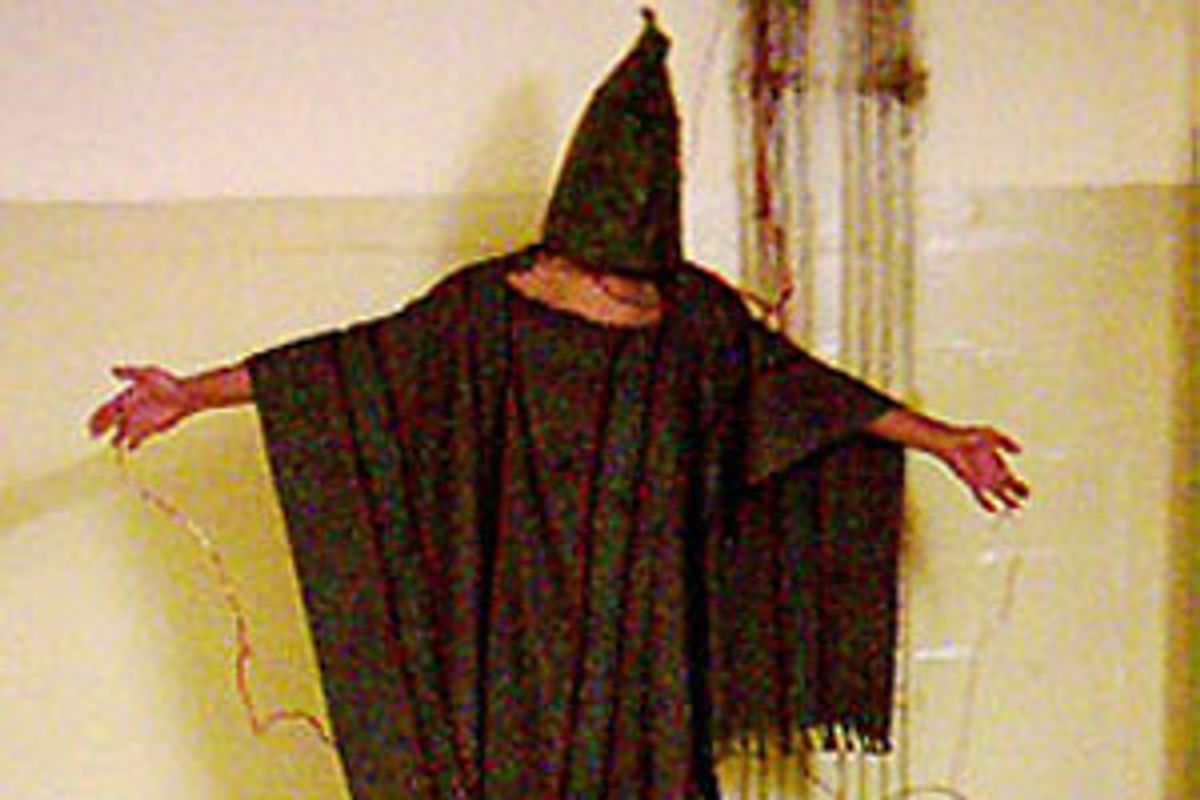
The New York Times announced Monday night that it would review the accuracy of a recent Page One story that claimed to identify the hooded detainee shown in one of the most iconic photos of abuse from Abu Ghraib, after Salon presented evidence suggesting that the paper had identified the wrong man.
In an apparent scoop on Saturday, the Times reported that Ali Shalal Qaissi, a former Baath Party member, had been photographed standing on a cardboard box, hooded, with his arms spread, a blanket around his shoulders and electrical wires extending from his hands.
But Army documents obtained by Salon contradict the Times' account. An official report by the Army's Criminal Investigation Command (CID) concluded that the photo the Times said showed Qaissi actually showed another detainee, named Saad, whose full name is being withheld by Salon to protect his identity. According to the official report, this second detainee was nicknamed "Gilligan" by military police at Abu Ghraib.
The documents were among many photos and files obtained by Salon last month, from a uniformed member of the military who spent time at Abu Ghraib and is familiar with the CID probe.
In an e-mail interview, a spokesman for CID confirmed that investigators had concluded the photograph shown on the front page of the Times was not Qaissi. "We have had several detainees claim they were the person depicted in the photograph in question," the CID spokesman told Salon. "Our investigation indicates that the person you have cited from the NY Times is not the detainee who was depicted in the photograph."
Ethan Bronner, the deputy foreign editor of the Times, said the newspaper was now investigating the possibility that two people were depicted in the photographs. He said the newspaper was no longer certain that the picture it ran on the front page depicted Qaissi. "Serious legitimate questions have been raised," Bronner said.
In an internal CID archive of 280 Abu Ghraib photos obtained by Salon, there are a total of five photographs depicting a hooded man -- or men -- attached to electrical wires, taken from different angles by three different digital cameras in a span of roughly 15 minutes on the night of Nov. 4. While CID investigative materials reviewed by Salon indicate that all the hooded photos depict Saad, not Qaissi, the possibility that a second hooded prisoner was subject to similar treatment cannot be ruled out.
The CID spokesman said the agency would include the information about the photograph reported by the Times as its investigation continues, to "determine if there is any credibility to this allegation."
A lawyer representing Qaissi confirmed to Salon Monday night that the Times had made a mistake. "He [Qaissi] believes that there are two different people depicted in the photographs," said Jonathan Pyle, of Burke Pyle LLC. "Ali believes that the picture of himself is the one with his arms pointed diagonally down." Qaissi uses this photograph on his business card.
Lawyers and human rights workers who are investigating the abuse at Abu Ghraib maintain that the official government reports of abuse are far from comprehensive, containing several possible inaccuracies and omissions. "We don't think the investigation is complete at all," said Pyle, the lawyer representing Qaissi. He spoke by phone from Amman, Jordan, where he and other lawyers were meeting with alleged victims of U.S. detention policy.
Up to this point, the investigations by the U.S. military, and statements by military police, have indicated that there was only one detainee, the man named Saad, who was forced to stand on a cardboard box with wires connected to his hands. This detainee was suspected of involvement in the kidnapping and murder of two U.S. soldiers. According to Army documents, Saad was being held by CID, the same military agency that would later lead the investigation into abuse at the prison.
Military police officers have since told investigators that a CID agent at the prison ordered the mistreatment of this detainee, who was called "Gilligan" by military police. According to a CID spokesman, one CID agent, who has been identified elsewhere as Sgt. Ricardo Romero, was found derelict in his duties in connection with this detainee's treatment.
In an e-mailed statement, Qaissi told Salon Monday night that he remembered another detainee, Saad, who was abused in a similar manner at the same time. "I have seen at least two dreadful pictures showing this horrible experience," Qaissi wrote. "One is me. The other I believe could be Saad because he went before me to the area I had to go, where I was to be interrogated."
CID documents do place a man fitting Qaissi's description -- with a deformed left hand -- in the military intelligence wing at Abu Ghraib on the night that electrical wires were used. According to a statement that Military Police Cpl. Charles Graner Jr. gave CID in April 2005, this detainee was known as "The Claw." In the statement, however, Graner does not allege that "The Claw" was ever abused with electrical wires. The photo archive obtained by Salon contains several photographs of a detainee with "The Claw" scrawled on the front and the back of his jumpsuit. There is one close-up photo of the detainee's deformed left hand.
Other parts of the official CID investigation also differ from the account Qaissi gave to the Times. According to the Times story, Qaissi chokes up when describing a photo that shows Spc. Lynndie England pointing at the genitals of naked detainees. "That's Jalil, Khalil and Abu Khattab. They are all brothers and they are from my neighborhood," Qaissi told the Times.
The CID investigation obtained by Salon listed the full names and aliases of all the detainees present for that night of abuse, which Salon has chosen not to publish. The names do not appear to match Qaissi's description, but it's possible the detainees went by other names as well.
Similarly, Qaissi alleges that a detainee being menaced by a dog in a photo is named Talib. "He is a young Yemeni, a student of the Beaux Arts School." The CID archive of Abu Ghraib abuse photos obtained by Salon shows two episodes of detainees being menaced by dogs. One is described in Army reports as a Syrian, whom the Washington Post has identified as Ashraf Abdullah Ahsy. The other, who was known to military police as "The Iranian," does not have Talib in his name, according to a CID report.
In addition to the question of whether one or two detainees were photographed with electrical wires on his hands, confusion remains over whether the wires were ever connected to a power source. Reports by Maj. Gen. George R. Fay and Maj. Gen. Antonio M. Taguba both claimed that simulated electric wires were used at Abu Ghraib. Military police have also maintained in statements to investigators that the wires were a bluff, intended to terrify the detainee.
"I put the wires on his hand," Spc. Sabrina Harman told investigators, in a description of the man she called "Gilligan." "I was joking with him and told him if he fell off, he would get electrocuted."
In his interview with the Times, Qaissi said that he was shocked five times, "enough for him to bite his tongue."
In an e-mail with Salon, Qaissi said that he would continue to cooperate with reporters in an effort to get a full account of what happened at Abu Ghraib. "I have to tell you that your question adds to the pain I have already suffered, where people have tried to hide or question what I went through," Qaissi said in the e-mail.
But he added that he understood why the questions were being asked. "Your inquiry is great example of democracy where people are free to ask questions," he wrote. "This is what is great about America. Unfortunately, I was denied that in prison."
Update: On Tuesday, the Times published a story responding to Salon's concerns.
Shares