

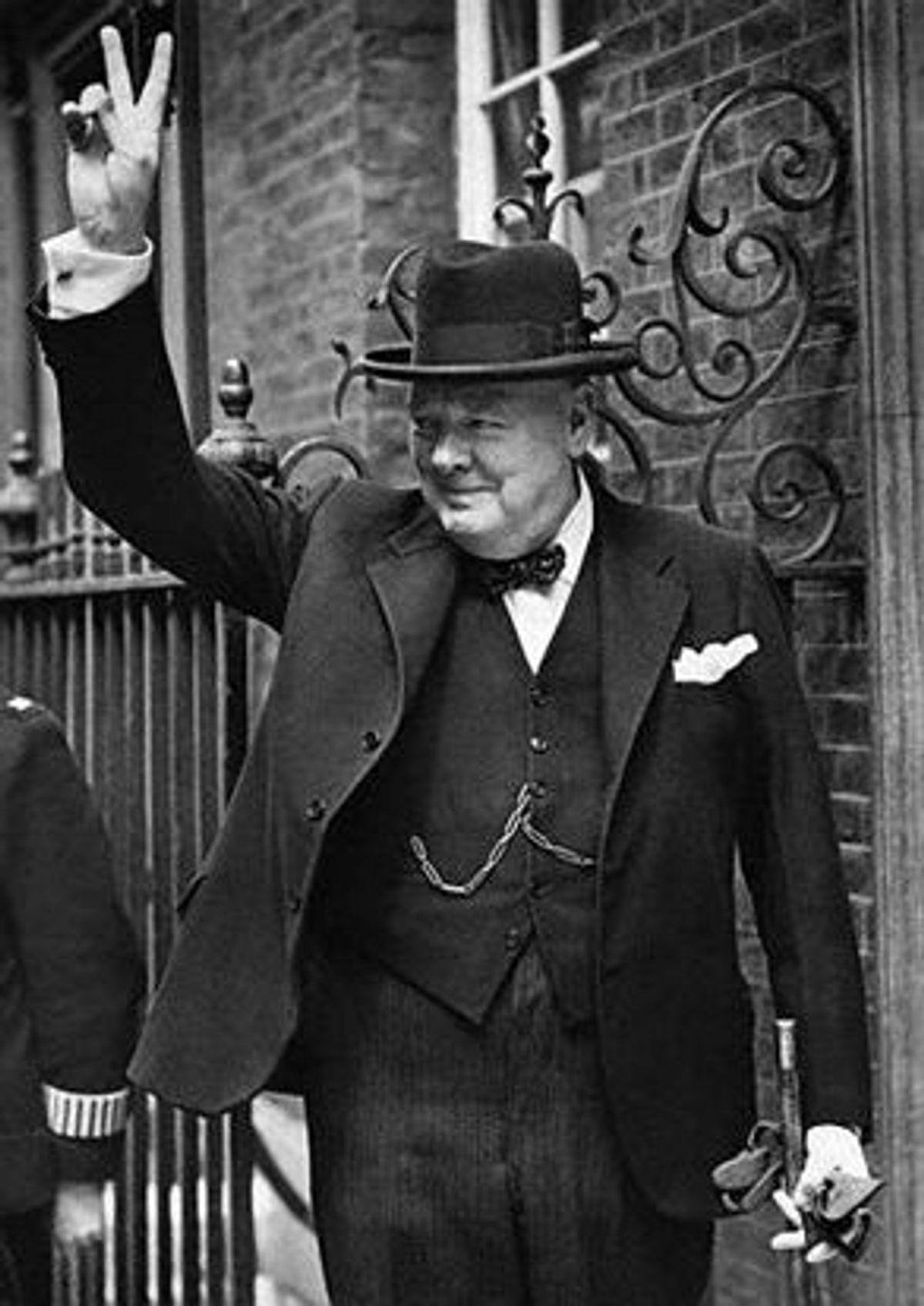
June 1940, London. The Nazis poised to strike at Britain. The prime minister, Winston Churchill, gravely addresses Parliament. His oratory is stirring, grandiloquent, passionate: "Let us therefore brace ourselves to our duty," the great man intones, "and so bear ourselves that, if the British Commonwealth and its Empire lasts for a thousand years, men will still say, 'This was their finest hour.'" It was one of his greatest speeches.
October 2001, New York City. The aftermath of a deadly, frightening attack, almost instantly compared to the Blitz. Thousands dead. A city in mourning. On the television, a commercial featuring the bright lights and sights of Manhattan flashes across the screen, Mayor Giuliani imploring would-be visitors to "come see New York united in its finest hour."
We are all Churchillians now. And the clichis are flying.
From Bush to Blair, Churchillisms have become a lingua franca for our leaders. "We will rally the world to this cause by our efforts, by our courage. We will not tire. We will not falter and we will not fail," the president gravely declaimed in his address to Congress after the attacks, his words a clear homage to the rolling cadences of Churchill's "we shall not flag or fail" speech before a weary, stunned Parliament in the wake of Britain's ignominious retreat from Dunkirk in the dark days of early summer, 1940. "[Churchill's] words are being mobilized and once more sent into battle," noted one approving historian.
Then there is Giuliani, New York's "Churchill in a Yankees cap," as reporters took to calling him after Sept. 11, adopting one of Churchill's most famous phrases to rally the city (using it as a marketing tool, no less!). And just as Churchill, the gruff epitome of John Bull, visited the bombed-out areas of London's East End during the Blitz, comforting citizens, giving them hope, there was Giuliani, the New Yorker's New Yorker, at ground zero, somber, sober, his resolute determination invariably compared to Churchill's reassuring steadfastness as bombs fell on London 60 years ago.
This is fitting, for Giuliani is a known Churchill buff. In the days after the attack, he took up John Lukacs' book "Five Days in London: May 1940," a blow-by-blow account of Churchill's hard-won decision to fight on alone against the Nazis -- a decision he had to push through over the objections of his own war cabinet, which he wore down through a combination of perverse will, guile and clever persuasion. Even though Lukacs' book is not an account of the Blitz, but rather the circumstances that led to it, it is clear why Giuliani would find much inspiration from its pages. In Lukacs' account, Churchill was the man who wouldn't deal with the Nazis, who wouldn't take no for an answer, who rebuked his critics with stinging eloquence. (Of those who would negotiate with Hitler, Churchill quipped, "An appeaser is one who feeds a crocodile hoping it will eat him last." )
The rhetoric is inspiring; his quotations could fill a book, yet we forget that Churchill's now titanic standing in 20th century history has a complicated history all its own. His reputation has been itself a kind of battleground; generations of historians, politicians and critics have contested his actions and dissected his words.
Then again, he was an inviting target. A man of enormous ego (like the mayor of a certain big city), Churchill felt called by destiny, convinced Providence would steer him to greatness. (Jibed one friend after the publication of his history of World War I: "Winston has written an enormous book about himself and called it 'The World Crisis.'") A political opportunist, he switched parties, not once, but twice (Conservative, then Liberal, then back to Conservative). He consorted with shady characters, raffish hacks and the vulgar rich. Were one to overhear a conversation between two Tory MPs about him in the late '20s (after he had gone back to the Conservatives), epithets like "shameless cadger" and "incorrigible scrounger" would pepper the air. Even when he walked onto the floor of Parliament for the first time as prime minister, members of his own party sat on their hands, saving their praise for the man he deposed -- Neville Chamberlain, Hitler's dupe.
Without the Second World War, Churchill would be remembered very differently today. Until he became prime minister in 1940, there was a whiff of failure about him; he was merely near-great. Though he had held almost every portfolio outside Britain's highest office -- 1st lord of the admiralty (secretary of the navy), home secretary, chancellor of exchequer -- he had a long list of screw-ups on his résumé. Perhaps the most notorious of these were the Gallipoli landings, which he planned. The operation was a fiasco, and to this day is still remembered as one of the great failures of World War I.
By the 1930s, books like "The Tragedy of Winston Churchill" were appearing in shops. During those fraught decades -- his "wilderness years" -- he was out of office, working as a journalist and, at least among the ranks of Tory politicians, a lone voice warning against the Nazi menace, "an alarm clock, but [a] rasping one, which made most more anxious to turn it off than to respond to its summons," as Roy Jenkins aptly writes in his new biography, "Churchill." In our own time, "appeasement" is a dirty word; but in the '30s, the appeasers were widely considered honorable men who wanted to avoid another war with Germany. To a great many, Churchill was merely an irresponsible warmonger, a dangerous adventurer hell-bent on drawing Britain into battle to advance his career.
Yet what of Churchill's "finest hour," his leadership in the Second World War? A great many hoary clichis have grown up about his war years. For A.J.P Taylor -- a notoriously contrarian historian of leftist tendencies -- Churchill was nothing less than the "savior of his country." But in recent years there has been much debate about this, his one seemingly unassailable achievement.
Historians have lined up to take their best shots at knocking the man off his pedestal. In 1993, a flurry of revisionist accounts appeared -- most prominent of them the massive "Churchill: The End of Glory," by maverick scholar John Charmley, who argued that Britain's victory came at a steep price -- the loss of its Empire, its financial enslavement to the United States and the Soviet domination of Eastern Europe. In a review of Charmley's book, the Tory rascal Alan Clark argued that Churchill should have negotiated with Hitler (thus preserving the Empire), which set off a blazing row in the British media.
Though Charmley did not put the matter in such stark terms, his book ends on the most skeptical of notes, that Churchill's finest hour concealed the seed of Britain's own decline: "Churchill stood for the British Empire, for British independence and for an 'anti-Socialist ' vision of Britain. By July 1945 the first of these was on the skid, the second was dependent solely on America and the third had just vanished in a Labour victory. [I]t was indeed the end of glory."
But Charmley is hardly Churchill's most noxious scholarly critic. That accolade surely belongs to the notorious David Irving, who has embarked on an epic debunking (published at his own expense) of Churchill's war record. Vol. II appeared earlier this year to a skeptical reception from fellow historians. Harrumphed one Churchill scholar, "In this 1,063 page hymn of hate, it is clear that he has not managed to land one single significant blow on the reputation of Britain's wartime leader." Irving charges, among other things, that Churchill was a drunk (hardly an unknown fact), a liar, connived in the murder of a Polish general, asked for the assassination of General DeGaulle and even exposed himself in front of visiting statesmen! Irving's motivations are complex; but his well-documented admiration of Hitler has in some small part warped the reputation of his own scholarship, as does his barely concealed hatred of Churchill.
Hating Churchill has a long pedigree; the knives have been sharpened, the poison pens ready since the beginning of his career. As many want to tear him down as want to praise him. The politics of the Cold War are an unavoidable subtext in the interpretation of Churchill's war: His single-minded focus on defeating Germany paved the way for the Soviet domination of Eastern Europe, the argument goes. (Churchill, an early strident critic of the Bolsheviks, had a soft spot for Uncle Joe.) However, Lukacs recently put paid to this line of argument. "As early as 1940 (if not earlier) Churchill saw that the alternative was plain," he bluntly wrote in the Spectator, "either Hitler's Germany would rule all of Europe, or Stalin's Russia would rule much of eastern Europe; and half of Europe was better than none. "
Lukacs has an ally in Geoffrey Best, whose recent biography, "Churchill: A Study in Greatness" -- its title is an allusive riposte to a landmark 1970 work, "Churchill: A Study in Failure" -- is an ideal primer for the arguments for and against Churchill. Best's scholarship is incisive, his prose strong, his reasoning sharp. To the latter-day scholar-appeasers like Charmley, Best counters, "Churchill was right to believe that Hitler and Nazism had to be fought to the end, no matter what the cost; and the British people did well to sense that it was better for them and their posterity to follow his lead, even though the road promised to be hard and rough. The war indeed did not work out to Britain's material advantage (which was not in fact aimed at or expected), but Britain remained free, civilized and with a clear collective conscience."
For any historian, it is naturally tempting to refight World War II, and to second-guess Churchill. Yet the scholarly battles over his legacy often resemble clever parlor games: "He should have considered this," "He should have done that," ad nauseam. Revisionism in the service of understanding why leaders took the courses they did should be welcomed. Suggesting alternatives, however, is often a futile exercise.
All the wild conjecturing in the world won't restore the Empire, or change the fact that Churchill rallied an entire nation in a dark time. In his speeches, he took a great risk in not sugar-coating the difficulties of wartime, a tactic that won him even greater respect from the British people; his forthrightness during the war was a bold gambit that paid off. Some years after the war, in a moment of simultaneous vanity and modesty, Churchill remarked, "It was a nation and a race dwelling all around the globe who had the lion heart. I had the luck to be called on to give the roar." That more than anything illuminates how he led, the unique bond this aristocratic toff forged with British men and women from all walks of life.
So as we face our own difficulties, it is hardly surprising that it should be Churchill we invoke. Still, some of the comparisons are a bit ridiculous. George W. Bush, who seems like a boy doing a man's job, is fortunate to have a speechwriting team full of Churchill buffs -- and even so, his invocation of Churchillian grandeur was strained and self-conscious. He will never provide the roar. Giuliani, that great blusterer and bully, hardly trying, easily assumes the Churchillian mantle, proving that the qualities that grate in peacetime can be transformed in time of war.
In the end, Churchill remains a national monument, however tarnished by the work of revisionists and others. He was a man of many flaws who made numerous mistakes, there is no doubt, but to focus on his failings obscures his achievements -- not least of which are his words, the reason why we have turned to him now. What other 20th century statesman possessed such a style? His prose itself is a monument. While he still inspires gushing praise -- Jenkins can't help himself, calling Churchill "the greatest human being ever to occupy 10 Downing Street" -- historians will continue to probe his character, and to try to downgrade his achievements. But the writer of the "Winston Churchill" entry in the "Oxford Companion to British History" has it right: "No attempts to revise or belittle his reputation have yet proved successful."
Shares