

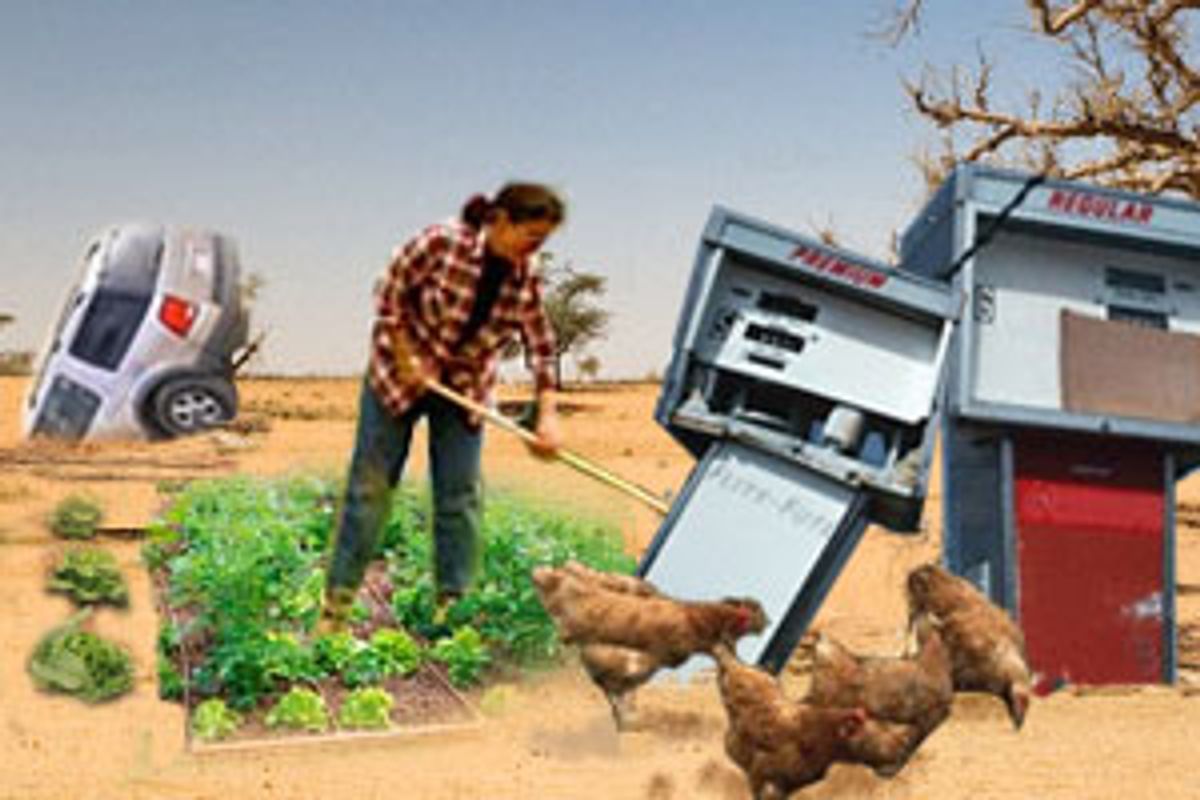
Matt Savinar, 27, once aspired to own a Hummer. He studied poli sci at the University of California, Davis, before going on to get his law degree at U.C. Hastings in San Francisco. He was into bodybuilding. Today, Savinar doesn't own any car, much less a Hummer, and he doesn't practice law, although he's licensed to do so. Frankly, he doesn't think that driving or the legal profession, with the exception of maybe bankruptcy law, have much of a future. Instead of buying a car, Savinar walks, takes the bus and catches rides with friends, but not because he's trying to save the world, he assures me.
Savinar doesn't drive because he's saving the money he'd spend on a used car to buy land; he's not sure exactly where yet, but somewhere with a supply of fresh water, arable soil, low population density and that's far from military bases. He's starting to get back into bodybuilding again, too, all the better to be healthy and in shape to till the earth and grow food, when the time comes. "I happen to think that we're going straight to hell, and I'm trying to figure out how to be in the least hot place of hell," he told me recently on an incongruously balmy 72 degree February afternoon in sunny Santa Rosa, Calif., at a restaurant just a few blocks from the apartment where he lives.
For a young, quick-witted, able-bodied man with an advanced degree, living in the most prosperous country in the world, Savinar has a pretty dim view of his -- and all the rest of our -- prospects. He believes that many if not most of the trappings of modern American life are endangered species and he's trying to figure out how not to become one of them. So Savinar has become a full-time prophet of "peak oil," spreading the word about how the world's oil production will soon peak and global demand will outstrip supply.
When that happens, he imagines that all the ways Americans now depend on oil will become rudely apparent, as the price of everything from filling up at the pump to fruits and vegetables in the supermarket shoots up. Cities and towns will start to struggle to provide basic services like police, firefighting, school buses, water and road repair. Office workers will lose jobs because they can't afford to commute to work from their suburban homes. Even if they could get to the office, there'll be fewer white-collar jobs, as businesses flounder under the strain of a flailing global economy. Yet suburbanites will be grateful for those big backyards to support vegetable gardens, if they can just keep their hungry neighbors from sneaking in at night and stealing their harvest. All that is before we even consider the possibility of an oil war with the likes of China, where, incidentally, so many of those cheap goods that we've come to depend on are manufactured.
But here's what really drives Savinar crazy. As our whole world is about to go hurtling, sickeningly, down the other side of peak oil, we cling to the vain hope that better fuel efficiency, more conservation and alternative energy will step in to save the day. He can't believe our ignorance. Just look at his lunch: chicken fajitas with red and green peppers, brown rice and green salad. Sound wholesome and healthy? No, Savinar reminds me, it's brought here courtesy of cheap energy.
"It's fossil fuels -- petroleum, coal, natural gas -- that have been converted into food," he says. Then, there's the wooden table he's eating it on, which was built god-knows-where and likely shipped here inexpensively courtesy of fossil fuels. Then, there's the financial system underpinning the bank loan that the owner of this restaurant likely got to open the joint, which is predicated on the idea that the economy will grow in the future, not shrink precipitously when oil prices spike. Then there's the asphalt on the four-lane of traffic outside, and the cars, trucks and, oh yes, SUVs zipping along on top of its smooth surface, as well as the concrete of the sidewalk bordering the mall across the street, where Ann Taylor and Talbots sell clothes surely imported from halfway around the world.
But Savinar isn't rollerblading while the oil burns. From his modest apartment, about 60 miles north of San Francisco, he parses the latest energy news and fulminates on his Web site, Life After the Oil Crash. "Dear Reader," he welcomes visitors to his site, "Civilization as we know it is coming to an end soon. This is not the wacky proclamation of a doomsday cult, apocalypse bible prophecy sect, or conspiracy theory society. Rather, it is the scientific conclusion of the best paid, most widely-respected geologists, physicists and investment bankers in the world. These are rational, professional, conservative individuals who are absolutely terrified by a phenomenon known as global 'Peak Oil.'"
Far from being ignored or dismissed as the hyperbolic rantings of an underemployed twentysomething California attorney, his Web site (which has about 6,000 visitors a day, and which sells books, DVDs and soon solar-powered ovens) has been quoted in the U.S. House of Representatives by members of the Congressional Peak Oil Caucus, like Republican Rep. Roscoe Bartlett from Maryland. He's been name-checked in Fortune magazine in a recent profile of one of Bush's billionaire buddies, who claims to have read Savinar's site every day since last September, and is keeping $500 million of his fortune in cash just in case Savinar and other peak oil doomsayers, like James Howard Kunstler, are right.
Savinar has given public speeches about peak oil but he says he prefers to do his Paul Revere-ing virtually so he doesn't have to see the look in people's eyes when they get it. "This is like the worst news that people have ever heard, other than maybe a death in the family, because you're basically finding out that your entire model of the world is based on bullshit," he says. He does not relish being the bearer of bad news: "People who want the Hummer or the three-bedroom home, or they want their kid to go to college, and grow up to be an attorney or a doctor -- all that, everything that they've based their lives on -- you're telling them that that's all out the window."
Critics debate the degree of doom to attach to peak oil, but Savinar is right: Scientists don't deny it's coming. The only question is when. Some geologists say we're already on the downslope while others put the peak at around mid-century. Regardless, thousands of people of various professions aren't waiting for the exact date of the bad news to be pinned down. They've seen the polemical documentary "The End of Suburbia: Oil Depletion and the Collapse of the American Dream," shown at countless house parties, community centers and city halls across the country. Or, maybe they've been frightened by truly alarmist Web sites, such as Die Off, that predict billions -- yes, that's right, billions -- of deaths globally because of peak oil. Or they've read the Hirsch report, a paper commissioned by the U.S. Department of Energy, in which professional energy analysts found that it would take at least a decade to prepare for peak oil, yet they don't see their government exactly leaping into action.
The peak oilers believe that by the time we know for sure that peak oil has come and gone it will be much too late to prepare to live without the 21 million barrels of oil a day that the U.S. is now accustomed to consuming. They aren't leaving anything to chance, let alone to the federal government, particularly with George W. Bush at the helm. To them, real change begins at home, where they're taking matters into their own hands. They're planning and preparing, and even lobbying their local governments to envision life with less oil. Some are hopeful they can make changes now in their own communities to mitigate the impact of the oil shocks to come.
To David Fridley, a scientist who works on energy efficiency at Lawrence Berkeley National Laboratory, and who worked in the oil industry for 15 years, the increasing concern about peak oil tells us a lot about the shape of people's assumptions. "Those who come from an environmental point of view see peak oil as an opportunity to disrupt the never-ending growth of our reliance of fossil fuels," he says. "Then there are those who see our ultra-consumerist society as flawed, and peak oil is the disruption that will bring an end to that. Then there are the people who believe technology can save us, who are delving more into what solar and water power can do." It's a pretty motley crew all trying to get a bead on the future at once. What about him? Is he part of the peak-oil movement? The mustachioed, bespectacled scientist says, "The facts are too compelling not to be involved."
A posh conference room on the 33rd floor of a skyscraper in downtown San Francisco is an elegant if ironic perch from which to ponder the uncertain future of life as we know it. One entire wall of the room is made of glass, a giant window offering a sweeping nighttime view of the Bay Bridge all lit up, sparkling with the orderly lights of the post-rush hour cars and trucks streaming across the bay into San Francisco. Yet the 20 people assembled around the golden conference table for the February monthly meeting of the San Francisco Post Carbon group believe that sooner rather than later that stream of cars and trucks will falter, if not actually stop, altogether. And as the geopolitical and economic dominoes start to fall in the wake of climbing oil prices, some wonder with macabre humor how long it will be before they'll have to climb 33 flights of stairs if they want to make it to this room.
Meeting in plush digs donated by a foundation for the occasion, San Francisco Post Carbon is a kind of combination study group, support group and citizens' action committee. Among their accomplishments is having produced a slick poster that depicts the history -- and possible future -- of the oil age, which they've distributed to every member of Congress. At least the lawmakers won't be able to say that they weren't warned! This post-carbon group is one of six such groups that meet regularly in the Bay Area. But it's hardly just a California obsession. There are groups around the world affiliated with the Vancouver, B.C., Post Carbon Institute, most of them in North America.
Over red wine and a potluck dinner of hummus and salads, the peak oilers, who tonight include a computer programmer, a consultant, a teacher, a retired engineer and a recent college grad, listen intently to the first speaker: Alice Friedemann, a systems analyst for a large transportation company. She's been studying the history of agriculture in California and learning sustainable farming techniques.
"As energy gets more expensive, food will get more expensive," Friedemann says, citing a stat that's often mentioned in peak-oil circles: In our era of industrial agriculture, it takes 10 calories of fossil-fuel inputs for fertilizers, pesticides, farm equipment and transportation from natural gas, oil and coal to produce one calorie of food. The fear is that the rising price of oil will drive us to rely on other fossil fuels, draining those as well, and destroying the atmosphere in the process.
Friedemann remarks that there are home-court advantages to being so close to California's fertile Central Valley. "The good news is we're near the food," she says. "But the bad news is people are likely to come here not just because of the food but because it will be too hot or cold where they live." Grapes of wrath, anyone?
Still, the prospects for growing a lot of food locally, à la the victory gardens during World War II, in these parts don't look good to her, given the built environment and population density. Even assuming "bio-intensive" farming methods, where just 4,000 square feet of land can produce enough food to feed a vegetarian diet to one person, there's nowhere near enough land in Oakland, where she lives, that's not in the shade of homes or buildings, covered in concrete, or on steep parkland with poor topsoil.
How bad does Friedemann really believe things are going to get? "I believe that we're going back to the 13th century at some point," she tells me. Her grandfather was a geologist who knew the geophysicist M. King Hubbert, who first posited the theory of peak oil, predicting the peak of U.S. production in the '70s. Having studied alternative energy for years, Friedemann says she just doesn't believe that there is anything that's going to replace oil, or even come close. "We won't appreciate what oil really did for us until we have to go back to muscle power," she says. The question that clearly both appalls and fascinates her is what happens next?
"How do you reengineer society to go backward? How do you carve up container ships and turn them into sailboats? We can't go back to steam engines burning wood because we burned all that wood when we were clearing the fields for farms," she says. And even going back to beasts of burden, using the muscle power of horses for transportation, isn't straightforward, not when horses and people are competing for local, arable land.
"On average, a horse needs six acres of pasture," she says. "So you can't use that for food if you're growing the food to feed the horses." At an upcoming meeting of the East Bay peak oil group, she'll be teaching a class on milling your own grain and cooking it. "These are skills that would be useful to have. I suspect that there'll be oil shocks and food shortages but grain is something that keeps for years and years and years. It's something that you can have at home as the grocery store shelves empty. It's going to be more Third World-like and people are going to need to cope."
At the meeting, it's time for a report on efforts to lobby the San Francisco Board of Supervisors to consider what impact peak oil might have in the city. Last year, a formal request to hold a hearing on peak oil died in committee. In the past few weeks, some of the post-carbon members have met with staffers from several supes' offices, some of whom were more sympathetic to their issue than others. "They looked at us and smiled," says Dennis Brumm, 53, a former middle manager at a produce company, now retired on disability, who devotes himself to activism. "Most of them didn't smile," chimes in Allyse Heartwell, 24, a recent college grad, drawing knowing chuckles from the rest of the group. The post-carbon group realizes that theirs is a very tough problem to get politicians excited about, given they can't in good conscience suggest an obvious way to fix it. "It's very difficult to go and say, 'We have a problem that has no real solution, and we are trying to mitigate what will happen to culture,'" says Brumm.
The group wants San Francisco to undertake a study to gauge what peak oil will mean to the city's economy, food distribution, transportation and tourism. "I want to see Golden Gate Park planted with community gardens," Heartwell tells me later. Heartwell, who studied international environmental issues in college, says that she's never been an activist but she's recently become obsessed with peak oil and reads sites like Energy Bulletin and the Oil Drum religiously. "Honestly, I don't think that it's likely that we're going to make smart choices in the next 10 or 20 years. It's hard but I personally don't see anything to be done but keeping at it," she says of the lobbying efforts. "Five years down the road, 10 years down the road, I would be kicking myself if I didn't do something, unless I'm starving, in which case, I would probably be kicking myself even more."
Some members of the group are trying to lower their personal energy consumption -- in the peak-oil vernacular, "powering down." One man has cut his gas consumption in half on his daily commute by buying a hybrid car. Several don't own cars. Some have solar panels on their homes and sensors so that the lights turn off when they leave the room. One chose to travel by train rather than plane on a trip to visit family in Texas over the holidays. But while they support the idea of taking individual action, they're aware that their own efforts are drops in the global bucket, and while they believe in setting a good example about a lower-energy lifestyle, they know just how hard it is to get anyone to listen when you're sounding this kind of alarm.
"The public doesn't understand how integrated oil is into every aspect of our lives," says Richard Katz, 55, who is fond of bringing oil industry newspaper ads to group meetings and giving a gallows-humor take on them. "The American spin on the world is that there is always some new technology or new answer that's around the corner. Standard economics says that there is always something to replace whatever is rare. But what we're talking about here -- oil -- is the product of millions and millions of years of distilled sunlight. How do you get people excited about living with less?"
Fridley of the Lawrence Lab rises out of his seat to tell us about "the myth of biofuels." He argues that the likes of ethanol, fuel drawn from crops like corn or plants like switchgrass, are not going to save the day. "Once you get past the media hype about ethanol, the reality scares you," he says. Fridley fears that in the search for cheap liquid fuel to replace oil we'll end up overmining the soil. By his calculations, the long-term potential of biofuels is low, yet it's draining federal dollars from wind and solar, about which he's more optimistic.
Finally, a documentary filmmaker working on a project called "Everybody Loves Oil" shows a preview and makes a plea for funds, while everyone passes around a glass mason jar, decorated with an apple, grapes and a pear, and filled with oil that was pumped out of a well in Bakersfield. It's a reminder that the slimy gunk that brought us together tonight is about to tear our whole world apart.
Plenty of social critics see the peak oilers as the latest horsemen of the environmental apocalypse. Take "J.D." (the only name he would give me), a 44-year-old American living in Japan who runs the blog Peak Oil Debunked. "Clearly, the radical environmentalists and primativists love peak oil," he writes in an e-mail. "It's like a dream come true for them." To the "doomers," peak oil is the "deus ex machina that will fulfill their long-cherished dream of bringing down 'growth' and modern, globalized, corporate, industrial society."
The fact is, though, the Cassandras of peak oil are not all wearing fleece and Birkenstocks, and using peak oil as a convenient reason to rekindle back-to-the-land fantasies. They are geologists and energy experts in governments, universities and think tanks. And many of them echo the core conviction of the activists: Oil-drunk America has to go on the wagon or it will soon be heading into a dauntingly thirsty future.
Experts point out that U.S. domestic oil production peaked in the early '70s. The world is expected to consume 85 million barrels of oil per day this year, with the U.S. guzzling some 21 million of that. Even Chevron admits that the era of oil that's easy to extract -- "the easy oil" -- is over. The question of when exactly global production will peak and then slide down the bell curve, with demand outstripping supply, is disputed by geologists, but some believe that it's already here and the world is already experiencing the fallout.
"The World Trade Center, the first Iraq war, the second Iraq war, high gasoline prices and enormous volatility in price," reels off Kenneth S. Deffeyes, an emeritus Princeton professor who calculates that the world passed peak last December -- Dec. 16, 2005, to be exact. "When supply and demand are closely matched, something as small as two hurricanes makes the price go wild; we saw gasoline go up almost a dollar. Political troubles in Venezuela, labor strikes in Nigeria make the oil price flap."
If Deffeyes turns out to be anywhere close to right, this is prescient news indeed. Even strategic advisors to the Bush administration's Department of Energy believe it would take a good 20 years and trillions of dollars of investment in infrastructure for the nation to avoid liquid fuel shortages, when peak passes. A 91-page report released in February 2005 by Science Applications International Corp. played out three scenarios for the Department of Energy. Titled "Peaking of World Oil Production: Impacts, Mitigation and Risk Management," it's come to be known as the Hirsch report, after one of its authors. Those three scenarios: Wait until the peak occurs to transition to other fuels, plan for the transition a decade in advance, plan for the transition 20 years in advance. In the first case, they predict significant fuel shortages globally and economic upheaval. Only in the third scenario do the report's writers conclude that major liquid fuel shortages could be avoided.
The report predicts that peaking will result in much higher oil prices, which will cause "protracted economic hardship in the United States and around the world." Yet it argues that impact can be mitigated if efforts are made on both the "supply and demands sides."
Deffeyes concurs. He believes that our short-term energy future would have been different, if we'd, oh, say, listened to Jimmy Carter and started preparing decades ago. "We'd be in great shape now. But we didn't. We've driven off the cliff without anyone putting their foot on the brake."
But even if Deffeyes is wrong, and peak is still 20 or 30 years off, peak oilers are skeptical that an orderly transition to alternative energies can be made. They worry that the alternatives to oil will not scale up to provide the amount of energy that we're used to consuming, and only by changing our consumption habits can we adjust. Some believe that making the transition won't just take a rough five or 10 years, but that it will mean a meaningful permanent decline in how much energy we use.
Richard Heinberg, author of "Power Down: Options and Actions for a Post-Carbon World," one of the peak-oil gurus, runs down a list of possible alternatives: coal to liquids, gas to liquids, ethanol, methanol, bio-diesel, not to mention getting oil from tar sands, shale oil and heavy oil from Venezuela. "Each of those alternatives has inherent constraints in supply," he says. "You can't increase the amount that you can produce to any arbitrary level by throwing money at the problem. There are practical constraints."
The fear is that even if the U.S. were throwing all the billions that we're spending on things like fighting the war in Iraq into a moon-shot-like effort to transition to alternatives, which we're obviously not doing now, despite the president's recent lip service to ethanol, we would not be able to produce the amount of energy that we now get from 21 million barrels of oil a day.
Like Fridley, Heinberg asserts that biofuels are not the answer. He notes that they appeal to environmentalists because they could be produced in a carbon-neutral way, as well as to patriotic conservatives because American farmers can help solve the problem, while lessening our dependence on foreign oil from the Middle East. "We don't have oodles and oodles of agricultural land that's not being used for growing biofuels, and the energy payoff is very low compared to what we're used to from oil," he says. "The net energy being produced is going to be very costly."
Of course, there are always techno-optimists, and in this case they are led by Amory Lovins of the Rocky Mountain Institute, co-author of "Winning the Oil Endgame." Lovins argues that ethanol, for instance, can be produced without using cropland, but from woody, weedy plants, like switchgrass, on currently idle conservation reserve land. He quotes Sheikh Yamani, a leading figure in OPEC for 25 years, who said, "The Stone Age did not end because the world ran out of stones, and the Oil Age will not end because the world runs out of oil."
Lovins thinks that oil will go the way of whale oil as alternatives are perfected. Besides, he contends, nobody knows who is right about peak oil, given that 94 percent of oil reserves are held by sovereign governments that have no incentive to reveal how much recoverable oil they actually have, even if they know themselves. He says an oil shortage is far more likely to be caused by an attack on a Saudi oil processing plant, or a natural disaster demolishing a key refinery. Ultimately, Lovins says, we will get much more out of the remaining oil by tripling the efficiency of cars, trucks and planes. "The rest of the oil," he states, "can then be displaced by a combination of saved natural gas and advanced biofuels." So, pessimists, chill out.
At a gathering at Berkeley Ecology Center, there's a vision of Utopia over the door. It's a painting, in which the rays of a huge sun beam down on a dark-skinned woman on her hands and knees gardening while a yellow butterfly flutters above her hands. A child holding a cornucopia of fruits and vegetables looks directly out from the painting. Over this pastoral tableau looms the slogan "Another World Is Possible."
This is a kind of community center where visitors can buy reusable hemp coffee filters, get info on local seed swaps and learn about the best source of worms for composting. From the magazine rack, the cover lines on Permaculture magazine shout: "Prepare for Life Without Oil. Find Your Own Wild Winter Food."
At the front of the room, David Room, director of municipal response for the Post-Carbon Institute, holds up his 3-year-old daughter to a microphone, and asks her to repeat the first word she learned to read: "Organic!" she proclaims, drawing appreciative laughs from the crowd of 80. Later, Aaron Lehmer, another post-carboner, asks the assembled: "How many people believe in the next couple of years that we are at the threshold of peak oil?" Half the hands in the room go up. The purpose of this meeting is to recruit volunteers and raise money for an effort called Bay Area Relocalize.
The goal is to do a citizen's assessment of West Oakland and a to-be-determined neighborhood in San Francisco to see how much of the energy and goods used there are produced locally. Likely answer: not very much. Then, to try to determine what could be produced locally if it had to be from food to energy to goods. Using Google Earth, and by walking around neighborhoods, the group wants to determine: How big are backyards? What roofs could be turned into rooftop gardens? What resources does this community have? Bethany Schroeder, a former Berkeley resident, who has relocated to Ithaca, N.Y., and speaks about a similar effort there, explains that everyone must understand Ithaca is way to the left of Berkeley. "You can't get into Ithaca and buy a house without a copy of 'The End of Suburbia' in your DVD file," she says. The Ecology Center event draws pledges of $1,100, and signs up 30 volunteers.
Room, who studied electrical engineering at Stanford as an undergrad and has a master's degree in engineering economic systems, used to do risk analysis and assessment for a consulting firm. Now he's in the nonprofit world where he believes he can help people reduce the great risks facing them from peak oil by making their local communities less dependent on the rest of the world.
"We believe that we're on a treadmill to tragedy," Room says. "We're headed for disaster but we're not there yet. We don't have time to lament about it, or to panic about it, we just need to act," he says. To him, that means each community taking steps to reduce its own vulnerability by "relocalizing." (He and others from the Post-Carbon Institute have written a forthcoming book called "Relocalize Now! Getting Ready for Climate Change and the End of Cheap Oil.")
An example of a community that's on its way is Willits, Calif., where Jason Bradford, 36, armed with a copy of "The End of Suburbia," launched a movement. Willits is a small town in Mendocino County, where just 5,100 people live within the city limits of 2.8 square miles. Yet there are about 13,500 people in the surrounding area of 322 square miles. Bradford, 36, a professional biologist, was so galvanized when he started to learn about peak oil in early 2002 that he and his wife, a doctor, moved to Willits with their twins in July 2004.
"I essentially wanted to find a small town where I could try to transform it politically and the infrastructure," Bradford says. He showed "The End of Suburbia" at the local library, at the high school cafeteria, at the charter school. He showed it for eight months, twice a month, at city council chambers. Thus was born the Willits Economic Localization Project, an effort to make the whole ZIP code as energy and food self-reliant as possible.
"We're just trying to do as much as we can as fast as we can and hope for the best," says Bradford. Citizens have already done the kind of assessment that the San Francisco post-carbon group is lobbying its government to undertake, and the Bay Area Relocalize group is just beginning. The city has put out a request for proposals asking contractors to bid to supply all its electricity with renewables. Bradford is leading an effort to convert one acre of the backyard of his children's elementary school into a farm, in hopes of bringing healthy food to the cafeteria. There are plans to put a three-acre farm next to a proposed hospital. A gleaning club is working with local orchardists to take the fruit that isn't market-worthy to food banks, and divide it among themselves.
Bradford is optimistic about finding local sources for electricity, like solar, biomass such as wood, and even hydropower from creeks in the local hills. Yet, like most of the rest of the United States, the area consumes much of its energy in transportation. "Over 50 percent of the energy consumed in the Willits area is in transportation -- oil and diesel for people's cars and trucks," Bradford says. "That's a common percentage around the country. It's very hard to replace that." And right now the ecologist says he does not see any easy, long-term solution for our car-mad consumption of oil.
South of Willits, the slightly larger city of Sebastopol, population 7,800, is also taking official government action to try to grapple with the post-peak future. Already, the city gets about a sixth of its energy from solar energy, and the majority of the members of its city council are affiliated with the Green Party. So, last October, a town-hall meeting starring "Power Down" author Heinberg, discussing peak oil and energy vulnerability, drew 200 citizens, and led to the formation of an official 11-member Citizen's Advisory Group on Energy Vulnerability.
Gas in the area is currently selling for about $2.40 a gallon but the group, which includes an economist and alternative energy experts, is now trying to imagine what will happen to city services if gas goes to $5 a gallon, $8 a gallon, $12 a gallon, as well as what if electricity went to 25 cents a kilowatt hour, 50 cents a kilowatt hour and so on. "We could see $5 a gallon gasoline within a year or two, or it could be 10 years off," says Larry Robinson, the former Green Party mayor of Sebastopol, who sits on the city council. "I want to be prepared for that, not saying: 'Oh my god, how are we going to pump water to provide for all these households.'"
The group is working on contingency plans so that the city will be able to maintain public safety, public facilities, streets, parks, water delivery and sewer services should the spikes in energy prices come. It's also exploring how the same energy increases would affect citizens, from transportation to education, food supply and even social cohesion, and it's arranging a meeting with pols from the four surrounding counties -- Marin, Napa, Lake and Mendocino -- to formulate a regional response to energy vulnerability.
"I think that a lot of people have their head in the sand about this," says Robinson. "Some believe that the market will solve the problem, and ultimately, it will, but markets aren't anticipatory. They're more reactive. If we wait for a market solution, it's going to come probably in the midst of a lot of disruption and unnecessary suffering."
But the Sebastopol City Council member also sees some silver linings in the slide down Hubbert's Peak. First, he believes that savvy local entrepreneurs will be able to create new businesses and local jobs, manufacturing shoes and clothes, when transportation costs make it prohibitively expensive to import them from halfway around the world. Beyond that, he sees peak oil as providing a kind of wholesale referendum on the American way of life.
"I think that we can adapt, but our adapting may not be so much technological, as sociological, and maybe even spiritual," Robinson says. "It really comes down to the question of the place that we see for ourselves in the world and what we need in order to live a meaningful life. For quite a while now, a meaningful life in America has meant acquisition of things and cheap energy, and we associate that with freedom. We do not see that it's really a form of dependence and slavery. So, I see the potential for a much greater level of freedom and spiritual fulfillment and social cohesion, and restoration of balance with the natural world. This is one of the great possibilities that I see on the other side of the crisis, and whether we get to that is a question of the choices that we make now."
Shares