

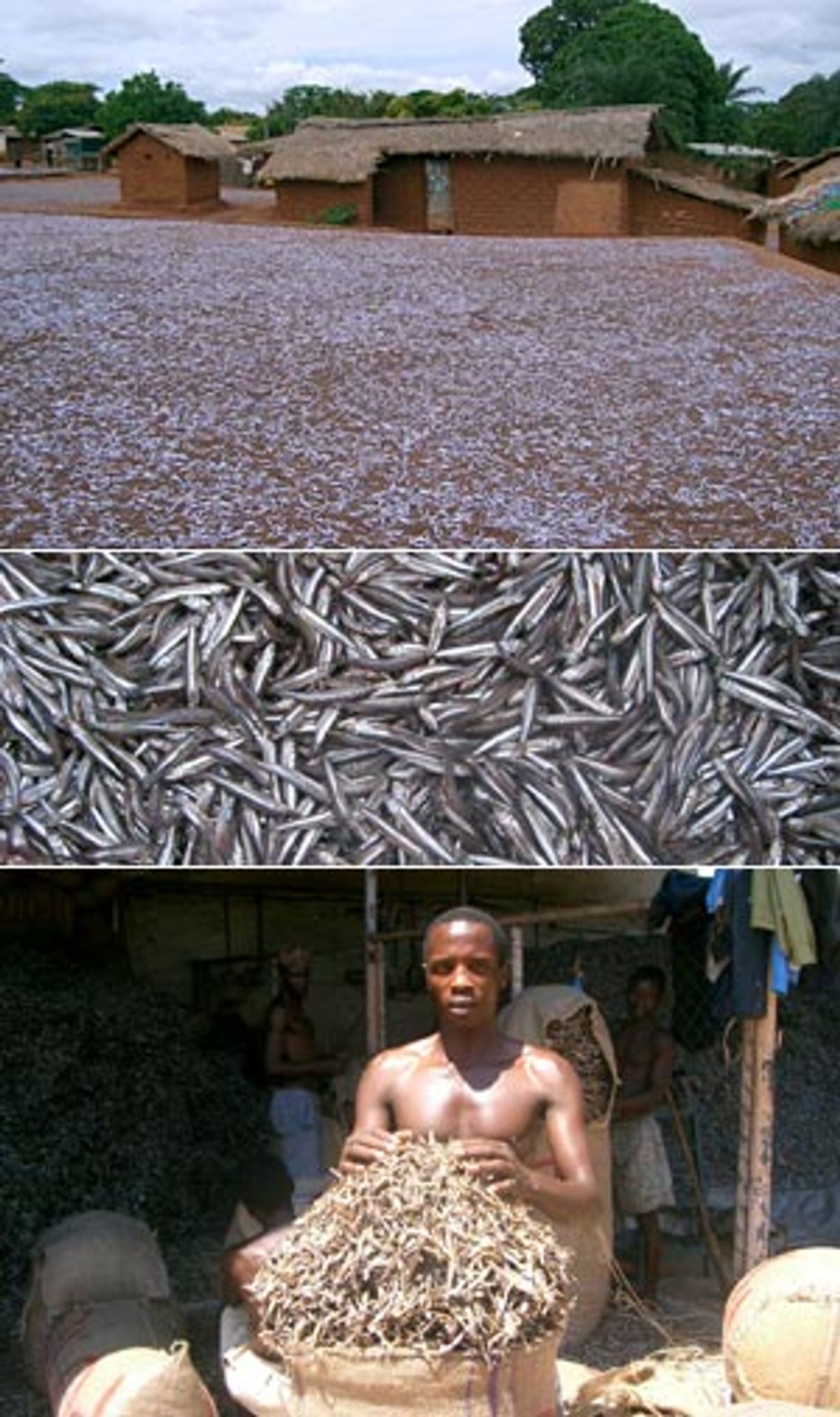
Along the shores of Lake Tanganyika, there are two kinds of fishermen: the ones who fish for an abundant nocturnal sardine called dagaa and the ones who don't. Retired fisherman Myonge Seph has spent most of his life going out at night to trail that small fish, a silvery wonder the length of an index finger.
When the moon is not full, the fishermen of his village, Kalalangabo, paddle out a few hundred meters in search of a good spot to catch dagaa in their nets. They dangle kerosene lamps over the sides of their wooden boats to attract zooplankton, the dagaa's main food. It's a classic mouse trap. Lure the zooplankton and the dagaa will follow. The darker the night, the more they are seduced by the lights above. From the shore, Tanganyika at night looks like a city and the Kalalangabo fishermen are just smudges of light in the distance. But thousands of fishermen float on the waters of Africa's deepest lake all night, waiting.
For generations, the dagaa were so plentiful, it never occurred to anyone the abundance wouldn't last. Sure, there are cycles of plenty and scarcity, largely driven by the moon and the weather. But fishermen always filled their nets over and over again. "Oh, it was so good," said Seph, recalling the days when he was first learning the trade 30 years ago. "When we used to fish with our fathers, it was really good. There were so many dagaa. People could fish 5,000 tons. Tons! Back in those days, there was so much dagaa."
But now, Seph said, the catch is down. All along the Tanganyika basin, from Bujumbura in Burundi to Kalemie in the Congo to Mpulungu in Zambia, fishermen like Seph are beginning to say their lake is changing and with it, their way of life.
- - - - - - - - - - - -
Tanganyika is the longest freshwater lake in the world, the second deepest and the second most biologically diverse. It is also getting warmer. Over the past 80 years, temperatures in the region have increased by about 0.8 degrees Celsius. Studies in the journals Nature and Science assert that increasing air and water temperatures are having an adverse effect on the growth rate of algae on which many fish species, including dagaa, depend for food. And a loss of dagaa could have a serious effect in this poor region, where dishes featuring the small fish are served up every day in nearly every household.
"Global warming is having an impact on areas of the world we haven't looked at very carefully yet," said Bard College biologist Catherine O'Reilly, lead author of a Nature study on the Lake Tanganyika region. "Most of the work has been done in the Arctic or areas of high latitude. This is one of the first studies to show the magnitude of changes in an equatorial region and the whole ecosystem effect of global warming."
O'Reilly, who has been studying the lake's ecosystem for over a decade, explained that "algae form the base of the food web in the lake." So if "algae are growing more slowly and reproducing less frequently, that would mean there are overall less algae available." She said the lake's ecological imbalance, kick-started by increased temperatures in the region, could be putting the dagaa population at risk in a place where this little fish is the biggest thing going.
The lake, which holds nearly 18 percent of the world's freshwater, and its dagaa, are the region's best sources of protein. Some people have compared the lake to a well-stocked aquarium with an estimated 300,000 metric tons of fish; it's such a prolific fishery that many have compared it to the boundless plenty of the sea.
But as a tropical lake, Tanganyika's waters are almost permanently stratified. That means the water separates into layers according to temperature and density. The waters only really mix during the dry season, when strong winds blow across the lake and stir things up. A warming lakes means those layers are even more stubborn and require more energy to mix.
And if that deep water can't mix with the warm water on top because of increased temperatures or slowed wind speeds, the lake can't produce sufficient algae. And less algae means less zooplankton, the dagaa's main food, which could mean, eventually, less dagaa.
"If we look into the future and look at predicted temperature changes, the temperature changes for the next 80 years are twice as high as the temperature changes that this region has experienced in the past 80 years," said O'Reilly. "So the current trend toward less mixing is going to continue quite dramatically."
Then the entire lake will warm up and the mixing will resume. But that, O'Reilly said, could take hundreds of years. In the intervening period, there will be less food for the fish to eat and, perhaps, so few dagaa that fishermen will no longer even be able to depend on the cycles of scarcity and plenty.
After spending a lifetime on the lake, Seph knows its cycles well. He knows the catch depends on many things: the water temperature, winds, good luck and magic. In the dry season from May to August, fish are scarce. Fishing is also bad when there is a big storm and every month when the moon is full, waxing or waning, when the natural light makes it hard to attract zooplankton with lamps.
Before going out to the fishing grounds, many fishermen stop along the way at sacred peninsulas to pray for good luck or perform secret rituals for good fishing. They call such rituals "dawa," or medicine, in Kiswahili. "It's part of our African tradition," Seph said on a bright January afternoon on Kalalangabo's beach. He was mending the cracks in a canoe with bits of cotton dipped in bright yellow palm oil. "Because everything has a beginning. When you see your old man doing it, you do it too."
But the medicine will only work if the disease has a cure. It only works when there is fish to be had. "Dagaa have their season," said Seph. "For example in May and June, when the water is very cold, dagaa don't come here even if you have dawa."
Unlike the fishermen at the big beaches who have boats with motors that let them cover great distances at fast speeds, and strong lights that attract more plankton, the fishermen of Kalalangabo, with their paddle boats and few lights, are confined by the limits of their physical strength to paddle into deeper waters. I asked Seph if they were doing OK at this lonely beach. He paused and twirled the cotton in his fingers before answering. "We're doing well because we can afford to eat. But here in Tanzania, the fishing is temporary."
- - - - - - - - - - - -
The Kigoma region, where Seph and his family have lived and fished for decades, is an underdeveloped, isolated and forgotten area. Only the United Nations High Commissioner for Refugees and the Red Cross have a major presence in the region -- this because of the thousands of refugees who settled in the area after fleeing conflicts in the Congo, Burundi and Rwanda. The infrastructure is poor and electricity intermittent, even more so than in the rest of the country, where roving blackouts are standard. Living in the poorest region of one of the poorest countries in Africa, the people have little other industry than fishing. Sometimes at night, the only lights you can see are the ones of the fishermen floating on the lake.
The region's main city, Kigoma, is the last stop on the Tanzania Central Rail line, which starts in urban Dar es Salaam 800 miles and a world away. Twice a week, when there are no delays, and there are always delays, the train brings toothpaste, dietary biscuits, cellphones and other dry goods for Kigoma's markets and freighters bound across the open waters of Lake Tanganyika. The train takes back, among other things, bags of dried dagaa, an emissary from this faraway land.
The dried dagaa is dull and smelly but will keep for months in transit to markets all over the country. But in Kigoma markets, it's the fresh fish that sells as fast as fish hawkers can arrange palm-size piles on their tables. The piles sell for 100 Tanzanian shillings, or about 10 cents.
At the market just down the road from Kigoma's train station, the fish stalls keep company with the freshly milled grains, electronics, bootleg music, DVDs and brightly colored fabrics emblazoned with Kiswahili proverbs and political slogans. It's a compact market, where a few steps take you from the vegetable stands to a "fundi," or repairman, who can fix a cellphone in 10 minutes.
Fish hawker Hassan Kanyoe said the retail price of fresh dagaa always stays the same, even when he has to pay more, sometimes five times as much, for the same amount of fish. "If there's more fish, we make the pile higher," said Kanyoe in between calls to passersby. "If there's less, we make it smaller."
To some women shopping for their families, a small pile of dagaa means they may not get the best value for their money, and so they just buy beans and cabbage instead. But other women said that when dagaa is scarce, they'll buy more piles to feed their families. Instead of their usual three, they'll stretch the family budget to buy five. Kanyoe explained that even when the piles are small, dagaa is still a better deal than meat, which could cost 10 times as much.
Those who live tied to nature realize that it will often let them down. Dagaa fishermen, sellers and customers understand that the catch goes through periods of boom and bust. But it's difficult to know if the warming lake has already begun to take its toll on the catch when such fluctuations happen on a monthly and sometimes even daily basis.
"No one has a crystal ball," said Robert Hecky, a biologist from Canada's University of Waterloo and a specialist on African lakes. He contributed to the report in Science about the effects of warming on Lake Tanganyika, and said it's impossible to determine with certainty that there's been a decline in the dagaa catch.
"It's very difficult to look for a climate signal for a fishery that's been growing over the years," said Hecky. The U.N.'s Food and Agriculture Organization reports that more people are fishing on the lake than ever, and with so many people pulling dagaa out of the lake, it's hard to track a potential decline. He and his colleagues agree that decreased algal productivity should affect the fishery. But a decline in catch, they say, could be mitigated by fishermen using brighter lights to attract more fish or moving into different waters, as some are.
Fishing in Lake Tanganyika is mostly small scale, even though industrial fisheries in the lake's Zambian and Burundian waters have thrived and died in the past. In Kigoma, local fishery statistics show the catch is erratic and only partially dependent on the number of boats on the lake. You might expect the catch to go up when there are more fishermen on the lake and to go down when the numbers of fishermen decline. Sometimes that has happened, but in many years it has been just the opposite.
But the data on the lake is poor and no one really even knows how many people are fishing on the lake. Half of the Tanganyika shore belongs to the Democratic Republic of the Congo, but a long-standing civil war there means fishing records are hard to get.
Biologist O'Reilly said that climate change, no matter how hard to track, is having an effect on top of everything else -- pollution, alteration of habitat because of sedimentation and overfishing -- that might be putting the fishery at risk. "It's difficult to say definitively how much the fish populations would have declined," said O'Reilly. "But all the data that we have available to us now, including the fish catch data, the limnological [water sample] data, the climate data, all of that data points towards decreased fish populations."
The Food and Agriculture Organization estimates that the Tanganyika fishery directly employs one-tenth of the population on its shores, including the many who dry, sell or pack the small fish into 100-pound burlap bags bound for the copper mines of Zambia or the villages of the Congo.
Even fishermen who don't depend on fishing dagaa still depend on the little fish for food. Idi Bukuku is one of them. I found Bukuku on a morning in early January standing on the beach at Ujiji. He was wearing a blue and yellow Hawaiian shirt that stood out against the monochrome background of sand, choppy water and stormy skies. A cool breeze moved rain clouds across the shallow Ujiji shore, and people walking 20 paces out looked as if they were hovering on water.
Bukuku uses nets from the beach to capture bottom crawlers like catfish, crabs, some bony species of cichlids and the occasional small sangala -- the top predator of the lake -- but not very many dagaa, which school farther offshore. But when Bukuku goes home, chances are his wife will prepare him a stew, or "mboga," with dagaa.
"There's so many types of fish that I can get and sell and that I am going to use in my home there," said Bukuku, as we took shelter from a rain shower under a shelter made from young tree trunks and covered by palm fronds. "But mostly we are going to eat the small fishes we call dagaa. Even me, I'm going to eat it. Since I was born, maybe, our staple food is called dagaa. The majority depends on this."
Ujiji was once the main port of call on the sultan of Zanzibar's trade route that brought slaves and ivory from the Congo. But the beach now is a lonely stretch, full of abandoned boats and makeshift shops of wood and sheet metal with names like Kuwait and Sea Never Dry. One shop owner makes use of a discarded shipping freight container from a company called Cronos. Father Time.
Bukuku said that fishing at Ujiji is nothing like what they do at main dagaa beaches at Katonga or Kibirizi, where fishermen bring back fish gold -- full nets of mature dagaa. Those fishermen, he said, use motorboats, which he can't afford. "My ability is poor, so to go there to fish is not something easy for me to do in this time," he said. "Maybe when I get some money I can be there."
Despite the uncertainty, fishermen keep getting into the dagaa game every day. The trade requires relatively little specialized skill and offers a more immediate payoff than farming, which is the only other main activity in the area. Besides, there has always seemed to be enough for everyone in this great lake. Now, however, for fishermen at Katonga beach, just south of Kigoma, success seems to depend increasingly on technology their grandfathers, with their paddle boats and torches, never had.
On one morning in early January, Matt Ahmadi stood on the beach with a fistful of cash and a rainbow-colored umbrella. He's the boss and a big man with a round stomach and a quiet but commanding voice. Ahmadi owns several boats and has a number of fishermen who work for him. Think of it as fish sharecropping. He pays his crew a portion of the dagaa sales at the end of the month after subtracting money for nets, gasoline and kerosene for the lamps.
He also provides his fishermen with the modern fishing equipment that Seph's relatives at Kalalangabo and Bukuku at Ujiji can't afford. Ahmadi does better than subsistence fishermen because of the big engines, plentiful lights and ability to ply waters farther from the shore. Ahmadi said he worries less about the abundance of fish than the rising price of gasoline and banditry on the lake, where pirates hunt hapless fishermen, rip motors from their sterns and steal dagaa from full nets.
That morning, the beach was cluttered with at least 100 brightly painted boats with names like the Power of Jesus and the Male Seed. The fishermen emerged from the water bent under the weight of full crates of dagaa, each about two feet by three feet and weighing nearly 50 pounds. The fishermen balanced the crates confidently on their heads and deposited them on the sand near Ahmadi.
"Our prices are set according to demand," said Ahmadi. "When the catch is low, the price goes up, and when the catch is high, the price drops. It's a business of estimation. There's no maximum."
On that rainy day, the crates sold for 15,000 Tanzanian shillings, a little less than $15. The prices can get as low as 5,000 when there's lot of dagaa and as high as 70,000 when dagaa are scarce.
One of Ahmadi's fishermen, Mikedadi Jafari, does not share the optimism of his boss about the fishing life. Jafari's father was a fisherman and so was his father's father. But he has grown uncertain about depending on this way of life. Jafari is not happy to see his adult son carrying on the tradition. And like fishermen everywhere, he wants his children to have a better life.
"This life is too tough," said Jafari. "He can't do it. I've decided to send him to school so he can get an education. I got stuck in this job and I missed a chance to go to school."
Even here, on a beach where powerful motors take them to waters where the dagaa still thrive, people talk about fishing as their last resort -- a career by default. Since the catch varies, it's hard for them to save money or plan ahead. On any particular day, there's no telling what they'll get. It changes every day.
A few days later, it had changed again. Fish merchant Ahimsi Aruna waited at Kibirizi beach just north of Kigoma for the fishermen to return from their night on the water. The morning was drizzly and gray, as mornings in this corner of Tanzania in January often are, and the rain, instead of making the air seem fresh and new, intensified the smells of dry fish, wet goat fur, fuel, burning trash and the remnants of a breakfast of chapatis fried in palm oil over charcoal stoves.
Aruna comes every morning to this beach, where he collects a box or so of dagaa. He sells it fresh at the market or dries it on the sand to sell later. But this morning, most fishermen were late. Aruna had only been able to buy half a box of dagaa for 15,000 Tanzanian shillings. A few days before, that money would've bought him a full box, maybe more.
So he waited for the others and hoped that when they came in, the price would go down. "You can be waiting here and buy the first batch and it's always a higher price," Aruna explained.
He stood that morning on the rocky beach with a half-filled box at his feet and looked at the water for signs of approaching boats. There wasn't much to make out past a few hundred feet -- just the mountains of the Congo in the distance, enshrouded by clouds.
"Sometimes you could be waiting for those who come in last," said Aruna. "And they show up with nothing."
Read other articles in the Early Signs: Reports from a Warming Planet directory.
Shares