Kemberly Samuels, a former resident of the hurricane-ravaged 9th Ward now living in Houston, took a three-hour bus trip last Monday to cast her ballot during early voting for the New Orleans mayoral election. "I didn't trust the absentee process because I didn't want a repeat of what happened to the people in Florida," Samuels told Salon in a phone interview. The 52-year-old African-American teacher was part of an ongoing effort by civil rights groups to bus into Louisiana any voters who were scattered by Katrina to neighboring states. "I felt that it was my right as a citizen to vote in person, and that it would send a message that we want to have a say in who will run our city."
Samuels, who said she hasn't missed an election in the 34 years since she began voting, has spent the seven months since Katrina volunteering with the Association of Community Organizations for Reform Now, an advocacy group for low-income families, to educate displaced New Orleans residents about the upcoming elections. She fears that tens of thousands of potential voters may be effectively shut out of the April 22 primaries and the May 20 general election.
Louisiana officials have offered two alternatives to accommodate displaced residents: absentee ballots, and 10 "satellite" polling stations set up around the state to which voters can travel. Despite a recent outcry, a federal judge in Louisiana determined that officials were not required to provide polling stations outside the state.
Sharing Samuels' concern are civil rights advocates, legal experts and researchers who have tracked Katrina's toll. They warn that not nearly enough has been done to protect against the disenfranchisement of New Orleans residents -- a majority of them African-American and from poorer neighborhoods ravaged by Katrina. Beyond the reliance on absentee ballots and in-state satellite polling stations, critics say the integrity of the election is threatened by serious problems within the city itself, where some polling stations are dilapidated and possibly hazardous, and others are inaccessible to the disabled -- a violation of federal law.
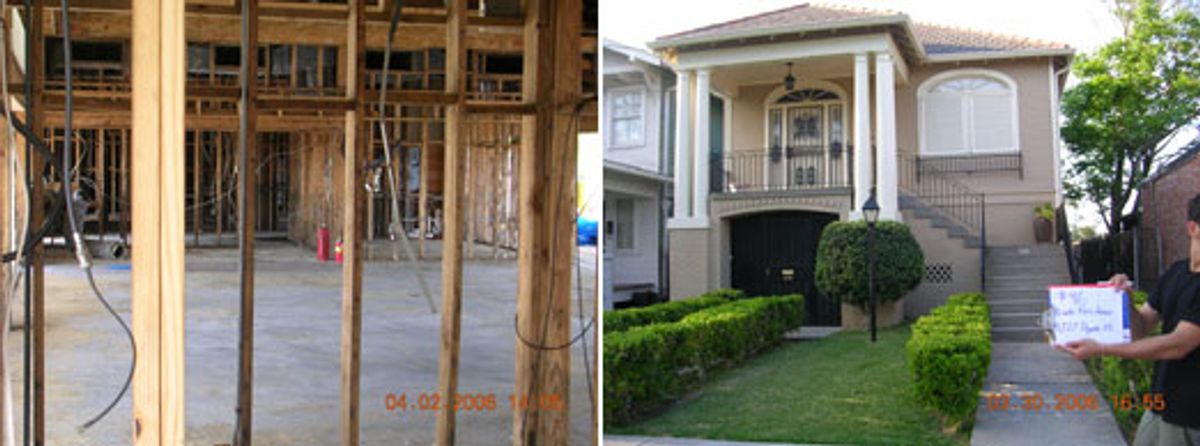
In late March, New Orleans lawyer and civil rights advocate Tracie Washington sent eight visiting UCLA Law School students to photograph the 76 polling places sanctioned by state officials for the election. They discovered at least seven locations to be inaccessible to the disabled. One polling location on Eastover Drive in New Orleans East, a predominantly black neighborhood that was devastated by Katrina, is just the bare skeleton of a building, with exposed wiring and no walls. Photographs of the polling places, reviewed by Salon, show several buildings with no apparent way to accommodate the disabled, including one with a zigzagging set of 15 stairs. According to Washington, a majority of the 76 sites do not meet the requirements of the Americans with Disabilities Act, due to uneven sidewalks, a lack of wheelchair ramps, and inadequate parking.
"It's obscene," said Washington. "Many of [the locations] are completely inaccessible to visually and mobility-impaired individuals. We will have a significant portion of our voting populace that will not be able to access the ballots because they will not be able to get out of their wheelchair to get up some stairs."
Washington also noted a sharp drop in the overall number of polling places in New Orleans. For the last mayoral election in May 2002, there were 252 polling places citywide, according to the Web site of the Louisiana secretary of state.
Louisiana officials have suggested that the election can proceed just fine, despite the trying circumstances. But all involved agree almost unanimously on one thing: This may be the most important election in New Orleans' history, because its next mayor will play a critical role in the city's reconstruction.
Secretary of State Al Ater shrugged off concerns about accommodating displaced residents. "With a 39 cent stamp and by doing it by mail, I don't know how much more accessible you can get," Ater told Salon. More than 17,000 requests for absentee ballots had been received by the Tuesday deadline, according to the Orleans Parish Registrar of Voters office. Of those requests, 70 to 75 percent have come from African-Americans, according to Ater, who reiterated, "No one has been left out of this process."
According to John Logan, a professor of sociology at Brown University, a recent survey shows that more than twice as many blacks as whites were displaced out of state after Katrina. Logan headed a study released in January that found that New Orleans could lose up to 80 percent of its black population if residents displaced by Katrina were unable to return to their neighborhoods. Logan's research included the Current Population Survey released by the U.S. Department of Commerce in December, which showed that an estimated 102,000 African-Americans outside Louisiana were eligible to vote, compared with 48,000 whites. The number of blacks scattered within the state drops to an estimated 31,000, compared with 92,000 whites.
"The population that has returned to the city or general area is white and middle class," Logan said. "It's quite clear that if voting is higher within the state than by people out of state, that introduces a serious race and class bias to the electorate."
"We believe that the court could order out-of-state voting so that these displaced voters are not more burdened than white counterparts who stayed in parts of the city that did not flood and therefore have better access to the polls on Election Day," said Washington, one of several local lawyers who have pushed for out-of-state polling places. Without them, Washington believes, a "train wreck" is inevitable.
Louisiana Gov. Kathleen Blanco successfully pushed for legislation in February allowing displaced voters to cast their ballots in 10 locations around the state. Blanco said that otherwise, "tens of thousands of citizens could easily be disenfranchised through no fault of their own." But she stopped short of calling for out-of-state polling places.
Despite repeated calls, Blanco was unavailable for comment. But Johnny Anderson, her assistant chief of staff, told Salon that the governor remains confident in the measures taken to accommodate displaced residents, and that the election can proceed with integrity.
Beaulah Labostrie, 84, a New Orleans resident born in the severely damaged 8th Ward, said that the officials' portrayal of absentee ballots as easy and accessible is misleading. "You have to face reality. In our city the educational level wasn't that high," Labostrie, the president of the Louisiana chapter of ACORN, said by phone from her current home in Metairie. "The way [the instructions are] written, it's complicated and not that easily understood. The people will maybe be scared off by that. They don't even know enough of what's going on in our city to really take part. They're not getting enough information."
Kwame Asante, Louisiana state director for the NAACP, affirmed that many people have misunderstood mailings about absentee voting. "The information was confusing at best," Asante said. A number of people the NAACP spoke with, he said, thought that requesting an absentee ballot meant they would need to have it notarized, and that they would have to spend "some amount of money." Another pitfall with absentee balloting, Asante said, is that many Katrina evacuees have been forced to move several times, so it is doubtful that government mailings about the upcoming election have reached them all.
For months now, civil rights groups have fought to delay the election, which was already postponed from Feb. 4. Experts acknowledge there was no easy way to handle it. "One of the things you worry about is people taking positions for electoral advantage," said professor Keith Werhan of Tulane Law School, a specialist in constitutional law and civil rights. "It's reasonable to worry on the one hand that someone wants to speed the election and make absentee voting difficult because you're kind of gerrymandering the electorate. On the other hand, you don't want to have the sense that the election is being postponed until the electorate has changed in a way [that benefits the other side]." But the worst-case scenario, Werhan added, would be to hold an election widely viewed as illegitimate.
"I think the election is really crucial," said Logan, of Brown University. "All decisions about the rebuilding of the city have been put on hold up to now. There's been much discussion but people have not taken clear positions, and there is no city policy at the moment."
Logan said that reconstruction decisions will be made primarily by municipal authorities, under the new mayor. "The federal and state government will have a very big role in the rebuilding of the levee and what funds are available to work with on the local level, but I think they're going to steer clear on decisions of where to actually rebuild," he said. Those decisions, Logan said, will dictate the future for much of the city's black population, who made their home in many of the Katrina-ravaged neighborhoods.
Veteran politician Lt. Gov. Mitch Landrieu and incumbent New Orleans Mayor C. Ray Nagin, the only major black candidate, are leading the pack of 22 hoping to make it to the runoff in May. Landrieu's campaign has emphasized reaching across racial lines, while Nagin, who won his first term largely with the support of white voters, is now targeting the black vote. Recently, Nagin participated in an NAACP protest decrying the unfairness of the election and has condemned reconstruction plans that neglect black neighborhoods. Landrieu has not taken a clear stance on rebuilding, though he has argued that residents should be able to decide whether to rebuild certain neighborhoods.
As of Wednesday evening, still a week and a half before Election Day, 3,236 votes had been counted in early voting at satellite polling stations, according to Louis Keller Sr., the New Orleans registrar of voters. Absentee votes had not yet been counted. The preliminary results show a sharp increase in early voter participation: In the last mayoral election, 2,392 residents participated in early voting, with 160 coming from absentee ballots, according to Keller.
But even if early voter turnout continues to be strong, said Tulane's Werhan, it remains unclear how much say the population of pre-Katrina New Orleans will have in selecting the city's next mayor. "Hopefully we will have a demographic that looks somewhat like what we had before," Werhan said. "This election is a crucial moment for us."
Shares