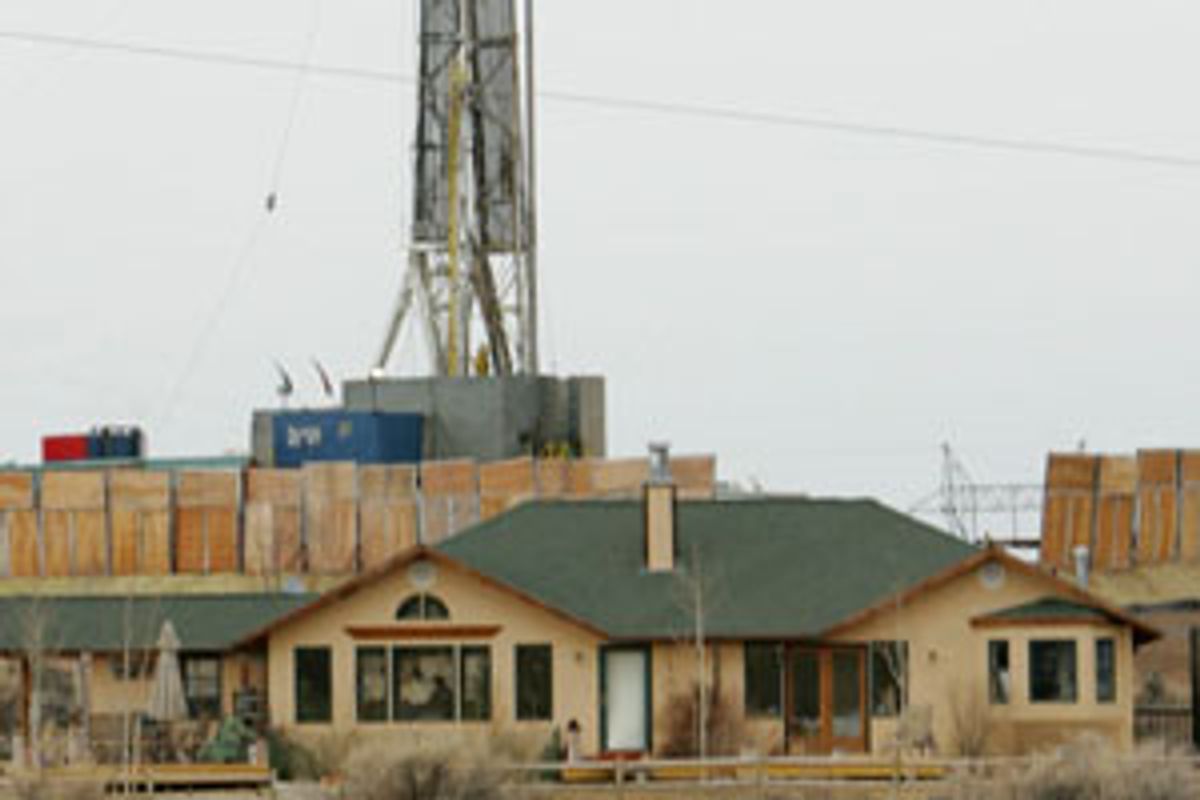
The 20 miles of interstate highway between rural Silt and Parachute, Colo., slice a crusty landscape where sagebrush clings to ochre mesas. Nearby, the snakelike silver Colorado River carves a valley floor where poplar trees, naked in the winter cold, cast spindly blue shadows across the snow. There are few exits through this section of Garfield County, where the local population of deer and elk rival the number of ranchers, retirees and others who live here.
Susan Haire, a former elementary teacher who ranches on a small scale, has lived atop one of the surrounding mesas for nearly a decade. But she says the landscape has been turned against her. When she drives down this stretch of highway, her nose bleeds, her eyes burn, and her head pounds. She's taken to wearing a respirator, even in the car.
"I feel like an alien, like I don't fit into my own environment. It's frightening," says Haire, 55, tears filling her pale slate eyes as she looks through her living room window out on her back fields. "It's horrifying what's happening here. The changes that have happened in the past 18 months are so dramatic. It's just a nightmare."
Haire's doctor blames her health problems on the scenery's relatively recent addition: 600 natural gas wells, drilled by oil companies over the past two years. Every few feet, 150-foot-tall drill rigs, graced with American flags, rise upward into the sky. Compressor stations, banks of rectangular huts with five-foot-diameter fans, sit back from the road and pump the gas into underground pipelines.
Haire is not alone. Several dozen people in the area blame a rash of health problems on the wells, says Colorado lawyer Lance Astrella. For 15 years, Astrella was a successful attorney for the energy industry. For the past 15 years, he has been defending citizens like those in Garfield County, who blame the wells near their homes for their cancerous tumors, rectal bleeding and chronic headaches. Between January and March of this year, eight people called the Garfield County oil and gas department, complaining about black smoke and strong chemical odors they worry are making them sick.
Scientists and environmentalists say the health hazards of the natural gas wells stem not only from air pollution but "fracking fluid," a mixture of carcinogenic chemicals, used in many of them. Laura Amos, 43, an outfitter who lives 20 miles from Haire, recently developed a tumor in her adrenal gland, which she blames on her exposure to the chemicals. Fracking or hydraulic fracturing is a half century-old process in which a gas company injects water, sand and the chemicals into the wells. Developed by Halliburton, the corporation formerly headed by Vice President Dick Cheney, fracking loosens the rock and maximizes the flow of gas to the surface.
At least 2 trillion cubic feet of natural gas lie in the tight sand and coal bed formations below Garfield County, according to gas companies and industry geologists. Over the next eight years, energy companies expect to build more than 10,000 additional wells in the county.
The small Colorado community is a microcosm of the natural-gas boom exploding across the Rocky Mountains. Today, federal and state agencies in Wyoming, Colorado and New Mexico are issuing more permits to drill for gas than ever before -- the increase in some places is 90 percent. The Bush administration has said that such development is critical to reducing foreign imports and ensuring national security. And in the aftermath of Hurricane Katrina, Congress has pushed to increase energy sources beyond the reach of the coastline. Colorado holds an estimated 7.6 percent of America's natural gas reserves, making it "one the most growing active regions," says Fred Lawrence of the Independent Petroleum Association of America.
In ramping up energy production, the federal government has weakened environmental regulations and reduced enforcement of public-health laws. Despite the potential for health problems from unregulated pollution, neither the Centers for Disease Control and Prevention nor the Environmental Protection Agency is conducting any long-term public-health studies. There is literally no broad statistical information about how natural-gas development may be polluting the air or water and affecting human health.
A group of 18 top public health experts wrote EPA and Interior Department officials in 2004, asserting that accelerated oil and gas drilling is taking place without adequate regard for human health. But rather than conduct tests, the EPA appears to be trying to get out of the gas companies' way. Last June, Steve Johnson, an EPA administrator, said the agency was asking itself, "What can we be doing to identify the pitfalls [that] energy companies are experiencing to obtain permits, rather than being a stumbling block or a hindrance?"
For its part, the oil industry says there's no need for concern about the health impact of the wells. "We're one of the most regulated industries out there," says Dan Larson, a Durango, Colo.-based spokesperson for British Petroleum. "The best safeguard that exists is the company's desire to not harm its neighbors."
Haire and her neighbors say they're carrying the burden of America's addiction to oil and gas. "You can't put your finger on it exactly, it's hard to say exactly what it's all from, but there's something going on," says Deb Meader, a nurse for the past six years at Valley View Hospital, the county's largest medical facility. Meader grew up in the area and lives on the same road as Haire. "We look around the mesa and everyone's got high blood pressure or cancer or something," she says. "The guy below us had a real bad heart attack. The guy that owns the orchard has prostate cancer. I have headaches. My husband has high blood pressure and gets headaches. My daughter has symptoms of bladder infections. Everybody has a sinus infection that doesn't go away. We're having a reaction to what's in the air."
Meader acknowledges that her views, and those of her colleagues, are not based on official studies but on their daily experiences with patients. Hospital administrators refused to answer any questions about the potential impact of the wells. Of course, many other personal or medical factors could explain the apparent rise in the health problems that Meader has witnessed. Currently, Garfield County is conducting a public health study, paid for with energy industry fines. But environmental experts say it is narrow in scope, underfunded and far from a comprehensive epidemiological analysis. What is really happening, say an increasing number of scientists, agency whistleblowers and public health officials, is the government is intentionally ignoring the plight of rural citizens.
"It's a Catch-22," says the remarkably frank Weston Wilson, an environmental engineer with the EPA's Denver office for the past 32 years. "If the EPA doesn't study the health impacts, then there's no proof that there's anything dangerous happening. It's irrational and corrupt. We used to investigate mysteries, and now we're not. It's sad. It's kind of like we're being paid off with our generous salaries. The American public would be shocked if they knew we [at EPA] make six figures and we basically sit around and do nothing."
If Hollywood were to make a thriller about the gas fields out here, David Hogle would be a shoo-in for the oil and gas company guy with the big-time swagger. He is, however, the EPA's regional energy advisor. With leather cowboy boots and a thick mustache, Hogle, a structural geologist who worked for Pennzoil before coming to the EPA 19 years ago, ends every workday by checking the going price for methane gas.
"Time is money to industry," he says, as he describes the agency's role in the new "energy up-cycle." "They're going to do everything they can to maintain profit, and that includes environmental protection." He explains that if companies aren't proactive about caring for the land, it costs them more later due to lawsuits or regulatory fines. Three thick white notebooks that contain the 1,725-page Energy Policy Act of 2005 spill off the chair beside him. "I've read that thing all the way through twice. The first sitting took me two weeks."
Hogle explains that it really isn't the EPA's job to deal with the health concerns of citizens in places like Garfield County. "The EPA doesn't control oil and gas production; the states control that. If citizens have a complaint, they would go to the [state oil and gas commission]. They're the first line of defense. They get the first swing at the ball," Hogle says, leaning back in his chair. "We help them when they request it. We don't override state decisions for the most part."
So far the state hasn't asked the EPA to conduct any investigations, nor is the state likely to conduct any itself anytime soon, says Tricia Beaver, a Colorado Oil and Gas Conservation Commission (COGCC) staff person. It's simply not set up to conduct epidemiological studies. "We don't have anybody here with a medical background," she says from her office in Denver. "We don't have any health assessment or risk assessment type employees."
Furthermore, the agency is overwhelmed by the increased pace of drilling. There are only 10 inspectors statewide to monitor nearly 30,000 permitted wells. Of these, 17,000 haven't been inspected in the past five years, according to COGCC statistics leaked to Salon. "We're doing the best we can with the people we have, but we have more volume than we have people to address it," Beaver says. "It's difficult."
Longtime citizen activists say the state agency's dual mandate -- to promote gas development and to regulate its impacts on public health and the environment -- creates a basic conflict of interest. By state law, five of the seven oil and gas commission members are allowed to work for the oil and gas industry, often as geological or engineering consultants, while serving on the board.
"It's the classic situation of the fox guarding hen house," says Gwen Lachelt, executive director the Oil and Gas Accountability Project, a network of 120 citizen organizations from the United States and Canada. "State oil and gas agencies are primarily charged with developing oil and gas resources. We need a federal agency that isn't tied to local revenue streams and has the ability to look at regional impacts. Without the EPA, who will protect us?"
- - - - - - - - - - - -
Nestled in a two-story office, located on a sleepy, three-block-long main street in Paonia, Colo., two hours of south of Silt, Theo Colborn, an environmental health expert, and her two-member staff, are conducting detective work. It requires no magnifying glasses or bloodhounds but a lot of searches though Internet databases and scientific studies. In order to show the EPA, policy makers, and physicians the potential health impacts of gas development, Colborn is attempting to accumulate all that is and isn't known about the chemicals used to extract natural gas.
"What we have been able to accomplish already shows that there's a tremendous need for monitoring drinking-water resources, and it must start prior to any development," says Colborn, a professor of zoology at the University of Florida and the author of "Our Stolen Future," which looks at the harmful impacts of synthetic chemicals on people and wildlife. "Anybody with any common sense could see that this is a very serious problem."
The most serious problems may stem from fracking. The chemicals pumped into the wells to aid the flow of gas to the surface include known carcinogens such as benzene, naphthalene, arsenic and lead. Several chemicals that may be injected can be lethal at levels as low as 0.1 part per million, according to the Department of Energy's Argonne National Laboratory. Up to 40 percent of the fracturing fluids remain in the formation, according to studies conducted by the Environmental Protection Agency and the oil and gas industry; that means that fluids such as diesel and benzene may seep into the surrounding soil, groundwater, and water wells. The wastewater that the industry recaptures after the well hole is drilled often sits in open evaporation pits for upward of a year.
Because so many of the chemicals used in the fluid are proprietary, the industry isn't required to disclose their contents or ratios of concentration. The products' material data safety sheets, OSHA-required forms available on the Web, warn that the volatile chemicals have serious skin, respiratory and nervous-system effects. So far, Colborn and her staff have identified 190 chemicals that could be used in fracking fluids in Colorado, but there could be far more. A study by the Canadian government found more than 900 chemicals used in the fracking process.
Of the chemicals Colborn has identified, many have never been subject to any long-term animal studies to determine their impact on fetuses, children and other vulnerable human subpopulations. Also troubling, the EPA doesn't require that companies study how different chemicals interact or change in composition when exposed to heat. The literature that does exist only indicates acute health reactions; it doesn't explain what could happen in the long-term when people are exposed to lower doses on an intermittent or constant level.
"It's quite real to me why the people in Garfield County are concerned," says Colborn, talking at a mad sprint. "[Industry is] putting chemicals in water that you don't even want to take a bath in, let alone drink."
In 2001, while EnCana Gas Co., a Canadian company that is among the largest gas producers in North America, was drilling four gas wells near Laura Amos' property, the cap on her water well blew off and fizzy gray water gushed from the well. After the company assured them that no gas or chemicals had polluted their well, Laura, her husband and their baby daughter continued to drink the water. Two years later, Amos, 43, contracted a tumor in her adrenal gland. She had to have both the tumor and gland removed; she's healthy now, but without her adrenal gland, she is at risk for future thyroid problems.
Such rare tumors are associated with a chemical found in fracturing fluid called 2BE, according to the Agency for Toxic Substances and Disease Registry. EnCana has subsequently admitted that it used 2BE while fracking in the same geological formation that Amos' water comes from, just 750 feet away from her water well. In March, the COGCC fined the company $99,400 for contaminating the Amos well. While it didn't specify whether fracking fluid seeped into Amos' water, local newspapers reported EnCana reached an out-of-court settlement with Amos; both parties are legally obliged not to disclose the amount.
"I can't believe that all that time I was drinking water that was probably poisoning us," Amos says. "The more I've learned, the angrier I've become." Amos points to the gas well just several hundred yards from her house, a wood cabin. A brassy brunette who runs an outfitter business with her husband, she worries intensely about how the well water may have affected her daughter. Amos and her family are moving over the mountains into the next valley, where gas development is less prevalent. EnCana, she says, "knowingly and willingly blew the top off that water well -- and there could be contaminants in the water -- but they decided to expose us anyway. We have no protection. I haven't felt like anyone cares about what we're being exposed to. There's too much money below us. Our health is being sacrificed. But to industry, that's just a small cost of doing business."
Congress' enactment of the energy-policy bill last summer gave Amos, Haire and their neighbors even less protection. Following the EPA's recommendation, Congress amended the Safe Drinking Water Act so that gas companies can hydraulically fracture without any regulation or oversight by the EPA. That means that the toxic components of fracking fluids aren't reported to any regulatory authority or to the public. There is no monitoring of the process; the public's only assurance that companies aren't contaminating their water or air will come from industry.
Congress concluded from a 2004 EPA study that the industry exemption would pose no threat to underground sources of drinking water. Agency engineer Wilson described the report as "scientifically unsound," "contrary to the purposes of the law," and "unsupportable," in a letter written to a House member and the two senators from Colorado. The EPA determined fracking was safe after a survey of state oil and gas commissions, which all reported they had never found a definitive example of fracking's effect on human health -- even though none of the agencies had ever directly studied the connection.
"Absence of proof is not proof of absence -- that's not good science," says Geoffrey Thyne, a geology professor at the Colorado School of Mines, based in Golden. As Garfield County's geological expert, he speaks in steadied tones. "There's a real dearth of baseline information. I don't think any fracking expert would tell you that we are 100 percent sure where the fractures go. No one has studied how often there are lateral leaks into nearby aquifers. People out here kind of figure that the government is looking out for them, and if there was a real problem, some expert would come forward and say so. Unfortunately, because no one's studying this, it might be a while."
The outlook for any policy that would offer local citizens peace of mind is about as hopeful as a forecast of drought in the high country. While Amos and Haire plan to file lawsuits against the gas companies they blame for their illnesses, proving such cases is tremendously difficult without basic studies that prove a connection between gas emissions and disease, explains lawyer Astrella. A compact bulldog of a man, Astrella's wide windowed office looks out on downtown Denver.
"Really, there's just not enough data, so it's been a real uphill battle to show a causal connection," he says. "If EPA had baseline data, that would make a huge difference. It's easier to recover damages for damaged property than to recover for sick people. It's a travesty."
Even so, he says, the courts are a citizen's best hope, since they're reasonably free of political influence. "The energy lobby is just so strong," he says. "They have so much money and they're horribly well organized."
Indeed. In the past three election cycles, gas companies gave federal Republican political candidates more than $60.3 million and federal Democratic candidates about $14.6 million. Approximately 50 of the Bush campaign's premier fundraisers are energy executives. Nearly 60 percent of the top contributors hold leases on Western public lands, according to a 2004 report by the Environmental Working Group. This political clout was obvious in last year's energy bill, says Astrella, as it didn't include any protections for landowners.
"To get a feel for the extent of the bowing and scraping the industry enjoys in the nation's Capitol, the oil and gas industry received massive public subsidies in the 2005 energy bill they didn't even ask for," says Sen. Ron Wyden (D-Ore.), the only member of the conference committee who voted against the bill, in part because of the massive public subsidies for industry. "The president said last year that with the price of oil at $55 per barrel, the industry didn't need incentives to explore, but Congress shoveled new tax breaks and royalty relief to them anyway. "
Under this climate, staffers at the EPA report that they're unable to do their job of protecting human health and the environment. "People are being penalized just for asking questions," says an EPA staffer who spoke on a condition of anonymity. "I've heard a bunch of people say they're keeping their heads down and basically focusing on their kids or personal interests and trying to keep their jobs. There doesn't seem to be attention whatsoever to health and the environment. They're ignoring all of their own standards and regulations left and right. It's just about corporate power to get the gas out."
In the meantime, some residents of Garfield County continue to live in fear of what awaits them from the chemicals they may have ingested. "I've read the studies. I know what could happen," says Haire, as she shakes her head and looks at the floor. She's been trying to sell her property in Colorado and says she can't stand waiting anymore. She's rented a house near Tombstone, Ariz., and plans to move there within the month. "Man, it makes me mad," she says. "I would ask the people in charge, how do they sleep at night, knowing that people out here are sick and dying? If they think this is such a safe environment, would they dare come live in my house? If you think your government protects you, you're wrong. Government protects the dollar and the people who have all the dollars. It doesn't protect regular people."
Shares