

Within a week after the 9/11 terrorist attacks, officials at New York's Lincoln Center for the Performing Arts set up a half dozen massive concrete freeway separators in a stately line across Josie Robertson Plaza, the complex's main outdoor entryway. The security barricades, unsightly white slabs known as Jersey barriers, were intended to protect the center's performance halls from a speeding truck bomb. Perhaps only the most unusually cultured of terrorists would want to hit Lincoln Center, which sits five miles north of ground zero on the Upper West Side of Manhattan -- but in the tense aftermath of the attacks, no precaution seemed too much. Lincoln Center groundskeepers thoughtfully topped the Jersey barriers with colorful potted plants, a rehabilitation technique along the lines of pinning a tiara on Medusa. Almost five years have passed since the attacks. The barriers remain in place.
To appreciate how America has changed since 9/11, walk slowly through any major city. What you'll see dotting the landscape is the physical embodiment of fear. Security installations put up after the attacks continue to block public access and wrangle pedestrian traffic. Outside Manhattan's Port Authority Bus Terminal, garish purple planters menace rush-hour pedestrian traffic. The gigantic planters have abandoned all horticultural ambition, many of them blooming with nothing more than trash and untilled dirt. "French barriers," steel-grate barricades meant for controlling crowds, ring many landmark sites -- including San Francisco's Transamerica Building -- like beefy bodyguards protecting starlets. Then there are the bollards, the cylindrical vehicle-blocking posts that are so pervasive you wonder if they've mastered asexual reproduction. In Washington, bollards surround everything. Not since Confederate Gen. Jubal Early attacked the city in 1864 has the nation's capital felt so under siege.
It's not just the barriers, it's also the buildings. Since 9/11, risk consultants working for police departments, federal agencies and insurance companies have wrested control over many new construction plans. "There's a sense that security experts are acting as the associate architects on every project built today," says Paul Goldberger, the architecture critic of the New Yorker. Consultants tend to encourage architectural bulk at the expense of grace. As a prime example, Goldberger points to the Freedom Tower, the skyscraper at the center of the proposed new Trade Center site. After the New York Police Department determined that an early design was vulnerable to truck bombs, the building's architect, David Childs, of the firm Skidmore, Owings and Merrill, was forced to move the structure far back from the street, and to turn its lower 20 stories into a windowless reinforced concrete pedestal covered in glass. "It's a pretty grim piece of architecture," Goldberger says of the tower. "It doesn't advertise freedom to the world, it advertises fear."
Goldberger's assessment jibes with designers' larger worry over what we're losing in cities changed by 9/11. Security measures, they say, are undoing the many pleasures and functions of urban life. You don't need to have studied Jane Jacobs to understand that what's best about a city is often to be found on or just off sidewalks, in the dense, chaotic and free interplay between people and buildings. This may sound high-minded and theoretical. But by pushing people tightly together in small spaces, cities naturally increase the possibility of social intercourse. Merely strolling down a sidewalk in New York requires and instills more tolerance for other people than you're likely to need or learn during a year of life in an Atlanta exurb. Cultural theorist Marshall Berman, author of "On the Town," and other books on New York, adds that after 9/11, "the bonds of civil society were strenghthened in New York." He believes that now, in an era of low crime, New York feels more united than at any time in the recent past.
But others fear that security measures may be inhibiting urban connections. Setting buildings far back from the street, placing them atop concrete blast shields, crowding sidewalks with barricades, constantly screening people as they enter or exit buildings, electronically surveilling them at every waking moment -- these measures push us apart and foster our fears and suspicions. The effect is physical as well as psychic. Goldberger points out that you used to be able to walk around Manhattan, both on the sidewalks and through the lobbies of large buildings, without showing any credentials. Today that's nearly impossible because entering nearly every building requires passing through a security checkpoint. The checkpoint culture weighs on the soul, reminding us at every point that we live in a dangerous time, and that anyone we see might seek to do us harm.
Many progressive architects argue that this is not how it has to be, and they've come up with thoughtful designs that accommodate legitimate security concerns without giving in to our worst nightmares. "Architecture has always elevated our society in times of distress, and always spoken to a sense of great social optimism," says Tim Christ, an architect at the Santa Monica firm Morphosis, which has won acclaim for the way it has balanced safety and beauty in its public projects, including the enormous new federal building in San Francisco. In New York, in particular, select firms are striving to incorporate the new security mandates into their designs in innovative ways. But conquering fear is difficult, and architects, whose creations will remain on the planet for decades to come, are divided on whether they can succeed. The 9/11 attacks put our cities on the front lines of a new war. Can we keep them from looking like battlefields?
Jersey barriers have no natural business on city sidewalks. That's not just because they're ugly -- they also do nothing to halt attacks. The barriers, which were designed as lane separators by New Jersey's state Highway Authority in 1955, are intended to be placed on roads parallel to the direction in which cars are traveling. A vehicle that nudges too close to the barrier will ride up its tapered edge and slide back onto the road, suffering minimal damage. But placed the opposite way -- in front of a building to protect against oncoming attack -- a Jersey barrier is no match for a fast car or truck. In crash tests, speeding vehicles that hit the barriers at obtuse angles simply knock them over or vault over them straight at the target.
In their rush to beef up security after 9/11, however, few building operators thought much about the aesthetic or practical shortcomings of such barriers. There was no time for such high-minded introspection -- buildings needed to install something quickly, and Jersey barriers were all they had. Betsy Vorce, a spokeswoman for Lincoln Center, says that no one at Lincoln Center considers the plant-topped barriers to be a statement of the center's design sensibility. As part of an overall renovation, the complex is currently looking for a permanent replacement for the Jersey barriers, but it hadn't given much thought to design of the barricades until recently. In an emergency, Vorce points out, "security is the paramount consideration."
But in a never-ending war, it's never quite clear when the emergency is over. After the 9/11 attacks, especially in New York and Washington, there wasn't exactly a moment in time when people could decide that the situation was now finally safe and that the barriers could come down. So they stayed up, and not just at Lincoln Center.
In the days after 9/11, the New York Stock Exchange, about a half-mile south of the World Trade Center, decided to limit vehicular traffic on the streets that run past the building. Officials blocked off the seven intersections surrounding the Exchange using a jury-rigged combination of Jersey barriers, traffic cones, bright fences and sandbag-laden pickup trucks. The barricade system looked ad hoc and temporary, like checkpoints you might see in war-torn cities in the Middle East. But the system wasn't temporary at all. It stayed in place for four years.
Living and working in a militarized cityscape is a toxic affair. The blocked-off intersections surrounding the Stock Exchange suggested a city that had barricaded itself inside its own worst fears. In 2004, business tenants in the Financial District began threatening to leave because their employees had grown weary of the indignity of spending time in such a dreary wasteland. "It wasn't just the perception but the reality that this place was a target that had everbody on edge," says Noah Pfefferblit, president of Wall Street Rising, a nonprofit neighborhood group in lower Manhattan. Residents no longer wanted to be constantly reminded of the dangers they faced "by seeing a visually overwhelming security presence." City planning authorities finally stepped in to save the Financial District; they selected a TriBeCa firm called Rogers Marvel to come up with a new way to protect the area.
I took a walk through the district on a recent sweltering weekday afternoon. The Stock Exchange continues to block vehicles at its surrounding intersections, but instead of idling pickups, the streets are now populated with giant sculptural boulders called NoGos. The NoGos, designed by Rogers Marvel, are blocks of heavy concrete covered in multifaceted boxes of shimmering bronze. They resemble a comic-book artist's take on a barricade, a playful and handsome gem whose actual purpose -- keeping a speeding truck laden with explosives from getting anywhere near the Stock Exchange -- is invisible to the public. In fact, people have found many uses for the barricades. At 2-and-a-half feet tall, a NoGo makes an ideal seat. Suited Wall Street types crowd about the NoGos at lunchtime and kids climb and stretch on them as if they were a downtown jungle gym.
Like other architects who've been working to design better ways of securing public sites, Jonathan Marvel is wary of providing many details about his firm's projects. But he is keen to discuss why, after 9/11, he became interested in working on security infrastructure. He says that as he looked out on the streets of New York in the months after the attacks, he began to sense that architects weren't being consulted about this newly crucial aspect to urban design. "Everybody within the design community is distressed by what's happening," Marvel says. "To navigate public space you have to meet a new threshold that wasn't there before. Everywhere is like the airport now -- the barriers, the lining up, the undressing. At the airport all that is an unfortunate necessity, but when you have to do it in a building, that's when -- as a designer and as a citizen -- I find it unacceptable."
Marvel describes today's increasingly barricaded streetscape as "a throwback to the Middle Ages, where there was a moat and drawbridge separating one side of society from the other." If Marvel was in business back then, he might have turned the moat into a fountain. His philosophy entails creating security devices whose true function isn't clear from their form, devices that, like those NoGos, also fill some other public purpose.
In Battery Park City, just across West Street from ground zero, and home to the World Financial Center, Marvel's firm reduced the threat of truck bombs simply by redesigning the streets surrounding the targeted buildings. On North End Avenue, the main thoroughfare leading to the WFC buildings, the firm proposed subtly raising parts of the roadbed and inserting sharp turns at strategic locations on the road. Not only did the new configuration force vehicles approaching the buildings to slow down -- which is important because a fast truck bomb can cause a lot more damage than a slow one -- reshaping the street also created a pedestrian walkway and a small park in the area.
Just outside the World Financial Center buildings, Rogers Marvel designed what the firm calls a Tiger Trap, a sidewalk plaza built on top of the kind of collapsible concrete used to stop runaway planes at airports. The concrete is strong enough for pedestrians to walk on but it crumbles under the weight of a truck. In tests, a Tiger Trap has stopped a 15,000 pound vehicle going at 50 miles per hour. But that capacity will remain completely invisible to people who visit the site.
In design circles, such innovative security efforts have gained prominence, and public agencies that wield the greatest influence in urban design -- such as the planning authorities in New York and Washington and the General Services Administration, which builds federal office buildings -- have begun to encourage permanent and elegant architectural responses to security threats.
In 2001, the National Capital Planning Commission rejected several bulky plans to protect the Washington Monument, including one proposal to surround the site with a ring of almost 400 bollards. Instead, the commission -- which had thrown up Jersey barriers at the monument after the Oklahoma City bombing in 1995, another temporary measure that had become permanent -- chose a brilliantly invisible plan by the Philadelphia landscape architecture firm Olin Partnership.
Olin proposed using an 18th century fortification called a ha-ha, a long, low wall sunken inside a trench used by European gardeners to keep animals corralled without visible fencing. Olin designed a series of granite ha-has along the pathways leading to the monument; the simple system, which keeps the site safe from vehicles in a way that's friendly to people, was installed in 2005.
"If we are going to remain a social culture, we have to allow people to live in an environment that is physically safe but isn't replete with physical barriers," says David Rubin, a partner at Olin. "There's a growing demand for that sophistication."
Others aren't so sanguine. Vishaan Chakrabarti, former director of the Manhattan office of New York Department of City Planning, says one problem with invisible security installations is that they often don't satisfy security consultants. "A lot of security folks are trained to believe that a place needs to look secure," Chakrabarti says. Indeed, one of the paradoxes of security infrastructure is that sometimes appearance can be more important than actual strength. A Tiger Trap is more effective at blocking a truck bomber than a Jersey barrier -- but a Jersey barrier looks more menacing. "Especially if you're a private entity, what you're trying to do is make your place look secure so the bad guys go next door," Chakrabarti explains. "The problem is the design and planning community is trying to make the stuff invisible -- they're trying to say, 'Let's make the NoGos as small as possible.' The security people might say, 'All right, technically, scientifically, that smaller thing may protect against the same level of threat as something bigger -- but it doesn't look as defensive.'"
Even sites that have been designed to cleverly address security, Chakrabarti says, are victims of security creep, a culture in which security officials keep putting up more NoGos, or increasing the perimeters around buildings, long after the designers have had their say. "What's difficult is that these things sort of require constant monitoring," Chakrabarti says. New emergencies throw any design asunder. In New York, "there was a big push for Jersey barriers during the Republican Convention," says Rick Adler, the founder of RSA Protective Technologies, a firm that designs perimeter security systems. "It was like half of the push after 9/11. People just put up anything they could."
For those who argue that security experts now trump architects in urban design decisions, the plans for the Freedom Tower constitute Exhibit A. Critics have long derided the design as too bland for the charged site, an uninspired mingling of the visions of two very different architects -- Skidmore's David Childs, whom the developer Larry Silverstein selected to work on the site, and Daniel Libeskind, who won a competition to become the master planer for ground zero. But it was in June 2005, when Childs unveiled a plan to satisfy the New York Police Department's assessment that a previous design was too vulnerable to truck bombs, that the critical clamor rose to fever pitch.
To minimize the building's vulnerability to street-side explosion, Childs moved it away from its surrounding roads and sidewalks. The building will be set back an average of about 90 feet from West Street, the busiest thoroughfare running past the site. Childs also changed the manner in which the tower meets the ground, converting the previous designs' inviting entryway into a 200-foot-tall podium constructed of reinforced concrete. The concrete base would serve as a blast shield surrounding the lobby; there would be some openings to let in light at its higher edges, but it would primarily be unadorned of windows. Tenants would work high up above the lobby, far out of a truck bomber's way. Nicolai Ouroussoff, the New York Times' architecture critic, wrote that the plan represented "exactly the kind of nightmare that government officials repeatedly asserted would never happen here: an impregnable tower braced against the outside world."
Carl Galioto, a partner at Skidmore, told me that he thinks much of the criticism was premature. The concrete base the firm unveiled in 2005 was never supposed to be the final plan; architects had always meant to dress the Freedom Tower's pedestal in something more attractive. A few months ago, they did just that, proposing to clad the building in panels of glass prisms that would shimmer in sunlight. The laminated glass would also be safe for occupants -- in the event of a blast, it would shatter into tiny harmless pieces, much like a car's windshield.
Galioto believes the new glass-clad base will make the Freedom Tower both exceedingly safe and habitable. He says the design shows that the terrorist attacks haven't changed architecture so much as they changed "the practice of architecture." The best architects, he says, will find ways to create beauty within the new constraints. As an example, he points to the new Seven World Trade Center, also designed by his colleague David Childs.
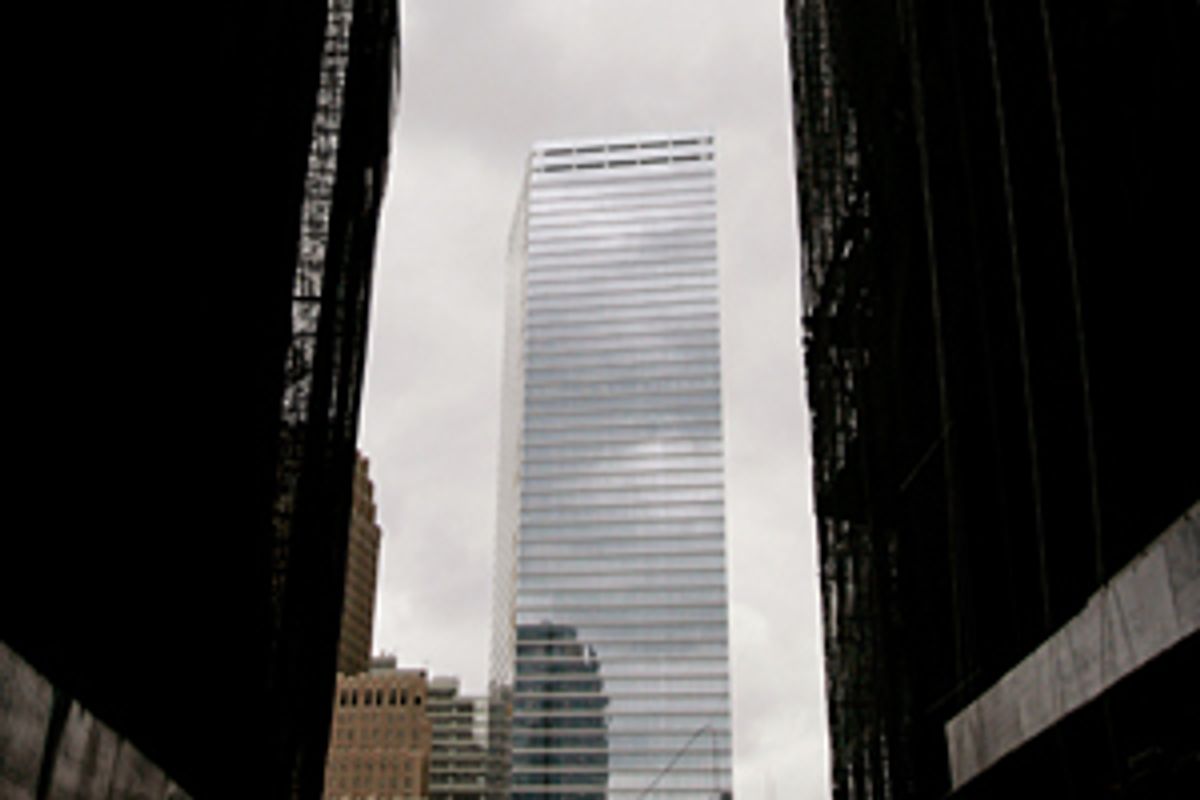
Tower 7 does seem to stand as a monument to the possibility of realizing grace in a grim world. The original 47-story granite-and-glass building that stood across Vesey Street from the Trade Towers disappeared into the ground at 5:21 p.m. on 9/11. The new tower, which opened in May, is an elegant glass parallelogram that now dominates ground zero. Like the Freedom Tower, 7 also sits atop an enormous concrete vault (it's not there for blast resistance but because it houses a Con Edison substation that powers much of Lower Manhattan). But from the street, the concrete isn't visible. Childs has covered the base with handsome stainless steel panels designed by the celebrated TriBeCa designer James Carpenter. Carpenter also designed the tower's exterior glass cladding, which surrounds its office space from the eighth story to the top. He chose glass that's low in iron and coated with an anti-reflective material that keeps out radiant heat; the glass is so transparent that at certain hours, when the sun hangs low on the horizon, Tower 7's walls seem to disappear, and you can see through entire floors of the building.
But what's most striking about 7, considering its location, is its pronounced ordinariness. Inside, the building has been outfitted with a thick concrete core to protect its elevators and stairwells in the case of attack. Compared to the previous WTC towers, it's got wider stairwells for emergency egress, and its floors are protected by a much thicker layer of fireproofing. Its designers call it the "safest office building in America." But from the outside, you can't tell any of this. "One of the best things about it is that it looks like many other elegant, sophisticated glass office buildings rather than like something different," says Goldberger. "I think it's a very nice building."
But Tower 7 doesn't eliminate all of Goldberger's concerns about the site, or about the way urban design has been corrupted by security. He concedes that Childs' new plan to surround the Freedom Tower's base in glass mitigates the harshness of the concrete pedestal, but he points out that it "doesn't deal with one of the key problems of all those designs, which is that they're set back so far from the street that the whole nature of a civilized street life is all wiped away."
Many designers and planners agree that the practice of setting new buildings back from the street is one of the most troubling security impositions. In "The Death and Life of Great American Cities," Jane Jacobs told of the "intricate sidewalk ballet" that characterized the stretch of Hudson Street in Greenwich Village, where she lived in the 1960s. The ballet involved locksmiths, shopkeepers, butchers, longshoremen, teenagers, tailors, toddlers -- people of all stripes whose everyday interactions on the packed street, she argued, provoked a sense of "casual public trust" in the community. Today's security installations reduce our chance encounters on the street and risk breaking our casual public bonds.
"Cities basically operate off their street life, and if buildings become just big blank walls because people are afraid of the street, it's fundamentally contradictory to what cities are all about," Chakrabarti says. He adds: "You look at the charts that a lot of security people use and they'll say, 'The building has to be X-hundred feet from the street.' You start thinking about that en masse and what you're talking about is the suburbs. That kind of thinking, when it starts becoming cumulative, could really endanger something that we really want and need, which is a dense urban environment."
Architects, like many artists, are by nature a contemplative and slightly anxious lot, and some are given to exaggeration over the actual practical difficulties imposed by post-9/11 security measures; where you or I might see only a line of ugly Jersey barriers or buildings inhospitably far away from the street, a designer will see the seeds of civic destruction. It is, in other words, possible to get carried away in this analysis, and Chakrabarti, for one, understands that setting back some new buildings in the city isn't going to turn New York into a suburb. Moreover, in the case of the World Trade Center site, setbacks won't be anything new. As Goldberger has pointed out, 16 acres of lower Manhattan in 1968 were destroyed to create the "superblock" upon which the original World Trade Center was set. Ground zero's new design will restore the streets eliminated then -- therefore we might see more street-side interaction in the new design because it adds streets to the map.
A few designers even point out that moving buildings away from streets can make for a nice addition to cities. Barbara Nadel, a New York architect who edited a volume called "Building Security: Handbook for Architectural Planning and Design," says that if they're designed cleverly, plazas built in the spaces created by set-back buildings might become useful open areas in otherwise too densely packed metropolises. Right now in many cities, she says, "there's not enough open space where you can sit down and have a lunch or take in the sun." When you push a building away from the sidewalk, you create precisely such an area.
In renderings showing a street view of the future Freedom Tower, the building's concrete base is surrounded by a large plaza topped with trees, steps and a fountain. If you're working in downtown New York one day 10 years from now, the steps might be a nice place to stop and have a burrito. On the other hand, you can see in this picture the cause of architects' fears. The plaza is surrounded by a line of vehicle-blocking posts that resemble tombstones, and you've got to climb a mountain of stairs to get to the building, barricaded against the street.
And this illustrates the main flaw in using architecture as a tool to fight terrorism -- we're building structures that may last forever but are frozen around our present-day fears. Architecture is an art form of anticipation, the challenge of building structures that will continue to be meaningful and useful in the decades and centuries to come. Truck bombs, on the other hand, are an acutely modern phenomenon. "There's a tendency right now to design out of fear of the last generation of terrorism," Goldberger argues. "The reality is terrorists are very smart, they're way ahead of us. And yet we're still worrying about truck bombs and giving up so much of what is important to us."
Certainly we can make buildings that are easier to escape from during disaster, or that are less vulnerable to total collapse, Chakrabarti says. But architecture is ultimately a weak defense against terrorism. "As soon as you get into the notion of people flying planes into buildings," he says, "you're talking about a scale of madness against which architecture should not be the line of defense."
Shares