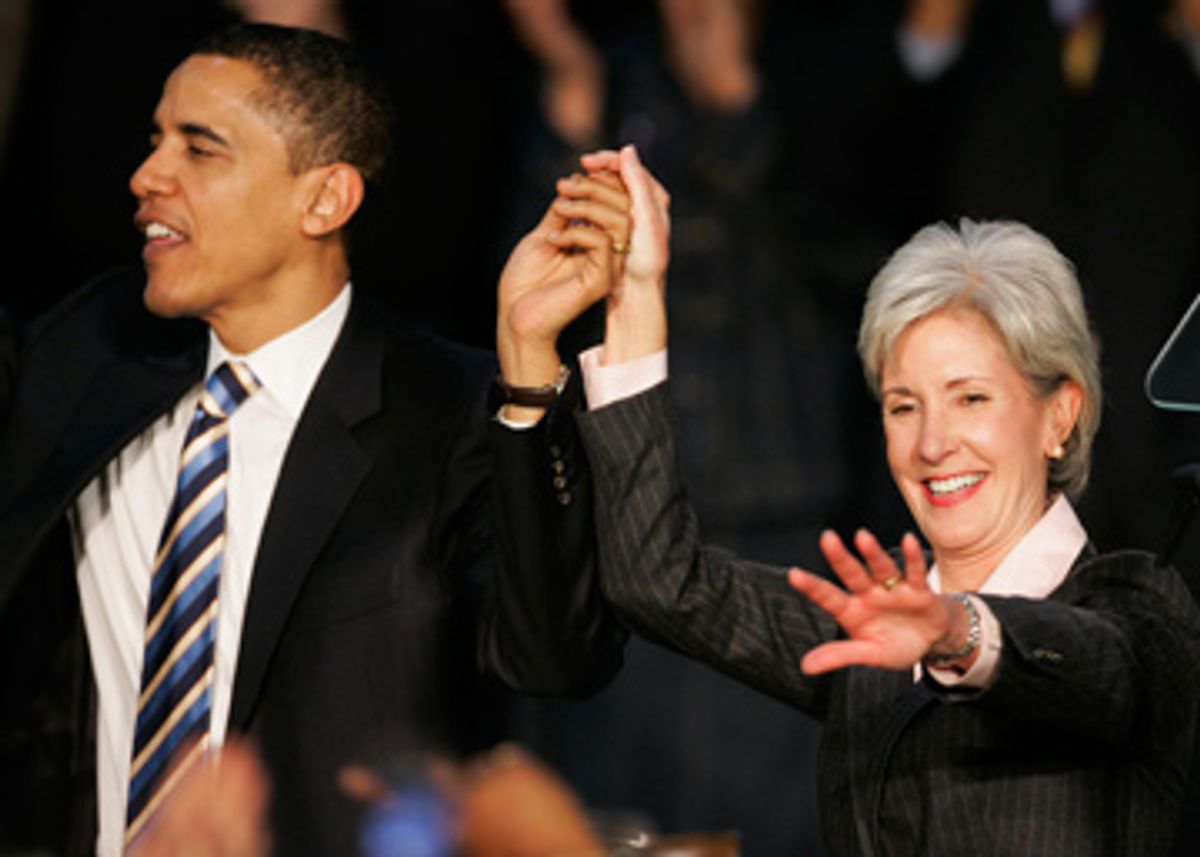
Kathleen Sebelius -- the silver-haired two-term Democratic governor of mostly ultra-Republican Kansas -- is a passionate advocate of political moderation, as oxymoronic as that may seem. Discussing the Republican Party's lurch to the far right in a speech last week to the centrist Democratic Leadership Council, Sebelius said, "It gives an enormous opportunity for Democrats to reintroduce themselves as the sensible, pragmatic, practical approach to coalition government. That is what attracted me to Barack Obama in the first place."
Since endorsing Obama in late January, Sebelius has been a tireless campaigner for the Illinois senator, who has Kansas roots on his mother's side. Obama, who often resists the sloppy excess of rote political praise, pulled out all the stops when asked last week about Sebelius as a possible running mate. "I love Kathleen Sebelius," he gushed. "I think she is as talented a public official as there is right now. Integrity. Competence. She can work with all people of all walks of life. But I promised that I am not going to say anything about my vice president until I actually introduce my vice president."
As the other woman in the vice-presidential derby, Sebelius is often regarded as a road-company version of Hillary Clinton, a pale reflection of the real thing. In an interview in Chicago, right before her speech to the DLC, I asked Sebelius what Obama can do to win over women voters angered by the way that Clinton was treated during the primaries. "At the end of the day," she said, "I have absolutely no doubt that those voters will embrace Barack's candidacy. I think all he needs to do -- and he is doing it and will continue to do it -- is to talk about his vision, to talk about his life story ... His mom and his grandmother raised him. He's married to this accomplished and focused working woman. And he's the father of two daughters. The likelihood that he will ever lose a frame of women's issues is slim to none."
Perhaps more politically relevant than her gender, Sebelius as veep would accentuate Obama's professed vision of a post-partisan America. Chosen to deliver the Democratic response to George W. Bush's State of the Union address in January, Sebelius opted to go with bland bring-us-together sentiments: "The American people -- folks like you and me -- are not nearly as divided as our rancorous politics might suggest."
Still, aside from perhaps New York Mayor Mike Bloomberg, it is hard to think of a political figure who operates in a more inclusive fashion than Sebelius. "It's the only way she can be an effective governor in a Republican state," says Mark Parkinson, a former GOP state chairman who abandoned his party to successfully run with Sebelius for lieutenant governor in 2006. Mike Hayden, a Republican governor in the 1980s who now serves in the Sebelius Cabinet, adds, "Kathleen does have this great ability to reach across the partisan divide."
The personal life of the 60-year-old Sebelius embodies this across-the-aisle harmony. Her husband, Gary Sebelius, a federal magistrate, is the son of the late Kansas Republican congressman Keith Sebelius. Her father is former Democratic Ohio Gov. John Gilligan, a one-term liberal who toyed with running for president in 1976. Asked about the similarities of the father-and-daughter governing styles, Gilligan cracked, "She knew how to get reelected. I didn't."
She has prospered, romping home with 58 percent of the vote in 2006, by taking advantage of the ideological warfare in the Republican Party. "Kansas has evolved into a weird third-party system with the rise of the social conservatives," explains Alan Ehrenhalt, the executive editor of Governing magazine, which covers state and local government. "If Sebelius allies herself with the suburban moderate Republicans, they can't beat her." By holding the line on taxes, Sebelius has been a reassuring figure to the business community on most issues. "Kansas Democrats have never been screaming liberals," says Hayden. "All our Democrat leaders have been moderates. We don't know what a liberal is in Kansas."
But Sebelius can hit the liberal high notes on issues ranging from abortion rights (as a pro-choice Catholic she has battled with social conservatives for years) to the environment. In May, she vetoed for the third time legislation that would permit the construction of two coal-fired electric power plans in southwestern Kansas. "The reason it was so newsworthy is that this was the first time that a coal plant was rejected solely because of carbon emissions," says Parkinson, who as lieutenant governor oversees energy policy. Even though critics predictably claimed that Sebelius was costing Kansas jobs with her go-green environmental stance, the governor had political cover, since 86 percent of the electricity that would be produced by the coal plants would flow to other states.
If Obama were to tap Sebelius, whom he first met during his 2004 Senate campaign, it would not be a gambit to snag the six electoral votes of Kansas, a state so Republican that Bush carried 103 of its 105 counties in 2004. Even when Obama campaign manager David Plouffe recently gave an upbeat presentation to the press about the 2008 electoral map, Kansas was never mentioned as anything but part of John McCain's base. Asked at a press conference at the DLC meeting whether Obama could carry Kansas if she were on the ticket, Sebelius gamely responded, "Well, twice in our history has Kansas voted for a Democrat for president. The last time was 1964. So I am not betting on it, but I think we can make a full-court press in Kansas."
Unlike some politicians who bristle at the mere mention of the vice presidency, Sebelius appears to be enjoying her moment in the spotlight, even as she airily says, "I think that Barack has a wide variety of great possibilities and choices" for the veep slot. As her father puts it, "Kathleen is level-headed about the whole thing. She knows it's a long shot, but she's going with the flow." As a girl with solid Great Plains values named Dorothy discovered in another era, it is a long way from Kansas to the Emerald City. But sometimes in politics, the ruby slippers just fit.
Shares