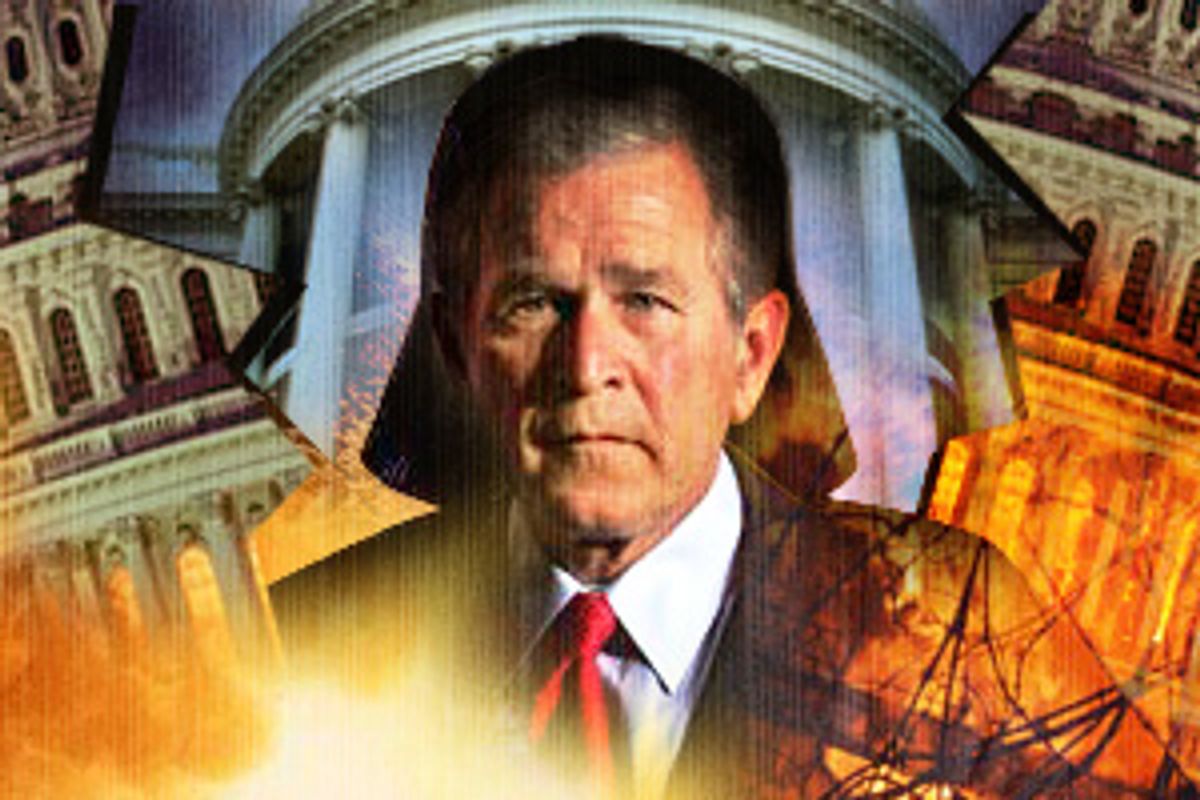
No one predicted just how radical a president George W. Bush would be. Neither his opponents, nor the reporters covering him, nor his closest campaign aides suggested that he would be the most willfully radical president in American history.
In his 2000 campaign, Bush permitted himself few hints of radicalism. On the contrary he made ready promises of moderation, judiciously offering himself as a "compassionate conservative," an identity carefully crafted to contrast with the discredited Republican radicals of the House of Representatives. After capturing the Congress in 1994 and proclaiming a "revolution," they had twice shut down the government over the budget and staged an impeachment trial that resulted in the acquittal of President Clinton. Seeking to distance himself from the congressional Republicans, Bush declared that he was not hostile to government. He would, he said, "change the tone in Washington." He would be more reasonable than the House Republicans and more moral than Clinton. Governor Bush went out of his way to point to his record of bipartisan cooperation with Democrats in Texas, stressing that he would be "a uniter, not a divider."
Trying to remove the suspicion that falls on conservative Republicans, he pledged that he would protect the solvency of Social Security. On foreign policy, he said he would be "humble": "If we're an arrogant nation, they'll view us that way, but if we're a humble nation, they'll respect us." Here he was criticizing Clinton's peacemaking and nation-building efforts in the Balkans and suggesting he would be far more restrained. The sharpest criticism he made of Clinton's foreign policy was that he would be more mindful of the civil liberties of Arabs accused of terrorism: "Arab-Americans are racially profiled in what's called secret evidence. People are stopped, and we got to do something about that." This statement was not an off-the-cuff remark, but carefully crafted and presented in one of the debates with Vice President Al Gore. Bush's intent was to win an endorsement from the American Muslim Council, which was cued to back him after he delivered his debating point, and it was instrumental in his winning an overwhelming share of Muslims' votes, about 90,000 of which were in Florida.
So Bush deliberately offered himself as an alternative to the divisive congressional Republicans, his father's son (at last) in political temperament, but also experienced as an executive who had learned the art of compromise with the other party, and differing from the incumbent Democratic president only in personality and degree. Bush wanted the press to report and discuss that he would reform and discipline his party, which had gone too far to the right. He encouraged commentary that he represented a "Fourth Way," a variation on the theme of Clinton's "Third Way."
In his second term, Clinton had the highest sustained popularity of any president since World War II, prosperity was in its longest recorded cycle, and the nation's international prestige high. Bush's tack as moderate was adroit, shrewd and necessary. His political imperative was to create the public perception there were no major issues dividing the candidates and that the current halcyon days would continue as well under his aegis. Only through his positioning did Bush manage to close to within just short of a half-million votes of Gore and achieve an apparent tie in Florida, creating an Electoral College deadlock and forcing the election toward an extraordinary resolution.
Few political commentators at the time thought that the ruthless tactics used by the Bush camp in the Florida contest presaged his presidency. The battle there was seen as unique, a self-contained episode of high political drama that could and would not be replicated. Tactics such as setting loose a mob comprised mostly of Republican staff members from the House and Senate flown down from Washington to intimidate physically the Miami-Dade County Board of Supervisors from counting the votes there, and manipulating the Florida state government through the office of the governor, Jeb Bush, the candidate's brother, to forestall vote counting were justified as simply hardball politics.
The Supreme Court decision in Bush v. Gore, by a five to four margin, perversely sanctioned not counting thousands of votes (mostly African-American) as somehow upholding the equal protection clause of the 15th Amendment (enacted after the Civil War to guarantee the rights of newly enfranchised slaves, the ancestors of those disenfranchised by Bush v. Gore). In the majority opinion, Justice Antonin Scalia argued that counting votes would cast a shadow on the "legitimacy" of Bush's claim to the presidency. The Court concluded that the ruling was to have applicability only this one time. By its very nature, it was declared to be unprecedented. Never before had the Supreme Court decided who would be president, much less according to tortuous argument, and by a one vote margin that underlined and extended political polarization.
The constitutional system had ruptured, but it was widely believed by the political class in Washington, including most of the press corps, that Bush, who had benefited, would rush to repair the breach. The brutality enabling him to become president, while losing the popular majority, and following a decade of partisan polarization, must spur him to make good on his campaign rhetoric of moderation, seek common ground and enact centrist policies. Old family retainers, James Baker (the former Secretary of State who had been summoned to command the legal and political teams in Florida) and Brent Scowcroft (elder Bush's former national security adviser), were especially unprepared for what was to come, and they came to oppose Bush's radicalism, mounting a sub rosa opposition. In its brazen, cold-blooded and single-minded partisanship, the Florida contest turned out in retrospect to be an augury not an aberration. It was Bush's first opening, and having charged through it, grabbing the presidency, he continued widening the breach.
The precedents for a president who gained office without winning the popular vote were uniformly grim. John Quincy Adams, the first president elected without a plurality, never escaped the accusation of having made a "corrupt bargain" to secure the necessary Electoral College votes. After one term he was turned out of office with an overwhelming vote for his rival, Andrew Jackson. Rutherford B. Hayes and Benjamin Harrison, also having won the White House but not the popular vote, declined to run again. Like these three predecessors Bush lacked a mandate, but unlike them he proceeded as though he had won by a landslide.
The Republicans had control of both houses of the Congress and the presidency for the first time since Dwight Eisenhower was elected. But Eisenhower had gained the White House with a resounding majority. He spent his early years in office trying to isolate his right wing in the Congress, quietly if belatedly encouraging efforts to censure Senator Joseph McCarthy. Eisenhower greeted the Democratic recovery of the Congress in 1954 with relief and smoothly governed for the rest of his tenure in tandem with Senate Majority Leader Lyndon Johnson. The outrageous behavior of the Republicans during the brief period in which they had held congressional power and unleashed McCarthy was a direct cause of their minority status for 40 subsequent years. But the Republicans who gained control of the Congress in 1994 had not learned from their past.
The Republican radicals in charge of the House of Representatives remained unabashed by their smashing failures of the 1990s. They were willing to sacrifice two speakers of the House to scandals of their own in order to pursue an unconstitutional coup d'état to remove President Clinton. (It was unconstitutional, strictly speaking, because they had rejected any standards whatsoever for impeachment in the House Judiciary Committee in contradistinction to the committee's exacting standards enacted in the impeachment proceedings of President Nixon.) Now these Republicans welcomed the Bush ascension as deus ex machina, rescuing them from their exhaustion, disrepute and dead end. They became Bush's indispensable partners.
Immediately upon assuming office, Bush launched upon a series of initiatives that began to undo the bipartisan traditions of internationalism, environmentalism, fiscal discipline, and scientific progress. His first nine months in office were a quick march to the right. The reasons were manifold, ranging from Cheney and Rumsfeld's extraordinary influence, Rove's strategies, the neoconservatives' inordinate sway, and Bush's Southern conservatism. These deeper patterns were initially obscured by the surprising rapidity of Bush's determined tack.
Bush withdrew from the diplomacy with North Korea to control its development and production of nuclear weapons. Secretary of State Colin Powell, after briefing the press that the diplomatic track would continue, was sent out again to repudiate himself and announce the administration's reversal of almost a decade of negotiation. Powell did not realize that this would be the first of many times his credibility would be abused in a ritual of humiliation. Swiftly, Bush rejected the Kyoto treaty to reduce greenhouse gases and global warming, and presented a "voluntary" plan that was supported by no other nation. He also withdrew the U.S. from its historic role as negotiator among Israelis, Palestinians and Arabs, a process to which his father had been particularly committed.
In short order, Bush also reversed his campaign promise to reduce carbon dioxide emissions from power plants and canceled the federal regulation reducing cancer causing arsenic levels in water. He joked at a dinner: "As you know, we're studying safe levels for arsenic in drinking water. To base our decision on sound science, the scientists told us we needed to test the water glasses of about 3,000 people. Thank you for participating." He appointed scores of former lobbyists and industry executives to oversee policies regulating the industries they previously represented.
As his top priority Bush pushed for passage of a large tax cut that would redistribute income to the wealthy, drain the surplus that the Clinton administration had accumulated, and reverse fiscal discipline embraced by both the Clinton and prior Bush administrations. The tax cut became Bush's chief instrument of social policy. By wiping out the surplus, budget pressure was exerted on domestic social programs. Under the Reagan administration, a tax cut had produced the largest deficit to that time, bigger than the combined deficits accumulated by all previous presidents. But Reagan had stumbled onto this method of crushing social programs through the inadvertent though predictable failure of his fantasy of supply-side economics in which slashing taxes would magically create increased federal revenues. Bush confronted alternatives in the recent Republican past, the Reagan example or his father's responsible counter-example of raising taxes to cut the deficit; once again, he rejected his father's path. But unlike Reagan, his decision to foster a deficit was completely deliberate and with full awareness of its consequences.
Domestic policy adviser John DiIulio, a political scientist from the University of Pennsylvania, who had accepted his position in the White House on the assumption that he would be working to give substance to the president's rhetoric of "compassionate conservatism," resigned in a state of shock. "There is no precedent in any modern White House for what is going on in this one: a complete lack of a policy apparatus," DiIulio told Esquire magazine. "What you've got is everything -- and I mean everything -- being run by the political arm. It's the reign of the Mayberry Machiavellis ... Besides the tax cut ... the administration has not done much, either in absolute terms or in comparison to previous administrations at this stage, on domestic policy. There is a virtual absence as yet of any policy accomplishments that might, to a fair-minded non-partisan, count as the flesh on the bones of so-called compassionate conservatism."
After just four months into the Bush presidency, the Republicans lost control of the Senate. Senator Jim Jeffords of Vermont, who had served for 26 years as a moderate Republican in the House and the Senate, left his party in response to Bush's radicalism. "In the past, without the presidency, the various wings of the Republican Party in Congress have had some freedom to argue and influence and ultimately to shape the party's agenda. The election of President Bush changed that dramatically," Jeffords said on May 24, 2001. Overnight, the majority in the upper chamber shifted to the Democrats.
Bush spent the entire month of August on vacation at his ranch in Crawford, Texas. His main public event was a speech declaring federal limits on scientific research involving stem cells that might lead to cures for many diseases. Bush's tortuous position was a sop to the religious right. On August 6, three days before his nationally televised address on stem cells, he was presented with a Presidential Daily Brief from the CIA entitled "Bin Laden Determined to Strike Inside U.S." CIA director George Tenet later told the 9/11 Commission on Terrorist Attacks on the United States "the system was blinking red." The Commission reported: "The President told us the August 6 report was historical in nature ... We have found no indication of any further discussion before September 11 among the President and his top advisers of the possibility of a threat of an al Qaeda attack in the United States."
By September 10, Bush held the lowest job approval rating of any president to that early point in his tenure. He appeared to be falling into the pattern of presidents who arrived without a popular mandate and lasted only one term. The deadliest foreign attack on American soil transformed his foundering presidency.
The events of September 11 lent Bush the aura of legitimacy that Bush v. Gore had not granted. Catastrophe infused him with the charisma of a "war president," as he proclaimed himself. At once, his radicalism had an unobstructed path.
Bush's political rhetoric reached Manichaean and apocalyptic heights. He divided the world into "good" and "evil." "You're either with the terrorists or with us," he said. He stood at the ramparts of Fortress America, defending it from evildoers without and within. His fervent messianism guided what he called his "crusade" in the Muslim realm. "Bring them on!" he exclaimed about Iraqi insurgents. Asked if he ever sought advice from his father, Bush replied, "There's a higher Father I appeal to."
After September 11, the American people were virtually united in sentiment. Support for the Afghanistan war was almost unanimous. "The nation is united and there is a resolve and a spirit that is just so fantastic to feel," said Bush. But two weeks after he made this statement, in January 2002, his chief political aide, whom he called "The Architect," Karl Rove, spoke before a meeting of the Republican National Committee, laying out the strategy for exploiting fear of terror for partisan advantage. "We can go to the country on this issue because they trust the Republican Party to do a better job of protecting and strengthening America's military might and thereby protecting America," said Rove. His strategy was premised on the idea that Republicans win elections by maximizing the turnout of their conservative base; his method was to polarize the electorate as much as possible. Rove's tactic was to challenge the patriotism of Democrats by creating false issues of national security in which they could be demonized. September 11 gave his politics of polarization the urgency of national emergency.
Bush's politics sustained his remaking of the government that had been the agenda of his vice president from the start. Even before September 11, when "wartime" was used to justify secrecy, Bush resisted transparency. He fought in the courts the disclosure of the names of the participants on Vice President Dick Cheney's energy panel. Kenneth Lay, Enron's chief executive officer, was among them. Enron was the biggest financial supporter of Bush's political career, before that had been a partner in Bush's oil ventures and provided its corporate jets to the Bush campaign for its Florida contest. Bush, who referred to Lay as "Kenny Boy," claimed he didn't get to "know" him until after he became governor and then hardly at all.
Vice President Cheney and Secretary of Defense Donald Rumsfeld were the prime movers behind the concentration of power in the executive. Their experience going back to the Nixon presidency had imbued them with belief in absolute presidential power, disdain for the Congress ("a bunch of annoying gnats," Cheney called its members, of which he had once been one), and secrecy.
Executive power was rationalized by a radical theory called the "unitary executive," asserting that the president had complete authority over independent federal agencies and was not bound by congressional oversight or even law in his role as commander-in-chief.
Bush constructed a hidden world of his "war on terror" consisting of "black sites," secret CIA prisons holding thousands of "ghost" detainees deprived of legal due process and approved methods of torture. Cheney insisted it was necessary to go to "the dark side," as he called it.
Attorneys in the Office of Legal Counsel in the Department of Justice wrote numerous memos to justify the "unitary executive" and the president's unfettered right to engage in torture and domestic spying. Bush's White House legal counsel Alberto Gonzales (appointed Attorney General in the second term) derided the Geneva Conventions against torture as "quaint" and Bush overruled strenuous objections from the military, Secretary of State Powell and senior officials in the Department of Justice in abrogating U.S. adherence to them. Indeed, Bush signed a directive stipulating that as commander-in-chief he could determine any law he wished in dealing with those accused of terrorism.
At Gonzales's request, on August 1, 2002, the Office of Legal Counsel at the Justice Department sent him a memo on torture. It was signed by OLC's director Jay Bybee (later appointed a federal judge) and written by an OLC deputy, John Yoo, who drafted at least a dozen crucial memos justifying absolute presidential power. In this memo, the president's authority to conduct torture without any oversight and by rules he determined was asserted as fundamental to his power: "Any effort by the Congress to regulate the interrogation of battlefield combatants would violate the Constitution's sole vesting of the Commander in Chief authority in the President." The memo defined torture specifically and broadly: "Physical pain amounting to torture must be equivalent to intensity to the pain accompanying serious physical injury, such as organ failure, impairment of bodily function, or even death."
Revelations of torture at the Abu Ghraib prison in Iraq were the tip of the iceberg of the vast network of the detained and disappeared. The International Committee of the Red Cross was forbidden access. Those at the top of the chain of command were shielded from legal accountability while a few soldiers and the female general in charge at Abu Ghraib were offered up as scapegoats. After FBI agents witnessed gruesome spectacles of torture at Guantánamo, the Bureau issued orders that it would not participate in this netherworld.
At the same time, Bush ordered the National Security Agency to conduct domestic spying dragnets outside the legal confines of the Foreign Surveillance Intelligence Act and without seeking warrants from the FISA court. Conservative lawyers within the Justice Department wrote memos justifying the practice on the same grounds as they had rationalized torture -- the right of the commander-in-chief to do as he saw fit. Once again, the presidency was construed as a monarchy. Bush and Cheney argued publicly that operating outside the FISA court might have prevented the terrorist attacks of September 11, though nothing stopped the administration from getting warrants to eavesdrop on calls from the United States to al Qaeda before or after.
Foreign policy was captured by neoconservative ideologues, a small group of sectarians rooted in the hothouse environment of the capital's right-wing think tanks. Its principals had been fired from the Reagan administration after the Iran-contra scandal and banished from the elder Bush's administration, but Bush rewarded them with positions at the strategic heights of national security. These cadres operated with a Leninist sensibility following a party line, engaging in fierce polemics, using harsh invective, and showing equal contempt for traditional Republicans and liberal Democrats. Cheney acted as their sponsor, protector and promoter. Under his aegis, they ran foreign policy from the White House and the Pentagon. Secretary of State Colin Powell was sidelined. The Undersecretary of State John Bolton, inserted by Cheney, blocked Powell's initiatives and spied on him and his team, reporting back to the Office of the Vice President. National Security Adviser Condoleezza Rice made a separate peace and turned the National Security Council into an augmented force for Cheney and the neocons. Meanwhile, Republican realists, including elder Bush's closest associates such as Brent Scowcroft, were isolated or purged.
The 60-year tradition of bipartisan internationalism was jettisoned. After the Afghanistan war against the Taliban, the administration elevated into a "Bush Doctrine" the policy of preemptive attack, previously alien to the principles of U.S. foreign policy and expressly rejected as dangerous to the nation's security by presidents Eisenhower and Kennedy during the Cold War.
In the run-up to the Iraq war, an internal campaign was waged against professionals of the intelligence community and diplomatic corps who still upheld standards of objective analysis and carrying on the traditions of U.S. foreign policy. Intense political pressure was applied to them to distort or suppress their assessments if they contained caveats and to give credence to disinformation fabricated by Iraqi exiles favored by the neoconservatives. A special operation of neocons was set up at the Pentagon, the Office of Special Plans, to "stovepipe" information directly into the White House without passing through the analytical filter of the CIA and other intelligence agencies. Cheney made several unprecedented personal visits to CIA headquarters to try to intimidate analysts into certifying the disinformation. The caveats and warnings of the State Department's Intelligence and Research Bureau, the Defense Intelligence Agency, the Department of Energy, and the intelligence services of Germany and France were all ignored.
In making its case for war the administration stampeded public opinion with false and misleading information about Saddam Hussein's possession and development of weapons of mass destruction, particularly nuclear weapons. Later his National Security Adviser Rice (promoted to Secretary of State in the second term) admitted that President Bush had made a false statement in his 2003 State of the Union address about Iraq's seeking uranium to produce nuclear weapons. Yet Bush, Cheney, Rice and other officials had constantly suggested that Hussein was linked to terrorism and those behind the attacks on September 11. Secretary of State Powell's best-case presentation before the United Nations was later proven to contain 26 major falsehoods. Not a single substantial claim he made turned out to be true. He explained he had been "deceived." He called it the biggest "blot" on his record. His chief of staff Colonel Lawrence Wilkerson said it was the "lowest point of my life." It was certainly the lowest point of U.S. credibility.
After he resigned in 2005, Wilkerson revealed how a "Cheney-Rumsfeld cabal" controlled national security policy: "Its insular and secret workings were efficient and swift -- not unlike the decision-making one would associate more with a dictatorship than a democracy. This furtive process was camouflaged neatly by the dysfunction and inefficiency of the formal decision-making process, where decisions, if they were reached at all, had to wend their way through the bureaucracy, with its dissenters, obstructionists and 'guardians of the turf.' But the secret process was ultimately a failure. It produced a series of disastrous decisions and virtually ensured that the agencies charged with implementing them would not or could not execute them well."
Less than a year after September 11, the administration was beset by disclosures that it had refused to take terrorism seriously before the attacks and by stories about dysfunction at the FBI. An FBI agent at the Minneapolis bureau, Coleen Rowley, emerged with documentation of how the Bureau had ignored warnings of the coming terrorist strike. On the day that she testified before the Senate, June 6, 2002, Bush suddenly announced a dramatic reversal of his position against the Democratic proposal for a Department of Homeland Security. Rowley's story was blotted out.
Bush now turned the issue of a new department against the Democrats in the midterm elections, following Rove's script. In Bush's proposal the department would not recognize unions, and because the Democrats believed that employees should have the right to form unions they were cast as weak on homeland security and terrorism. Against this backdrop, Rove helped direct attacks on the patriotism of Democrats in the 2002 midterm elections. In one Republican television commercial, the face of Senator Max Cleland of Georgia, a Vietnam veteran who had lost three limbs, was morphed into that of Osama bin Laden, and Cleland lost. The Republicans captured the Senate by one seat.
The tactics used against Democrats were also deployed to stifle contrary views within the administration and to taint the motives of those who had served and become critics. Any loyalist, no matter the egregious error of judgment, was vaunted; any heretic was burned. Bush's radical remaking of government demanded a relentless war against professionals who did not operate according to ideological tenets but objective standards of analysis.
In 2003, the disillusioned Secretary of the Treasury Paul O'Neill, the former CEO of Alcoa, a traditional business-oriented Republican, published a memoir, "The Price of Loyalty," recounting that the deficit was deliberately fostered as a political tool contrary to economic merits. He disclosed that the invasion of Iraq was raised at a National Security Council meeting ten days after the inauguration. And he described the president among his advisers as being "like a blind man in a roomful of deaf people." The administration's response was to investigate O'Neill for supposedly unlawfully making public classified materials. It was a patently false charge, he was exonerated, but it succeeded in changing the subject and silencing him.
When, in 2003, retired Marine Corps General Anthony Zinni criticized the administration's Iraq policy and the neoconservatives' instrumental part played in its formulation, conservative media retaliated by labeling him "anti-Semitic." The former U.S. commander of Central Command and Bush's envoy to the Middle East, who had endorsed Bush in 2000, had told the Washington Post, "The more I saw, the more I thought that this was the product of the neocons who didn't understand the region and were going to create havoc there. These were dilettantes from Washington think tanks who never had an idea that worked on the ground ... I don't know where the neocons came from -- that wasn't the platform they ran on."
In July 2003, former U.S. ambassador Joseph Wilson wrote an op-ed article in the New York Times detailing that he had been sent on a mission by the CIA before the Iraq war to Niger, where he discovered that the administration claim that Saddam Hussein was trying to purchase enriched yellowcake uranium there for building nuclear weapons was untrue. Despite his report and that of two others the president insisted in his 2003 State of the Union that Hussein was in fact seeking uranium for nuclear weaponry. The counterattack against Wilson was swift. A week after his piece appeared, the conservative columnist Robert Novak wrote that "two senior administration officials" had informed him that Wilson's wife, Valerie Plame, an undercover CIA operative, had been responsible for sending him on his mission. The intent was somehow to cast aspersions on Wilson's credibility. (For his service as the acting U.S. ambassador in Iraq during the Gulf War, elder Bush had called him "a hero.") The disclosure of Plame's identity was an apparent felony against national security, a violation of the Intelligence Identity Protection Act, and soon a special prosecutor was appointed, and the president and the vice president were interviewed, along with much of the White House senior staff. Cheney's chief of staff and national security adviser, I. Lewis "Scooter" Libby, was indicted for perjury and obstruction of justice.
When, in March 2004, Richard Clarke, chief of counterterrorism on the National Security Council, testified before the 9/11 Commission and elaborated in a book, "Against All Enemies," that the Bush administration had ignored terrorism before September 11, his credibility was attacked by the administration and his motivations questioned. By then, the smearing of whistleblower career professionals had become a familiar pattern.
Traditional Republicans emerged among Bush's most penetrating critics, from O'Neill to Wilkerson, from Zinni to Clarke. They were not hostile to Bush when he entered office; on the contrary, they were willing and eager to serve under him. They observed first-hand, more than opponents on the outside, the radical changes Bush was making within the government. As Republicans, more than Democrats, they understood which traditions of their own were being traduced.
Bush's war on terror melded with his culture war at home. Never before had a president attempted so vigorously to batter down the wall of separation between church and state. In 2005, Bush proclaimed himself a votary of the "culture of life" as he signed unprecedented legislation seeking to reverse numerous state and federal court decisions that the husband of a woman named Terri Schiavo, in a persistent vegetative state for years, could end her life support. Political opportunism in the guise of theology trampled the Constitution.
Bush's appointments to the federal judiciary were an attempt to reverse the direction of the law for at least 70 years. Nearly all of his nominees were members of the Federalist Society, a conservative group of lawyers who seek to propagate certain doctrines and advance each other's careers. One of these doctrines is called "originalism," the belief that the intent of the framers can be applied to all modern problems and lead to conservative legal solution. Yet another is called the "Constitution in exile," a school of thought that argues that the true Constitution has been suppressed since President Franklin D. Roosevelt began naming justices to the Supreme Court and that its hidden law must be revived. One of Bush's judiciary appointments, Janice Rogers Brown, lecturing before a Federalist Society meeting, referred to the New Deal as "Revolution of 1937," and denounced it as "the triumph of our socialist revolution." It was hardly a surprise that Bush's nominee to the Supreme Court, federal appellate court judge Samuel Alito, was a proponent of the theory of the "unitary executive" and a wholehearted supporter of executive power.
No other president has ever been hostile to science. Russell Train, the Environmental Protection Agency administrator under presidents Nixon and Ford, observed, "How radically we have moved away from regulation based on independent findings and professional analysis of scientific, health and economic data by the responsible agency to regulation controlled by the White House and driven primarily by political considerations."
Bush's opposition to stem cell research was just the beginning of his enmity toward science. The words "reproductive health" and "condoms" were forbidden from appearing on websites of agencies or organizations that received federal funds. At the Food and Drug Administration, staff scientists and two independent advisory panels were overruled in order to deny the public access to emergency contraception. At the Centers for Disease Control, scientifically false information was posted on its website to foster doubt about the effectiveness of condoms in preventing HIV/AIDS. At the President's Council on Bioethics, two scientists were fired for dissents based on scientific reasoning. At the National Cancer Institute, staff scientists were suppressed as the administration planted a story on its website falsely connecting breast cancer to abortion. The top climate scientist at NASA, James Hansen, longtime director of the agency's Goddard Institute for Space Studies, was ordered muzzled after he noted at a scientific conference the link between greenhouse gas emissions and climate change. The president also suggested that public schools should equally teach evolution, the basis of all biological science, and "Intelligent Design," a pseudo-scientific version of creationism. "I think that part of education is to expose people to different schools of thought," Bush said.
Bush's antipathy to science had an overlapping political appeal to both the religious right and industrial special interests. Scientific research was distorted and suppressed at the U.S. Fish and Wildlife Service, the Department of Agriculture, and the Environmental Protection Agency. The administration censored and misrepresented scientific reports on climate change, air pollution, endangered species, soil conservation, mercury emissions, and forests. Scientists were dismissed or rejected from numerous science advisory committees, from the Lead Poisoning Prevention Panel to the Army Science Board.
In February 2004, 60 of the nation's leading scientists, university presidents, medical experts, and former federal agency directors from both Democratic and Republican administrations, including 20 Nobel laureates, issued a statement entitled "Restoring Scientific Integrity in Policymaking." It declared: "The distortion of scientific knowledge for partisan political ends must cease if the public is to be properly informed about issues central to its well being, and the nation is to benefit fully from its heavy investment in scientific research and education."
When Hurricane Katrina landed in August 2005 scientific reality and dysfunctional government collided. Bush had systematically distorted, suppressed and ignored evidence of global warming, which scientists believed was responsible for intensifying hurricanes. The director of the National Hurricane Center had briefed Bush on the devastating impact on New Orleans and the Gulf Coast of Katrina before it hit, but the president disregarded the advance warning. The Federal Emergency Management Agency, which under President Clinton had been one of the most efficient and effective, had become a morass of incompetence and political cronyism. Amid its abject failure, Bush praised its director Michael Brown, whose previous experience was as the head of the International Arabian Horse Association, as doing "a heck of a job." New Orleans, a major and unique American city, was destroyed. In the immediate aftermath of the storm, Bush traveled six times to the city, promising to rebuild it to its former glory, but most of the city lay in ruins a year later. In January 2006, Bush declared that he had received no rebuilding plan, apparently unaware that he had already rejected it.
During the 2004 campaign, Bush's essential appeal was that he alone could keep the country safe from terrorists. Before and after the Iraq war, he implied that Saddam Hussein was in league with those responsible for September 11. On May 1, 2002, in his speech on the USS Abraham Lincoln, behind a banner reading "Mission Accomplished," he declared, "The battle of Iraq is one victory in a war on terror that began on September the 11, 2001 -- and still goes on." This theme was at the core of his campaign message and stump speech. When under questioning late in the campaign he admitted Saddam Hussein had nothing to do with September 11, he still insisted Saddam was involved with al Qaeda. Bush's closing television commercial in his 2004 campaign showed a pack of wolves symbolizing terrorists about to prey on the viewer. The voiceover intoned: "And weakness attracts those who are waiting to do America harm."
As his supporters saw him, his simplistic rhetoric was straight talk, his dogmatism fortitude, his swagger reassuring, his stubbornness made him seem like a rock against danger, and his rough edges were proof that he was a man of the people. His evangelical religion was central to his image as a man of conviction and his purity of heart. This persona helped insulate Bush from accusations that he got things wrong, misled and had ulterior motives.
Faith was as important in sustaining Bush's politics as fear. Evangelical ministers and conservative Catholic bishops turned their churches into political clubhouses. At the behest of Karl Rove, right-wingers put initiatives against gay marriage on the ballot in 16 swing states that were instrumental in maximizing the vote for Bush there in the 2004 election.
The White House carefully tended an alternative universe of belief into which its supporters took a leap of faith. From the Schiavo case to Intelligent Design, from the morning after pill to abstinence, Bush sent signals of encouragement to the religious right. His anti-scientific approach helped arouse suspicion and detestation of "experts." Critics were tainted as "elitists." Contempt for contrary facts was cultivated as a psychological prop of the leader's authority.
In 2004, the University of Maryland Program on International Policy Attitudes issued a study, "The Separate Realities of Bush and Kerry Supporters." It reported that 72 percent of Bush supporters believed that Iraq had weapons of mass destruction even after the U.S. Iraq Survey Group had definitively concluded that it had none. Seventy-five percent of Bush supporters believed that Saddam Hussein had been providing help to al Qaeda; 55 percent believed that the 9/11 Commission had proved that point, though the commission's report had disproved it and Bush had been forced to deny it. The social scientists conducting the survey observed that respondents held these beliefs because they said the Bush administration and conservative media had confirmed them.
Near the end of the campaign, a senior White House aide explained the "faith-based" school of political thought to reporter Ron Suskind, who wrote in the New York Times Magazine: "The aide said that guys like me were 'in what we call the reality-based community,' which he defined as people who 'believe that solutions emerge from your judicious study of discernible reality.' I nodded and murmured something about enlightenment principles and empiricism. He cut me off. 'That's not the way the world really works anymore,' he continued. 'We're an empire now, and when we act, we create our own reality. And while you're studying that reality -- judiciously, as you will -- we'll act again, creating other new realities, which you can study too, and that's how things will sort out. We're history's actors ... and you, all of you, will be left to just study what we do.'"
The method described by the Bush aide was an updated version of the insight of the philosopher Francis Bacon, who, in 1625, wrote in his essay "Of Vaine-Glory": "For Lies are sufficient to breed Opinion, and Opinion brings on Substance."
The "separate realities" of Bush and Kerry supporters studied by the University of Maryland extended to the facts of their military records, controversies about which became decisive events in the campaign and case studies in the manipulation of information. Bush had numerous mysterious discrepancies in his Vietnam era service in the Texas Air National Guard, especially being absent without leave for a year. It is indisputable that he never actually completed his service. How he entered his unit through special preference and under what circumstances he was discharged without having finished his requirements was the subject of an investigation by CBS's "60 Minutes." The program's use of documents that could not be authenticated, though various witnesses confirmed the underlying facts, aroused an intense attack from Republican activists and the White House, and the entire exposé was discredited because of the journalistic lapse.
The Bush White House had anticipated the potential scandal in his military background, particularly in contrast to the record of Senator Kerry, who was a genuine war hero, awarded the Silver Star, Bronze Star and three Purple Hearts. In order to undermine Kerry's strong point and defend Bush's weak one, a group called Swift Boat Veterans for Truth was created, funded and its public relations handled by Bush allies, and led by one John O'Neill, who had been selected by the Nixon White House to hector Kerry during the Vietnam era. The group accused Kerry of having falsely earned his medals and subsequently lied about his war experiences. Though the Navy officially affirmed his right to his medals and those who served directly with him upheld his account, the Swift Boat Veterans were granted extensive media attention as if their fabrications were a valid point of view that must be heard. On cable television especially, and on CNN in particular, a perverse form of objectivity prevailed in which the news organization abdicated establishing the facts and allowed defamation to be presented as though it was just one reasonable side of a debate.
The Bush White House, drawing harsh cautionary lessons from the Nixon experience, considered the press an extremely dangerous enemy that must be treated with contempt -- isolated, intimidated, and, if not made pliable, discredited. The administration favored Fox News and other conservative media, using them as quasi-official government propaganda organs. Joining the long project by the conservative movement, the administration sought to bring the press into disrepute and marginalize it. If journalists did not support the administration's talking points or operate from its premises, they were assailed as unfair and biased.
The conservative campaign against journalism as "liberal media" was Leninist in its assumption that truth and fact were inherently sectarian and instrumental. Acting on this premise, the press was subjected to constant and elaborate campaigns of intimidation. The administration enjoyed unprecedented success. Not a single report in any major newspaper or on the broadcast news networks covered the campaign of intimidation, as the press had once readily reported on Nixon's early effort, progenitor of the current strategy.
As giant corporate conglomerates with extensive holdings in industries subject to all manner of government regulation, media outlets were sensitive to pressure from the administration. The effort to make the mainstream media compliant was so dedicated that even Cheney himself called corporate owners to complain about individual correspondents and stories. (In 2005, Time Warner, which owns CNN, hired Republican House Majority Leader Tom DeLay's chief of staff, Timothy Berry, as its chief Washington lobbyist.)
After September 11 and in the rush to war in Iraq, a jingoist spirit infected elements of the press corps and for a long time they largely abandoned holding the government accountable. The New York Times' news reports on weapons of mass destruction and the Washington Post's editorials were indispensable in lending credence to the disinformation on which the administration made its case for the Iraq war. (The Times published a lengthy editor's note on the failures of its coverage and the Times' chief correspondent on WMD, Judith Miller, eventually resigned from the newspaper. The Post refused to acknowledge how it had been misled in its editorials before the war.) The long-term damage to the credibility of the prestige press is incalculable.
Reality was often too radical and threatening for many in the press to venture covering. Those who dared were frequently thrust into fierce conflicts. Some were subject to legal investigations by the Justice Department (for example, the New York Times for reporting on Bush's warrantless domestic surveillance and the Washington Post for reporting on secret prisons for detainees). Some were even subjected to innuendo and invasions of private life (for example, after broadcasting a story on Army morale an ABC News reporter was outed as gay by right-wing gossip columnist Matt Drudge, who claimed he was given the information by a White House source).
A gay prostitute without journalistic background, carrying press credentials from a phony media operation financed by right-wing Texas Republicans, was granted access to the regular White House press briefings and the press secretary employed the tactic of calling on him to break up the questioning of legitimate reporters. The White House also funneled federal funds to conservatives posing as legitimate journalists and commentators. Bush's chairman of the Public Broadcasting System, Kenneth Tomlinson, drove distinguished journalist Bill Moyers off the air for his heretical views and approved a show for the Wall Street Journal editorial board. Tomlinson commissioned an enemies list of "liberal media" on PBS in order to guide purging the network. (Tomlinson resigned in November 2005 after the Inspector General of the Corporation for Public Broadcasting found he had violated PBS rules by meddling in programming and contracting.)
By containing and curbing the press, Bush attempted to remove another constitutional check and balance on his power. When President Bush made an extended joke at the 2004 Radio and Television Correspondents Dinner about his inability to find WMD in Iraq -- "Not here," he said, narrating a film depicting him looking under his desk in the Oval Office -- the 1,500 members of the assembled press corps burst into raucous laughter like pledges to his fraternity.
Bush's admirers have cast him in the mold of Shakespeare's Henry V, a wastrel royal son who upon rising to the purple realizes his leadership in war. Some detractors offered an opposite portrait of the dry drunk. But these literary and psychological theories failed to assess Bush's radicalism in the historical and constitutional terms of the American presidency.
Bush has deliberately sought to institute radical changes in the character of the presidency and American government that would permanently alter the constitutional system. He used the "global war on terrorism" to impose a "unitary executive" of absolute power, disdainful of the Congress and brushing aside the judicial branch when he felt it necessary (for example, his domestic surveillance outside the FISA court). He issued many "signing statements" (a device originally designed by Samuel Alito when he served as an aide in the Reagan Justice Department) to express his own understanding of the meaning of enacted legislation and how the executive branch would or would not enforce it. The Bush White House concept of the executive was the full flowering of the imperial presidency as conceived by Richard Nixon.
Operationally, within the White House, the Office of the Vice President controlled foreign policy, making the National Security Council its auxiliary, and the flow of information to the president. No vice president was ever as powerful.
Bush was unusually incurious and passive in seeking facts. He never demanded worst-case scenarios. His circle of advisers was tightly restricted. Only a select few of the White House staff were permitted to see him, much less interact with him. He made no effort to establish independent sources of information. He never circulated to his staff articles that sparked a policy interest in him. When his support in public opinion declined, he soaked up the flattery of his aides that the people had momentarily lapsed in their appreciation of his heroic strength and vision.
Accountability was treated as a threat to executive power, not as essential to democratic governance. No one up the chain of command was held responsible for the crimes of Abu Ghraib. No one who committed grievous errors of judgment in the Iraq war was held to account. Instead they were showered with honors, medals and promotions.
Bush's radical White House depended on one-party control of the Congress. The Republican Congress supported the consolidation of executive power, even at the expense of congressional prerogatives. Oversight was studiously neglected. On any matter that might cause irritation to the White House, hearings were not held or quashed. When the White House did not produce requested documents, for example, on its conduct in response to Hurricane Katrina, there were no repercussions from the Republican Congress. The intelligence committees and the House Armed Services, among other committees, covered up administration malfeasance. The Senate Intelligence Committee skewed and distorted its report on intelligence leading into the Iraq war to acquit the administration of responsibility and refused to conduct a promised investigation into administration political pressures on the intelligence community.
The Republicans in Congress enforced discipline by creation of a pay-for-play system. Lobbyists, trade associations and law firms were told that unless they contributed to Republican campaign funds and hired Republicans they would be treated with disfavor. House Majority Leader Tom DeLay developed this political machine, called the K Street Project, to a high degree of control over Washington, until he was forced to resign his post due to indictment for criminal campaign fundraising practices. Jack Abramoff, a super-lobbyist, worked closely with DeLay, and when Abramoff pled guilty in January 2006 to fraud, tax evasion and criminal conspiracy he triggered the biggest congressional scandal in modern history. Abramoff was also plugged into the White House, linked to Rove, and even attended staff meetings.
Bush's presidency was uniquely radical in its elevation of absolute executive power, dismissal of the other branches of government, contempt for law, dominant power of the vice president, networks of ideological cadres, principle of unaccountability, stifling of internal debate, reliance on one-party rule, and overtly political use of war. Never before had a president shown disdain for science and sought to batter down the wall of separation between church and state. None of it seemed in the offing upon Bush's inauguration in 2001. Yet these actions were not sudden impulses, spontaneous reactions or accidental gestures. They were based on deliberate decisions intended to change the presidency and government fundamentally and forever. And these decisions had deep historical roots.
One of the distinctive sources of Bush's radicalism was that he was the first Southern conservative ever elected to the presidency. Southern politics has always contained varied and conflicting traditions. Through Bush, a reactionary Southern political tradition captured the center of the federal government, a phenomenon that has never occurred before. His brand of conservatism is the expression of a commodity-based oligarchy rooted in Texas, deeply hostile to the New Deal, dedicated to neglect of public services, seeking to maintain class and racially based hierarchies. Using the rhetoric of limited government and states' rights these Texas conservatives claim control over government in order to consolidate power and wealth. Both Bush and Cheney (former chief executive officer of Halliburton, a Texas based company) come out of the oil patch background. Bush's language about "compassionate conservatism" was a simple emollient to ease the way for his harsher political and policy imperatives.
In method, spirit and goals, Bush's project was the opposite of the New Deal, which was a great improvisation in the spirit of American pragmatism, "bold, persistent experimentation," as Franklin D. Roosevelt put it. The New Deal, in the face of the greatest domestic crisis since the Civil War, mobilized the capacities of government for the general welfare. The New Frontier of John F. Kennedy and the Great Society of Lyndon Johnson extended the New Deal in its social inclusiveness, reforming immigration policy, ending poverty among the elderly, and expanding education. Most significantly, on racial justice, the frustrated legacy of Reconstruction and the great Civil War constitutional amendments was finally realized.
The three Southern presidents of the 20th century were all progressive Democrats -- Lyndon Johnson, Jimmy Carter and Bill Clinton. If Woodrow Wilson were to be counted as a fourth, having been born in Virginia, he would also fit the profile of progressive (though definitely of the pre-civil rights era, given his support for segregation within the federal government). Harry Truman, from the border state of Missouri, must be categorized as one of the great liberals (including on civil rights).
In the 19th century, the Southerners in the White House, from Jefferson through Andrew Jackson, represented expanded democracy. The only Southern conservative to hold the office before the Civil War was John Tyler, who acceded to the presidency after the sudden death of William Henry Harrison, the first Whig president. Tyler was a conservative Democrat from Virginia and a man without a party whose tenure was an accidental one term. Zachary Taylor, the last Whig, from Louisiana, a national hero as the triumphant commander in the Mexican War, was setting himself against the pro-slavery forces from the South, including his son-in-law Senator Jefferson Davis of Mississippi, at the time of his death. Andrew Johnson, another accident and anomaly, was both a vehement populist and conservative, who used the presidency to attempt to scuttle Reconstruction in the name of a white man's democracy. Lyndon Johnson, the first elected Southerner since the Civil War, of course, was the greatest president on civil rights since Ulysses Grant.
The two great epochal crises in American history after the revolution -- the Civil War and the Great Depression -- were accelerated and deepened by passive, accommodating or stubbornly out of touch presidents -- James Buchanan and Herbert Hoover. Political and economic forces they failed to control or understand overcame them. But neither sought conflict or courted turmoil, even though they accelerated it. By contrast, Bush purposefully polarized differences in the country for political advantage.
In foreign policy, Bush freely appropriated the language of Woodrow Wilson about freedom and democracy. But Wilson sought to bring the U.S. into a new international system of law. Bush's unilateralism opposed the Wilsonian heritage at every turn, exemplified by his appointment of John Bolton as ambassador to the United Nations.
Bush also claimed to stand in the conservative tradition of Ronald Reagan. Indeed, Reagan sought to overturn longstanding policies of Democratic and Republican presidents alike in his pursuit of a radical and often fanciful conservatism. But when he found himself cornered by realities, Reagan the ideologue gave way to Reagan the old union negotiator prepared for compromise. Facing reality, he gave up his rhetoric about privatizing Social Security to join with Democrats to fund its long-term solvency. After the Iran-contra scandal, he summarily dismissed his neoconservative aides and forged a détente with Soviet leader Mikhail Gorbachev that helped lead to the end of the Cold War. That achievement, which required disenthralling his administration from the right wing, was his finest moment and the enduring basis of his presidential reputation. Had he not cast out the right, he would have remained covered with disgrace in history.
George W. Bush's father, Reagan's vice president and successor, George H.W. Bush, pointedly blackballed the neoconservatives from his administration. Yet the son George dusted off Reagan's discredited zealots and their doctrines to provide him with reasons for a war of choice in Iraq. His rejection of his father's realism in foreign policy was pointed and that rejection signaled a larger radicalism.
Nothing like Bush's concerted radicalism has ever been seen before in the White House. One would have to go back to the Civil War era to find politics as polarized. But not even the president of the Confederate States of America, Jefferson Davis, ran as extreme and insulated an administration. Davis, a former U.S. senator and Secretary of War, appointed men he knew to be experienced politicians and diplomats to responsible positions within his government, and kept the radical Fire-eaters at bay. As soon as the Fire-eaters' vision of an independent slave republic materialized through secession they were consigned to the sidelines, where they remained as critics of the Confederate president for the duration of the Civil War.
Never before has a president so single-handedly and willfully been the source of national and international crises. The tragedy of September 11 cannot be offered as the sole justification to explain his actions. In his first inaugural address, Bush cited a biblical passage about an "angel in the whirlwind." His presidency has been a self-created whirlwind.
In 1900, Theodore Roosevelt wrote a sympathetic biography of Oliver Cromwell, the leader of the short-lived English republic of the 17th century. While Roosevelt admired many of Cromwell's intentions to create representative government, he described how Cromwell's volatile temperament undermined his virtuous goals. "In criticizing Cromwell, however, we must remember that generally in such cases an even greater share of blame must attach to the nation than to the man." Roosevelt continued:
"Self-governing freemen must have the power to accept necessary compromises, to make necessary concessions, each sacrificing somewhat of prejudice, and even of principle, and every group must show the necessary subordination of its particular interests to the interests of the community as a whole. When the people will not or cannot work together; when they permit groups of extremists to decline to accept anything that does not coincide with their own extreme views; or when they let power slip from their hands through sheer supine indifference; then they have themselves chiefly to blame if the power is grasped by stronger hands."
The tragedy that Theodore Roosevelt described is not reserved in its broad dimensions to Britain. Roosevelt wrote his history as a lesson for Americans, who had been spared the travesties of the English revolution. Instead of Cromwell, we had had Washington. Ultimately, a people are responsible for its leaders. Bush's legacy will encompass a crisis over democracy that only the American people can resolve.
Shares