

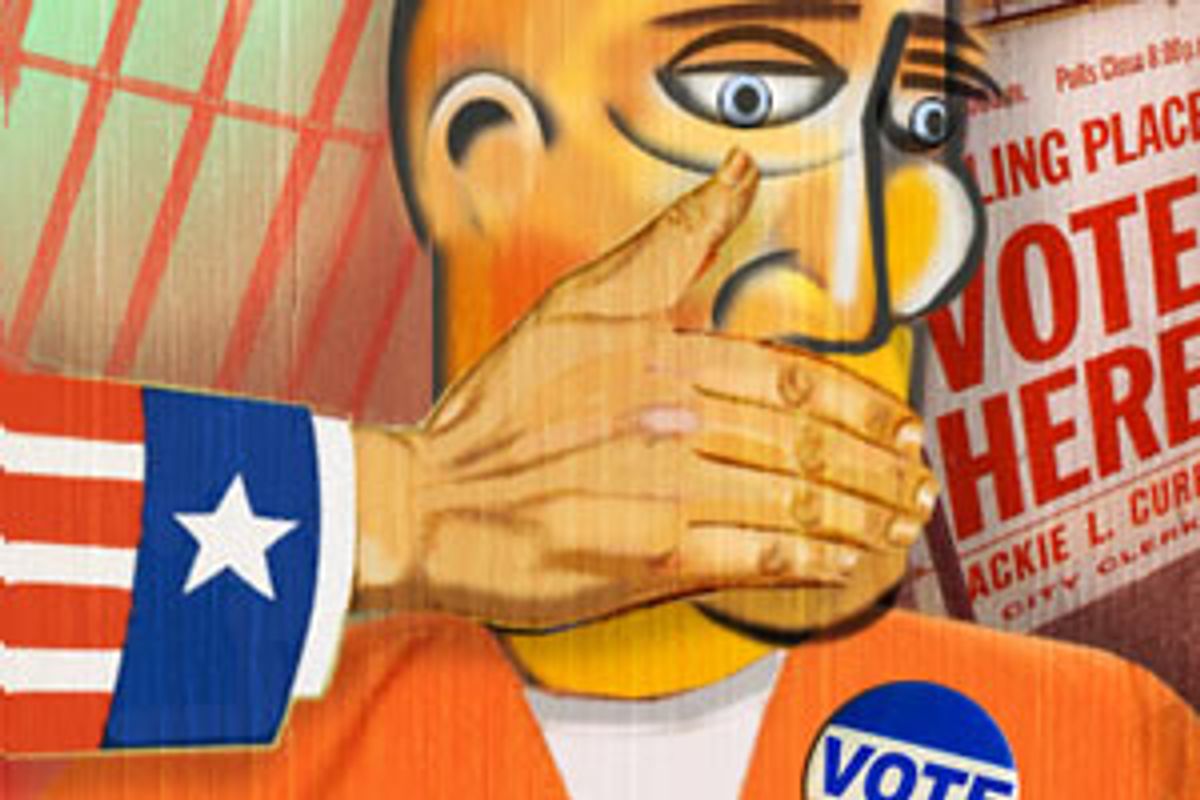
When Koren Carbuccia went to prison for the second time, her son, Vaskan, was just 3 months old. Being incarcerated during the earliest years of his life changed hers. She wanted nothing more than to be home with him.
Carbuccia had gone to prison for dealing cocaine. She was just 20 years old the first time she was caught. She was working the night shift at a clothing factory while going to school during the day, studying to become an emergency medical technician. Carbuccia wasn't a user, she says; dealing just meant easy money.
But not for long. After being released from jail, Carbuccia, who lives in Pawtucket, R.I., just outside of Providence, was arrested again for possessing drugs. "Wrong company, wrong friends," she says with a sigh. This time, she'd been on leave from her restaurant job as a waitress.
Carbuccia won an early release in February 2005. Today, at 27, she is a student at Community College of Rhode Island, studying substance abuse counseling, and working toward a master's degree. While going to school and caring for her son, she also works 20 hours a week doing data entry at the Family Life Center in Providence, which provides assistance for ex-offenders and their families. Recently, she took Vaskan, now almost 5, to his first day of preschool. "I want to do the right thing," says Carbuccia, who describes herself as a PTA mom. "I want to be responsible and raise my child. "
But there's one way Carbuccia isn't like other moms, and as the law in Rhode Island now stands, won't be until 2017. Only then, when she's completed both parole and probation, will she be allowed to vote. Until she's 38 years old, she'll be a second-class citizen, working, parenting, studying, paying taxes, but unable to cast a ballot. In a state of just 1 million, she's one of more than 15,000 disenfranchised voters because of prior felonies.
Across the U.S., nearly 4 million people with felony convictions, who are out of prison, have no say in their own government, and won't be going to the polls on Nov. 7. Their lost votes could make a decisive difference in close Senate and House races this fall, especially in Florida, Kentucky and Virginia, where, unlike most states, felons, even after serving their time, never regain the right to vote. Among the races that could be affected are Virginia Sen. George Allen's attempt to retain his Senate seat, despite his recently exposed history of using racial slurs, and the House race for Kentucky District 3, where polls now show Republican Anne Northup essentially tied in her attempts to keep her seat from challenger Democrat John Yarmuth.
Sociologists who have long studied the disenfranchisement of felons say that the lost votes amount to a built-in advantage for Republicans, seen most famously in the 2000 presidential race in Florida, in which Al Gore would have likely beat George W. Bush had ex-felons been allowed to vote.
The war on drugs and a trend toward tougher sentencing laws have seen the nation's prison population swell over the past few decades. In Rhode Island, for instance, some 40 percent of inmates are in prison for nonviolent drug offenses, like Carbuccia's.
What it means to be disenfranchised really hit Carbuccia one day when she was talking with mothers at her son's day care about upcoming school-board elections. "I thought, 'Oh my God. Do you mean I can't say anything? You're pretty much putting a hand over my mouth.'" She wants to be able to vote not only to influence policies that will affect her son's education, but to set a good example for Vaskan about the importance of participating. "It's not uncommon for parents to take their kids to the polls and I can't do that," she says.
This year, Carbuccia joined a campaign, organized by the nonprofit where she works, to change the law in Rhode Island to allow felony parolees and probationers to go to the polls. On Nov. 7, Rhode Islanders will vote on a referendum, which if it passes would amend the state's Constitution to give ex-felons, now living on the outside, the right to vote. While Carbuccia can't vote on the measure, she is vocal about why she thinks it should pass, speaking out at rallies and appearing in ads in support of the campaign. "Voting is a responsibility of each and every citizen," she says. "We want one vote, just like everyone else."
An unlikely catalyst brought national attention to felon disenfranchisement in the United States: George W. Bush. The 2000 election debacle in Florida put a spotlight on the stringent policy in the state, where if you've been convicted of a felony, you're essentially disenfranchised for life. Despite all the attention paid to hanging chads and purged voter rolls, it was this little-known issue that really decided the election, according to sociologists Christopher Uggen of the University Minnesota, and Jeff Manza of Northwestern University.
They looked at the demographics of former felon populations -- age, race, income, gender, marital status, education -- to determine the likelihood of their voting at all, as well as their likely preference for Democrats or Republicans. They found that former felons were about half as likely to vote as the general population, but would have a pronounced preference for Democratic candidates, given that many of them come from working-class poor and African-American backgrounds, where people typically vote Democratic.
In a paper published in American Sociological Review, the sociologists concluded that Gore would have likely received some 60,000 more votes had former felons in the state been able to vote, almost certainly reversing the results, giving Gore the presidency.
Since then, the number of disenfranchised in Florida has only grown. As of the end of 2004, there were 957,000 ex-felons in Florida alone who were "off paper" -- meaning they'd completed their time in prison, probation and parole -- yet couldn't vote. Of those, 205,000 were African-American. According to the American Civil Liberties Union, one-third of black men in Florida cannot legally cast a ballot, either because they're in prison or once were.
It is possible to regain voting rights as an ex-felon in Florida, but only by appealing to the state's Board of Executive Clemency. At the moment, this means pleading one's case before none other than Gov. Jeb Bush. According to the American Civil Liberties Union, applicants for clemency have been asked questions such as "Do you drink?" "Do you go to church?" "Are you married?"
"I thought character tests are no longer required for voting, but they are," says the ACLU's Laleh Ispahani. A survey by sociologists Uggen and Manza found that many appeals for clemency in Florida fail.
Critics say that disenfranchising former felons is un-American because it treats voting as a privilege, not a right. "If you think about it as a further way to punish criminals, it makes perfect sense," says Uggen. "If you think about it in terms of representative democracy, as trying to get everyone's opinion, it doesn't."
Felon disenfranchisement also has significant partisan implications, and not just for the U.S. presidential election in 2000. Uggen and Manza found that "by removing those with Democratic preferences from the pool of eligible voters, felon disenfranchisement has provided a small but clear advantage to Republican candidates in every presidential and senatorial election from 1972 to 2000."
They calculate that felon voters could have made a decisive difference in as many as seven senatorial races since 1978, which they estimate would have led to the Democrats' holding majority control over the Senate from 1986 to the present. Among the Senate races that would have had different outcomes, in their estimation, are the narrow Republican victories of John Warner in Virginia, John Tower in Texas and Mitch McConnell in Kentucky.
The partisan implications of the former-felon vote are not lost on Republicans, either. In Alabama, which maintains strict restrictions on ex-felons' voting, the chair of the Republican Party Marty Connors said in 2003: "As frank as I can be, we're opposed to [restoring voting rights] because felons don't tend to vote Republican."
The roots of the concept of disenfranchising felons goes back as far as ancient Greece, when offenders deemed "infamous" weren't allowed to vote, make speeches in public or appear in court, according to Alec Ewald, a political science professor at the University of Vermont. In a 2003 paper, "Punishing at the Polls," he writes that in Renaissance Europe, some criminals were punished by being deemed "outlaws," literally outside the law, and could be killed with impunity. Later, the concept took a less literal cast, evolving into "civil death." The basic idea: a criminal could be deemed "dead in law," unable to perform any legal function, including voting.
Many U.S. states imported that European tradition in the form of laws restricting voting rights, some of which are written into state constitutions, like Rhode Island's. But in the South, in the late 1800s and post-Reconstruction period, the laws, like poll taxes and literacy requirements, were used explicitly to restrict the voting of African-Americans. "Many of these laws were made more extreme after Reconstruction to disenfranchise people of color," says Spencer A. Overton, a professor at George Washington University Law School.
For instance, in Alabama and Mississippi, not all felonies would result in disenfranchisement. At the time, certain crimes were considered "black" crimes, those thought to be committed only by African-Americans. Such crimes would result in the loss of voting rights, while even more severe offenses, thought to be committed by blacks and whites alike, would not. "In Alabama, if you were convicted of beating your wife, you would lose your right to vote," says Marc Mauer, executive director of the Sentencing Project, a nonprofit research and advocacy group. "If you were convicted of killing your wife, you would not." That law stayed on the books for 100 years.
Since the 2000 election, there have been some significant movements toward restoration of voting rights to ex-felons in several states. With the laws in flux, new questions have arisen about who is and who is not eligible to vote.
In 2001, New Mexico repealed its lifetime ban on ex-felons' voting. In 2003, Nevada restored voting rights to nonviolent first-time-offender felons immediately after they get out of prison. In 2005, Nebraska significantly reduced its former lifetime ban, so that now ex-felons are banned from casting a ballot for just two years after the completion of their sentences. The Sentencing Project estimates that in the past decade, voting rights have been restored to some 620,000 people, who'd formerly not been eligible. Just this year, 73 bills were introduced in 22 states about felons' voting rights, with the vast majority of those seeking to expand voting rights.
In Iowa, where draconian laws like those in Virginia, Florida and Kentucky are still technically on the books, Gov. Tom Vilsack issued an executive order in 2005, restoring voting rights to ex-felons. However, in Virginia, despite pressure from advocacy groups, former Gov. Mark Warner failed to do the same before leaving office. Many states, like Alaska, Arkansas, Idaho and South Carolina -- and Rhode Island, at least for the moment -- ban all felons on probation or parole from voting. And almost all states -- 48 total -- don't allow felons to vote while they're in prison. Notably, Maine and Vermont, the mavericks, allow prisoners behind bars to cast ballots.
The myriad of different state laws and recent revisions leads to another form of disenfranchisement, as many felons assume they can't vote and stay home on Election Day. In fact, the laws often befuddle election officials. Sasha Abramsky, author of "Conned: How Millions Went to Prison, Lost the Vote, and Helped Send George W. Bush to the White House," found substantial differences in the ways the laws are written, and how they're implemented on the ground. "You have all these laws that in theory let ex-felons vote, but election officials at the county level didn't understand the law, and were erring on the side of not letting felons vote," he says.
Who can blame many ex-offenders for having a hard time figuring out if they're welcome at the polls? That was Joe Loya's experience.
When the former bank robber got out of federal prison, he was put on "supervisory release," essentially the federal version of parole. He asked his parole officer if he could vote. The parole officer simply didn't know. As a resident of California, it turned out he couldn't vote, but he could have if he was on probation. Now, 10 years later, Loya, a writer and memoirist, says that he's an enthusiastic voter when he goes to cast his ballot at an elementary school in Oakland.
"I love being there," Loya says. "At that moment, I get sentimental about it. I feel this is my duty. I'm participating in society. I'm no longer antagonistic with society, which I used to despise."
Loya believes that not only should ex-felons be allowed to vote when they leave prison, they should be encouraged to do so. Parole officers should not only know the law, they should be handing out voter registration information. It's a way of encouraging felons to participate in society, rather than rebel against it. "Many guys who come out want to do the right thing," Loya says. "It behooves society to invite us in. Most people will not invite us into their house for a dinner, but they can invite us into the community in multiple ways, and one of those ways is the vote."
Andres Idarraga's life has changed course dramatically since 1998, when he was arrested for drug possession and distribution, as well as gun possession, and went to prison in Rhode Island. His sentence was for 14 years but he got out in six and a half. Today, he's a junior at Brown University studying comparative literature and economics, after transferring from the University of Rhode Island. He works part-time as a writing fellow, tutoring other students, and aspires to get a Ph.D. and become a literature professor.
"There's no way when a person comes out of prison, and you're struggling to put your life back together you should be denied the right to vote," Idarraga says. He argues the implications go far beyond the individual's recovery, impacting a whole community's political clout. For instance, in South Providence, 40 percent of black males ages 18 to 34 can't vote. "When you cannot vote, it affects your family and community," he says. "Candidates have a tendency to not even go into those communities and ask, 'What are your needs?' because they don't have to."
Like Koren Carbuccia, Idarraga is campaigning for the Rhode Island measure that would restore voting rights to ex-felons on probation or parole. Under the current law, he won't be able to vote for 30 years, when he's 58 years old.
Shares