

Almost all the country within their view was roadless, uninhabited, a wilderness. They meant to keep it that way. -- Edward Abbey, "The Monkey Wrench Gang"
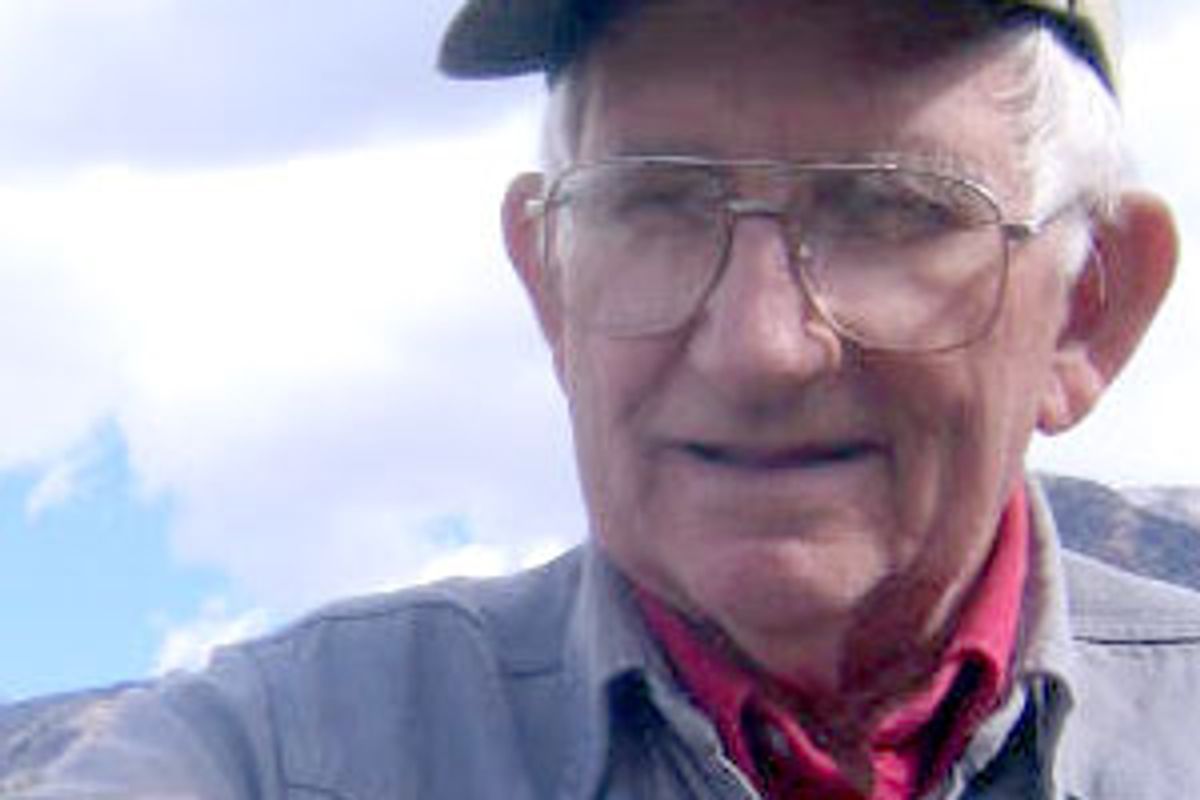
Ken Sleight is 77 years old, lean, dusty-booted, hard of hearing, wears old jeans and long-tailed shirts untucked. It is said that as a younger man he was the model for the lapsed Mormon renegade Seldom Seen Smith in Edward Abbey's novel "The Monkey Wrench Gang," which itself became the incendiary model for eco-saboteurs such as Earth First. Sleight owns a horse farm called Pack Creek Ranch, up on Abbey Road, outside Moab, Utah, in the high red desert of the canyon country, where for the last five months I've been renting a cabin 33 steps from the door of his lodge. I see him every day in his old blue Ranger pickup, or tending to his Appaloosas and Arabians with his wife, Jane, or laying gravel with his tractor and shoveling manure for shade trees.
I like Sleight. I like him because the other night he drank me under the table, because a few days later I got stuck in a September snow in the mountains above the ranch and he dropped everything to get in the Ranger and winch out my truck. I like him because when he drives long distances he pisses in a bottle instead of stopping at the side of the road. "No time to waste and why pollute the water," he says. I like him because on his horse a few years ago he charged two bulldozers in the forest near the ranch, refusing to dismount until the drivers shut their engines. I like him because he reminds me of my father, both of them agitators and nostalgics, angry young men more than twice my age, twice as angry as the young men you meet today.
Sleight talks about the way things were in southern Utah before the too-many strangers like me showed up, before Arches National Park, so beloved by his old friend Abbey, was snatched away by the seekers of heat and light and solitude once just his own, before the motor-home panzer units full of speedboats and mountain bikes and grandpas and babies in diapers. Just under 800,000 people flocked to Arches last year, almost a fivefold increase from 30 years ago. Everywhere in the red rock national parks of southern Utah -- in Arches, Capitol Reef, Zion, Bryce, wherever motorized man can find a way -- the people are coming. Sleight calls this "obscene." Too many "goddamn people," Sleight says. "In such a conglomeration, it's like down in Rome when all those masses see the pope. I don't understand how in the hell they get any meditative spiritual great stuff with so many damn people around."
Which would sound blinkered, curmudgeonly, elitist, plain mean if it were spoken by anyone else but Sleight, who says it with a sad, generous smile, sipping whiskey at noon. Sleight at first glance has settled down in his old age. He has been a river runner, cattle driver, canyoneer, sheepherder, wilderness guide and, as once denounced by a land developer, a "dangerous saboteur."
In "The Monkey Wrench Gang," published in 1975, Sleight, aka Smith, topples road-grading Caterpillars off a cliff, derails a coal train with dynamite, and attempts to incinerate the armatures of three bridges north of Lake Powell, which he refers to as "the Blue Death," the water having drowned the marvels of Glen Canyon. He prays on his knees atop the dam that created the hated lake. "Dear old god," the jack Mormon river rat cries out, "how about a little ol' pre-cision-type earthquake right under this dam?"
Abbey and Sleight met in 1967 at the put-in at Lee's Ferry on the Colorado River, 15 miles below Glen Canyon Dam, which had been completed four years earlier to charge a hydroelectric turbine that, in turn, would power casinos in Las Vegas and electric toothbrushes in Phoenix. Abbey was posted at Lee's Ferry as a park ranger with a penchant for cadging beer from river-runners. "Instant recognition," says Sleight. "We sat there and built a fire and drank and laughed until 3 in the morning. Talked about how to get rid of the goddamned dam! That was probably the start of the Monkey Wrench Gang right there."
So was Sleight really the model for the marauding Smith? "I admit to nothing except the Mormon part," he tells me.
In reality the character is not as effective as the man has been himself. "Ken has tilted at more windmills than Don Quixote could in 10 lifetimes -- he never gives up," says Jim Stiles, who publishes (and writes and edits) the Canyon Country Zephyr, southeast Utah's only alternative monthly newspaper.
Sleight indeed has had a very real hand in stopping more ill-conceived and rapacious projects threatening red rock country than probably any other Utahan. He was the first elected chair and catalyzing force behind the radical Glen Canyon Group of the Sierra Club's Utah Chapter (his original vision for the group, he would discover, was too radical). In 1999, he was bestowed the David R. Brower Award "for Outstanding Service in the Field of Conservation," with Brower, the unruly and iconic mountaineer and environmentalist, personally presenting the plaque. For eight years, Sleight honchoed the San Juan County Democratic Club, his chairmanship mostly spent trying to elect Native Americans, more than 55 percent of the jurisdiction, in a county ruled by minority whites. (He himself in 1990 would run for the Utah House of Representatives on an Indian ticket and lose with 35 percent of the vote.)
From what I can tell living at Pack Creek, Sleight doesn't sleep. Often I see him at 2 a.m. or 4 a.m. or 6 a.m. -- "Ken keeps wolf-hours, watch-hours," says Jane -- heading north in his Ranger on the 260 miles of exhausting road to Salt Lake City (bound for a quixotic morning meeting about draining Lake Powell) or driving more contentedly south to work with the Navajo and Ute nations, where corporate prospectors claim the land for coal, uranium, oil and gas, calling it progress; the Indians, left to suffer the cancers and clean up the mess, call it "energy genocide." At the age of 75, Sleight himself was diagnosed with prostate cancer: "You know what this guy does? He's getting radiation therapy five days a week in Salt Lake City," Jane Sleight tells me, "and he's sleeping in the back of his pickup, in November, in a parking lot. With no heater."
Today, in Moab and Monticello and Blanding, main habitations in southeast Utah, Sleight's enemies, a good number of them ranchers, sprawl boosters, oilmen or mining scions with interests in industrializing the high desert to no end, will say (off the record -- "in respect for Ken") that Sleight's got too much Abbey in his head, too much of Abbey's doomy vision of technology and sprawl and greed run riot. Maybe this is so.
The drowning of Glen Canyon in 1963 transformed Sleight, but in the end the change had nothing to do with Abbey. If the wilderness needed no defense, only more defenders, as Abbey would write, Sleight was destined for the duty, though his birth would seem to have conspired against it.
Sleight was born into a family of Idaho conservatives, ranchers, horsemen, farmers, his father, who ran a feed business, insisting he was conceived in a saddle (his mother loudly demurring). As Sleight understood it, conservatism among his Mormon kin meant "you go slow, you don't change dramatically," Sleight tells me. "You conserve!" In 1951, he took a river trip, his first, down the Canyon of Lodore in what is today Dinosaur National Monument. The first white man to run Lodore, the one-armed Capt. John Wesley Powell, wrote in 1869 that the cliffs of Lodore, blood-burgundy and sheer, were "a black portal to a region of doom," the rapids quickly slicing in half the first of his four boats, the water-roaring walls, awful and without egress, driving his men to bad dreams. Sleight and his crew, 15 drunken guys and gals in three boats, fared somewhat better -- only two of the boats flipped but washed up worthy -- and Sleight, 22 years old, was reborn.
There was an interregnum of war, college, confusion. He served in Korea, fought with the 48th Field Artillery Battalion at Pork Chop Hill. He soon had a wife and two children, with two more to come. He graduated in marketing and accounting at the university in Salt Lake City, finding a job with Firestone balancing the books for tire sales. He wore a bow tie to work. He went to John Birch meetings, backed Barry Goldwater; the know-nothingism soon wearied him. He remembered Lodore, "the most exhilarating moment of my life to that point." Within four years, he had quit Firestone and relocated his family to southern Utah and was in the guiding business, buying a fleet of old Army landing rafts, 8 feet wide, 18 feet long, at $50 each, calling the venture Wonderland Expeditions.
Sleight was a good guide, though the business, by its nature, destined him to a glorified poverty. He was puckish, and a flamboyant cook at camp, and he had the right instincts in the canyons. He could read clouds and white water, could smell out springs in the barrenness of rock. Jane Sleight tells me how once they were leading a group of horses and tourists in a canyon under blue sky, and Sleight turned to her, quietly, his nose twitching, and said, "Maybe we'll get up outta here." Minutes later a torrent of floodwater the color of smashed tomatoes filled the arroyo -- dumped silently from clouds far up the drainage -- and would have carried them and their beasts and clients away.
In 1955, Sleight took his first trip down Glen Canyon. If Lodore had shouted to him, Glen Canyon whispered, laid him down. In 1955, it was among the most remote places in the United States, and it should have been ranked as a wonder of the world. "It was inculcated in my soul," Sleight tells me. "It was heaven on earth." When Sleight talks about Glen Canyon, his voice goes quiet, almost murmurous -- he stops tonguing his whiskey, there is no shaking of fists or banging of tables, no wanting to charge you with his horses.
"The deep canyons, the meanderings, the quiet of the water, the great beaches," he begins. "I could show you all down those canyons the silhouettes of a woman's attributes, her body. The sandstone was petrified dune. It was sculpted, had a natural tendency to curve, everything rounded off, sensuous. And the color: oranges, browns, reds, always changing. You'd sit in one place, the sun'd come up and the colors -- the feelings of each of the colors! When the sun was straight up in the sky, I'd go off into a little cavish place and watch the little things of the desert, the closeness of the land, the rock, these fleeting images. I wondered how come a certain place is so calm, so beautiful. Why do I feel so good here? I wondered about the glens along the way, how I'd ever get to know them all. Hundreds and hundreds of amphitheaters, alcoves, tucked away in the cliffs, shadowy, full of maidenhair fern, the dripping springs, the green in the yellow rock -- the greenery, the fragrance, it hit you all at once. And always there were no rapids. Water smooth and calm. A matter of floating."
Sleight pauses. "So the places came to you: Cathedral in the Desert. Music Temple. Temple View. Temples! You'd wait for them in the morning, you'd wait in the evening -- spectacular. Eliot Porter" -- the photographer whose book "The Place No One Knew" is today's classic elegiac portraiture of the pre-flood canyon -- "told me, 'Wait for it. Just wait for it.'"
Later I looked up the names of Glen Canyon on a map of the river where it ran before the flood. Here was the Cathedral, and here was Last Chance Canyon, Hidden Passage Canyon, Rainbow Bridge, Salvation and Forbidden and Twilight Canyons, all gone now. Looking at the graveyard of the map, I thought of Sleight and his reverie and suddenly I felt like bursting into tears, a ridiculous sentiment no doubt, given I'd never seen the place and probably never will -- yet the loss seemed infinitely sad, personally tragic.
When, in the 1950s, Glen Canyon Dam began its inexorable ascent at the town of Page, it was to be one of the great works of humanity, 800,000 tons of concrete rising 58 stories above the river, costing $750 million and the lives of 16 men. To Sleight, it was mania, a nightmare. He tried to stop it, forming a group called Friends of Glen Canyon with six other river-runners. But no one heard the plea, no one listened. Even the dauntless David Brower, then executive director of the Sierra Club, cut a deal favoring Glen Canyon Dam in exchange for the federal government's abandonment of a dam project in Dinosaur National Monument. (Brower would forever curse his compromise, and to Sleight it would be a bitter irony when he received the Sierra Club's highest award from Brower himself.)
Sleight watched the water rise, tortured himself with its rise. "Growing up on a farm, I learned to feel that the land was a part of you, part of your being, your very mind," he tells me. "I don't care if it's public land, you can call it under any jurisdiction or bureaucracy you want -- Bureau of Land Management, Forest Service, National Park Service -- but it's your land, it's my land. Glen Canyon was part of me. And the water starts rising and covering up all those little canyons that I took people into for years. Sometimes a foot a day, sometimes 2. The most agonizing thing. Would you have your temple flooded? How would you feel if your house was bulldozed down? That's a hard one to think about. I feel it to this day."
Stiles of the Canyon Country Zephyr always wondered why Sleight stuck around to watch the disaster unfold. "It was as if he felt the need to die some when Glen Canyon went under, as if it was something he owed the canyon," Stiles says.
The loss radicalized Sleight -- or, rather, he understood that the "conservatives" pressuring for development in the Utah backcountry were in fact radicals in disguise and probably dangerous, the kind of zealots who refused to "go slow," who wanted to conserve nothing. As the 1960s unreeled, Sleight organized. In the good Mormon town of Escalante, Utah, where he was living in 1965, he helped fight off a multimillion-dollar highway that was to have paved easy tourist entry into the slot canyons and towering folds of what is today the Grand Staircase-Escalante National Monument. The Mormons of Escalante turned on him and his family, threatening Sleight from the fearless anonymity of crank phone calls; Sleight even found his truck sabotaged, pushed into a ditch in the night.
Stopping useless automotive-tourist-gerbil-wheel roads became a habit. Thanks, in part, to Sleight, the Book Cliffs near Desolation Canyon on the Green River -- where a massive road project was planned in the 1990s -- today remains the lower 48's largest roadless area, a place pretty much untouchable except to the toughest traveler. And thanks to Sleight, the canyon that first welcomed me to the Utah -- the winding lonely Davis Canyon outside Canyonlands National Park --remains as it was intended and just as it was when I came there in my tent four years ago under the watch of the rims and the buttes.
In the 1980s, a Mormon cowboy tycoon named Cal Black, representing the interests of progress and profit in conservative San Juan County, was pushing for the nation's first high-level nuclear waste dump to be sited at Davis Canyon. The plan called for a 640-acre floodlit compound, a truck-haul road, a power line, a rail line, and nuclear waste to squat in salt beds underground for 100,000 years or longer. Sleight was his usual nuisance self, writing letters to his congressmen and governor, protesting at the public meetings, questioning the authority of Black, who didn't like to be questioned, especially not by a Mormon who every Sunday skipped church.
It was on the figure of Black that Abbey based the chief antagonist in "The Monkey Wrench Gang," the unforgettably leather-faced, yellow-toothed, power-obsessed J. Dudley Love, better known across San Juan County as Bishop Love, the veritable Bishop of Blanding. (Like Black, who hailed from Blanding, pop. 3,100, Love the booster was a bishop in the Church of Latter-Day Saints.) Here's how Abbey has Smith describe Bishop Love: "neck deep in real estate, uranium, cattle, oil, gas, tourism, most anything that smells like money. That man can hear a dollar bill drop on a shag rug." Per usual, Abbey exaggerated. "I liked Cal," says Sleight. "He was sure of himself, could speak well, write well, make his case. He used to wear a bolo tie that had a vial of uranium strapped to it, wearing it on his chest, over his heart, to show it wasn't dangerous." Black got lung cancer and died in 1990 at the age of 61.
By 1986, Sleight had settled down with Jane at Pack Creek Ranch. In the last years of the decade, Abbey often stayed in the ranch's cabins, where he completed at least one of his 14 books and conceived his fifth child. When Abbey wasn't pecking at his typewriter or sucking liquor and ogling teenage girls, he'd head out hiking or on horseback in the summer afternoons, usually accompanied by Sleight. The two men talked, as they always did, about Glen Canyon and the dam. They considered alternatives to its violent destruction: How about just draining it like a bathtub? They drank to the notion. In 1989, Abbey, at 62, passed away, battered from a life of alcohol abuse.
Today the National Park Service has made clear that Glen Canyon shall neither exist in memory nor in the history books. "The Place No One Knew" is not sold in the bookstores at national parks. Nor is "The Monkey Wrench Gang." Nor is the DVD of the recent film in which Sleight appeared, "Glen Canyon Remembered," a documentary of interviews and archival footage and photography of the pre-flood canyon.
If the dam was built in service of gigantism and profligacy -- at once an electricity mill for out-of-control sprawl cities and a cash cow for the Colorado River Storage Project, which itself financed out-of-control high-waste agriculture and still more dams across the Southwest -- then its net effect on the culture of the canyon country was expected. Lake Foul, as Sleight dubbed the reservoir, allowed access to wilderness that once required days of travel through labyrinths of rock. Now you could find the drowned ruin of Cathedral in the Desert in two hours via houseboat. It was Lake Powell that first welcomed, in organized form and en masse, what Abbey called "industrial tourism," which depends for success on accessible wilderness and wildness as a marketed commodity, complete with hotel and restaurant chains and the kind of air-conditioned comfort stations that pimple the shores of Powell and the well-paved roads of parks like Arches and Bryce and Zion. Too many people on too many concrete paths, wanting to see too much in too little time, with too many signs telling them what they're missing, and what they should see next.
Of course, industrial tourism has in part morphed in the past two decades into a cosmetically greener version of itself, but one no less effective at exploiting the land. Now there are the rock climbers and hikers (like me), the canyoneers, the mountain bikers, and the river rafters and their guides. The hypocrisy of attacking adventure tourism is not lost on Sleight, for the adventure tourists are the very class of citizen that he once catered to as income, to whom he revealed the secrets of the canyons. The difference, offers Sleight, is that there are now too many adventurers. "Maybe," he tells me, "I shouldn't have guided one damn person into those places I loved so much."
The people come, and the developers come, faster than Sleight can counter. They come into his backyard, up into the hills behind Pack Creek Ranch, in jeeps, on mountain bikes. The bulldozers come, enforcing the Bush administration's Healthy Forests Initiative, chopping down the juniper and the pinyon trees. "I told the Forest Service, 'I want meetings on this! Bring us in as stakeholders!'" he says. "They said no public meetings." So last year, still the renegade, Sleight on his horse blockaded the 'dozers in a standoff that lasted 15 days. The uranium prospectors come, heirs of Cal Black, smelling money in the soaring price-per-pound of the ore. Operations are set to expand at the White Mesa Mill in Blanding, the only working uranium mill in the United States. The nearby Ute Indians don't want it. The Utes say the mill fouls their water and their soil. At public meetings, Sleight shouts that the plight of the Utes amounts to "environmental racism." His is a lonely voice among the whites of San Juan County.
A cynic will say that all of this rings of NIMBYism in its most crotchety form, but what Sleight really hopes for is sustainability, a simple and enduring concept by which he means the limited use of resources for limited ends. "There is a carrying capacity to everything," Sleight tells me. It's a phrase he repeats over many conversations.
One day in the cool of autumn, Sleight and I rode on horseback into the forest. We rode up a rocky gulch to a hillock where a petrified log had once lain whole, prone as a body, colored cobalt and rust and amber. I looked along the length of the log. Blocks of it had been chopped out like cake slices by scavengers who'd somehow gotten access, back here, where there were once no roads, no people. Sleight looked depressed, standing over the remnant of the find. "Not much left the way it was," he said. "I think this'll be gone in a couple years."
Shares