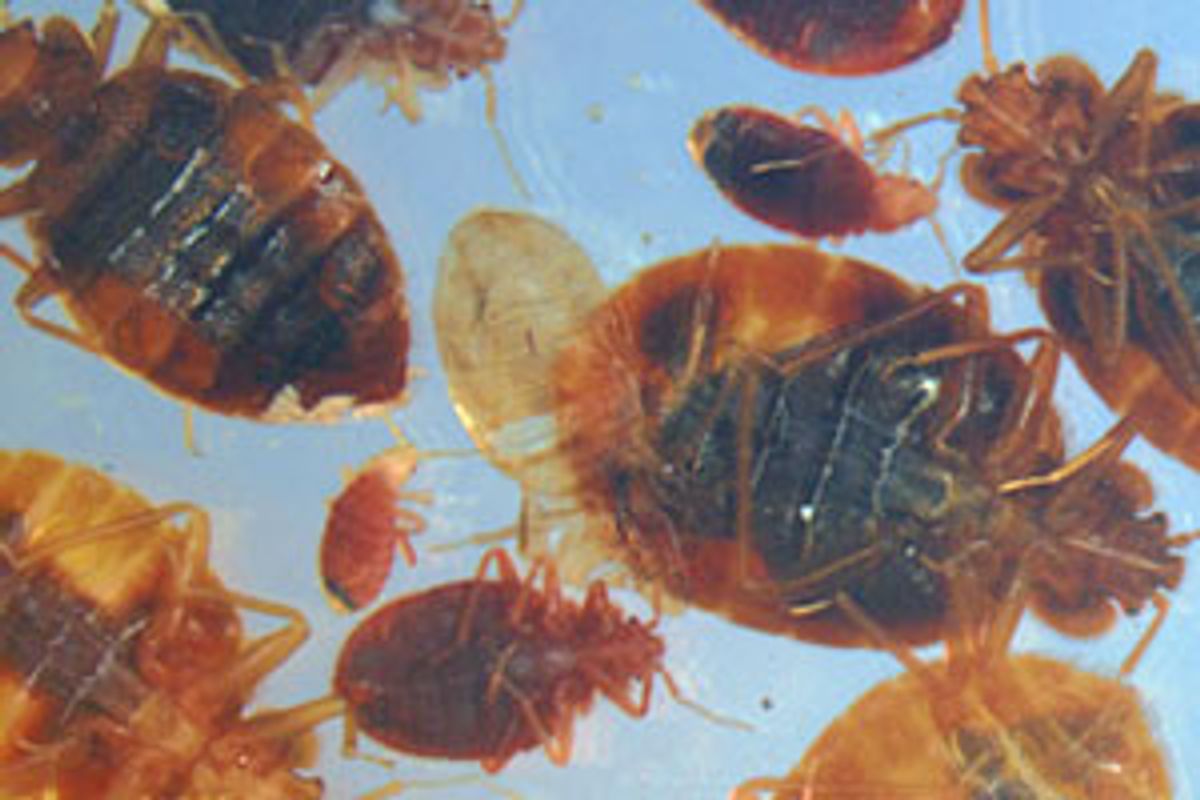
All but eradicated in the United States 50 years ago, the common bedbug has recently reappeared in hotels, apartment buildings and youth hostels across the country. From San Francisco to Las Vegas to New York to Miami, Cimex lectularius is leaving itchy welts, shedded skins and little drops of human blood in its wake. And now there are a growing number of reports of the tiny, ticklike nippers showing up in single-family homes as well.
The National Association of Pest Management reports that calls to its members about bedbugs increased 71 percent from 2000 to 2005. New York City alone received 4,638 official complaints about bedbugs in fiscal year 2006, up from 79 two years ago, and is on pace for more than 12,000 complaints in fiscal year 2007. It has become such a concern that one City Council member has introduced the "Bed Bug Bill," which would ban the sale of reconditioned mattresses in New York City and create an official city task force on the critter. Boston recently held a Greater Boston Bedbugs Conference, and has championed an effort to plaster furniture left out for the trash with bright orange stickers that read: "Caution! This may contain bedbugs. Do not remove!"
Hawaii has tried to legislate bedbugs out of its hotels and resorts; this September, fearing the economic impact that the little six-legged pests could have on the tourist industry, the state passed a resolution pledging that the Department of Health would help provide public education about the problem. San Francisco, meanwhile, has issued new guidelines on how to control infestations, which are showing up in the city's homeless shelters and youth hostels. The nocturnal parasite's resurgence has caused one entomologist to label bedbugs "the pest of the 21st century."
But what's causing the increase? The exterminators and entomologists are scratching their heads. Brian Cabrera, an assistant professor of entomology at the University of Florida at Fort Lauderdale, is among the entomologists collecting data on bedbug infestations to figure out why they're back. He spoke with Salon by phone from his office, where he keeps some bedbug specimens, in glass vials, that have not eaten in five months but are still alive. "When I bring them out they get really active," he says, "because they can detect my breath, and they're very hungry."
How big are bedbugs? Can you see them?
When they hatch out of the egg, they're about the size of a head of a pin. And then the adults are just under a quarter-inch long, and they're kind of the size of a large lentil or apple seed. The adults you can see with your naked eye. You see them crawling around if they're in your bed or your room.
If you think that you have them, what should you do?
One of the first things you should do is inspect your mattress and your box springs. Now, a lot of people are starting to hear about bedbugs, and it's having a psychological effect. Some people read about bedbugs, and they get itchy, and they think that they have them.
Before you start thinking you have bedbugs, check your bed. Check all the little seams and the corner guards on your mattress. And check the underside of your box spring. What you're going to be looking for are either the bedbugs themselves or the fecal spots or the shed skins. Other places to look are in the immediate vicinity of your bed. If you have a nightstand, check the underside. If you have anything on your nightstand, like an alarm clock or a lamp, check under there as well. Just think of anything that a really small, flat insect would want to hide under. Bedbugs don't like the light. They like to be in contact with something in tight, enclosed spaces. If you have carpeting, check along the edges where the carpeting meets the wall. Also look behind anything that's hanging on the wall -- pictures or a mirror.
The bedbugs shed their skin as they grow, and there can be a lot of these shed skins all over the place. It's not very pretty to look at. It's a mess. Bedbugs feed on blood, and they're taking in a lot of liquid. Then, when they defecate, they're basically defecating drops of blood. When they do that they spot the surface of whatever they're on.
Effectively, they're hiding during the day, and at night they come out ...
... To drink your blood. I call them six-legged vampires because that's basically the way that they operate. If you have bedbugs, when you're dead asleep the little bedbug will come out and start feeding on you. It kind of creeps people out to think about that, something that's coming out at night to feed on you. I don't know how that's different from a mosquito because a mosquito does that too, but something about them hiding in your bed and crawling out gives people the creeps.
What's the evidence that bedbugs are on the increase in the United States?
There are a lot of pest control companies across the country that had never seen them before until about 2000, except for the old-timers who had been doing pest control back in the '40s and '50s. And in the last six years, a lot of companies are starting to deal more and more with bedbug infestations. Last year, researchers at several universities sent out questionnaires to pest management companies in different regions of the country, and the response showed that they had all seen increases in the number of bedbug infestations.
So they're showing up all around the country?
What they found is it wasn't just limited to certain areas of the country. It was pretty much across the whole country. It's still not what I would call of epidemic proportions. It's not like we just have an explosion of bedbugs. They're seeing steady increases. Companies may see 10 bedbug cases per year, whereas before they didn't see any. Some of the larger companies are seeing larger numbers. They might get a couple of hundred cases, but it's not like we're getting hundreds of thousands of infestations by bedbugs. But right now the number is still rising.
What types of places do they show up?
Hotels and motels, college dormitories, youth hostels, homeless shelters, assisted-living facilities, cruise ships. It's generally any type of place where you have a large turnover of occupants and large numbers of people living in close quarters. And bedbugs hitchhike on baggage. A lot of people are picking them up as they travel and then bringing them home. Now, we're starting to see them in apartments, condominiums and single-family dwellings.
Then there is the occasional case of them showing up some place unusual. I've heard of a couple of accounts of them showing up in a restaurant, where they're infesting a chair.
So, it's not that they like a certain type of climate?
They're mostly associated with humans. They're pretty much adapted to living indoors. They originally were parasites from bats. There are some cases of people getting them from bats roosting in the attic, and the bugs moved down into the house. In some of the apartments and condominiums, they'll actually travel from apartment to apartment, unit to unit.
How do they spread?
They don't have any wings. The only way that they will spread is being transported by humans and their activities. So, there are documented cases of travelers' luggage getting infested when they're staying in a room that has bedbugs, and then they bring them home. There have been reports in hotels and motels where the bedbugs are actually in the bedding, so when the maid staff changes the bedding, the bedbugs will actually be on the service carts, and get transported.
There was one case of a person staying at a treatment facility, a couple days out of the week, and they found bedbugs in this facility. They were able to track it down to this one person; they checked his backpack, and they found something like 300 bedbugs on his backpack.
He didn't notice?
I guess not. He was using public transportation, and some of the old reports about bedbugs talk about people getting bit on buses, so it's likely that he was probably carrying these bedbugs around on the buses, kind of like a Johnny Appleseed spreading bedbugs across town.
Another way that they're spreading is with used beds and furniture. A lot of people buy stuff at garage sales or get hand-me-downs, and sometimes the furniture is infested, especially mattresses and box springs. Bedbugs can get under the box springs, the frame. If you see some furniture, a bed or mattress on the curbside, think twice before you take it.
I saw one presentation given by a person who studies bedbugs, and there was a guy [he found who had] several hundred bedbugs infesting his recliner. And his shirt was completely spotted with the bedbugs' fecal spots, basically dried blood. He had it all over his shirt. I said, "Didn't that guy realize he had all these bedbugs from the stains?" And he said, "Yeah, the guy didn't mind."
Some people I guess are more tolerant than others -- having some bedbugs doesn't bother them. Then, of course, there are people at the other side of the scale: They get bedbugs, and they throw everything out, and it's a real emotional trauma for them.
Why are there more of them appearing now in the U.S., after having been eradicated?
There are all these different theories that people have, but no one has actually proved any of these. Things like the change in pest control practices. In the old pest control treatment, the guy would come in, and he'd spray along the baseboard. They call it broadcast spraying in the pest control industry. They spray an insecticide along the baseboard, and underneath the sink, and that would leave a residue that would kill any insects that contacted it.
Starting around the mid-'90s, all these new products came out that are baits -- cockroach baits and ant baits. You put them out and the insect comes and feeds on them. You're targeting specific insects. And bedbugs feed on blood, so they're not going to feed on any of these baits. If they're switching over to using baits, and no longer doing this spraying along the baseboards, then there are no more residues. Then there's a researcher who is doing some work right now who is finding resistance to some of the insecticides that are being used. Back in the old days they were using DDT, and then the use of DDT got banned, and that was a very effective insecticide against bedbugs.
So now we have pelicans, but we have bedbugs, too?
Exactly. A lot of the insecticidal uses of DDT were taken away, and so we had to go to some other chemicals that are effective, but don't work as effectively as DDT.
Does human travel contribute to the problem?
Another theory is that the increase in travel and immigration is another reason that we're seeing more bedbugs. It seems like people are doing a lot more traveling than they ever have before. Now people are going all over the world and traveling to places that very few people used to go to before. So those are good places to pick up bedbugs.
Then, of course, we have a lot of immigrants coming in, and that's kind of a sensitive issue, because some pest control companies will say that they notice certain immigrant groups' houses or apartments are infested with bedbugs. I've heard of several cases where larger numbers of migrant farmworkers are sharing an apartment, and it's just loaded with bedbugs. So that could be another source, just people coming in from other countries bringing bedbugs with them.
Is it a myth that bedbugs are found only in places that are dirty?
Yeah. A lot of people assume that if a place has bedbugs it's kind of a fleabag hotel, or not very clean, but cleanliness doesn't really have anything to do with it. I've received bedbug samples from four-star hotels. There were a couple I got from Orlando, Fla., from really ritzy hotels. The person who was in that room just happened to pick them up from somewhere else, and it had nothing to do with hygiene.
Shares