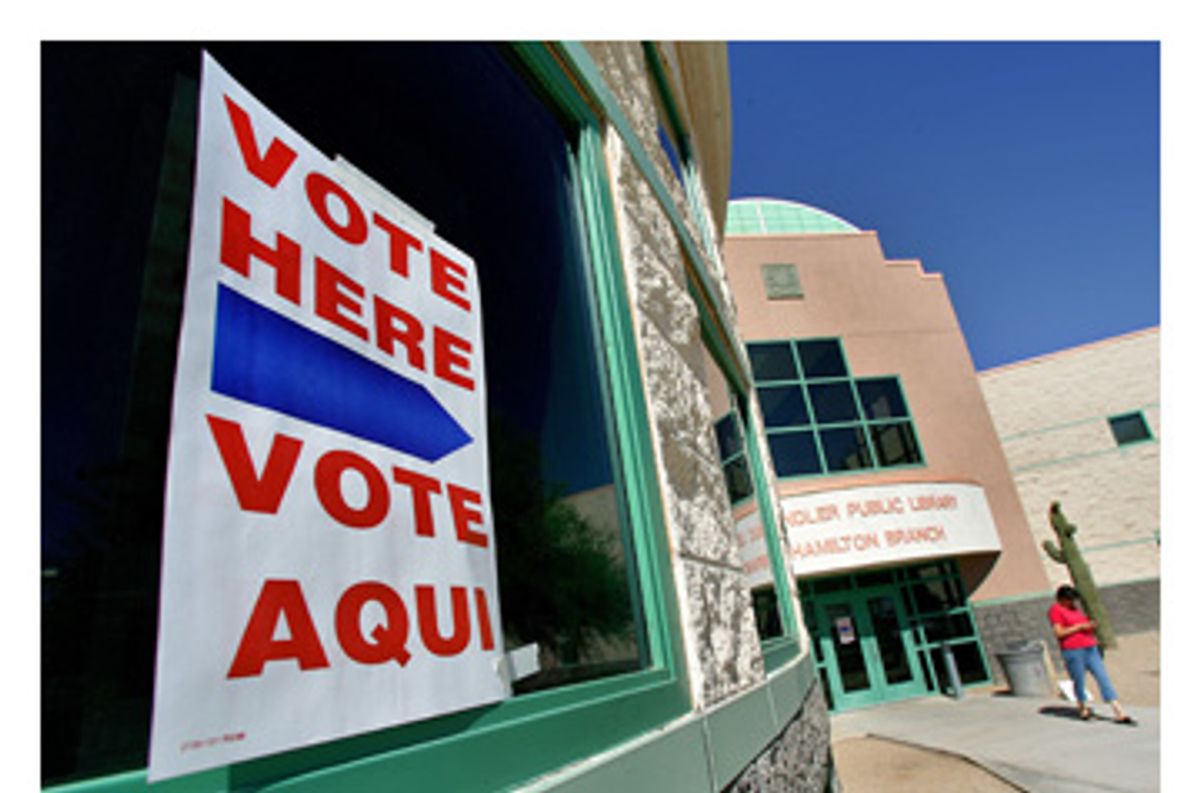
On Tuesday, Democrats stand an outside chance of picking up several House seats and a Senate seat in the once beet-red state of Arizona. Democrat Harry Mitchell is in striking distance of Rep. J.D. Hayworth in the 5th House District, and challenger Jim Pederson has closed within single digits of incumbent Republican Sen. Jon Kyl. But the prospects for Pederson, Mitchell and Democrats in general would be much better had the U.S. Supreme Court not recently upheld the state's new voter I.D. law.
Republicans nationwide have been proposing and passing various laws that require would-be voters to produce photo identification on Election Day. The nominal intent of the laws is to discourage fraudulent voting. In the absence of any real evidence of such fraud, however, the more likely effect of the laws is to disenfranchise members of Democratic-skewing groups -- blacks, Latinos, the poor and college students. Arizona passed its tough photo I.D. law by direct voter referendum in November 2004.
While lower courts in other states have tossed out similar laws, the Supreme Court's decision was its first direct ruling on a photo I.D. law. The court upheld the law on procedural grounds, and pointedly did not rule on its merits, but the decision was still a boost to the largely Republican proponents of voter I.D. laws across the country. The decision takes on added importance since the House of Representatives split along party lines in late September to pass an immigrant-bashing "Election Integrity" bill that would bar would-be voters nationwide if they can't produce a passport or other proof of citizenship at the polls.
On the ground in Arizona on Tuesday, the voter I.D. law means election officials may now shoo away or discourage enough Democrats to make a difference in any of several close races. Maricopa County alone, which encompasses Phoenix and has a population close to 4 million, has more than 1,100 precincts. If only a dozen voters are rejected or leave in frustration in each precinct, it could mean a difference of more than 13,000 votes. Democrat Janet Napolitano won the governor's race in 2002 by less than 13,000 votes. And last week, a state court ruled that nonpartisan poll watchers would not be permitted into the polling places to count the number of people turned away. "If anyone is interested in using voter suppression to win an election," says Linda Brown, director of Arizona Advocacy Network, a voting rights group, "Arizona is the place to do it."
Arizona's I.D. law is one of the most restrictive in the country. In order to register to vote, Arizonans must produce a state driver's license or a state-issued photo I.D. More than half a million potential voters in the state do not have either. Would-be voters can only prove citizenship to receive one of the I.D.s and register to vote using a very narrow range of official documents.
At the polling place on Election Day, a voter must again produce a photo I.D. or other documentation with a current address in order to be permitted to vote. A voter who can't produce the proper I.D. is supposed to receive what the state calls "a conditional provisional ballot." But for that provisional ballot to count, the voter is required to return to the same polling place later that day or to a county's election offices within five business days with the correct I.D. In some of the state's sparsely settled and sprawling counties, voters would have to make a 200-mile round trip to visit an election office.
Arizona officials already have an idea of what to expect on Tuesday. The arguments over the law and its effects ceased being hypothetical on Sept. 12, when the state held a primary election. Observers agree that there were problems, especially with poll-worker training, but whether those problems were serious depends on whom you ask.
Joe Kanefield, election director for Arizona Secretary of State Jan Brewer, a Republican, thought Sept. 12 went smoothly. "The new I.D. law was a tremendous success. The vast majority of people had no problem with the new requirements. When you have 10,000-plus poll workers, you're going to have isolated human mistakes. It's a rush to judgment to say they weren't properly educated about procedures."
Yet at a briefing for county and municipal workers in Maricopa County in October, the county election department's federal compliance officer, Tammy Patrick, expressed concerns about the "awful" foul-ups during the primary, according to observer Linda Brown. Patrick denies using the word "awful," but she concedes, "The [election] board workers faced a lot of challenges in this election. They had to learn the basics in a two-hour training," especially difficult because first-timers replaced many of the 7,000 often elderly poll workers who quit before the primary because of the complex touch-screen computers and I.D. rules. "Did they all retain the information?" she asks rhetorically. "Absolutely not." Maricopa County disallowed 73 percent of its conditional ballots.
Individual voters provide plenty of anecdotal evidence of just how stringent the new law can be, and how poorly trained some poll workers are. Dr. Michael Lopez, a Tucson anesthesiologist, thought he had enough I.D.s to qualify to vote when he showed up at 6:45 a.m. at the polling place before rushing off to assist in an operation at a local hospital. He not only had a valid driver's license and his voter registration card, he even had his hospital photo I.D. draped around his neck. He still wasn't allowed to vote, however -- the address on his voter registration card matched the address in the voter registration book, but the address on his driver's license did not. "Do you doubt this is me?" he asked, staring at his name in the book, irritation mounting. "No, but the law requires verification of your address," a poll worker told him. Without the correct address on his driver's license, the law required him to produce two forms of non-photo I.D. with a current address before he could vote.
"I don't have time for this," Lopez said. "I have to go to the hospital." Before he left, none of the poll workers, supposedly trained for two hours in the complexities of the new voter I.D. rules, offered him the opportunity to cast a provisional ballot. Their failure to do so was a violation of federal and state election laws.
Lopez vowed to return before the polls closed, but never got the chance. "If I was there with all these forms of I.D.," he asks now, "what's going to happen to underprivileged people who don't have driver's licenses or to people who are more transient?"
In the battle over I.D.s, most attention has focused on the possible disenfranchisement of traditionally Democratic voting blocs that are represented in the tens of millions nationwide -- the poor, the elderly, blacks and Hispanics. Within Arizona, it is the supposed concern about preventing electoral fraud by undocumented Mexican aliens that drove the GOP push for Proposition 200, the voter I.D. law, in 2004. But 5 percent of Arizonans are part of a non-white voting bloc that is both Democratic-leaning and undeniably native-born, and that is uniquely susceptible to disenfranchisement via I.D. requirements.
More than 250,000 Native Americans live in Arizona. As Leonard Gorman, an official of the Navajos, the biggest Arizona tribe, reported at a hearing in August, many Native Americans in the rural Southwest have no driver's licenses, utility bills or birth certificates. No one disputes their citizenship, yet they would not qualify to vote under what is now Supreme Court-approved Arizona law. "This is very burdensome to the elders," said Gorman.
Sure enough, on Sept. 12 an elderly Navajo woman from rural Chilchinbeto was barred by a poll worker from casting any ballot -- even a provisional one -- in the September primary. Agnes Laughter, who speaks only Navajo, lacked the proper I.D. "From just this one example, it is obvious that the ID requirement creates an undue burden on our citizens who are attempting to participate in the democratic process," one Navajo official, Speaker Lawrence Morgan, told the Gallup (New Mexico) Independent.
But the Republicans say there is another measure of success for voter I.D. laws. They claim that it increases voter registration. As Rep. Vernon Ehlers, R-Mich., chairman of the House Administration Committee, argued on the House floor, "The fact is people are encouraged to vote when they believe their vote will count and know that vote will not be canceled out by an illegal vote." GOP officials, including Ehlers and Arizona Secretary of State Jan Brewer, claim that Arizona has increased voter registration 15 percent since Proposition 200 took effect in 2005.
In fact, even before the primary there was already numeric evidence that the I.D. law actually depresses voter registration. A preliminary county-by-county analysis of the drop-off in registered voters between the 2004 election and the 2006 primary by John Brakey, co-founder of Arizona Citizens for Election Reform, shows a net decline of 110,000 voters, or 4 percent. This reduction took place even though Arizona is the second-fastest-growing state in the country, adding as many as 200,000 residents yearly, and its number of registered voters should've increased markedly. "If you calculate the population growth," claims Brakey, "the real possible impact is 250,000 to 300,000 people missing from the state voter rolls." By comparison, Nevada, the one state that's growing marginally faster than Arizona, saw its voter registration rolls shoot up 20 percent during the same period. Nevada doesn't have a voter I.D. law.
Who are the people who aren't registering to vote? Perhaps the most overlooked impact of rigid voter I.D. laws, as in Arizona and Indiana, is the effect on college students. A 2005 study of driver's license possession in Wisconsin, for instance, found that 98 percent of those college students living in dormitories didn't have a driver's license with their current address. The result is unsurprising given how many times the average student changes addresses while attending college, but it makes voting in voter I.D. states very difficult.
In Arizona, students can't register to vote unless they provide an Arizona-approved birth certificate and multiple proofs of their current address. In-state students who are already registered to vote in one Arizona county must provide proof of U.S. citizenship if they want to reregister in another county. At Arizona State University in Tempe, with its 63,000 students living on and off campus, voter registration has essentially evaporated. Allowing for the difference in intensity between presidential and midterm elections, the falloff is still stunning. From 5,000 voters registered in six weeks before the 2004 presidential race, the ASU Young Democrats' post-Proposition 200 registration drive has produced little more than 200 new voters in a year and a half. According to Joaquin Rios, 20-year-old president of the local Young Democrats chapter, the problem is the I.D. requirement. "I've encountered hundreds of students," he reports, "and I don't know a single one who has decided to get a state I.D."
Even if an Arizona college student is determined to vote, overcoming all the obstacles is still a bureaucratic nightmare that could deter all but the most fervent political activist. For instance, Christopher Gustafson, the 19-year-old Texan who is president of the student senate at ASU, was eager to register to vote in his new home. But when he went down to the Arizona Department of Motor Vehicles with a state-certified birth certificate that his mother had mailed to him from Texas, he still didn't qualify to vote. He was told he only had a "short-form" birth certificate, and needed a "long-form" birth certificate that included his father's birthplace. The Arizona DMV wouldn't accept the short version even when combined with his Texas driver's license.
"Is this because of Proposition 200?" Gustafson asked a supervisor.
"No, it's because of 9/11," the supervisor replied.
Ultimately, after spending a total of $42 and getting the long-form birth certificate mailed to him, Gustafson was finally granted the Arizona driver's license that permitted him to register to vote. He is well aware that other would-be voters may not have the necessary funds or perseverance. And he doesn't think many of his fellow students will get a chance to vote. If they bother to show up, he predicts, "They're going to be turned away, and they won't come back."
Alarmed at what may happen on Tuesday, voting activists in Arizona have been trying to recruit volunteers to monitor the polls and alert people to the 1-866-OUR-VOTE help line. The Democratic Party and an "Election Protection" coalition of nonprofit groups affiliated with People for the American Way hope to field a few hundred election monitors in Democratic-leaning precincts in Tucson, Phoenix and other areas. Other advocacy groups are trying to sign up monitors by promoting "Poll Workers for Democracy."
But a court decision on Nov. 1 said those nonpartisan volunteers won't actually have access to polling places to monitor voters being turned away. Instead, it will be up to state and local officials to do so. According to activist Linda Brown, "The counties have a vested interest in demonstrating that there are no problems with the law."
Poll observers may not be able to stop disenfranchisement, but they can bear witness, and counter any unwarranted spin. Brown's group will try to do its watching outside the polling places. "If things are perceived as going smoothly," Linda Brown points out, "and no one has monitored the number of people who were turned away or couldn't vote, supporters of the I.D. laws will say that opponents were crying wolf. Then the story will be spun that the voter I.D. law works, it doesn't disenfranchise anybody."
Meanwhile, next door in New Mexico, there are already signs that the Arizona experiment has the potential to spread. Over the past five years in this closely divided purple state, the Democratic-controlled Legislature has managed to quash or gut most of the photo I.D. provisions proposed by the Republican minority. But using the public relations approach that worked so well in Arizona, where the GOP went straight to the public with Proposition 200 and won by raising the specter of electoral fraud, New Mexico Republicans seem to have convinced the public that photo I.D.s are a necessity. Polls indicate a strong majority in favor of the requirement. Local Democratic politicians, in turn, have decided that it is a winning issue. On Tuesday, New Mexico voters have a choice of a Republican and a Democrat for secretary of state. Both of them support voter I.D.
Shares