

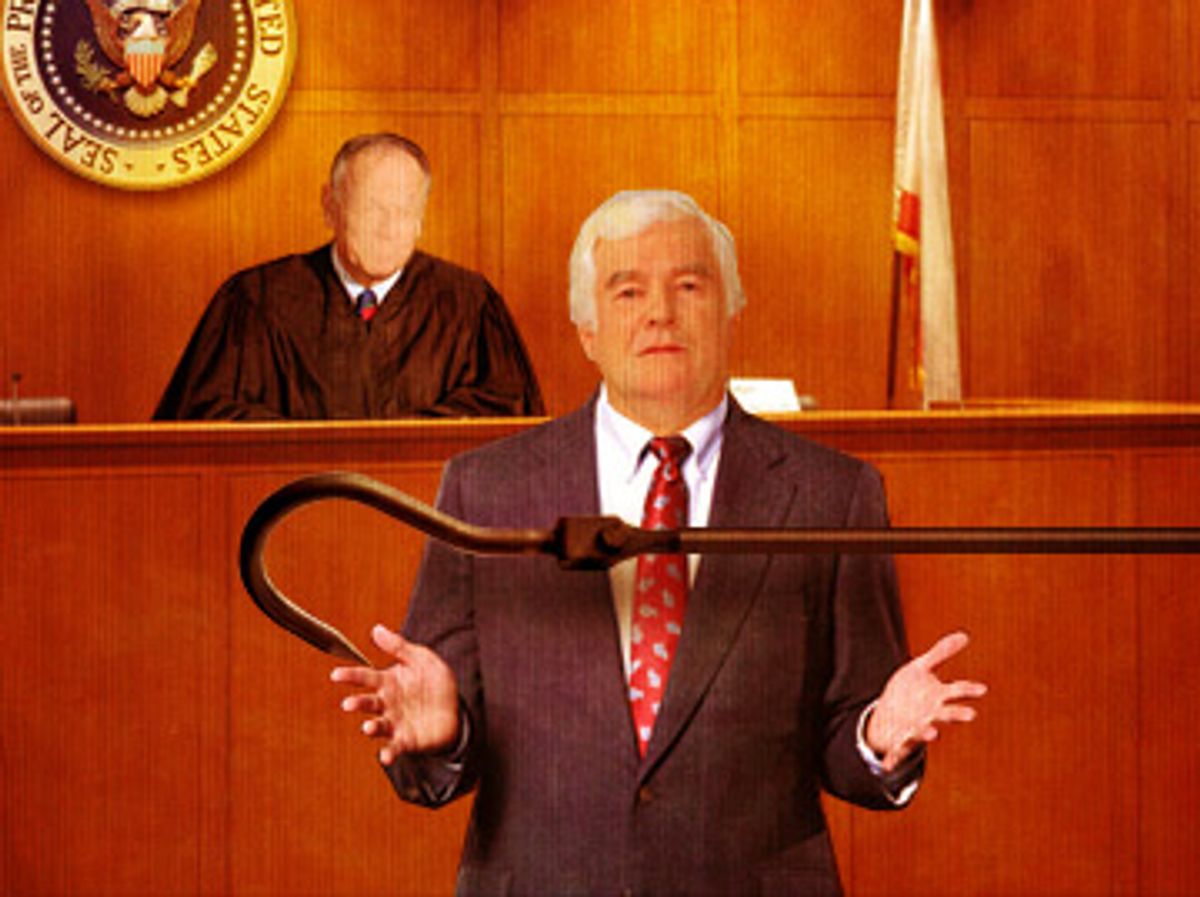
Ever since the Bush administration shocked the legal community by dismissing eight U.S. attorneys in December, Justice Department leaders have vigorously denied that the firings were politically motivated. "I would never, ever make a change in the United States attorney position for political reasons," Attorney General Alberto Gonzales said in Senate testimony in early January. In a Feb. 6 hearing, Deputy Attorney General Paul McNulty told lawmakers, "When I hear you talk about the politicizing of the Department of Justice, it's like a knife in my heart."
But at least three of the eight fired attorneys were told by a superior they were being forced to resign to make jobs available for other Bush appointees, according to a former senior Justice Department official knowledgeable about their cases. That stands in contradiction to administration claims that the firings were related either to job performance or policy differences. A fourth U.S. attorney was told by a top Justice Department official that the dismissal in that attorney's case was not necessarily related to job performance. Meanwhile, U.S. Attorney David Iglesias in New Mexico -- who officially steps down from his post on Wednesday, and who says he was never told by superiors about any problems with his work -- plans to go public with documentation of the achievements of his office.
"I never received any indication at all of a problem" regarding performance or policy differences, Iglesias told Salon on Monday. "That only leaves a third option: politics."
Iglesias acknowledged that U.S. attorneys serve at the pleasure of the president and can be dismissed without cause. "But it's really been maddening," he said, that the administration is pointing to job-performance issues to defend the firings. Iglesias, who was appointed by Bush in 2001, noted that his office got a "very positive" evaluation in the Justice Department's own internal ratings system as recently as last fall and that he received a letter from the Executive Office of U.S. Attorneys in January 2006 commending him for his "exemplary leadership in the Department's priority programs," including antiterrorism, community crime prevention and law enforcement coordination.
Iglesias said he was "shocked" by the phone call on Dec. 7 telling him to resign. He added, "I think Americans need to have full confidence that their federal prosecutors are above politics."
Suspicions about the unusual purge of eight U.S. attorneys in December exploded into the open across the legal community and on Capitol Hill after McNulty conceded in Senate testimony on Feb. 6 that the U.S. attorney in Arkansas, Bud Cummins, was pushed out for no reason other than to give someone else a shot at the job. Using a little-noticed provision in the Patriot Act allowing interim appointments, Gonzales gave the post to Timothy Griffin -- who had been both an operative for the Republican National Committee and a deputy to senior White House advisor Karl Rove -- in what many believe was a maneuver to sidestep the traditional Senate confirmation process for U.S. attorneys.
More recently, U.S. attorney Carol Lam, who is best known for nailing corrupt Republican Rep. Randy "Duke" Cunningham and his partners in crime, was replaced on Feb. 15 by Karen P. Hewitt, who according to a Justice Department press release, "will serve on an interim basis until a United States Attorney is nominated by the president and confirmed by the Senate." According to an Op-Ed in Monday's New York Times, Hewitt has a résumé with "almost no criminal law experience" and is a member of the Federalist Society, a conservative legal group.
While Cummins was first informed of his dismissal last June, it wasn't until Dec. 7 that Michael Battle, a top Justice Department official, informed the rest of the group of U.S. attorneys in phone calls that they would be required to step down. That group included Daniel Bogden in Nevada, Paul Charlton in Arizona, John McKay in Seattle, Carol Lam in San Diego, and David Iglesias in New Mexico -- all of whom had received positive job reviews before they were dismissed and some of whom are viewed by colleagues and law enforcement officials as exceptional leaders. Most of them have said publicly that they were never told of any management or policy problems by their superiors.
According to the former senior Justice Department official, one of the U.S. attorneys in the group was told by Battle on Dec. 7: "It's hard not to think you did something wrong when you get a call like this, but that's not always the case." Two other U.S. attorneys in the group, upon seeking clarification from superiors in Washington, were told by a different top Justice Department official that they were being pushed out to give other Bush appointees their posts. A current senior Justice Department official confirmed that one of those two was Bogden in Nevada.
When asked about those conversations with top officials, Bryan Roehrkasse, a public affairs spokesman for the Justice Department, declined to comment about "specific personnel matters."
Former officials, legal scholars and U.S. lawmakers from both parties have publicly questioned the administration's stated rationale for the firings and have suggested troubling theories about the real reasons for the purge, which experts say is without precedent. Some former Justice Department officials say they believe the administration's moves are a politically driven power grab -- aimed not only at a tighter grip on policy from Washington, but also at creating openings with which to reward their friends and build up a bench of conservative loyalists positioned to serve in powerful posts in future administrations.
"It's really remarkable to have a wholesale removal of an administration's own U.S. attorneys, particularly this deep into the term," said John Kroger, a federal prosecutor under Clinton and Bush who now teaches at Lewis & Clark Law School in Portland, Ore. "Clearly there was a concerted decision made to ask a bunch of them to leave. It suggests a desire to more tightly control policy. With the Democrats in control of Congress, perhaps it's because this is one of the few levers of government they have left."
Many point to the Cummins firing as proof that the administration is lying. "It is simply not believable that these were all performance-based dismissals, and everyone knows it," said a veteran prosecutor who served for a decade in the Justice Department until 2005. He also noted that he found it interesting that half of the posts cleared out are in the Southwest, where immigration is a key issue.
Kroger added that a stint as U.S. attorney is often a springboard to federal judgeships or other prestigious appointments. "Being a U.S. attorney is a huge credential, one a lot of people would like to have," he said. "It certainly looks like they're clearing out spots to reward loyalists in the last two years of the administration."
To support their claim that the dismissals were performance related, Bush officials have pointed to one among the fired U.S. attorneys, Kevin Ryan in San Francisco, who has been widely reported to be a focus of management complaints. The firing of Margaret Chiara in Michigan, the eighth U.S. attorney caught up in the December purge, was not made public until last Friday. To date, no explanation for her dismissal has been provided by Chiara or administration officials, but the former senior Justice Department official confirmed she was asked to resign in December and was in negotiations to stay in her post.
Realistically, federal appointments are never apolitical. But while U.S. attorneys serve at the pleasure of the president, they are traditionally recommended by federal judges and senators from the regions they serve, and are ultimately confirmed by the Senate. But thanks to a change put into the Patriot Act by Pennsylvania Republican Arlen Specter when it was reauthorized in late 2005, Gonzales and the White House gained the power to fill vacancies with interim appointees who can hold office for indefinite terms. Earlier this month, the Senate Judiciary Committee put forth legislation to restore limits for those terms (and thereby congressional vetting for long-term hires), but a full Senate vote on the bill was blocked by Republicans.
Incoming presidents are known to overhaul the corps of U.S. attorneys installed by prior administrations. Upon taking office, both Presidents Clinton and Bush replaced nearly all of the head prosecutors serving in the Justice Department's 94 districts nationwide. But it is rare for even one U.S. attorney to otherwise be dismissed during a president's term -- and in this case, all those dismissed by Bush were his own appointees.
Experts see a continuing pattern that began long ago: A Bush White House seizing greater executive power to the detriment of democratic principle.
"No doubt this is a threat to the independent stature that the Justice Department as an institution has enjoyed over the years," said Sam Buell, an associate professor at Washington University School of Law in St. Louis and a former federal prosecutor under the current President Bush. "It goes against the 'hands off' tradition, which has insulated U.S. attorneys from criticisms of politics influencing their choices and handling of cases. This doesn't look like a decision that's been made in the best interest of law enforcement."
Indeed, several of the fired attorneys had stellar track records. Like Iglesias in New Mexico, Daniel Bogden steps down Wednesday from the helm of a U.S. attorney's office in Nevada that saw unsurpassed achievements in law enforcement during his tenure. In a phone interview Monday, Bogden cited a record number of cases targeting guns, drugs, identity theft and sexual exploitation, among other criminal issues.
"To this day, I've never been told of any deficiencies in my performance or that of my office," Bogden said. "I've never been called by anyone suggesting that I should do something differently on policy, or that I was going against their policy."
In Seattle, John McKay's record as U.S. attorney has left many observers baffled by his dismissal. The raison d'être of the Bush White House is supposed to be the war on terrorism -- and McKay, by many measures, was an invaluable lieutenant in that battle.
McKay was appointed by Bush shortly after terrorists struck the United States on Sept. 11, 2001. Over the next five years, in a major port city and a border region critical for antiterrorist operations, he personally handled high-profile prosecutions, including that of Ahmed Ressam, who had driven across the Canada-U.S. border with plans to bomb Los Angeles International Airport at the turn of the millennium. In 2004, at a time when poor coordination among law enforcement agencies had been judged at least partly to blame for the 9/11 attacks, McKay developed an innovative data-sharing system that continues to be rolled out today in law enforcement offices nationwide.
Just over five months ago, on Sept. 22, 2006, the Justice Department completed a comprehensive evaluation of McKay's office, filled with high marks on both criminal and counterterrorism matters, including McKay's efforts to build greater cooperation among law enforcement agencies in both the United States and Canada. McKay "has been responsible for major advances in a cooperative cross-border effort," the report said. "All involved in these efforts pointed to U.S. Attorney McKay as the individual most responsible for the dramatic increase in cooperation."
"The report says nothing about me with regard to management or policy differences," McKay said in an interview last week. "Counterterrorism was our No. 1 priority, and I put an enormous amount of my personal time into it." He added, "If there were performance issues of any kind, they didn't tell me about it, and to this day I'm unaware of any."
"This is a huge loss," said Gil Kerlikowske, Seattle's chief of police. "I've worked with a lot of U.S. attorneys in my time and John is absolutely at the top of the ladder, not only on issues of terrorism but on law enforcement in general. I can tell you that if they're saying John's dismissal was performance related ... I find that almost inconceivable." Kerlikowske noted that McKay had crucial perspective, having served as a White House fellow at the FBI. "He knew how tough the barriers could be between law enforcement agencies, and he really helped break down those walls with information sharing."
"He was a champion with all the federal law enforcement agencies, but especially with ATF," said Kelvin Crenshaw, a 19-year veteran of the Bureau of Alcohol, Tobacco and Firearms and the special agent in charge of the Seattle field office. "He's one of the best U.S. attorneys I've ever worked with."
Administration officials have declined to provide further explanation for any of the attorneys' dismissals, including McKay's. On Feb. 14, McNulty, the deputy attorney general, gave a private briefing to the Senate Judiciary Committee, but afterward, Patty Murray, D-Wash., said, "I heard nothing from Department of Justice officials that changed my mind about John McKay's performance." Other senators who were present concurred with that view, according to a Democratic congressional aide briefed on the closed-door session.
Questions remain about how the Bush administration will seek to fill the newly vacant posts. Some former Justice Department officials say they believe that the administration has since revised its plans to reward political loyalists with the jobs, due to the backlash against the decision to push out Cummins in Arkansas and hand his post to Griffin. Earlier this month, the administration withdrew Griffin's name from consideration for a permanent appointment, though he remains in office indefinitely.
But if other recent appointees are an indication, the administration may be intent on installing conservatives with close ties to the White House. According to a Jan. 26 report by McClatchy Newspapers, since last March the administration has named at least nine U.S. attorneys who fit that profile, most of them hand-picked by Gonzales under the little-noticed provision of the Patriot Act that has since become law. They include Jeff Taylor, previously an aide to both Gonzales and former Attorney General John Ashcroft; Alexander Acosta, a protégé of conservative Supreme Court Justice Samuel Alito; and Edward McNally, a former senior associate counsel to President Bush.
And some critics expect that, despite the recent uproar over Cummins and the other attorneys' firings, the Bush White House will continue to find ways to erode the independence of the Justice Department.
"This is an administration that has not hesitated to discard conventional wisdom just because people say it's wrong," said Buell, the former federal prosecutor under Bush. "This is an administration that looks at the landscape and isn't afraid to rewrite the rules and say, 'We're going to do it our own way.'"
Shares