

Last November, Army Spc. Edgar Hernandez, a communications specialist with a unit of the Army's 3rd Infantry Division, had surgery on an ankle he had injured during physical training. After the surgery, doctors put his leg in a cast, and he was supposed to start physical therapy when that cast came off six weeks later.
But two days after his cast was removed, Army commanders decided it was more important to send him to a training site in a remote desert rather than let him stay at Fort Benning, Ga., to rehabilitate. In January, Hernandez was shipped to the National Training Center at Fort Irwin, Calif., where his unit, the 3,900-strong 3rd Brigade of the 3rd Infantry Division, was conducting a month of training in anticipation of leaving for Iraq in March.
Hernandez says he was in no shape to train for war so soon after his injury. "I could not walk," he told Salon in an interview. He said he was amazed when he learned he was being sent to California. "Did they not realize that I'm hurt and I needed this physical therapy?" he remembered thinking. "I was told by my doctor and my physical therapist that this was crazy."
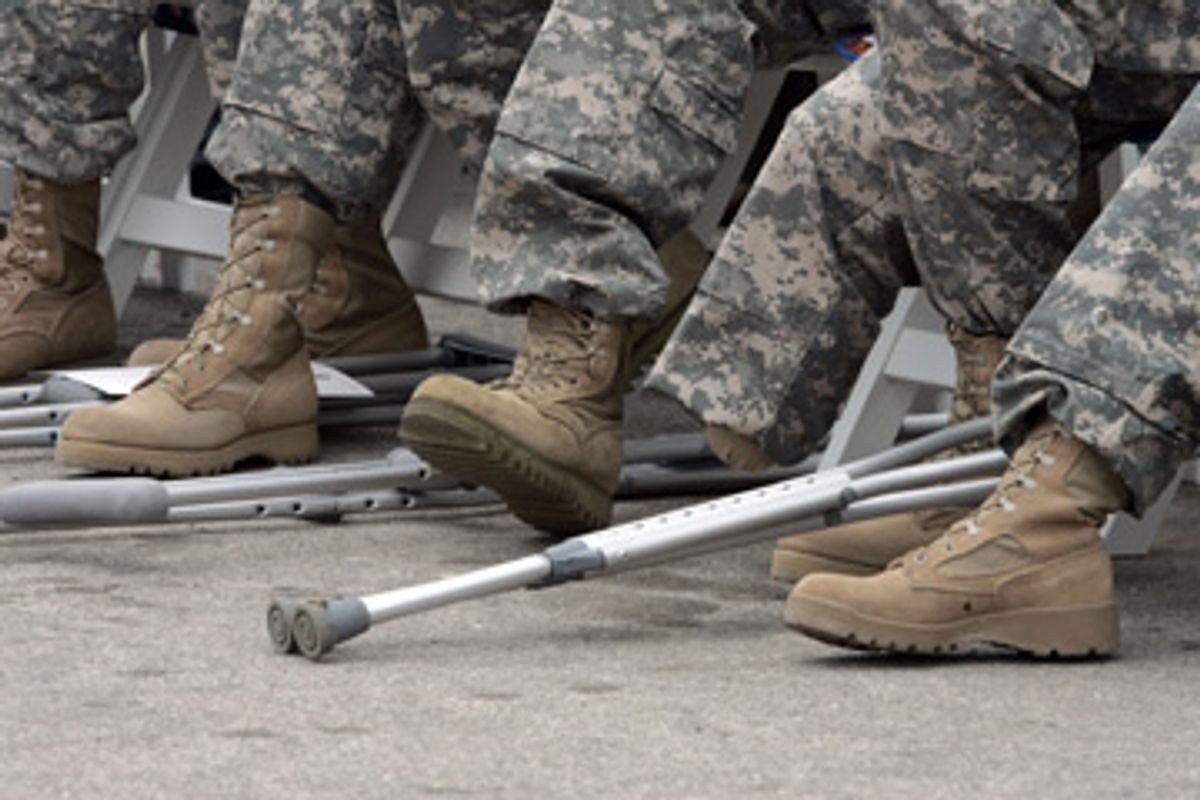
Hernandez had served two tours in Iraq, where he helped maintain communications gear in the unit's armored Bradley Fighting Vehicles. But he could not participate in war maneuvers conducted on a 1,000-square-mile mock battlefield located in the harsh Mojave Desert. Instead, when he got to California, he was led to a large tent where he would be housed. He was shocked by what he saw inside: There were dozens of other hurt soldiers. Some were on crutches, and others had arms in slings. Some had debilitating back injuries. And nearby was another tent, housing female soldiers with health issues ranging from injuries to pregnancy.
Hernandez is one of a dozen soldiers who stayed for weeks in those tents who were interviewed for this report, some of whose medical records were also reviewed by Salon. All of the soldiers said they had no business being sent to Fort Irwin given their physical condition. In some cases, soldiers were sent there even though their injuries were so severe that doctors had previously recommended they should be considered for medical retirement from the Army.
Military experts say they suspect that the deployment to Fort Irwin of injured soldiers was an effort to pump up manpower statistics used to show the readiness of Army units. With the military increasingly strained after four years of war, Army readiness has become a critical part of the debate over Iraq. Some congressional Democrats have considered plans to limit the White House's ability to deploy more troops unless the Pentagon can certify that units headed into the fray are fully equipped and fully manned.
Salon recently uncovered another troubling development in the Army's efforts to shore up troop levels, reporting earlier this month that soldiers from the 3rd Brigade had serious health problems that the soldiers claimed were summarily downgraded by military doctors at Fort Benning in February, apparently so that the Army could send them to Iraq. Some of those soldiers were among the group sent to Fort Irwin to train in January.
After arriving at Fort Irwin, many of the injured soldiers did not train. "They had all of us living in a big tent," confirmed Spc. Lincoln Smith, who spent the month there along with Hernandez and others. Smith is an Army truck driver, but because of his health issues, which include sleep apnea (a breathing ailment) and narcolepsy, Smith is currently barred from driving military vehicles. "I couldn't go out and do the training," Smith said about his time in California. His records list his problems as "permanent" and recommend that he be considered for retirement from the Army because of his health.
Another soldier with nearly 20 years in the Army was sent to Fort Irwin, ostensibly to prepare for deployment to Iraq, even though she suffers from back problems and has psychiatric issues. Doctors wrote "unable to deploy overseas" on her medical records.
It is unclear exactly how many soldiers with health issues were sent to the California desert. None of the soldiers interviewed by Salon had done a head count, but all agreed that "dozens" would be a conservative estimate. An Army spokesman and public affairs officials for the 3rd Infantry Division did not return repeated calls and e-mails seeking further detail and an explanation of why injured troops were sent to Fort Irwin and housed in tents there during January.
The soldiers who were at Fort Irwin described a pitiful scene. "You had people out there with crutches and canes," said an Army captain who was being considered for medical retirement himself because of serious back injuries sustained in a Humvee accident during a previous combat tour in Iraq. "Soldiers that apparently had no business being there were there," another soldier wrote to Salon in an e-mail. "Pregnant females were sent to the National Training Center rotation" with the knowledge of Army leaders, she said.
One infantry sergeant with nearly 20 years in the Army who had already fought in Iraq broke his foot badly in a noncombat incident just before being sent to Fort Irwin. "I didn't even get to put the cast on," before going, he said with exasperation. He said doctors put something like an "open-toed soft shoe" on his foot and put him on a plane to California. "I've got the cast on now. I never even got a chance to see the [medical] specialist," he claimed. The infantry sergeant said life in the desert was tough in his condition. "I was on Percocet. I couldn't even concentrate. I hopped on a plane and hobbled around NTC on crutches," he said. He added, "I saw people who were worse off than I am. I saw people with hurt backs and so on. I started to think, 'Hey, I'm not so bad.'"
Master Sgt. Ronald Jenkins was one of those soldiers at NTC with a hurt back, even though late last year, doctors recommended he be considered for medical retirement. Jenkins, 42, has a degenerative spine problem and a long scar down the back of his neck where doctors fused three of his vertebrae during surgery. He takes morphine for the pain in his neck and back.
"I slept on a damn metal cot for 26 days with serious back problems," Jenkins told Salon. "It was an unpleasant experience," he said, adding that his condition worsened while he was there. Hernandez, the communications specialist, said he reinjured his ankle at Fort Irwin, leaving him hobbling around in the sand and gravel for a month. When he returned to Fort Benning, Hernandez had to be put into another cast. (He is still in that cast now and hopes to start physical therapy when it comes off on March 26.)
"We could not train," Jenkins said. "Why were we even there?"
Military experts point to the brigade's readiness statistics, including "unit status reports" that carefully track personnel numbers and are sent up through the Army's chain of command. "There are a number of factors used to establish whether a unit is mission-capable," explained John Pike, director of GlobalSecurity.org, an independent organization that studies military and security issues. "One of them is the extent to which it is fully manned," he said. Pike says he suspects the injured soldiers were camped out at Fort Irwin so that on paper, at least, "the unit would have a sufficient head count to be mission-capable."
Lawrence Korb, who was an assistant secretary of defense for manpower during the Reagan administration and is now with the liberal Center for American Progress, says that the 3rd Brigade can show statistically that more troops trained in California simply because they were there. "Basically, they could say 90 percent went through Fort Irwin," Korb said about the brigade.
But injured soldiers from the brigade were not just shuttled to California; some were sent on to Iraq. Earlier this month Salon reported that on Feb. 15, shortly after returning from Fort Irwin to Fort Benning, 75 injured soldiers from the 3rd Brigade lined up for screenings at the troop medical clinic. Some of the soldiers there that day described cursory meetings with a division surgeon -- meetings designed to downgrade their health problems, the soldiers said, so that they could be deployed to the war zone. Records for some of those soldiers show doctors had previously concluded that those soldiers could not wear body armor because of serious skeletal and other injuries.
A military official knowledgeable about the training in California in January and the medical processing of the injured soldiers at Fort Benning in February told Salon that commanders were taking desperate actions to meet an accelerated deployment schedule dictated by President Bush's so-called surge plan for securing Baghdad. "None of this would have happened if we had just slowed down a little bit," the military official said. "A lot of people were under a lot of pressure at that time."
In an interview for the Salon report earlier this month, Col. Wayne W. Grigsby Jr., the commander of the 3rd Brigade, did not dispute that injured troops were being deployed, but insisted they would be put in safe noncombat jobs once they were in Iraq.
Some of those soldiers have since been deployed, while others fought orders to go to Iraq. Jenkins, with the bad back, even appealed his case to the Army surgeon general. Three days after he was quoted in the Salon report, Jenkins received official word through his chain of command that he would not be going to Iraq. Smith, the soldier with sleep apnea and narcolepsy, who was also quoted in the Salon report, also had his deployment orders dropped by the Army in mid-March.
Jenkins said the disregard for soldiers' health motivated him to speak out, despite his fears that as an active-duty soldier he could suffer reprisal from superiors. "I am a guy who has been in the Army for 21 years," he said. "For me to speak about this -- and risk everything -- then there has got to be a problem. There has got to be an issue here."
Pete Geren, the acting Army secretary, told a Senate panel on March 14 that the Army would investigate the injured soldiers' claims that their medical records were modified at Fort Benning in February in order for them to be sent to Iraq. House Armed Services Committee chairman Ike Skelton, D-Mo., has asked the Government Accountability Office to investigate. The Army inspector general has also launched a probe. It remains unclear if any of those probes will also look into injured soldiers' being sent to the National Training Center at Fort Irwin in January.
Experts say there is little doubt that military readiness has diminished with the strain of the Iraq war. But the Army says the problem is limited to units recuperating in the United States, and that by shifting around troops and equipment, brigades going to Iraq are in tip-top shape. "Today's deployed soldiers are the best-trained, best-equipped and best-led we have ever sent into combat," Army vice chief of staff Gen. Richard Cody told a House Armed Services Committee panel March 13. "However, we've done this -- after five years of combat -- we've done this at the expense of our non-deployed forces," he admitted. "We do have shortages with the non-deployed forces." The New York Times reported on March 20 that of the 20 Army brigades not currently deployed to Iraq or Afghanistan, only one has enough equipment or soldiers to be sent quickly into combat.
Indeed, there are indications that the problems go beyond Fort Benning. When Skelton, the chairman of the House Armed Services Committee, wrote to the GAO asking for an investigation into the deployment of injured troops to Iraq, he added in that letter that "the committee has received a number of phone calls and letters from concerned service members and their families, including similar allegations that injured and wounded service members are being deployed into combat despite their injuries."
"My back was broken while I was in the military, I now have a ruptured/bulging discs in my lumbar spine," one distressed soldier wrote to Salon in an e-mail earlier this month. She said she had been in the process of a medical review that would end her service in the Army. But upon her return from the National Training Center in California, she claimed, doctors at Fort Benning "changed my profile and made me deployable." She pleaded for help in bringing attention to her case, after frantically seeking help through military and congressional channels.
"If anyone has the ability to help ... PLEASE do so," she wrote. "I am heading to Kuwait tomorrow where I will then go to Baghdad with my unit."
Shares