

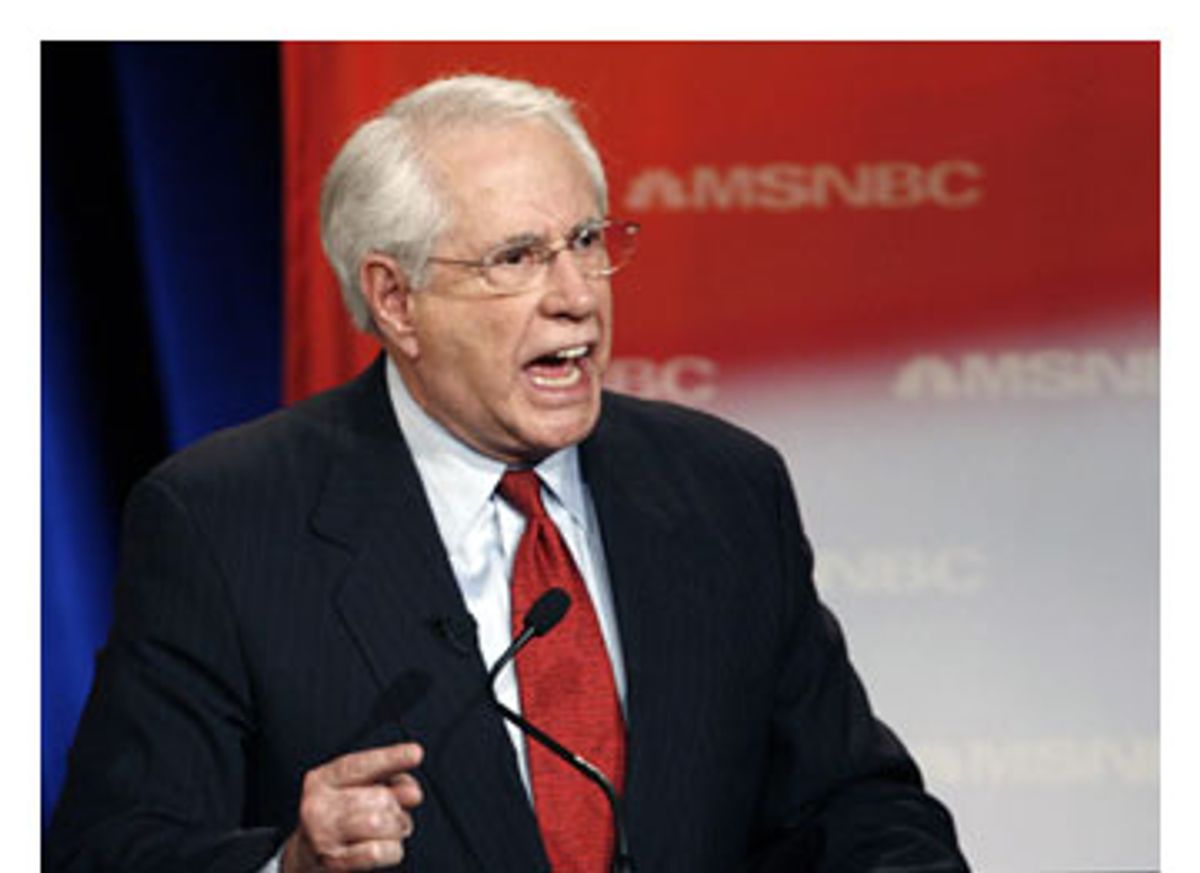
If Mike Gravel, the former senator from Alaska now running for president as a quasi-lefty long shot, can be said to have a base, then he should have been standing right in the thick of it Wednesday night.
Fresh from taping an appearance on Comedy Central's "Colbert Report" in midtown Manhattan, Gravel and press secretary Alex Colvin took an impromptu drive down to Cooper Union in the East Village. Six blocks north of the defunct punk-rock club CBGB, venerable leftist historian Howard Zinn was leading a group of actors and musicians, including Danny Glover, Ally Sheedy and Steve Earle, in a selection of readings and songs, such as Woody Guthrie's "This Land Is Your Land," Bob Dylan's "Masters of War," Allen Ginsberg's "America," and speeches from Martin Luther King Jr. and Cindy Sheehan. But when the 76-year-old Gravel, white-haired and clad in the dark suit and red tie that are the uniform for all male presidential candidates, strode into the back of the crowded auditorium almost two hours after the event began, there was little hint that the mostly graying throng in attendance recognized him. What notice Gravel did get was from one 30-something man who told him to keep up the fight, and from two gushing, acne-marked teenagers who asked for an autograph and promised their vote if he continued sticking to the issues.
Gravel, who drove a cab when he lived in New York and attended Columbia University more than 50 years ago, had weathered 60 blocks and 45 minutes of post-rush-hour Manhattan traffic to be at the event. But he shook no hands that were not offered to him. And though he had expected to get backstage and see his old friend Zinn, after a minute of bewildered negotiation he was told sharply that he would have to wait -- the kind of reprimand that is simply not given to a presidential candidate. Instead of arguing he turned for the door. He didn't want to be a nuisance to Zinn, he explained halfheartedly. "After an event like this one," he said, "no one wants someone they haven't seen in years coming up and shaking their hand and saying, 'How are you!?'" Mean, angry Mike Gravel, the man who had said during the first Democratic presidential debate that the other candidates "frighten[ed]" him, who demanded of Sen. Barack Obama, "Tell me, Barack, who do you want to nuke?" just gave up and walked away.
But there were those three people who recognized him, two of them eager political neophytes starstruck in Gravel's mere presence. That's the audience Gravel, who was the first Democrat to announce his candidacy for president, is slowly beginning to attract. According to On Politics, a blog by USA Today, Gravel's name became the 15th most popular search in the blogosphere shortly after the debate. A YouTube video of him at the debate has been viewed more than 200,000 times, and, according to a graph of traffic stats provided by Alexa and posted at Students for Gravel, in late April and early May, Gravel's Web site had more traffic than those of the three Democratic front-runners.
Gravel's support seems to be coming from those disaffected Democrats who, tired of politics as usual, watched the debate and saw a fiery man no one had heard from for 25 years saying things no other candidate would dare. After the debate, the image of Gravel as a sort of cross between Adm. James Stockdale and Grampa Simpson -- crotchety, rambling and maybe a little dotty -- is congealing into conventional wisdom in the snarkier quarters of the mainstream media. But there are some Democratic primary voters who not only don't mind cantankerousness but relish it as the mark of a plain speaker. They like a candidate who insists on being quoted calling Rahm Emanuel, chairman of the Democratic Congressional Campaign Committee, a "son of a bitch" for saying the freshman class of congressional Democrats should avoid "The Colbert Report." And though they may never have heard of Gravel before, his new fans are enjoying a glimpse of the bomb-throwing senator of three decades past, whose filibusters and unorthodox tactics made him both loved and hated among the public and his Senate peers, and who, then and now, has always seemed oblivious to the long odds against him.
Over dinner at a Manhattan coffee shop after the Zinn event, as Gravel and company, now joined by a scruffy middle-aged Green Party supporter who identified himself only as "zool," drank the four minibar-sized bottles of red wine that came in the "Colbert Report's" goody bag, Gravel reminisced about his combative tenure in Congress. He admitted that by 1980, when he went down to defeat in a Democratic primary after 12 years in the Senate, he had alienated "almost every constituency in Alaska."
"I was like Richard III inside my armor with all the scar tissue," he says. "All you had to do was blow on me and I'd fall over." With that, he retired from politics, disgusted, he says, "with public service, with the way government operated."
Now, however, he is broke, unemployed and happy. He has, in his own words, "zero net worth." His Senate pension all goes to his ex-wife, and he hasn't earned a regular paycheck in years. Since leaving the Senate he has endured two bankruptcies, one corporate and, just three years ago, one personal. He doesn't care. He quotes mythology scholar Joseph Campbell, who advised everyone to "follow your bliss." He and his wife have "difficulties" financially, he says, but he also says he has never been more content.
Mike Gravel is just following his bliss, and for him, that's always been politics. He caught the bug growing up in Springfield, Mass., the child of blue-collar French-Canadian immigrants. At 26, after a few years in the military and then graduation from Columbia, he began thinking about where he could move to get his start as a politician. "I had no money, I had no name and no contacts. So I thought I might as well go some place and start from scratch." He narrowed his choices down to Alaska and New Mexico, and chose Alaska because he didn't like warm weather.
"When I got there, I was broke. It was probably about 3 o'clock in the afternoon, I was at a gas station, and I asked the guy, 'Do you know where I can get a job?' I didn't care -- any job. I was broke. He says, 'I've got a friend who's a manager of a real estate company. I'll give him a call, and why don't you show up there Monday morning?'"
He got the job. In the fall of 1958, two years after his arrival, while Alaska was still a territory, he ran for what would become, in January 1959, Alaska's first state Legislature. He lost. By the 1960 election, Gravel was prevented by new residency requirements from running for the Legislature, so he ran for the Anchorage City Council instead. He lost. In 1962, he finally won election to the state House of Representatives. By the start of his second two-year term in 1965, the articulate and handsome New Englander was speaker of the Alaska House.
In 1966, he tried to take out the incumbent occupant of Alaska's lone U.S. House seat, a fellow Democrat. He failed. In 1968, he set his sights on the U.S. Senate. To get there he again targeted a Democratic incumbent, the grand old man of state politics. In the Democratic primary, 38-year-old Gravel beat 81-year-old Ernest Gruening, a former territorial governor whom many considered the father of Alaska statehood, by playing up his youth. He blanketed the low-cost Alaska television market with the slickest political commercials the fledgling state had ever seen. Though it might come as a surprise to his newfound fans, the liberal Gravel also ran to the right of Gruening on the issue of Vietnam. Gruening had been one of just two senators to vote against the Gulf of Tonkin resolution, which authorized the Vietnam War.
Gravel says now that he was never really a hawk. "If Ernest Gruening only knew at the time that when he voted against Tonkin, I wrote him a heartfelt letter saying how great he was for doing that," Gravel says. "But when I ran, being a realistic politician, all I had to do was stand up and not deal with the subject, and people would assume that I was to the right of Ernest Gruening, when in point of fact I was to the left of him."
In the Senate, Gravel proved to be antiwar and a reliable liberal on most issues except the environment -- though he was an early crusader against nuclear testing, as an Alaskan, his political survival required him to support resource exploitation. Gravel also became known as a firebrand with an unorthodox style of doing business. Nancy Leonard, who worked as his representative on the Senate Finance Committee, says now that Gravel "didn't just dismiss an idea on the basis of 'We don't do things that way.' He'd think, 'Is there a way to do them differently?' ... He did a couple of really good things ... but he was never going to be one of those 'Let's dig down and burrow and figure out the rules here and see what we can accomplish day-to-day' senators."
Gravel reports that his old colleague Joe Biden recently put the matter more plainly. After the first Democratic presidential debate, Sen. Biden, who served with Gravel in the Senate 30 years ago, introduced Gravel to Mrs. Biden. According to Gravel, Biden told her what to expect from Gravel on the presidential campaign trail. "He says, 'I've got to tell you, this is the old Gravel -- he's just going to be lobbing hand grenades into this whole thing.'"
Sometimes Gravel's methods were both dramatic and effective. In June 1971, after the Nixon administration obtained temporary injunctions to stop both the New York Times and the Washington Post from publishing further portions of the controversial Pentagon Papers, a secret internal Department of Defense history of the Vietnam War, the Supreme Court agreed to take both cases. The night before the court's decision, so that the papers would be public no matter how the court ruled, for three and a half hours Gravel read passages of the Pentagon Papers aloud in a Senate subcommittee meeting, pausing to cry, and entered thousands of pages into the Congressional Record. He, Howard Zinn and Noam Chomsky then published the Pentagon Papers as a book. The same year, Gravel's lengthy filibuster against a continuation of the military draft was successful, and it helped bring about the end of conscription in 1973.
Other times he just annoyed people. In 1972 he nominated himself, unsuccessfully, for vice president at the Democratic National Convention. In 1978, he killed a compromise bill on the question of huge parcels of Alaska land then still under control of the federal government. The bill, which would have brought some of the property under the control of Alaskans while also determining how much would be preserved as parks and refuges, was the product of the almost-obsessive work of many disparate groups and, especially, Ted Stevens, the state's Republican senator. Stevens, who through a spokesman declined a request to be interviewed for this article, reportedly blames this, and Gravel, for the death of his wife, Ann, in a plane crash later that year when she was accompanying Stevens on a trip. In 1979, testifying before a House committee, Stevens said he thought that "if that bill had passed, I might have a wife sitting at home when I get home tonight." A 1979 Washington Post article by Nicholas Lemann said that Stevens had been "drop[ping] hints, in Washington and Alaska, that he felt the only reason he was in that plane in the first place was that he had to piece the effort for a lands bill back together, and that the only reason he had to do that was that Mike Gravel killed the bill."
In 1980, a new lands bill, less favorable to Gravel and the Alaskan interests he was representing, passed over his objections and his filibuster. In this instance, as in his biggest legislative achievement -- pushing the Alaska pipeline through the Senate -- Gravel took a stand that might trouble potential backers in his current presidential bid.
The passage of the lands bill was widely believed to be the reason for Gravel's loss in the 1980 Democratic Senate primary to Clark Gruening, the grandson of Ernest. After his loss, Gravel tried to go back to being a businessman, at least for the first decade or so. He did some consulting. He had a stockbroker's license. There were dabblings in real estate. He had a condo business that went bankrupt; it was undercapitalized, he says, and there was a lawsuit. There was another lawsuit over a business deal, in which he represented himself against predecessors of the Carlyle Group, the well-connected and controversial private equity firm that has counted among its employees and investors members of the Bush and bin Laden families and has owned defense and communications companies.
Then in 1989 he scaled back his less-than-gung-ho pursuit of money and returned to his original passion. He started to get interested in politics again and in an idea that had always interested him: national referenda. He wanted to turn the American people into one massive legislative body 300 million legislators strong. Over the period of a decade he researched the concept of the "national initiative." He drafted a law and created three interlocking nonprofit groups, Direct Democracy, Philadelphia II and the Democracy Foundation, to work on it. The National Initiative is also the idea that prompted his run for presidency.
"In order to get it enacted, a friend of mine suggested, 'Gravel, you've got to run for president.' I was not interested at first," Gravel says. "And then I realized that this could be an opportunity to make it known, so I told friends that I was running for president, and they were all excited ... But I didn't really think I could win. Around January of '06, I was looking at the other candidates, and I started to say, 'I don't know if I can win, but I sure can beat them.'"
Gravel is running for president despite a post-Senate résumé, a financial history and a medical chart that might give a more introspective man pause. His single-minded pursuit of the National Initiative, as well as three surgeries in 2003, one to install rods in his back and two for neuropathy, drove him into bankruptcy in 2004. In his filing, Gravel listed $85,000 in credit card debt and virtually no assets beyond a car.
Most politicians would think twice about running for president in 2008 if they had declared bankruptcy four years earlier. This one, however, doesn't mind discussing his bankruptcy in detail. "After [the National Initiative] had done a conference, raised some money for that, didn't have enough money, I started using credit cards. I had about five, six credit cards. So when I really had a bad year healthwise, there was concern about my wife, because she might be liable for what had occurred, and it was all done for the National Initiative. And she said, 'Well, maybe you should think about bankruptcy.'" Gravel had watched one of his business concerns go bankrupt two decades before. "I had been there. I didn't want to mess with that again. And then I thought about it: 'My God, isn't this interesting? I'm going to get these six credit card companies who have been predators on normal people. I'm going to get them to contribute to the National Initiative.' And I filed bankruptcy just in a heartbeat, and that was it."
"It will really disturb people on Wall Street," he says, "when they see the president of the United States is less well off economically than Harry Truman. I'm my own man."
Before the bankruptcy, he took no salary from the three nonprofits. Afterward, the boards of the groups decided that he should, if only to provide his wife some security, and a donor contributed about half of the $304,000 the groups decided Gravel was owed -- $76,000 for each of four years. Much of the money Gravel received has been lent to his presidential campaign. Which is, in a way, fitting, since the campaign has been pursuing ideas just as quixotic as the National Initiative.
Many planks in the Gravel platform would probably make lefty hearts flutter. He is anti-death penalty, pro-gay rights and pro-marijuana legalization. He wants U.S. forces to withdraw from Iraq as soon as possible.
But Gravel also favors some conservative positions, like school vouchers. Notably, he's enamored of an idea more closely associated with right-wing dreamers than putatively populist liberals. Gravel backs his own version of the so-called FairTax Plan, which would replace the income tax with the ultimate in regressive taxes, a nationwide sales tax.
On the other hand, there's the law he first hinted at during the debate, which would make it a felony for the commander in chief, meaning President Bush, to keep U.S. troops in Iraq. He plans to officially introduce his proposed law at a press conference on Monday, May 14, and acts as if he believes this will be the decisive stroke in ending the war. It will "get Bush to the wall," he says.
"It's the only way you're going to get out of Iraq in the next six months if you want to ... George Bush said that he's not going to get out of Iraq until his term is over. The members of Congress -- they don't understand English? Pelosi doesn't understand English? Reid doesn't understand English? 'Oh, we can persuade the president.' My God, they don't even know the man! They don't understand him! And they're trying to offer leadership to address that situation? And then the whole talk about impeachment is a herring at this time -- it's tactically not the thing to do. The thing to do is to just put a law down, put your marker down, get it passed -- and you can get it passed -- and that's what I'll outlaw, the tactics for that. You can get it passed. And once they get it passed, hey, George Bush isn't going to want to go to jail. And that's what's involved."
A former senator who once displayed flashes of political cunning must know there won't be much congressional enthusiasm for this law. Yet to hear him talk about the event he's holding May 14 to officially announce it, you'd swear he was doing more than grandstanding, that he believes wishing will make it so. Impeachment is pie in the sky, he says, just a meaningless, pointless distraction by people who aren't very good strategists -- but turning Bush into a felon overnight will be easy.
Gravel's political judgment is demonstrably fallible. No one who hopes to be president should speak approvingly of Lyndon LaRouche, even if the praise is heavily qualified and the candidate is only talking about maglev trains. Gravel's blinkered devotion to his direct-democracy idea has also led to at least one public embarrassment. In 2003, he spoke to a conference cosponsored by the Barnes Review, a magazine devoted in part to Holocaust denial, as was the conference. Gravel, however, has repeatedly denied that he had any knowledge that this was the case and said he was there solely to speak on behalf of his own cause. On Wednesday, Washington Jewish Week reported that Gravel spoke before the Jewish Community Center of Greater Washington and told them he had been invited to the conference again in 2006 and declined, telling organizer Willis Carto that Carto was as "nutty as a loon."
But Gravel's quixotic and combative attitude has also worked for him, as he proved at the first debate. Painting the other Democrats as dangerous warmongers got him some attention; it drew supporters and the campaign's first real infusion of cash. Ben Duffy, who started the Web site Students for Gravel after seeing the debate, freely admits that he had no idea who Gravel was before that. But, Duffy says, "when I saw Gravel and I saw him speaking, I was actually motivated for the first time in a couple years ... He doesn't do that political wishy-washy thing. He doesn't try to appeal to every demographic, and it's very easy to see his stance on the issues. He's not your typical politician."
Gravel's willingness to not be wishy-washy, and his memorable performance in the first debate, may also be the reason he was just added to the roster for the second Democratic presidential debate. Gravel can still be seen on YouTube grousing about his exclusion, but as of May 1 it was determined that he would be permitted to join the other Democrats onstage in New Hampshire on June 3.
Pollster John Zogby says he believes it's too early for Gravel to see a real uptick in his poll numbers. But he thinks that Gravel, after making an impression in South Carolina, might find his way out of the basement. Zogby believes Gravel can take support from Rep. Dennis Kucinich of Ohio, before this the Democrats' official fringe candidate, and will draw as well upon those who had been waiting for former Vice President Al Gore to enter the race. Ultimately, Zogby says, Gravel can pull perhaps 3 to 5 percent of the vote.
"He got the coverage and he got the buzz," Zogby says, "and there is an element within the Democratic Party of likely voters who subscribe to what can be best described as what is a Mexican peasant revolutionary slogan: 'Down with whoever's up!' And that's Mike Gravel."
Shares