

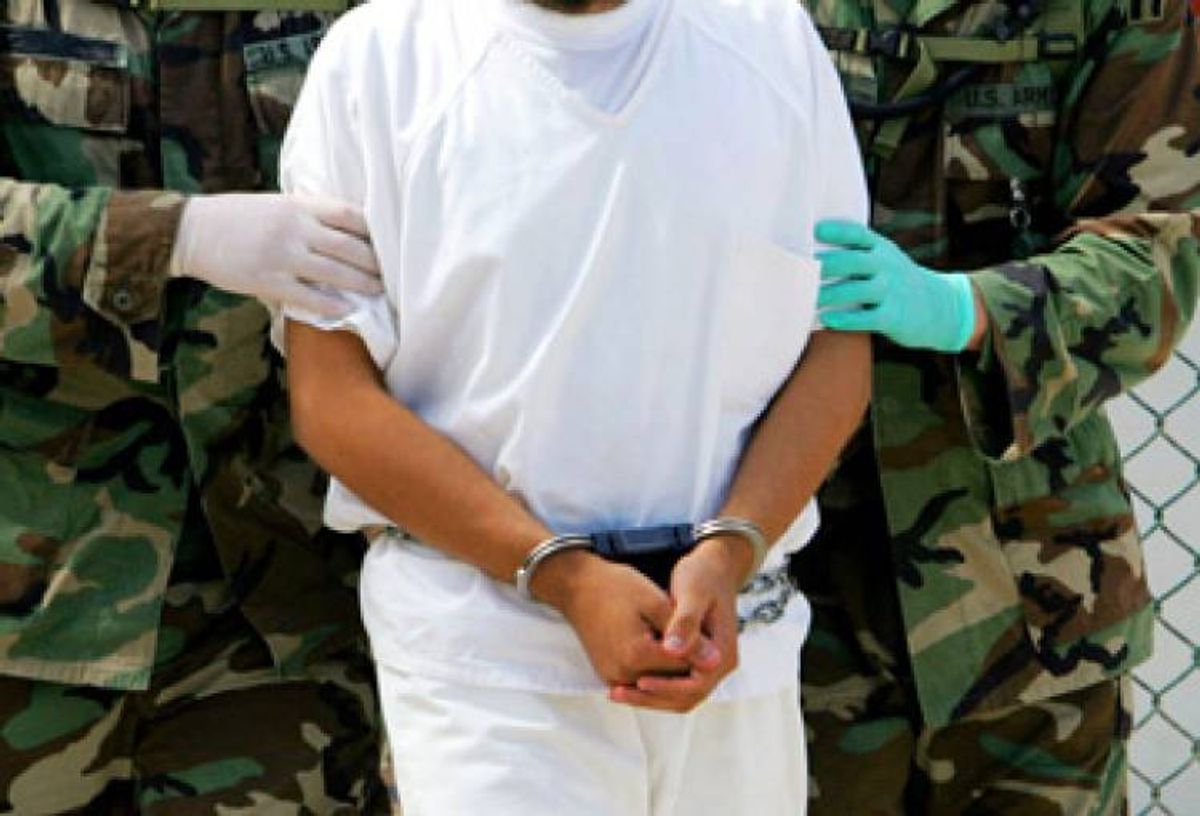
There is growing evidence of high-level coordination between the Central Intelligence Agency and the U.S. military in developing abusive interrogation techniques used on terrorist suspects. After the Sept. 11 attacks, both turned to a small cadre of psychologists linked to the military's secretive Survival, Evasion, Resistance and Escape program to "reverse-engineer" techniques originally designed to train U.S. soldiers to resist torture if captured, by exposing them to brutal treatment. The military's use of SERE training for interrogations in the war on terror was revealed in detail in a recently declassified report. But the CIA's use of such tactics -- working in close coordination with the military -- until now has remained largely unknown.
According to congressional sources and mental healthcare professionals knowledgeable about the secret program who spoke with Salon, two CIA-employed psychologists, James Mitchell and Bruce Jessen, were at the center of the program, which likely violated the Geneva Conventions on the treatment of prisoners. The two are currently under investigation: Salon has learned that Daniel Dell'Orto, the principal deputy general counsel at the Department of Defense, sent a "document preservation" order on May 15 to the chairman of the Joint Chiefs of Staff and other top Pentagon officials forbidding the destruction of any document mentioning Mitchell and Jessen or their psychological consulting firm, Mitchell, Jessen and Associates, based in Spokane, Wash. Dell'Orto's order was in response to a May 1 request from Sen. Carl Levin, the Democratic chairman of the Senate Armed Services Committee, who is investigating the abuse of prisoners in U.S. custody.
Mitchell and Jessen have worked as contractors for the CIA since 9/11. Both were previously affiliated with the military's SERE program, which at its main school at Fort Bragg puts elite special operations forces through brutal mock interrogations, from sensory deprivation to simulated drowning.
A previously classified report by the Defense Department's inspector general, made public last month, revealed in vivid detail how the military -- in flat contradiction to previous denials -- used SERE as a basis for interrogating suspected al-Qaida prisoners at Guantánamo Bay, and later in Iraq and Afghanistan. Moreover, the involvement of the CIA, which was secretly granted broad authority by President Bush days after 9/11 to target terrorists worldwide, suggests that both the military and the spy agency were following a policy approved by senior Bush administration officials.
Close coordination between the CIA and the Pentagon is referred to in military lingo as "jointness." A retired high-level military official, familiar with the detainee abuse scandals, confirmed that such "jointness" requires orchestration at the top levels of government. "This says that somebody is acting as a bridge between the CIA and the Defense Department," he said, "because you've got the [CIA] side and the military side, and they are collaborating." Human-rights expert Scott Horton, who chairs the International Law Committee at the New York City Bar Association, also says that the cross-agency coordination "reflects the fact that the decision to introduce and develop these methods was made at a very high level."
On Wednesday, dozens of psychologists made public a joint letter to American Psychological Association president Sharon Brehm fingering another CIA-employed psychologist, R. Scott Shumate. Previous news reports led the American Medical Association and the American Psychiatric Association to ban their members from participating in interrogations, but the issue has remained divisive within the American Psychological Association, which has not forbidden the practice. "We write you as psychologists concerned about the participation of our profession in abusive interrogations of national security detainees at Guantanamo, in Iraq and Afghanistan, and at the so-called CIA 'black sites,'" the psychologists wrote. In violation of APA ethics, they said, "It is now indisputable that psychologists and psychology were directly and officially responsible for the development and migration of abusive interrogation techniques, techniques which the International Committee of the Red Cross has labeled 'tantamount to torture.'" [Ed. note: The full letter detailing the allegations of APA complicity can be read here.]
The letter cites a previously public biographical statement on Shumate that listed his position from April 2001 to May 2003 as "the chief operational psychologist for the CIA's Counter Terrorism Center." The bio also noted that Shumate "has been with several of the key apprehended terrorists" who have been held and interrogated by the agency since 9/11. At CTC, Shumate reported to Cofer Black, the former head of CTC who famously told Congress in September 2002, "There was a before 9/11, and there was an after 9/11. After 9/11 the gloves come off." Shumate's bio, obtained by Salon, has been removed from the InfowarCon 2007 conference Web site. Shumate did not return a phone call seeking comment.
The SERE-based program undermines assertions made for years by Bush administration officials that interrogations conducted by U.S. personnel are safe, effective and legal. SERE training, according to the Department of Defense inspector general's report, is specifically designed "to replicate harsh conditions that the service member might encounter if they are held by forces that do not abide by the Geneva Conventions."
"The irony -- and ultimately the tragedy -- in the migration of SERE techniques is that the program was specifically designed to protect our soldiers from countries that violated the Geneva Conventions," says Brad Olson, president of the Divisions for Social Justice within the American Psychological Association. "The result of the reverse-engineering, however, was that by making foreign detainees the target, it made us the country that violated the Geneva Conventions," he says.
There are striking similarities between descriptions of SERE training and the interrogation techniques employed by the military and CIA since 9/11. Soldiers undergoing SERE training are subject to forced nudity, stress positions, lengthy isolation, sleep deprivation, sexual humiliation, exhaustion from exercise, and the use of water to create a sensation of suffocation. "If you have ever had a bag on your head and somebody pours water on it," one graduate of that training program told Salon last year "it is real hard to breathe."
Many of those techniques show up in interrogation logs, human rights reports and news articles about detainee abuse that has taken place in Guantánamo, Afghanistan and Iraq. (The military late last year unveiled a new interrogation manual designed to put a stop to prisoner abuse.) An investigation released this month by the Council of Europe, a multinational human rights agency, added extreme sensory deprivation to the list of techniques that have been used by the CIA. The report said that extended isolation contributed to "enduring psychiatric and mental problems" of prisoners.
Isolation in cramped cells is also a key tenet of SERE training, according to soldiers who have completed the training and described it in detail to Salon. The effects of isolation are a specialty of Jessen's, who taught a class on "coping with isolation in a hostage environment" at a Maui seminar in late 2003, according to a Washington Times article published then. (Defense Department documents from the late 1990s describe Jessen as the "lead psychologist" for the SERE program.) Mitchell also spoke at that conference, according to the article. It described both men as "contracted to Uncle Sam to fight terrorism."
Mitchell's name surfaced again many months later. His role in interrogations was referenced briefly in a July 2005 New Yorker article by Jane Mayer, which focused largely on the military's use of SERE-based tactics at Guantánamo. The article described Mitchell's participation in a CIA interrogation of a high-value prisoner in March 2002 at an undisclosed location elsewhere -- presumably a secret CIA prison known as a "black site" -- where Mitchell urged harsh techniques that would break down the prisoner's psychological defenses, creating a feeling of "helplessness." But the article did not confirm Mitchell was a CIA employee, and it explored no further the connection between Mitchell's background with SERE and interrogations being conducted by the CIA.
A call to Mitchell and Jessen's firm for comment was not returned. The CIA would not comment on Mitchell and Jessen's work for the agency, though the contractual relationship is not one Mitchell and Jessen entirely concealed. They advertised their CIA credentials as exhibitors at a 2004 conference of the American Psychological Association in Honolulu.
In a statement to Salon, CIA spokesman George Little wrote that the agency's interrogation program had been "implemented lawfully, with great care and close review, producing a rich volume of intelligence that has helped the United States and other countries disrupt terrorist activities and save innocent lives."
Until last month, the Army had denied any use of SERE training for prisoner interrogations. "We do not teach interrogation techniques," Carol Darby, chief spokeswoman for the U.S. Army Special Operations Command at Fort Bragg, said last June when Salon asked about a document that appeared to indicate that instructors from the SERE school taught their methods to interrogators at Guantánamo.
But the declassified DoD inspector general's report described initiatives by high-level military officials to incorporate SERE concepts into interrogations. And it said that psychologists affiliated with SERE training -- people like Mitchell and Jessen -- played a critical role. According to the inspector general, the Army Special Operations Command's Psychological Directorate at Fort Bragg first drafted a plan to have the military reverse-engineer SERE training in the summer of 2002. At the same time, the commander of Guantánamo determined that SERE tactics might be used on detainees at the military prison. Then in September 2002, the Army Special Operations Command and other SERE officials hosted a "SERE psychologist conference" at Fort Bragg to brief staff from the military's prison at Guantánamo on the use of SERE tactics.
The chief of the Army Special Operations Command's Psychological Directorate was Col. Morgan Banks, the senior SERE psychologist, who has been affiliated with the training for years and helped establish the Army's first permanent training program that simulated captivity, according to a 2003 biographical statement. Banks also spent the winter of 2001 and 2002 at Bagram Airfield in Afghanistan "supporting combat operations against Al Qaida and Taliban fighters," according to one of his bios, which also said that Banks "provides technical support and consultation to all Army psychologists providing interrogation support."
In 2005, Banks helped draft ethical guidelines for the APA that say a psychologist supporting an interrogation is providing "a valuable and ethical role to assist in protecting our nation, other nations, and innocent civilians from harm." But as Salon reported last summer, six of the 10 psychologists who drafted that policy, including Banks, had close ties to the military. Some psychologists worry that the APA policy has made the organization an enabler of torture. Those ethics guidelines "gave the APA imprimatur to any of these techniques," says Steven Reisner, an APA member who has been closely tracking psychologists' role in interrogations. The policy, Reisner says, was developed by "psychologists directly involved in the interrogations."
Another of the six psychologists on the panel that drafted the guidelines who had ties to the military was Shumate. His bio for that APA task force said he worked as a "director of behavioral science" for the Defense Department. It never mentioned that he also worked for the CIA.
Shares