

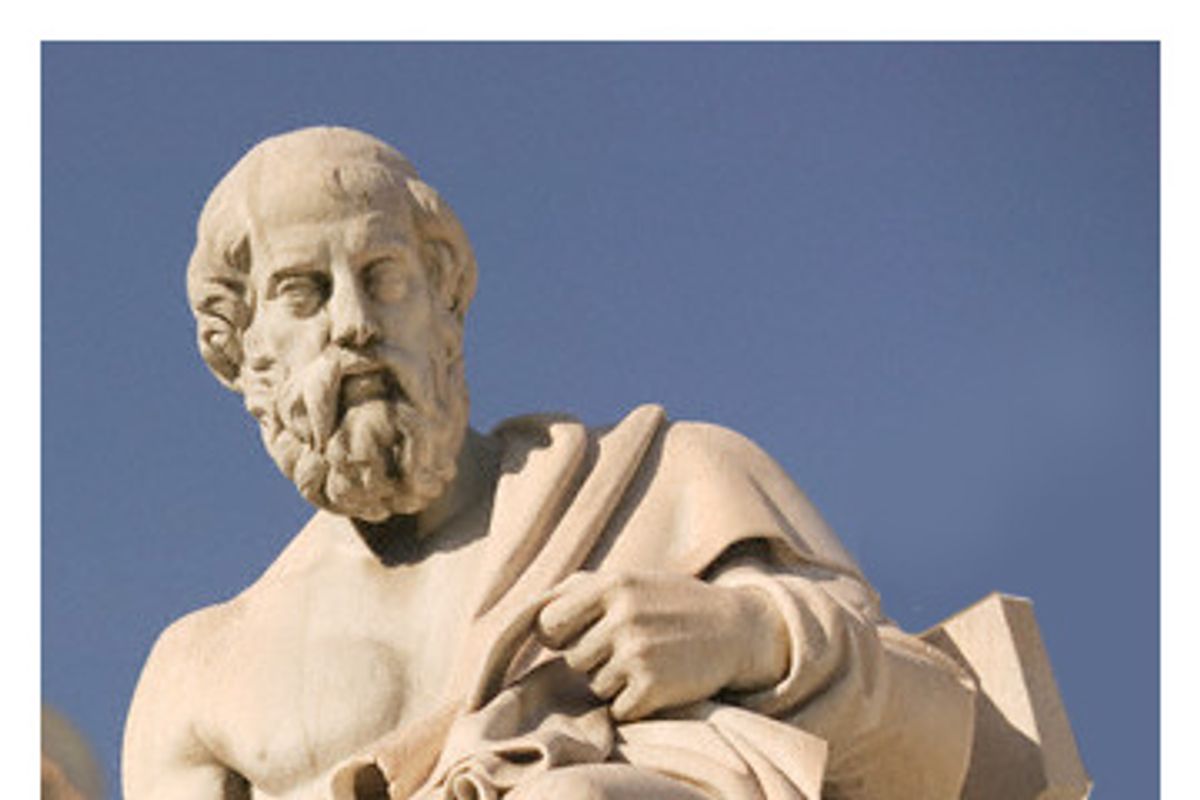
Sometimes, even the newest ideas have ancient roots. Take, for example, neoconservatism, the radical philosophy that supposedly guided the Bush administration's ill-fated foreign policy decisions. Who would have thought the classical Greek philosopher Plato had anything to do with the invasion of Iraq?
Twenty-four hundred years ago, Plato wrote a book called "The Republic," in which the famed teacher Socrates and his pupils discuss the ingredients of an ideal government. They decide that there is a higher realm than mere physical reality, that it is the duty of a small cadre of enlightened, elite citizens called "guardians" to become philosopher kings, and that only these rulers can grasp what is truly real and Good. Over the years, "The Republic" has been invoked to justify everything from authoritarian elitism to liberalism, but during the 20th century, neoconservative godfather Leo Strauss reinterpreted it to his own political philosophy, with its controversial assertion that it's OK for the enlightened elite to tell "noble lies" in the service of the Good. Former Deputy Secretary of Defense Paul Wolfowitz actually took courses on Plato from Strauss at the University of Chicago; other neoconservative hawks with Straussian genes include Richard Perle, Zalmay Khalilzad, the former U.S. ambassador to Afghanistan and Iraq and current ambassador to the U.N.; and Bill Kristol, neocon pundit and co-founder of the Weekly Standard.
In his new book,"Plato's Republic," Simon Blackburn re-explores the seminal work. The professor of philosophy at the University of Cambridge in England (yes, the professor of philosophy -- in England, Blackburn explains, professor really means head of the department), Blackburn was from 1990 until 2001 the Edna J. Koury distinguished professor of philosophy at the University of North Carolina. He's also written for the New Republic and the New York Times Book Review; this is his ninth book. Salon spoke with Blackburn to get his perspective on why Plato is a hit with modern American conservatives, and what the ancient Greek philosopher might think of George W. Bush's flight suit.
What's the relevance of Plato and "The Republic," especially for someone who is philosophically illiterate -- like me?
It's the first great text on political theory and moral theory, relating them, in the Western tradition. What Plato does is confront a variety of skeptics, people like Thrasymachus who say that morality is bunkum, that it's all power, it's a dog-eat-dog world, the weak go to the wall, the strong survive. Glaucon is another skeptic who says that, "Look, people are only moral because it costs them too much to be otherwise and if we could get away with it we'd all behave badly."
Socrates seeks to show that these views are wrong, and he does this by drawing an elaborate analogy between the state of your soul and the state of the body politic, the city -- the "polis," as [the Greeks] called it. [He] says that a disordered soul is as bad for you as a disordered polis, a disordered city, and the kind of disorder represented by Thrasymachus or Glaucon would eventually lead to catastrophe. So there's [a] utilitarian argument for virtue. And that's the sort of overall thrust of the book. So it's a connection between the health of the city and the health of the individual, but the health here includes, as it were, behaving well, good behavior.
What about in terms of his influence on contemporary politics?
I think Plato [has been] picked up and distorted in a couple of different ways. There were people who took what are undoubtedly fairly absolutist or totalitarian aspects of the state that he describes in "The Republic" and said, "Look, he's nothing more than an apologist for the totalitarian state." This is a famous attack, most vigorously and very ably prosecuted by Karl Popper in his famous book just after the Second World War, "The Open Society and Its Enemies." Plato was No. 1 of all [Popper's] enemies of the open society.
Another reading of him, which is I think even worse, is due to the American political theorist Leo Strauss, who saw him as in some sense endorsing the idea that it's a dog-eat-dog world. This was kind of a covert message, Strauss thought, of [Plato's] text. Strauss thought that this covert message or esoteric message was supposed to be perceived only by a number of people of special illumination, amongst which he included himself, of course. And that was the ideology that eventually became American neoconservatism, the view that the servants of the state are entitled to do anything -- to lie, to manipulate, to foment war, to destabilize neighboring states, to disguise their actions under a hypocritical cloak of goodness. So it's an extreme example of realpolitik, which I think is just a 180 degree misreading of what Plato is about. But it just shows that you can put down the clearest words on the page and it will be read saying the opposite.
I think that [Strauss's reading] is very perverse. You have to ignore what seems to me the very obvious thrust of ["The Republic"]. The book is largely given over to Socrates, and Socrates was largely arguing against the kind of things that Strauss represents. So you have to really pick up little bits and corners and say, "Ah, that's where Plato's speaking in his own voice or that's the message he wants us to take away." I always find that kind of reading very perverse. You know, it's not much better than finding the name of the beast in the order of the letters in the Talmud or something.
In general, why is Plato currently fashionable among conservatives? What's the appeal?
It hasn't always been an appeal to conservatives. In the 19th century, Plato had an appeal to liberals, largely. But there is undeniably an element of elitism in the book. That is, it's important for Plato's city that the people who know how to rule, rule. And conservatives, I suppose, always mistrust democracy, always mistrust the people. "The vulgar are not capable of ruling themselves" is a sort of fairly conservative doctrine. And it's obviously charming to include yourself amongst the elite. That's in common with Leo Strauss' view. But to a conservative of any kind, I think there's going to be a kind of role for guardians, as Plato calls them, that is a role for people who have undertaken to uphold the spirit of the polis, of the state, and who as it were see the great unwashed outside as a kind of threat. That can be, and I argue it is in Plato, much less politically divisive than that sounds, because in Plato it's simply a plea that the people who've got the science right, the understanding right, are the ones that are listened to in government. I don't think it's a plea for a hereditary elite or anything like that. But there's no doubt that Plato's an elitist -- he thinks that people come in different grades and it's better if the golden people rule.
You also bring up in the book the famous example of the person in the Bush administration who talked about...
Reality.
Yes, the "reality-based community." An aide to Bush told a New York Times reporter right before the election in 2004 that the reporters and others were still living in the "reality-based community," studying reality and thinking of solutions, and that "That's not really the way the world works anymore."
As if it was rather stick in the mud to belong to the reality-based community. I was just having fun there.
Plato can be a lot of things to a lot of different people. I mean, there's a visionary element in Plato. And Socrates at several points makes it plain that his ideal city is a fantasy, it's a construction. He doesn't even care whether it could be realized. And so I suppose visionaries, who perhaps don't have their feet on the ground, people who construct Utopias, have always found Plato's "Republic" a kind of inspiration. And you might argue that for all their sins, people like George Bush are trying to construct a Utopian world by their own lives, and if that's so, then they can in principle try to trace their pedigree back to Plato. Myself, again, I'd say that's a pretty bad distortion of his message, but I can see how the train of thought might go. As I say, it's a multifaceted book. It can be used in different ways by different people, some good, some bad. I don't think it's a book that, you know -- it's not a benign book. It's quite a dangerous book, I think.
How is it dangerous?
If you convince yourself that you're amongst the elite or that you alone are privy to the eternal truths about how to govern, then you can become a very dangerous person.
So you sort of sympathize with Popper's view about Plato being an enemy of the open society?
I try to strike a balance. I think that Plato did have certainly aristocratic and elitist leanings, and I can't deny them. On the other hand, I don't think the book is -- I mean, Popper made the book out to be a kind of blueprint for Hitler or Stalin, for the totalitarians, and I don't think that's correct. But I think that Plato is to a large extent trying to draw the moral back to what health in the individual amounts to, and that is the rule of reason.
I think it's a great mistake to see the mad tyrants of totalitarian regimes -- the Hitlers and the Stalins -- as any kind of descendant of Plato's guardians. Plato's guardians were by definition good and wise and knowledgeable, and the Hitlers and Stalins were anything but. So I think that Popper was exaggerating horribly.
You also say in the book that Plato might have looked down on Bush for a display like the flight suit on the aircraft carrier.
Very much so, yes.
Why is that?
The danger he elaborates especially in Book 4 of "The Republic" and other places is the danger represented by the man of "thumos," or spirit. Now this is a military virtue, the kind of strutting warrior-hero. Plato thinks that the artists of his time elevate that figure. They make a cult of that kind of heroism. But in effect, that's worshipping brutality. It's not worshipping the right kind of human virtue, which is lodged in the philosopher, in the man of wisdom, not the man of brutal ability to cow other people. And when you see George Bush strutting about on the aircraft carrier, you've got exactly somebody who's plugging in to the cult of the brute, the cult of the powerful figure, who gets his own way by sticking his elbows out and kicking other people. And you're not likely to see a democratic politician going and consorting with academics. You're much more likely to see them standing on podiums, watching the troops go by. And Plato's against that. He thinks it's a very, very dangerous aspect of human nature and one that he would suppress in his ideal city. And so I always argue that's not a silly idea. We may be so attached to liberty that we don't follow him in suppressing it, but I think we should certainly follow him in recognizing that it's a dangerous kind of diet to feed people.
What's your opinion of Plato?
As I say in the beginning, in the introduction to the book, I've never been a great fan of Plato. I always disliked some aspects of the Socratic figure ... [I]n some respects I found him an uncongenial author. I started in science. I'm a philosopher of science by origin. I'm an empiricist: I like to keep my feet on the ground. And Plato is a kind of inspiration, has been an inspiration, for many theologically minded philosophers -- people who don't keep their feet on the ground -- who take pride in voyaging into the supernatural.
Now, all of that led me to some antecedent worries about taking on the project. But, as I took it on, I did begin to find that there's a magic in the book, in "The Republic," to which I could respond. It's partly that it's so difficult to know exactly what his message is, partly that there's a very profound seriousness about it, which is very attractive, I think. So I began to fall under its spell if you like and look forward to trying to read more Plato before my time is up. I mean, for a professional philosopher who's been in the trade for so long I know rather too little about him and I think it's time I learned more.
So, if Plato is the ancient Greek philosopher du jour for conservative Republicans, who should liberal Democrats sign up as their favorite ancient Greek philosopher?
I'm afraid none of them were what we'd call good liberal Democrats. They all presupposed a slave society in which most of the labor was done by other people. Politics was the pursuit of the leisured male citizen. They all made a very sharp division between "us" and "others." And the [Greek] city-states were almost permanently at war with each other throughout the classical period. So they were in some respects not at all a good model for a universally enfranchised, educated democracy and we have to allow for that, we have to recognize that. I think that if you want to keep your feet on the ground, then Aristotle is the famous antidote to Plato.
The usual story is that Plato was a sort of dreamer and Aristotle was the hard-headed man of science, the empiricist, the person who looked at the world as it is. And to some extent I think that's true. I think from Aristotle's politics and particularly his rhetoric you can learn more about the day-to-day conduct of argument and politics than you probably do from Plato. But there's a cost to that. The benefit is that he's hard-headed and empirical but the cost is that he doesn't give you much of an ideal or a vision. It's not very plain to me what a state conducted by Aristotle would look like, and it's certainly not as entrancing as the kind of rather definite lines that Plato tries to draw. We may not know quite what the overall shape of Plato's state is eventually, but there's something rather magnificent about the energy with which he tries to draw it, whereas Aristotle is much more cautious and much less inspiring, I think.
Shares