

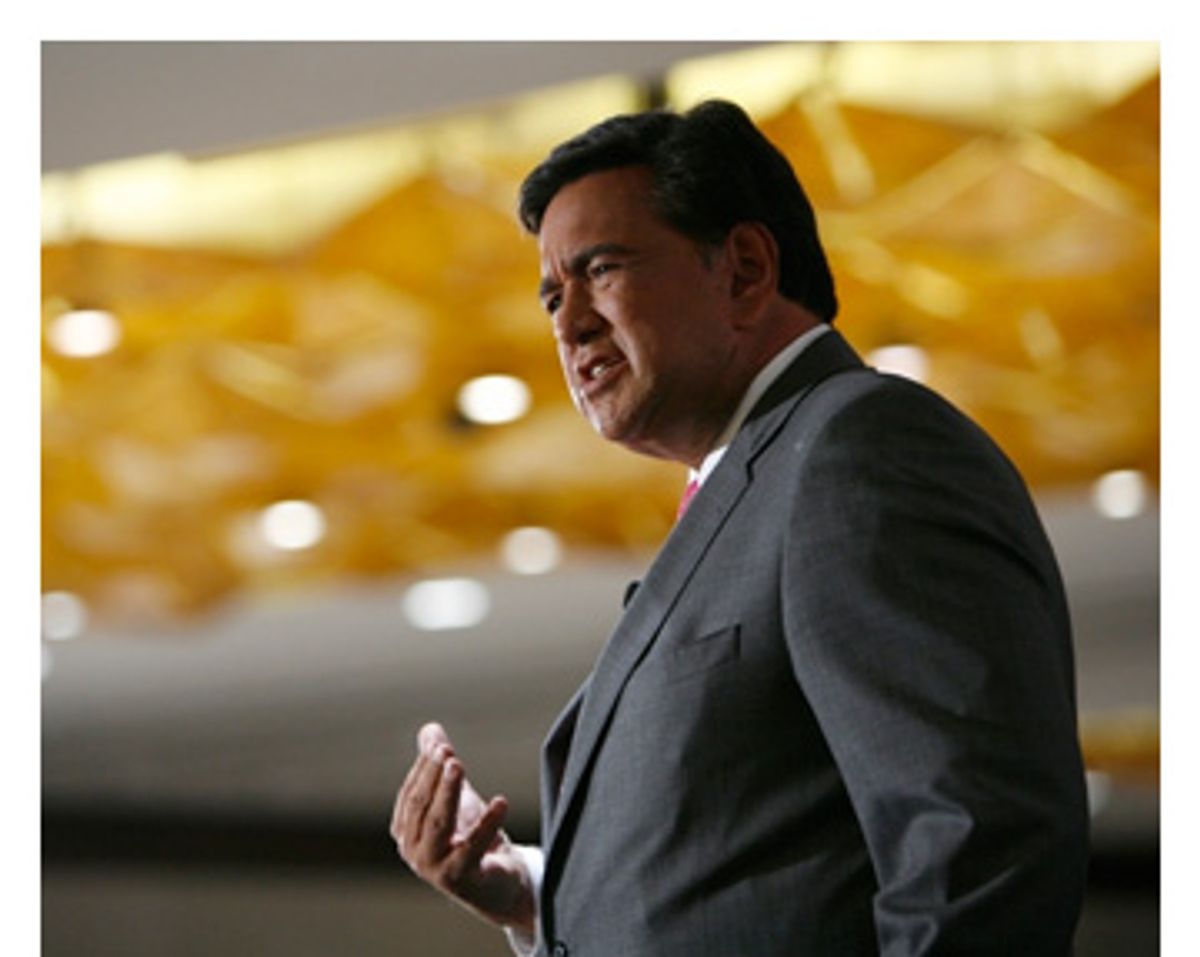
Bill Richardson sat down with Salon for an interview Tuesday afternoon after a campaign appearance here at the Old Ossipee Courthouse.
When you were just talking to Ossipee Democrats, you said that Al Gore was right on climate change, but that you hoped that he wouldn't get in the race? Do you think he's going to get into the race?
I don't believe so. Obviously, if he jumped in, he'd be a major factor. I wouldn't get out. But I always had a very strong relationship with him. My sense is that he's very comfortable and he's making a contribution already the way that he is spreading his message. I don't think he's going to get in, but if he gets in, it will even be a more spirited race. But it won't affect my plans.
Your "job interview" ads currently airing on New Hampshire television stress your background as a congressman, in the Cabinet as energy secretary, as U.N. ambassador and now as a two-term governor of New Mexico. Of all the jobs you talk about, which one fits the talents of Bill Richardson the best?
Governor of New Mexico. Because it's a job that made me decide to run for president for the first time. As a governor, I set the agenda for policy. I didn't do that as secretary of energy, U.N. ambassador and certainly not as a congressman. They're powerful and important positions. But being governor is the ultimate CEO governance job. And it made me realize that after a long career, I had become a good manager, a good governor, someone who has a passion for helping people.
And the ultimate CEO job is the presidency, to make a difference in this country. I like to tell people, "I like power. But to do the right things." And the presidency is the culmination of a career. And I didn't plan it this way. When I was about to get reelected as governor and I knew it would be a strong margin because we had done a good job, I said that I'm going to throw in my hand for the big one because I think I can do it. And I want to be tested -- and I believe this country needs my kind of leadership. I'm good at bringing people together -- countries, constituencies, Republicans, Democrats -- to get things done. And I'm getting into the race.
As a reporter, this is something I'm wrestling with. I saw Hillary and Bill Clinton before a crowd of maybe 1,300 people in Manchester last Friday. Because you're more accessible and unscripted, you say things that might not look good taken out of context. Earlier today at this event, you said in response to a question, "My mind is mush."
At the present time.
At the present time. But not on Inauguration Day January 2009.
I was tired out there.
I understand that. But should reporters like me cut you more of a break for what might be called "verbal missteps" than we would, say, Hillary Clinton who is only available in very controlled settings?
No, you shouldn't give me any breaks. That's who I am. I want you to report what I am. I'm open and accessible and I'm learning. I admit that I don't have my shtick down. I admit that my policies are evolving. I have fundamental principles that I don't change. But I said that I'm open on the subject of single-payer [national health insurance]. I want to be persuaded. Right now, I'm not.
But you should cover what you see, what you get. And I believe that there is a real thirst in the electorate for authenticity. For access. That's my point. I think I'm more effective having 10 meetings of 100 people than other candidates who have 1,000 in one hour. You connect more with those voters. And I think those voters appreciate the access. New Hampshire expects that. Which is why I'm undertaking this intensive grass-roots campaign.
Earlier today, you said in Wolfeboro that President Clinton "wasn't happy with me these days. I'm running against his wife." Is there something else between you and Bill Clinton other than that Hillary is a candidate and you're a candidate?
No. We get along very well. In fact, I talked to him quite a bit before the last governor's race [in 2006]. He's never told me that he's mad at me. But I heard that he is. Because I believe that he is supporting his wife. I'd expect him to do that. But I don't believe that they should have a sense of entitlement for the office. This is bigger than legacies.
And I owe the president a lot. Two great jobs [energy secretary and U.N. ambassador]. But I believe that this should be a spirited contest that defines where this country is going to go. And within the Democratic Party, there is a debate about where our soul is. And I want to be part of that debate.
Now to violate the rules of politics, I'm going to ask you a substantive question. You talk about wanting as president to leave no residual troops in Iraq and then you say, "But we will have to protect the embassy." How many Marines are you envisioning for that job?
First of all, a residual force is not the same as Marines.
Let me rephrase it. You said no residual forces in Iraq. But we will have Marines there to protect the embassy?
Yes, the existing Marine detachment. You have to keep that. Because that's where our personnel is.
But Joe Biden, the chairman of the Senate Foreign Relations Committee, has said that he has talked to people who say that it will take as many as 5,000 to 10,000 Marines to protect the embassy.
No, I think that's excessive. I would listen to a military argument. But where I object to the Biden and Clinton and other positions is that if you look at the Reid-Feingold [redeployment] legislation [currently before the Senate], it does not specify how many [troops would remain]. In fact, there is a [potential] number that is close to 50,000. And it says for the following purposes -- which I believe leaves a huge, gaping hole in the residual forces issue. It talks about to train Iraqis. To protect against terrorism. That's the same mission. You're either in or you're out.
But if it said 1,000 [troops] to protect the American embassy, that's fine with me. It's a Marine detachment. It's part of our diplomatic corps. I wouldn't even consider that a residual force. Of course I would permit that. But residual forces -- 5,000 to guard an embassy -- that means that the embassy is not safe. I would pull the embassy if it is not safe.
You talk about Darfur, our failure to intervene in Rwanda, the lessons of Bosnia. If we pull back our troops to Kuwait, as you advocate, and there was a level of near genocide between the Shiites and the Sunnis, could we just watch this unfold on Al-Jazeera television? Could we just sit in Kuwait and watch this happen?
You never preclude any option. Those troops in Kuwait would be for protection against international terrorist threats against this country. And if you have a real conflagration [in Iraq], you never limit the options. But the option mainly for shifting those troops to Kuwait and to Afghanistan is terrorism, al-Qaida.
My plan is that there be an all-Muslim peacekeeping force that would involve Iran and Syria, who wouldn't want a genocide because there would be thousands of refugees in their territory. But also a diplomatic plan that allows and permits a coalition government. And possible partition. A sharing of oil revenues. A political deal that sets up a framework for a future Iraq. Iraq is not exactly helpless.
All these people say it's going to go into civil war. They have 330,000 security forces and 150 billion reserves of oil. They've had three elections. They have some democratic institutions. It's not exactly like they're helpless. They should tend to their own security. We have done our job. Our troops have done a magnificent job.
Iraq is not just a question of a genocide or a civil war in Iraq. We're talking about American foreign policy shifting so many resources into Iraq that we're neglecting other priorities. Like terrorism, like North Korea, like Iran, like nuclear proliferation -- the need to secure fissionable materials -- like global climate change, like so many other issues. We're virtually out of NATO. We don't participate. We're not part of the international community because of this obsession.
You have been talking about some sort of protest of the 2008 Olympics in China because of Chinese resistance on Darfur. But you say that we will be going to the Olympics eventually. But in 1980, Jimmy Carter didn't send us to the Moscow Olympics over Afghanistan. He was ridiculed at the time domestically, but in hindsight the Soviet invasion of Afghanistan proved to be a pretty important event. So is there a situation where you would like us not to go to the Olympics?
What I said is that I would use the Olympics as a tool, as a threat. There is nothing wrong with that. To be part of an international group that threatens China because they don't use their leverage. They're the country that could probably stop the Darfurian genocide more than anyone else. So I would keep the option open.
I know it is not practical. But to suggest that it is totally separate, it isn't. Genocide is more important than sports. In the end. But I'm not running on that. I threw it out as an option. And a lot of people liked it and a lot of people didn't.
Had you thought about throwing it out as an option before you mentioned it in the New Hampshire debate in early June? Or was it something that occurred to you right onstage?
Right there, onstage. Though I had said before that citizen action was really important in the Darfurian issue. Mia Farrow and George Clooney had probably had a more positive effect than any of us put together.
I sort of see a contradiction in your domestic policy. You talk about your support for a balanced-budget amendment to the Constitution. This would have been approved during the era of the Gingrich Congress if Bill Clinton had not been opposed to it. If it went through in a Richardson administration with you supporting it, wouldn't that rule out the funds for any expansion of healthcare or education or other major domestic initiatives?
If you recall, the Clinton deficit-reduction plan, which passed by one vote [in 1993], caused the resurgence in the economy. We grew 20 million more jobs, a [budget] surplus. When we pass a constitutional amendment to balance the budget, first of all I would never pass it if a recession or a war was going on. But you stage it, [over] several years. You commit yourself to certain steps.
No, I believe it would immediately send a signal to grow the economy, make more budget funds available. And I still believe that you could reshift priorities and spend more on healthcare and education. I think you could do it.
I was able to do it. I cut taxes in New Mexico. I increased spending for healthcare and education and had a surplus because the economy grew. I am a believer in growing the economy and being a pro-growth Democrat. I'm not somebody for whom every solution is a tax increase or more spending.
But isn't there a difference between talking about a balanced budget, which Bill Clinton achieved, and putting into play a constitutional mechanism that the Republicans could use against any new spending programs?
No, I think you also have to take other steps that involve tough medicine like a line-item veto. Clinton tried to do it and he almost got it done. Pay-as-you-go policies. Corporate welfare. I'd have a national commission like the base-closure commission that would list all the $73 billion in fat in corporate welfare in one vote and not allow it to be picked up. It would be tough to get rid of earmarks, you know that. But we've got to significantly reduce them or make them open.
Were you against earmarks when you were in Congress?
No, I did some myself. Not that many. But when I was the secretary of energy, I got into trouble by saying that some of these Department of Energy earmarks [were wasteful]. [Robert] Novak wrote a column about it. [The Novak column about Richardson's fight with the Senate over pork-barrel spending appeared on Sept. 11, 2000.] Check Novak, though he doesn't like me anymore.
Just general ideological reasons?
I don't know. He just wrote some snotty column. Just like your guy. I'm talking to you because of your reputation, not because of that idiot that wrote that story about me. [Richardson was referring to this June article by Michael Scherer, Salon's Washington correspondent.]
What was wrong with the story?
The story was, like, almost racist. It said that this guy is like a Don Quixote. The story was almost totally biased, I felt. [The Salon article was titled "The Democratic Don Quixote." The headline, written by a Salon editor, was inspired by Richardson's visit to the Don Quijote Restaurant in Manchester, N.H., which is described in the story.]
I reread the story when I first heard of your complaints, in setting up this interview, and I don't see any problem. But with time short, I don't want to get bogged down in this. But I am sorry you feel that way.
I don't want to fight with you. You're a good journalist.
Let's switch to a serious policy question. Given your experiences negotiating with Saddam Hussein and North Korea, is there anybody in the world that the U.S. shouldn't be talking to?
We shouldn't be talking to Osama bin Laden. We shouldn't be talking to the most extreme leadership of al-Qaida. We shouldn't be talking to the most extreme leadership of Hamas. But short of that, I don't mind using mediation and other techniques to deal with the world's worst [leaders]. But I am talking about using traditional diplomacy to talk to Iran, to talk to Syria.
I think the proof in the pudding is to talk to North Korea as we did. I think I had a little bit to do with them recently announcing that they're going to let inspectors in a little bit. I give credit to the administration. But I'll take credit for getting the remains of our soldiers back. [During the 1990s, Richardson negotiated with North Korea several times and secured its agreement to search for the bodies of U.S. MIAs from the Korean War.]
But there are parameters. You can't negotiate with someone who wants to kill you.
You just said that you wouldn't negotiate with "the most extreme leadership of Hamas." Are there parts of Hamas that we might think about talking to?
There are parts of Hamas that might be able to work with [Palestinian leader Mahmoud] Abbas. I still would fundamentally have a precondition: They have to renounce the destruction of Israel. Yes, I have seen some things that suggest that there are a few openings there.
A last question. You mentioned here in Ossipee that you are in the Guinness Book of World Records for the most handshakes in a single day. [The Richardson record is 13,392 while campaigning for New Mexico governor in 2002.] What do you think that people want when they shake the hand of a presidential candidate like yourself?
They want to look you in the eye and make a judgment whether you're genuine. They want to touch you to see if you care about them. If you don't look them in the eye -- and if you appear to be just going through the motions -- they will detect that. It is a way of connecting personally. Which is why I believe that running for president is not just appearing on television and having TV ads and having bloggers talk about your policies. It's also talking to human beings and simply sending them two messages. That you care about them. And if you elect me, I'll make your life a little bit better. That's all.
Thank you.
Shares