

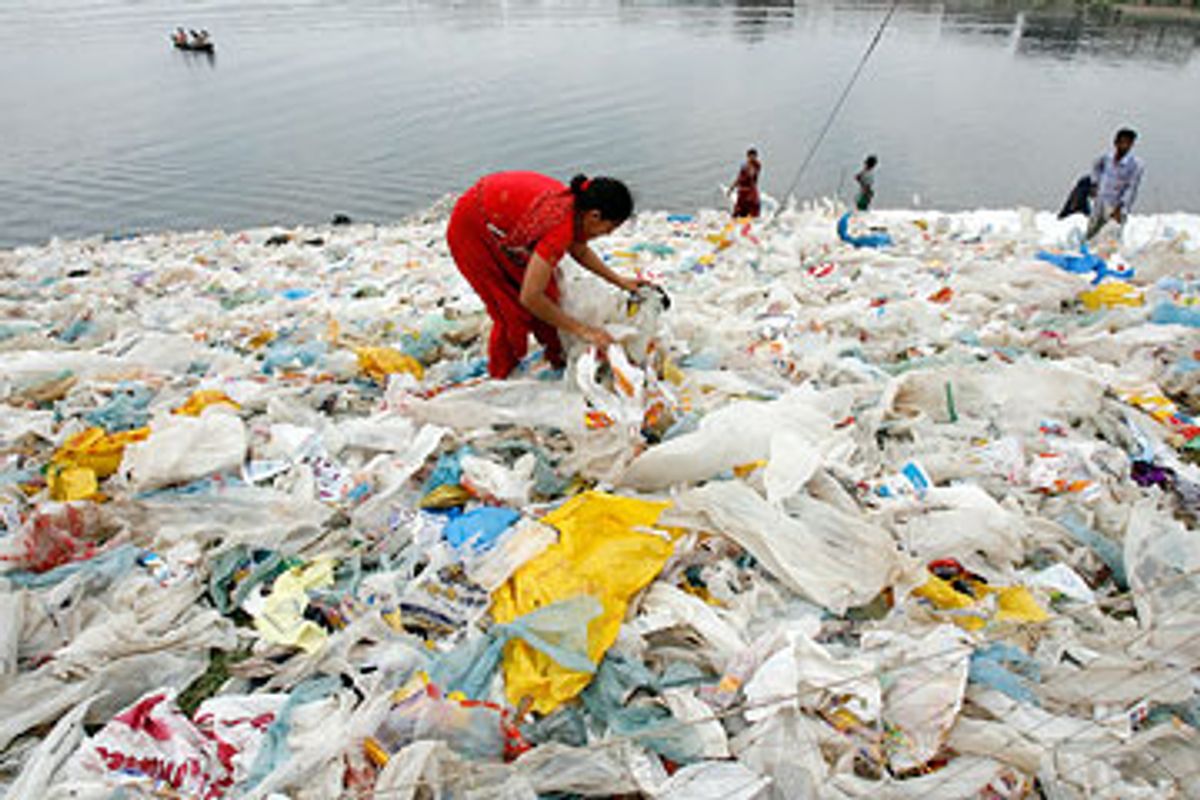
On a foggy Tuesday morning, kids out of school for summer break are learning to sail on the waters of Lake Merritt. A great egret hunts for fish, while dozens of cormorants perch, drying their wings. But we're not here to bird-watch or go boating. Twice a week volunteers with the Lake Merritt Institute gather on these shores of the nation's oldest national wildlife refuge to fish trash out of the water, and one of their prime targets is plastic bags. Armed with gloves and nets with long handles, like the kind you'd use to fish leaves out of a backyard swimming pool, we take to the shores to seek our watery prey.
Dr. Richard Bailey, executive director of the institute, is most concerned about the bags that get waterlogged and sink to the bottom. "We have a lot of animals that live on the bottom: shrimp, shellfish, sponges," he says. "It's like you're eating at your dinner table and somebody comes along and throws a plastic tarp over your dinner table and you."
This morning, a turtle feeds serenely next to a half submerged Walgreens bag. The bag looks ghostly, ethereal even, floating, as if in some kind of purgatory suspended between its briefly useful past and its none-too-promising future. A bright blue bags floats just out of reach, while a duck cruises by. Here's a Ziploc bag, there a Safeway bag. In a couple of hours, I fish more than two dozen plastic bags out of the lake with my net, along with cigarette butts, candy wrappers and a soccer ball. As we work, numerous passersby on the popular trail that circles the urban lake shout their thanks, which is an undeniable boost. Yet I can't help being struck that our efforts represent a tiny drop in the ocean. If there's one thing we know about these plastic bags, it's that there are billions and billions more where they came from.
The plastic bag is an icon of convenience culture, by some estimates the single most ubiquitous consumer item on Earth, numbering in the trillions. They're made from petroleum or natural gas with all the attendant environmental impacts of harvesting fossil fuels. One recent study found that the inks and colorants used on some bags contain lead, a toxin. Every year, Americans throw away some 100 billion plastic bags after they've been used to transport a prescription home from the drugstore or a quart of milk from the grocery store. It's equivalent to dumping nearly 12 million barrels of oil.
Only 1 percent of plastic bags are recycled worldwide -- about 2 percent in the U.S. -- and the rest, when discarded, can persist for centuries. They can spend eternity in landfills, but that's not always the case. "They're so aerodynamic that even when they're properly disposed of in a trash can they can still blow away and become litter," says Mark Murray, executive director of Californians Against Waste. It's as litter that plastic bags have the most baleful effect. And we're not talking about your everyday eyesore.
Once aloft, stray bags cartwheel down city streets, alight in trees, billow from fences like flags, clog storm drains, wash into rivers and bays and even end up in the ocean, washed out to sea. Bits of plastic bags have been found in the nests of albatrosses in the remote Midway Islands. Floating bags can look all too much like tasty jellyfish to hungry marine critters. According to the Blue Ocean Society for Marine Conservation, more than a million birds and 100,000 marine mammals and sea turtles die every year from eating or getting entangled in plastic. The conservation group estimates that 50 percent of all marine litter is some form of plastic. There are 46,000 pieces of plastic litter floating in every square mile of ocean, according to the United Nations Environment Programme. In the Northern Pacific Gyre, a great vortex of ocean currents, there's now a swirling mass of plastic trash about 1,000 miles off the coast of California, which spans an area that's twice the size of Texas, including fragments of plastic bags. There's six times as much plastic as biomass, including plankton and jellyfish, in the gyre. "It's an endless stream of incessant plastic particles everywhere you look," says Dr. Marcus Eriksen, director of education and research for the Algalita Marine Research Foundation, which studies plastics in the marine environment. "Fifty or 60 years ago, there was no plastic out there."
Following the lead of countries like Ireland, Bangladesh, South Africa, Thailand and Taiwan, some U.S. cities are striking back against what they see as an expensive, wasteful and unnecessary mess. This year, San Francisco and Oakland outlawed the use of plastic bags in large grocery stores and pharmacies, permitting only paper bags with at least 40 percent recycled content or otherwise compostable bags. The bans have not taken effect yet, but already the city of Oakland is being sued by an association of plastic bag manufacturers calling itself the Coalition to Support Plastic Bag Recycling. Meanwhile, other communities across the country, including Santa Monica, Calif., New Haven, Conn., Annapolis, Md., and Portland, Ore., are considering taking drastic legislative action against the bags. In Ireland, a now 22-cent tax on plastic bags has slashed their use by more than 90 percent since 2002. In flood-prone Bangladesh, where plastic bags choked drainage systems, the bags have been banned since 2002.
The problem with plastic bags isn't just where they end up, it's that they never seem to end. "All the plastic that has been made is still around in smaller and smaller pieces," says Stephanie Barger, executive director of the Earth Resource Foundation, which has undertaken a Campaign Against the Plastic Plague. Plastic doesn't biodegrade. That means unless they've been incinerated -- a noxious proposition -- every plastic bag you've ever used in your entire life, including all those bags that the newspaper arrives in on your doorstep, even on cloudless days when there isn't a sliver of a chance of rain, still exists in some form, even fragmented bits, and will exist long after you're dead.
Grand efforts are under way to recycle plastic bags, but so far those efforts have resulted mostly in a mass of confusion. A tour of Recycle Central in San Francisco makes it easy to see why. The plant is a Willie Wonka factory of refuse. Located on a bay pier with a stunning view of the downtown skyline, some 700 tons of discarded annual reports, Rolling Rock bottles, Diet Coke cans, Amazon.com cardboard boxes, Tide plastic detergent bottles and StarKist tuna fish cans surge into this warehouse every weekday, dumped from trucks into a great clattering, shifting mound. The building tinkles and thumps with the sound of thousands of pounds of glass, aluminum, paper, plastic and cardboard knocking together, as all this detritus passes through a dizzying network of conveyor belts, spinning disks, magnets and gloved human hands to emerge as 16 different sorted, recyclable commodities, baled up by the ton to be shipped or trucked away and made into something new again. It's one way that the city of San Francisco manages to divert some 69 percent of its waste from landfills. But this city's vaunted recycling program, which is so advanced that it can collect coffee grounds and banana peels from urbanites' apartment kitchens and transform them into compost used to grow grapes in Napa Valley vineyards, simply cannot master the plastic bag.
Ask John Jurinek, the plant manager at Recycle Central, what's wrong with plastic bags and he has a one-word answer: "Everything." Plastic bags, of which San Franciscans use some 180 million per year, cannot be recycled here. Yet the hopeful arrow symbol emblazoned on the bags no doubt inspires lots of residents to toss their used ones into the blue recycling bin, feeling good that they've done the right thing. But that symbol on all kinds of plastic items by no means guarantees they can be recycled curbside. (The plastic bags collected at the recycling plant are trucked to the regular dump.) By chucking their plastic bags in the recycling, what those well-meaning San Franciscans have done is throw a plastic wrench into the city's grand recycling factory. If you want to recycle a plastic bag it's better to bring it back to the store where you got it.
As the great mass of recyclables moves past the initial sort deck on a series of spinning disks, stray plastic bags clog the machinery. It's such a problem that one machine is shut down while a worker wearing kneepads and armed with a knife spends an hour climbing precariously on the disks to cut the bags out, yielding a Medusa's hair-mass of wrenched and twisted plastic. In the middle of the night, when the vast sorting operation grinds to a halt to prepare for the next 700-ton day, two workers will spend hours at this dirty job.
Some states are attacking the recycling problem by trying to encourage shoppers to take the bags back to grocery stores. California requires large grocery stores and pharmacies that distribute the bags known in the trade as T-shirt bags -- those common polyethylene bags with two handles, usually made from petroleum or natural gas -- to take them back for recycling, and to print instructions on the bags to encourage shoppers to return them to the stores. San Francisco Environment Department spokesperson Mark Westlund, who can see plastic bags lodged in the trees on Market Street from his second-story office window, is skeptical about the state's ability to get shoppers to take back their bags. "We've had in store recycling in San Francisco for over 10 years, and it's never really been successful," says Westlund, who estimates that the city achieved only a 1 percent recycling rate of plastic bags at the stores. "People have to pack up the bags, bring them into the store and drop them off. I think you'd be more inclined to bring your own bag than do that."
Regardless, polyethylene plastic bags are recyclable, says Howie Fendley, a senior environmental chemist for MBDC, an ecological design firm. "It's a matter of getting the feedstock to the point where a recycler can economically justify taking those bags and recycling them. The problem is they're mostly air. There has to be a system in place where they get a nice big chunk of polyethylene that can be mechanically ground, melted and then re-extruded."
So far that system nationwide consists mainly of supermarkets and superstores like Wal-Mart voluntarily stockpiling the bags brought back in by conscientious shoppers, and selling them to recyclers or plastic brokers, who in turn sell them to recyclers. In the U.S., one company buys half of the used plastic bags available on the open market in the United States, using about 1.5 billion plastic bags per year. That's Trex, based in Winchester, Va., which makes composite decking out of the bags and recycled wood. It takes some 2,250 plastic bags to make a single 16-foot-long, 2-inch-by-6-inch plank. It might feel good to buy decking made out of something that otherwise could have choked a sea turtle, but not so fast. That use is not an example of true recycling, points out Carol Misseldine, sustainability coordinator for the city of Oakland. "We're not recycling plastic bags into plastic bags," she says. "They're being downcycled, meaning that they're being put into another product that itself can never be recycled."
Unlike a glass beer bottle or an aluminum can, it's unusual that a plastic bag is made back into another plastic bag, because it's typically more expensive than just making a new plastic bag. After all, the major appeal of plastic bags to stores is that they're much cheaper than paper. Plastic bags cost grocery stores under 2 cents per bag, while paper goes for 4 to 6 cents and compostable bags 9 to 14 cents. However, says Eriksen from the Algalita Marine Research Foundation, "The long-term cost of having these plastic bags blowing across our landscape, across our beaches and accumulating in the northern Pacific far outweighs the short-term loss to a few."
Of course, shoppers could just bring their own canvas bags, and avoid the debate altogether. The California bag recycling law also requires stores to sell reusable bags. Yet it will be a sad irony if outlawing the bags, as San Francisco and Oakland have, doesn't inspire shoppers to bring their own canvas bags, but simply sends them to paper bags, which come with their own environmental baggage. In fact, plastic bags were once thought to be an ecologically friendly alternative to cutting down trees to make paper ones. It takes 14 million trees to produce the 10 billion paper grocery bags used every year by Americans, according to the Natural Resources Defense Council. Yet suggesting that plastic bags made out of petroleum are a better choice burns up Barger from the Earth Resources Foundation. "People say, 'I'm using plastic. I'm saving trees,'" he says. "But have you ever seen what Shell, Mobil and Chevron are doing down in the rain forests to get oil?"
Gordon Bennett, an executive in the San Francisco Bay chapter of the Sierra Club, agrees. "The fundamental thing about trees is that if you manage them properly they're a renewable resource," he says. "I haven't heard about the oil guys growing more oil lately." Still, as the plastic bag industry never tires of pointing out, paper bags are heavier than plastic bags, so they take more fossil fuels to transport. Some life cycle assessments have put plastic bags out ahead of paper, when it comes to energy and waste in the manufacturing process. But paper bags with recycled content, like those soon to be required in San Francisco and Oakland, use less energy and produce less waste than those made from virgin paper.
The only salient answer to paper or plastic is neither. Bring a reusable canvas bag, says Darby Hoover, a senior resource specialist for the Natural Resources Defense Council. However, if you have to make a choice between the two, she recommends taking whichever bag you're more likely to reuse the most times, since, like many products, the production of plastic or paper bags has the biggest environmental impact, not the disposal of them. "Reusing is a better option because it avoids the purchase of another product."
Some stores, like IKEA, have started trying to get customers to bring their own bags by charging them 5 cents per plastic bag. The Swedish furniture company donates the proceeds from the bag sales to a conservation group. Another solution just might be fashion. Bringing your own bag -- or BYOB as Whole Foods dubs it -- is the latest eco-chic statement. When designer Anya Hindmarch's "I am not a plastic bag" bag hit stores in Taiwan, there was so much demand for the limited-edition bag that the riot police had to be called in to control a stampede, which sent 30 people to the hospital.
Shares