

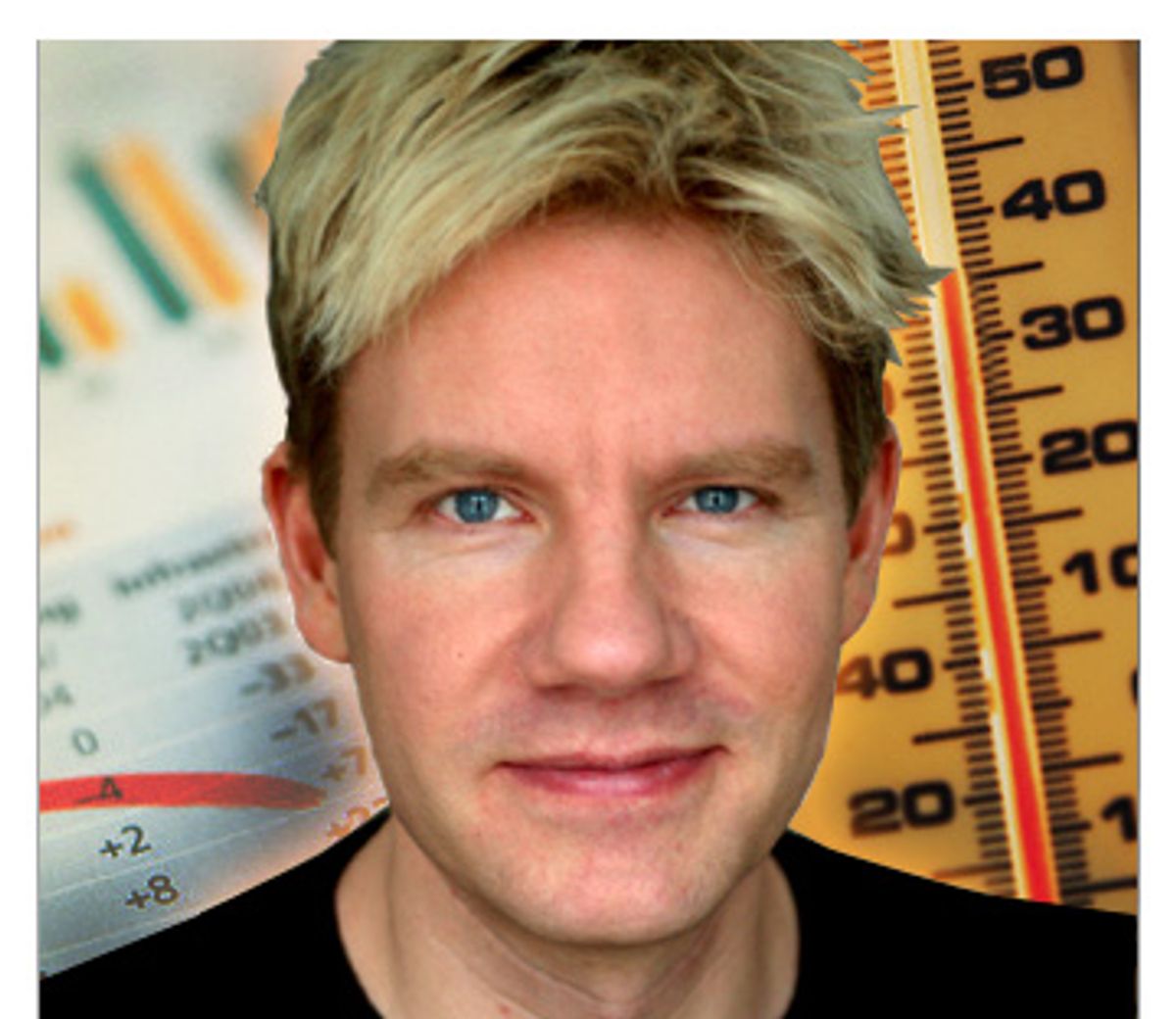
Bjørn Lomborg drives people crazy. The tale of the controversy that swarmed his 2001 book, "The Skeptical Environmentalist," in which the native Dane argued that many environmental problems were overblown, has been widely told. With a few clicks you can read all about his skirmish with the Danish Committees on Scientific Dishonesty and his protracted battle with Scientific American. In a flash you can find his defenders strafing his critics from their libertarian bunkers or congressional offices. When Sen. James Inhofe, R-Okla., wants to back up his claim that global warming is the "greatest hoax ever perpetrated on the American people," or invites somebody to Washington to debate Al Gore, he calls on Lomborg.
Lomborg, 42, rose to infamy by way of a Ph.D. in political science and a love affair with statistics. Today he is an adjunct professor at the Copenhagen Business School and the director of the Copenhagen Consensus Center, where he strives to devise economic solutions to the world's pressing problems. Next week he will storm back into the cultural fray with "Cool It: The Skeptical Environmentalist's Guide to Global Warming," a highly readable asseveration that global warming is not so bad and that Al Gore is an inconvenient truth-stretcher.
Lomborg is such an iconoclastic figure that you are inclined to scrutinize his every remark. (Eban Goodstein, a professor of economics at Lewis and Clark College, reviews "Cool It" in an accompanying article.) But I used the question-and-answer format to give Lomborg his say because, like it or not, he is an internationally popular voice. A prestigious publisher, Alfred A. Knopf, has seen fit to publish and promote "Cool It," and the book has already racked up impressive orders on Amazon, rising to the top 10 on the site's Environmental Science list. I researched critical passages in "Cool It" and presented Lomborg with studies that challenged them. I looked at some of the reports that Lomborg used to make his key points -- "Polar bears aren't facing extinction" is one -- and read him passages from those same reports that he ignored.
Lomborg himself is a fascinating guy, a gay vegetarian lionized by rigid conservatives. In person, the tan and blond author appears to have just strolled out of a Jamba Juice in Malibu. He has a naturally friendly manner and speaks most of the time without sounding didactic. While he can be open and curious, I wouldn't rush to nominate him for a humility award. He has such a singular economic bead on the world that he can sound arrogant as he deflects any other point of view about global warming. But I enjoyed talking with him. We spoke in a conference room at Knopf, where out a panoramic window we could watch the beleaguered Hudson River flow to the ocean on a clear and hot New York day.
Why did you write "Cool It"?
Because we're stuck in this unproductive question, Is global warming a hoax or a catastrophe? Left-wingers say it's a catastrophe and we need to change our entire means of production and society. Right-wingers say we shouldn't bother with it all. If they were right, those conclusions might follow, but that's not what the science tell us. The science tells us that global warming is problem but not a catastrophe. On the other hand, it's not a hoax. I'm trying to make a middle ground for arguing that this is not a problem that will be solved within the next five or 10 years. This is a problem that will take a half or full century, and we need to be sure we have good ways of dealing with it.
You write, "Doing too little about climate change is definitely wrong. But so is doing too much." Why?
Doing too little is obvious, but let's say it anyway: If you don't do something about global warming, of course it will become a bigger problem. So obviously we need to address it and in the long term fix it. On the other hand, doing too much about it means we are focusing too much effort on climate change and forgetting all the other things that we have a responsibility to deal with, like HIV/AIDS, tuberculosis, malaria and malnutrition. If we spend too much time and resources focusing on climate change, then we do the future a disservice because we say, "Hey, we fixed climate change but we let all the other things slide."
How can you separate climate change, which would lead to the despoilation of all the earth's living systems, from those problems? They are interrelated. What good does it to do to treat them as separate?
It's clear that they are all interrelated. But one of the things that seems curious in the climate change discussion is the insistence that climate change is linked to all these other issues. But they are equally linked back. When we talk about how global warming is going to make people more vulnerable to malaria, that's absolutely true. At the same time, rampant malaria is going to make everyone much more vulnerable to climate change. In a perfect world, we should fix all problems. But in a world where we haven't fixed all the problems in the last 50 years, it makes sense to ask, If you fix a large chunk of malaria, how much good do you do?
Yes, people will have to deal with more climate change, but maybe overall they'll be better off. It's like when your family has to decide where to live. It would be nice to have a great house and be close to a good school. But there's also a budget restriction. So you make trade-offs and say some things are more important to focus on first.
Why do you assume there is a zero sum of money for the world's problems and that it has to partitioned for one thing and not the other?
So you're saying, What if we had $1 billion for malaria and $1 billion for climate? Why not do both?
Isn't that how the world works? There are a lot of organizations devoted to these problems. The Bill and Melinda Gates Foundation gives billions to help fight malaria and AIDS. One organization or government doesn't steal from the other, right?
Recently the Global Fund to Fight AIDS, Tuberculosis and Malaria came out and said we have to recognize that over the coming years, because of the incredible attention to climate change, we're probably going to get much less money. [The Global Fund "is not naive about what (the increased importance of) global warming will do to AIDS funding in a few years' time," said Jon Liden, head of communications, as reported in the Financial Times.]
My point is much simpler. Let's assume we had $1 billion for each of these areas. If the $1 billion in malaria does a lot more good than the $1 billion in climate, and assuming that the next $1 billion will do the same thing, I would still argue, Shouldn't we then have a conversation about perhaps spending both billions on malaria and none on climate change? I'm not saying that's what we should do. But I'm saying we need to have that conversation. If we could spend that money better somewhere else, shouldn't we?
But, again, that's just a hypothetical question.
I prefer to call it an academic question. But you are absolutely right that we have a lot of organizations that will meet and say: We are about climate change. We are about acid rain. We are about HIV. The problem today is the organizations with the most riveting picture and the best stories end up winning the day. It's important to say this is not because environmentalists are bad guys. The tendency to exaggerate is one we have in our society. We base our views on images we typically see, but those images are not representative of what's actually happening.
A great example is the razing of rain forests. It's absolutely true: We do lose rain forests. But it's not surprising that you only see the razed areas -- that's the only place where cameras can go. So at the Copenhagen Consensus, we see ourselves as defenders of boring problems, the ones that don't get as much attention because they seem old hat. People dying from hunger? Yeah, we've heard that before. But maybe it's still an incredibly good place to spend money.
Tell us a little more about the Copenhagen Consensus.
We assembled a panel of eminent experts, including four Nobel laureates, to look at all these different problem areas and say, "Yeah, I know you think your solution is good, but we have to compare it to everyone else's." They asked, How much good can we do for every dollar spent? And ranked all the opportunities. It turned out that the best investment we can do is prevention of HIV/AIDS. For every dollar you spend on prevention of HIV/AIDS, you'll end up doing $40 worth of good. The same is true with malnutrition. For every dollar you spend on micronutrients, basically a vitamin pill, you would do about $30 worth of good. And that would affect more than half the world's population. With malaria, for every dollar you spend on mosquito nets and information and some medicine, you'd do about $10 worth of good.
Climate change ended up at the bottom of your list. So are you saying that climate change is not as significant as malaria, AIDS and malnutrition, and therefore we shouldn't spend public resources on it now?
I'm sure some people would see it that way. But what we're saying is for every $1 you spend as part of the Kyoto Protocol to reduce carbon emissions, you will do only about 30 cents' worth of good for the world. What that tells us is that the solutions that are proposed right now to climate change are fairly poor.
Malaria and AIDS are problems happening right now. How can you compare them to climate change, which will be at its most severe in the future?
In principle, we tried to value all of the impacts that these problems will have in the coming years and into the future. But we don't typically have models for malaria and HIV/AIDS like we do for global warming. So, yes, we don't know what exactly will happen to them in 2100. At the same time, we know HIV/AIDS kills a lot of people now and maims society because it takes away the primary caregivers. If we did something about it, it wouldn't just mean that people would stop dying now. It would also mean they would get much richer and be more resilient toward the end of the century to climate change. So it's not just about the people now. It would have huge effects for generations to come.
Couldn't we say that climate change is a far worse problem than malaria or AIDS or malnutrition? The resultant rise in sea level and heat, as well as the loss of biodiversity, could harm the entire planet and all species, right? Shouldn't we start solving the worst problem now?
And the worst problem being that everyone dies on the planet? Do we then search for immortality? I'm not just being facetious. You wouldn't do that, because a search wouldn't be very valuable, right? We would not find anything, but we would spend all of our resources looking for the philosopher's stone. It just doesn't make sense to talk about what's the problem without thinking about what's the solution. As for your idea that this could spoil the entire earth and so it's a much bigger problem than malaria, well, again, climate change is a problem, but it's not a catastrophe. It's not the end of the world by any means.
At the end of the day, Kyoto is both impossibly ambitious and environmentally inconsequential. It's not smart. It's just not in the nature of the political process to say we're going to do something now to solve a problem later on. So instead of saying, "Let's do something that feels good right now," let's try and think of what we could do that will do good now.
Which is what?
My primary solution is to focus on research and development. Invest .05 percent of GDP, or $25 billion, in the R&D of energy technologies that don't emit carbon. The problem now is we focus on cutting emissions. Basically we're going to spend almost all of the money to meet Kyoto on buying windmills or solar cells or, more likely, natural gas instead of coal, or more expensive ways of doing production. It seems reasonable for me to ask, Does that do very much good?
I agree that when you make it more expensive to use fossil fuels, people will spend more money on research and development. But let's not buy things right now that make us feel good but result in fairly trivial carbon cuts. As you probably know, we have lots of windmills in Denmark. We felt incredibly good about this in the '80s and '90s. So we spent a lot on windmills that turned out to inefficient. Now we basically have to take down all our old windmills and put up the new efficient ones. My point is that maybe we shouldn't have put up the first ones. We should have invested in research and development and waited to put up bigger, better windmills.
But wasn't that a necessary process? Creating the first windmills is what led to the development of better ones.
Yes, but if you want to get a better windmill, maybe you put up one or 10 or even 100. Economists disagree on this. But you don't need 1,000 or 10,000. My point is: Don't do stuff before it's efficient, but make sure you get faster to the point where it gets efficient.
But if we refocus our political energy away from climate change to the other problems you mention, aren't we then putting a barrier in front of the kind of research and development that you want? Isn't that dangerous?
But if you grant that argument, I would also say if we focus attention away from HIV/AIDS and malaria and malnutrition, that would also seem dangerous. That's why we need to have a sense of balance. I'm saying you should spend $25 billion on climate change but not $180 billion -- which is how much it would cost each year if the U.S. and everybody else lived up to the Kyoto protocol of reducing carbon emissions below 1990 levels. The $180 billion is the average outcome of all macroeconomic models gathered by the Stanford economic energy modeling forum.
All macroeconomic models?
Obviously not all. But it's all the main academic models from the very optimistic, which say it's only going to cost $50 billion, to the very pessimistic ones, which the Bush government likes to use, that show it's going to cost $400 billion. It's basically saying, "Don't take the most optimistic, and don't take the most pessimistic either. But take the average of that." This is not a true number. But it's in that range.
Should global priorities really be set by a cost-benefit analysis?
Oh, God, no. Not at all. We are saying the Copenhagen Consensus is the price list. Essentially we're providing the prices on the social menu of what you can choose to do. No, no, no. Economists don't set the agenda of the world. Hopefully democracies do. You and I. So it's nice to know how much will this cost, how much good will this do. If you go into a restaurant and say, "The only thing I'm going to buy is beluga caviar," that's fine, that's your choice, but at least now you know what the prices are.
I don't know, Bjørn. Cost-benefit analysis seems to be how we got into this trouble in the first place. The oil and automobile companies, for instance, determined that we can pump out this much pollution because it will amount to this much profit, and that's a viable trade-off.
Obviously it's a very different thing when private companies make that choice. Private companies don't care if somebody else has to pay the pollution, and that makes sense.
Shouldn't private companies have a social responsibility?
Well, maybe. If you were a CEO and you had your responsibility to the stockholders, I think it's unreasonable to expect that they would have a huge amount of extra social responsibility. That's what societies have to regulate. That's why we have to make taxes, make environmental regulations, set boundaries, say, "No, you can't do that" or, "Yes, you can do that." Clearly you have to regulate that.
So I would say it's not that way of thinking that's gotten us into trouble. Think back 150 years, when we really started churning out a lot of CO2, and started using coal and then later oil in a massive fashion. If you had been back there then and known about all these problems, how much would you have changed? My sense is you would have said, "I want my kids and grandkids to be well off. I want them to be without diseases. I want them to have a good education and good nutrition." So a lot of good things happened because of fossil fuels. We're now starting to realize that wasn't the case, and we will have to start dealing with it.
But we constantly make trade-offs and ask, To what extent are we willing to let something be a future generation's problem? If we are rational, then we do try to make rational cost-benefit analyses. I'm not saying we must leave some problems for future generations. But it's important to say that we always have. We have never fixed all problems. It's never been like a generation handed over a clean slate and said, "Everything is fixed." Our job here is to fix the most important things, the ones where we can do the most impact, so that we leave the best possible future for our kids. But they'll also have to fend for themselves on some of the problems.
Tom Burke, former executive director of Friends of the Earth, and a former environmental consultant to the British government, called the Copenhagen Consensus "junk economics" in the London Guardian. "In the real world, outcomes are not so easily managed," he wrote. "The truth is that the Copenhagen Consensus is not economics at all. It is politics masquerading as economics."
I'm a little struck by the virulence of calling it junk economics. He's absolutely right this is a political decision, a democratic decision. We're not setting up a coup and letting economists reign. On the other hand, it seems less than smart to avoid, or taking into account, what are the actual impacts of cutting CO2 versus doing other things. I disagree with Burke when he says that's not a relevant input. But you would expect people who argue on behalf of problems that end up toward the bottom of the list to be less sympathetic to the process. If I tell him the things he's suggesting will deliver little benefit for the amount of money we're going to spend, he's likely to say, "We need to do it all."
What do you mean?
He's saying that without solving global warming in its entirety, we won't have a civilization. If this were true -- if we don't spend vast amounts of money right now, then we're all going to die -- our cost-benefit analysis would come out and show, well, he's bloody well right.
But saying we're all going to die is simply unreasonable and quite frankly an unsubstantiated way of looking at the data. I can't see how you can take that out of the predictions of the U.N. Intergovernmental Panel on Climate Change. Having a situation where sea levels will rise a foot is not going to doom civilization, just like a foot of sea-level rise over the last 150 years didn't doom civilization. Sea-level rise will be a problem, yes, but it will not be a catastrophe.
I know I've said it in the book, but I love it so much, allow me to say it again: It's the same sea-level rise that we saw in the last 150 years. If you asked an old woman, who likely lived throughout most of the 20th century, what were the important things that happened, she'll mention world wars and the suffrage of women and maybe the IT revolution. But it's very unlikely she'll say, oh, the sea level rose.
But not all scientists agree that it's going to rise a foot. Jim Hansen, director of the NASA Goddard Institute for Space Studies, and a professor of environmental sciences who has been studying climate change for decades, says that if the temperature rises 3 degrees centigrade by the end of the century, as the IPCC says, the sea level could rise to over 16 feet, and literally swamp the continents. Why should we believe you and not him?
I'm not asking you to believe me. I'm asking you to believe the hundreds of scientists on the U.N. climate panel. And the U.N. climate panel is mediating between a lot of scientists who are saying everything from the sea level is going to decrease -- although not many are saying that -- to it rising a little more than three feet over the coming century. Jim Hansen is the only scientist claiming that you can imaginably see even more over the century.
It's true, and the U.N. climate panel also tells us that, that if you have a sustained warming over centuries, then over millennia you might see a substantial part of Greenland melt. But even if that happened, that would mean a little less than two extra feet per century. That would be substantially more than the middle effort that the U.N. climate panel is talking about but still substantially less than what Jim Hansen is talking about. So, yes, it is true that we could envision three feet. But that is the worst analysis that you can imagine over the next 100 years.
Hansen points to the paleoclimate record and says that when CO2 in the air was at the same level it will be in the coming century if we don't do anything, ice-sheet melt led to a rise of several meters.
What he's basically saying is there's a risk for this to happen. That's absolutely true. There's a risk for virtually everything. But we are not well-guided in making judgments based on worst-case scenarios. I think this is utterly ridiculous. But I'm confronted with this all the time. I consider myself slightly left-wing in Denmark, which is saying a lot. But one of the things that we're incredibly annoyed with was how the military and the right would use worst-case analysis to tell us why we should spend much, much more on rearmament in the '80s during the Cold War. They were saying, "What if the Soviet Union gets everything right and they make a blitzkrieg and make a double war on both sides? So we have to get all this stuff to counter the worst-case analysis." You can't have that.
Obviously we should investigate these issues, and obviously if it suddenly turns out that climate change is a very different order of magnitude, then, yes, that would change the cost-benefit analysis, that would definitely tell us that it might actually be a much better investment to do something right now. But you cannot tweak the arguments by saying, "Oh, I have a worst-case scenario, and maybe this will happen, so we've got to spend all of our money over here."
If that kind of argument becomes reasonable, then you could equally well say that if we don't deal with HIV/AIDS, you'll have a collapse of sub-Saharan Africa, you will have a terrorist nest like in Afghanistan but in all of sub-Saharan Africa. You'll have nuclear potential with all these states. You can easily make up these stories that have very low probability and then say, "Give me all your money to prevent them." I don't think that's a helpful way to have a conversation about what we should be doing.
I'm simply saying, "Don't trust me, just like you shouldn't trust Jim Hansen." We should actually trust the best people on the planet and the actual people who do glaciology, who come together and say, "Yes, there are people out there who say the sea level could rise up to three feet, and there are people who say much less than half a foot. But the most reasonable assumption is that it's somewhere between a half and two feet, and most likely the middle scenario of one foot."
There's a danger of operating out of the best-case scenario too, right? If we don't spend on reducing carbon emissions and spend instead on your other problems, couldn't we be making a drastic mistake?
It's obvious with any choice you can end up making a mistake. I cannot promise that this going to be the right strategy. Mind you, there are reputable peer-reviewed studies out there that show that because we have pumped out so much CO2 in the atmosphere, we haven't gone into a new Ice Age. I'm not saying we should trust that. I'm simply saying that's also a best-case analysis of climate change. But I'm not arguing that either. I'm arguing on central estimates and reasonable spans of those estimates. But yes, there is no guarantee that either if we follow Al Gore or me or any other person that we can ensure ourselves the best future possible. Of course not.
Even if there's a 5 percent chance that Hansen is right, and that sea levels will rise 20 feet, shouldn't we act to reduce carbon emissions now, if only for insurance?
It's true that a lot of people say that Kyoto is an insurance, although it's typically not economists. It's shrewd but it's a drastic misuse of the word "insurance." Insurance means that you pay a small premium and if an unlikely event happens, you get all your money back. If your house burns down, you get the money so you can buy a new house. It amounts to a reduction in the chance of something bad happening. But by buying insurance against climate change, if your house burns down, you don't get anything. You could say you get a door back.
To use my favorite metaphor, saying "insurance" is like talking about lowering the speed on highways. It ensures you a little more safety, but it also has clear costs. And we need to have a conversation of asking, How quick should we drive? Clearly it shouldn't be 250 miles per hour, and likewise it shouldn't be 5 miles per hour. We need to have that sensible discussion. I'm happy to have the discussion of whether it should be 55 or 50, but I think it's silly when people come and say it should be 5.
Do you think Hansen is representative of the environmentalists, journalists and activists you call global warming doomsayers?
I don't know what he is. I've never met him. I'm not going to comment on him in particular. But the idea of only painting the worst-case scenario that's vastly beyond what's considered reasonable when you read the U.N. climate report is not helpful. That's what I'm saying. That doomsayer argument is one that says, "Hey, I'm much more important than everything else."
I take it you think Gore is a doomsayer.
I certainly think Gore is exaggerating, and he's clearly alarmist in the way he presents it. Gore has the best of intentions. I believe that he feels very strongly about this, and he feels that this is an issue to pay more attention to. I think we need to congratulate him on getting the issue on the agenda and taking it away from the people who just say it's a hoax or it's not happening. So that's an important preamble.
But, yes, he's also vastly exaggerating, in the sense of only showing the 20-foot sea-level rise, which, as you pointed out, could be substantiated by scientific voices. But it seems entirely unreasonable to me to leave out the vast majority of scientists who are telling us that it's going to be somewhere between half a foot and two feet over the coming century. I debated the Danish environment minister about "An Inconvenient Truth," and I hate to this day that I didn't pick her up on one point. She said, "Oh, but Bjørn, it's only a one-and-half-hour movie: You don't have time to say everything." But of course you might have time to say what the vast majority of scientists have decided is the reasonable view. And then perhaps say that some scientists even say this could go up to 20 feet. But that's not the sense you're left with in the movie.
You start "Cool It" by boldly stating that polar bears illustrate the exaggerated claims about global warming. You write that polar bears "may eventually decline, though dramatic declines seem unlikely." Yet the Arctic Climate Impact Assessment report, which you use to support your thesis, concludes: "As the amount of sea ice decreases, seals, walrus, polar bears and other ice-dependent species will suffer drastically." Don't you think that sounds like there will be dramatic declines?
I'm just saying that it will be harder for the polar bears but that they will not decline, and they're not going to be extinct or even appear to be affected at present.
But according to the report, they are showing signs of decline, and decreasing sea ice does threaten extinction. You write that what the Polar Bear Specialist Group of the World Conservation Union, whose research fed the Arctic climate report, "told us was that of the 20 distinct subpopulations of polar bears, one or possibly two were declining in Baffin Bay; more than half were known to be stable; and two subpopulations were actually increasing around the Beaufort Sea."
About bears in the Beaufort Sea area, the report says that "declines in cub survival, and other ecological evidence are consistent with a changing sub-population status. Also, observations of changes in polar bear body condition and unusual hunting behaviours in polar bears (e.g. cannibalism, digging through solid ice to find seals) suggest a sub-population that may be under nutritional stress. These observations parallel those made in western Hudson Bay, where changes in sea ice, caused by warmer temperatures, have caused sub-population reductions. These observations, therefore, mandate increased vigilance in the southern Beaufort Sea region." That doesn't sound stable to me.
My sense, as I read this, is that it may be a problem for polar bears, but we do not see this in the data now, and that it certainly does not seem reasonable to assume that they will go extinct. They may go down in size, but what we've seen over the last 40 years is actually a dramatic increase in the number of polar bears.
But you are making the point that a stable polar bear population is a sign that global warming is overblown. But it's not stable.
No. I'm saying that if we believe the strong assumption that this is all due to climate change, then we will see declines. But it seems unlikely that we are going to see dramatic declines, as has been posited. What we're likely to see is a decline in some populations, but we haven't seen that decline in all populations. Moreover, we can much better deal with this through regulation of hunting of polar bears. That's basically the main point of the whole story. That we worry about helping them very little through climate change policies, whereas we could help them an enormous amount, if we wanted to, through cessation of shooting them. In the Hudson Bay, the best-studied area, 16 bears are dying from climate change, but we're shooting 49. Maybe we should stop shooting 49 and that would be a much better way of helping the bears. By trying to help through climate change policies, we can only save about .06 bears a year.
That just seems so shortsighted, Bjørn. The report concludes: "Future challenges for conserving polar bears and their Arctic habitat will be greater than at any time in the past because of the rapid rate at which environmental change appears to be occurring." Now, you write that polar bears "will increasingly take up a lifestyle similar to that of brown bears." Then, in a footnote, you quote from the report: "The Arctic Climate Impact Assessment finds it likely that disappearing ice will make polar bears take up 'a terrestrial summer lifestyle similar to that of brown bears, from which they evolved.'" Are you saying that polar bears will be OK, that the species will survive if they evolve backward?
Yes, that's certainly how I read it.
But you edited the quote. The whole thing goes like this: "It is difficult to envisage the survival of polar bears as a species given a zero summer sea-ice scenario. Their only option would be a terrestrial summer lifestyle similar to that of brown bears, from which they evolved. In such a case, competition, risk of hybridization with brown bears and grizzly bears, and increased interactions with people would then number among the threats to polar bears." That sounds like the species faces much more dire chances to survive, wouldn't you say?
They're saying that it's difficult. Their only option would be this summer lifestyle. So this is what they can do. Yes, this is not going to be easy, but this is exactly what they can do.
It's possible. But Ian Stirling of the Canadian Wildlife Service, who studies polar bears, has said: "We have seen with our own eyes that climatic warming is causing the ice to break up earlier, and that is affecting the survival of the bears." He stipulates that climate change is happening too fast for the bears to revert to a summer lifestyle. "They don't have time to evolve backwards."
OK. But I've talked to a different expert that's up in Greenland, who works for the Danish government, and he has looked over my chapter, and said that it's OK.
You write: "Alarmism has a long history in the climate debate. Perhaps most chillingly, this was evident in the witch trials of medieval Europe." Are you really comparing Gore, Bill McKibben, the Natural Resources Defense Council, New Scientist magazine to the leaders of the Inquisition?
No, no, not all.
What's the purpose of that analogy?
It's to point out that weather has always been a huge part of human discourse. Previously, when most of us lived in the country, and we were dependent on the foods there, we had a tendency to blame anything and everything for what went wrong. Now we are much smarter, but we're still not smart enough to say, Well, so how should we deal with climate change? Clearly the medieval times should not have looked to the witches but to their agricultural practices and their strict limitations of imports and exports of food between neighboring cities, which is what economists said were the main reason that people starved dramatically.
Well, I have to say that linking today's media reports about the climate to the Inquisition seems like the same kind of reckless hyperbole that you accuse others of.
In that case, I'm sorry. That's actually a little disturbing. I have not read it like that at all. Sometimes you don't see these things yourself. I would also hope that my editor had pointed that out to me. The idea was simply that we have a long historical tradition of looking in the wrong place for solutions. I actually take that point, and I should change that slightly in the next edition, if there is a second edition.
What do you think of conservatives like Sen. James Inhofe relying on your work to support their claims that global warming is a hoax? I mean, Inhofe and company are not exactly socially progressive people.
No, I know.
Or ecologically minded.
Yeah. It's something I've given a large amount of thought to. But whenever you enter a debate and have a relevant political discussion, people are going to pull at you from both sides. The most misunderstood idea is that I think it's all a hoax, which I definitely don't think it is. Or that I'm saying, "Oh, let's just continue to use those oil wells" -- I don't do a Texas accent very well, do I? -- that I'm a spokesperson for big oil. I'm not. Those are portraits that have been painted by some of my opponents.
But these pie-in-the-sky arguments that we're going to cut our emissions 50 or 60 percent by 2050, with no sense of how this is going to be achieved other than, "Oh, thank god, that's someone else's problem," are doing the environment a big disservice. Remember the worry about bird flu a couple years ago? The funny thing is the bird flu hasn't gone away -- the risk is still there. But we've stopped talking about it because for a moment we worried so much about it that now we are just sick and tired of it. It's not helpful to worry too little about climate change, but it's also unhelpful to worry too much. What we need is a reasonable worry throughout this century in order to fix it.
You have another big fan in novelist Michael Crichton. I bet he based his protagonist in "State of Fear," the scientist who runs around debunking global warming and making fun of liberal movie stars, on you. Did he interview you or talk to you before he wrote it?
No.
Did you read "State of Fear"?
Yeah. I love those kinds of books. I love "Jurassic Park." I'll go and see those kinds of movies. I thought the action part was great. But it was a very schizophrenic book because it had all this action that was really cool and then it had all these ...
Lectures.
Yeah. And one of things that annoyed me about it was that a large part of the argument was saying that, "See, the temperature hasn't increased here, so therefore climate change is not real." That's of course arguing from a single instance, which is not what we're talking about. And so I thought that was a fairly weak argument. There were some arguments in there that were reasonable to be made, but in general I didn't think it made the overall argument very well. And I just don't understand the final point that environmentalists want to set off a tsunami. That's one of the few things that are not correlated at all to climate change. So it's not the best book. But to a certain extent I would argue we shouldn't get our information from "The Day After Tomorrow," and likewise we shouldn't get our information from "State of Fear."
Don't you think it's kind of odd that the Bush administration invited him to the White House to talk about climate change?
They did? Yeah, that is weird.
You sure do get hit with a lot of criticism. What drives you to stick to such an economic view of global warming?
To me it seems evidently moral to ask, How can I do the most that I possibly can with the money that I'm going to be spending? Quite frankly, most of us are not going to cut thousands of tons of CO2; most of us are not going to distribute condoms in sub-Saharan Africa or any of the other massive amounts of things we can do. We can do a little bit. We can change to better light bulbs. But most of us are going to rely on big macro structures for change, and those are things we make through our policies by choosing politicians. Right now we're heading down a road where a lot of people are focusing on Kyoto-style things that will do a little good for a lot of money. That's better than doing nothing. And I recognize the goodwill. But I would like to engage people in saying, If you have all that goodwill, shouldn't we spend it in the best possible way?
Do you think you're a contrarian?
No. Contrarian is somewhat of a curmudgeon, isn't it?
Someone who stakes out a ground to go against the grain.
I don't think I'm that. In 20 years, I think everybody's going to think this way.
- - - - - - - - - - - - - - - - -
Listen to Bjorn Lomborg read a brief passage from "Cool It," about a seldom acknowledged benefit of global warming, here.
Shares