

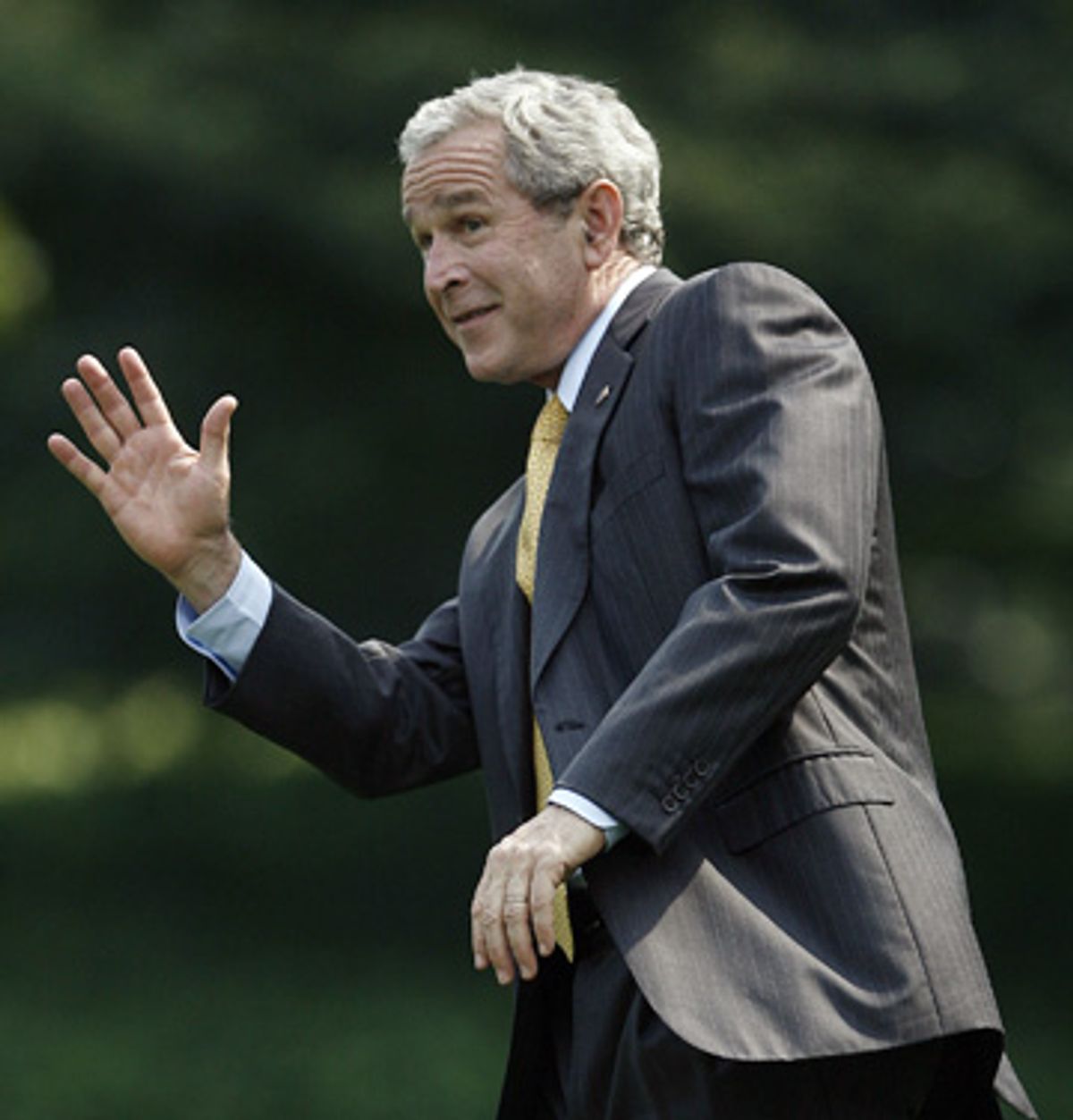
Revelations from "Dead Certain," Robert Draper's new biography of President George W. Bush, have received marquee play since the book's publication on Sept. 4. The disclosures have ranged from the petty -- Bush, a stickler for punctuality, once locked a late Colin Powell out of a meeting -- to the momentous. Among the more uncomfortable for the White House: Bush's claim that Paul Bremer, head of Iraq's Coalition Provisional Authority, made the disastrous decision to disband the Iraqi army without Bush's knowledge, an assertion rapidly rebutted by Bremer.
What Draper, a writer for GQ, really does with great skill in "Dead Certain," however, is debunk caricatures of George Bush, both positive and negative. Draper, who first spoke to Bush for GQ in 1998, did six additional interviews with Bush for the book and had access to the president's inner circle. In place of the dimwitted boogeyman of the left and the resolute hero of the right, Draper introduces a three-dimensional man full of contradictions. His George Bush is charming, petulant, open and insecure, smart but allergic to inconvenient facts.
On Friday, Salon spoke with Draper about "Dead Certain," his many encounters with George Bush, whether he likes the president personally, and how some former White House staffers have responded to the book's ambiguous, often unflattering portrait.
Newsweek headlined its article about your book "A Biographer Off Message" and called you "Bush's wayward biographer." How do you feel about that characterization, or the sense that you somehow got access to the Bush White House and then burned your sources, including the president?
It's a little bit silly, because it presupposes that I had some kind of handshake deal with the White House and have broken that. I did have a deal with the White House, and that is that I would write a fair-minded, nonjudgmental literary narrative of Bush's presidency, and I think I've delivered that. I do think that the writer of that piece, Richard Wolffe, whom I know and admire, is right that the book has thrown the White House off message when Bush is trying to turn the page on a lot of things. That's not my book's intention. Its intention is to be a lasting book, and I told the president that when I was making my pitch to him -- a book that was not just for and about the news cycle. But I have to say that I am grateful that it's in the news cycle, and I'm glad that people are interested in it and talking about it, and that has the consequence of reporters asking the White House questions about it, too. That sort of comes with the territory.
In the book you write that Bush asked you, "What is the purpose of this book?" And you don't record how you answered. What did you tell him was the purpose of the book?
I'd already given him the reply, and the reply is, "to write a first draft of the history of Bush administration -- and to answer the question that someone might pose 50 years from now." That question wouldn't be, What does Robert Draper think about George W. Bush? It is, How did an un-ambitious Midland [Texas] oilman change the world, for better or for worse? That's precisely the question that I told the president in August 2006, when I had this meeting with him, that I intended to answer. I thought that people would want to know. Who was this man who, before he became this pivotal character on an international landscape, was a virtually anonymous figure whom no one viewed as having leadership capabilities? How did he become a leader, and what did he do with it?
How did you get under the cone of silence of this very secretive administration? And how did you get the president to agree to talk to you?
While I was doing it, it didn't seem terribly difficult. But it was, from time to time. But what would happen would be -- it was Journalism 301 -- I would interview one guy and it would go well. And he'd say, yeah, sure, you can come back. And I'd say, by the way, you mentioned so-and-so in the interview. Do you know how to get in touch with him? And then I'd drop the name of the person I [then] interviewed. And so I moved closer and closer inside the circle.
And in the multiple interviews they became more and more candid even as they were also giving up other names of people for me to talk to. In the course of this too, they all began to talk among themselves about what I was up to, and I think that came back to the president. It helped that [Bush media strategist] Mark McKinnon had put in a good word for me to a handful of people. And he's a bike-riding companion of the president, and on a number of occasions mentioned to the president that I was doing a stand-up job and hoped that the president would speak to me.
I have to say: People have been trying to demystify how I got this access. Being a Texan I'm sure helped, but there's a lot of Texas reporters. Being Mark McKinnon's friend helped, but he has a lot of buds in the media. I don't have any particular gifts as a reporter. I don't have an interviewing technique that spellbinds people. Which is a long-winded way of saying I really don't know how. I just kind of plodded along. I think it meant a lot to this president -- it's the sort of thing that does mean a lot to him -- that I never asked it to be handed to me on a silver platter. I went about my business with the supposition he wasn't going to talk to me.
It helps to exhibit a true interest in the topic and the people you're talking to. I really was interested in [Office of Management and Budget Director and later White House Chief of Staff] Josh Bolten's relationship with the president, and Deputy Chief of Staff Joe Hagen's take on things. I did find all of this stuff interesting; there was no artifice to that. And I am the kind of person whose interest can be palpable. So perhaps I pleased a lot of these people.
And I'll add one final thing: These guys are tight-lipped and they don't do much talking. But people like to talk. They like to talk about what they are doing. So maybe that was some of it: Once I got in a little bit, all these people were sort of relieved to have the opportunity to share their insights and recollections.
Your book has gotten a lot of attention for revelations like Bush's claim that he didn't know Paul Bremer was going to disband the Iraqi army. Is there anything in the book that you feel is very important that hasn't yet been spotlighted in the media?
I think there's a lot of it. Speaking generally, I think that the Katrina chapter is interesting, and that the president the day before landfall went on this bike ride and was pretty worn out by it. And then they had this SVTC [secure video teleconference] in which he was pretty nonresponsive. In the wake of Katrina, he sort of pushed back on his aides who said he should take more responsibility. And saying, People not getting bottles of water, do they expect me to be the one doing that? There was sort of this petulance.
To me, one point that hasn't been discussed much that I think is central to the president's flaws is that his optimism -- which I think is basic to him and is genuine -- is offset by an unwillingness to acknowledge mistakes made. That is a point that has been made in the past. But I think what the book shows pretty vividly in the cases of Katrina and Iraq is the president has to be led very grudgingly to statements acknowledging mistakes made and accepting responsibility. And that [counselor to the president] Dan Bartlett and Josh Bolten and others had to plan very elaborately how the president would do this.
As I describe it in the book, it was the slow ratcheting down of triumphalism and the slow ratcheting up of humility ... A lot of Americans and people all over the world are taught to just say, "I'm sorry I screwed up. I've learned from my mistakes, and I will try to do better." For all of the other aspects of this president that I think are very emotionally honest that I witnessed, that was one aspect that is not -- his difficulty to own up to his mistakes. I think in a way he's like a baseball umpire who feels like if you call a ball a strike, you've got to stick to that. Otherwise people will question you. They will think that your equivocation is a sign of a lack of certainty.
Does Bush have clarity of purpose, or is he just stubborn?
I think he veers toward the one and toward the other, and at times is both. I think that the president's chief attribute is his clarity -- they say people know where he stands. His certitude can come off as steadfastness, as on Sept. 20, 2001, with his great speech. And can -- as in his speeches at the end of 2005, where he said, not only can we win in Iraq, but we are winning, when evidence pointed to the contrary -- come across as having a stubborn refusal to acknowledge realities. It is the lot of this presidency that they've chosen -- and when I say "they," I mean that the president is not the only one who buys in to that notion -- to believe that if you make a call, you stick with it. There are always two camps in this White House. One that believed the way the president did. And it consisted of the president and Karl Rove and Vice President Cheney and Secretary of Defense Rumsfeld. And then the other camp that believed that it was important to own up to mistakes, and that was largely people in the communications shop as well as the chiefs of staff.
Your book reveals a great deal of disagreement within the administration. What effect do you think that internal conflict has had on this presidency?
I think conflict is inevitable in all White Houses and to some degree is healthy. And disagreement is healthy. I think that historians will be exploring less the conflict in the administration and whether the people in the West Wing disagreed with each other [than] whether the president was willing to surround himself with people who disagreed with him. I think that's a matter that historians will spend a lot of time on.
I do think that the White House was paralyzed by dysfunctionality [early in 2006], exemplified by the quote I have of [counselor to the president] Ed Gillespie during the [Samuel] Alito hearings telling a Republican, "I feel like a shuttle diplomat going from office to office. No one's talking to each other over here, and I'm literally having to go from one to the next conveying messages from people whose offices are 20 feet away from each other."
In addition, the notorious division between State and Defense was exacerbated by the internecine warfare between Rumsfeld and Powell ... Obviously this has notable consequences. The lack of collegiality between Powell and Rumsfeld meant that, among other things, when Deputy Secretary of State Armitage went to Iraq after the toppling of the [Saddam Hussein] statue and began to see clear evidence that we didn't have enough troops there and that the power vacuum was being filled by insurgents, he went and told this to Powell. And Powell said, "It's not our place to tell Rumsfeld. If his people aren't telling him, then it's just too bad, let's stay out of it." It might have made a difference if Powell had said that to Rumsfeld. Then again, maybe not, because Rumsfeld wouldn't have listened. But that cold war between them did have consequences.
In the book you portray Bush as a voracious reader of history. Does he draw on the lessons of history -- as Santayana put it, that those who cannot learn from history are doomed to repeat it?
I think that part of the problem is that it is in the eye of the beholder. What are the lessons of history? The president can make a convincing case that right now [in] Iraq the fundamental question that must be asked is, What are the consequences of failure and of desertion? Since he has been preoccupied by this question he has been handed books by Rove and by Henry Kissinger on the Algerian revolution and the Khmer Rouge. If you read those history texts, you can conclude that people will be slaughtered.
Of course you can also ask the question, So what was the solution? Should the French still be in Algeria? Bush has long said on the matter of Vietnam that the lesson to be learned is that it was a politicians' war and waged by politicians rather than generals, and that the generals were hamstrung, and that was why we lost Vietnam. That's the lesson he learned from Vietnam. And one can certainly make the argument that that was not the lesson to be learned, and that even if it was, that it was misapplied to Iraq. And that his deferential nature toward Rumsfeld had very injurious consequences.
You said in an interview on NPR that you didn't believe Bush when he insisted to you that it was Rumsfeld who decided on the timing of his resignation as secretary of defense. Are there other things he said that you didn't believe?
Yeah. On the matter of that meeting in April of 2006 in the residence of the White House, where there was a show of hands about whether or not Rumsfeld should go, the president told me he just didn't remember the meeting. I don't think he was lying to me, per se. But I do think he has this way of being dismissive about things. And in dismissing, he will say, "I don't remember that."
My sessions with the president were interesting because he would sometimes start lapsing into his talking points and go into a train of thought that I'd heard before. And he'd stop himself and say, "But you already knew that." He seemed pretty determined to make these sessions productive from the very beginning. He became more expansive and looser as the sessions went on. But from the outset, I really appreciated the fact that Bush didn't want to waste his time any more than mine by just speaking pabulum and not telling the truth.
I think that he was toeing a company line with the Rumsfeld matter. And after he gave it to me, I had dinner with Dan Bartlett, told Bartlett that I didn't believe it and didn't intend to publish it. And Bartlett said to me, "Message received." And that led to my next interview with the president where he was a little more forthcoming.
Bush emerged as a more human figure for me after reading this book.
I saw that George Bush in 1998. And I remember describing it to people back then, and they didn't really believe me. And even those who believed [me] in 1998 came to believe otherwise in 2001, when he started passing tax cuts and had already selected Cheney as his running mate and in all other ways was acting like a fairly retro conservative rather than a compassionate conservative. I think that his adversaries have caricatured Bush at their peril, not at his. Bush has made a living off of being, as he puts it, "misunderestimated." And it ill serves his opponents not to concede his strong points. Not for nothing is this guy president of the United States.
And it's amazing to me that people refuse to acknowledge that he has any gifts at all. But those who are in a room can feel it. And among them is that Bush has a very pungent personality. He has these scruffy charms about him. He doesn't really put on airs. The guy you see is the guy he is, pretty much. Sure, he has a variety of shortcomings, and they've hamstrung his presidency in a variety of ways. But one thing that became meaningful to me in doing that book is that I interviewed people who have been working for Bush over the years -- they love this guy. I don't just mean that they admire him. I don't just mean they are in awe of him. I mean they really love him and would take a bullet for him. I've spent a lot of time now with a lot of elected officials and the people who work for them, and you can't always say that about them.
But beyond the fact that Bush is charming and there's this incredible loyalty that is cultivated between him and his subordinates, he has a surprising intellect. A guy who reads Cormac McCarthy isn't a dummy. And a guy who can listen to an economist talk about a tax scheme and just eviscerate the guy because he doesn't seem to really understand what he is talking about and there's a loose thread in his argument cannot be intellectually lazy. I think that what's difficult to reconcile is this man's brightness with his capacity for incuriosity. I think where the rubber meets the road there is that Bush, for all of his talk about him being so comfortable in his own skin, possesses insecurities like the rest of us. And Bush, due to his insecurities, really doesn't like to be challenged.
It says a lot that this man, at the age of 61, stills feels the need to differentiate himself from his father, and there are examples of that throughout the book. And that this man, at the age of 61, having received the best education that money can buy from Yale and Harvard, still feels the need to run down the elite Ivy Leaguers. That this man, after being a very successful governor, felt like he had to select as his No. 2 guy a man who had no interest in the No. 1 spot. Clinton, for all his shortcomings, was not in any way threatened by having as his vice president a guy with clear designs on the presidency. He still found he could get a lot out of Al Gore and trust Al Gore while dealing with Gore's ambitions. Bush couldn't do that.
This is a guy who really possesses a lot of insecurities, and I think that's why he evinces this sort of incuriosity. There are only certain kinds of challenges that he can deal with. What is admirable about Bush is also part of his insecurity. I think because his insecurity drives him to want to be relevant and want to do big things, he's willing to throw the ball long. And I think that because of that, history is not going to judge this man with indifference. They are not going to judge him as Franklin Pierce. He is either going to go down in history as a disastrous flop or a really monumental president.
Do you like him?
Yeah, I like him a lot. I think he's a real likable kind of fellow. I think he's full of surprises. The short answer is that I do like him.
How do you think he will feel about your book?
I think he will be disappointed, not because I betrayed him, per se, but because the president has his own point of view about what's important and what isn't, and I have little doubt he will disagree with what I found to be the story worth telling. For all of my insistence that I wasn't going to impose my own belief system, whatever it might be, on his narrative, journalism is a series of judgment calls. Fundamental to them [is] not only, who do you believe? but, what's the story to tell? I think that my emphasis on certain things and de-emphasis on others will be very much at variance with his own [view].
I don't have any idea if he started to read [my book] or intends to read it. He made a point of telling me that he hasn't read any of the other books that have been written about him. I suspect that when the dust settles, some of those around him will say: You know, Mr. President, it really is a pretty fair and for the most part accurate rendering of who you are. And that may lead him to it.
I think that what may disappoint him ... is the overall content. And that has now proved disruptive to his presidency. And I can understand and appreciate that. But as he knew all along, the book was going to be published in September of 2007. I made no secret of that. And in fact, on many occasions the president would ask me, "Now when is this book going to be published again?" before he would answer a particular question, so he was cognizant of it.
Have you heard from anybody in the Bush administration since the book has been published?
Not in the administration. I have heard from people who have left the administration in the last year -- three or four or five of them -- and they've been effusive. They all pretty much said: You nailed it. So that's been gratifying. But inside the White House I haven't. I expect to see some of them in the next week or two, and I'll be curious to see what they have to say.
Shares