Sonia Najera walks under a canopy of ash and sugar hackberry trees, down a dirt path that ends at the water's edge of the Rio Grande. The spot is a mile from the tidal flats where the river mixes with the Gulf of Mexico after its journey from the Colorado headwaters. Najera, South Texas project manager for the Nature Conservancy, points to paw prints in the muddy river bank. "That's a canine," she says, "probably a coyote. That looks like badger; that's chachalaca for sure," she continues, describing a pheasantlike bird found in this southern tip of Texas.
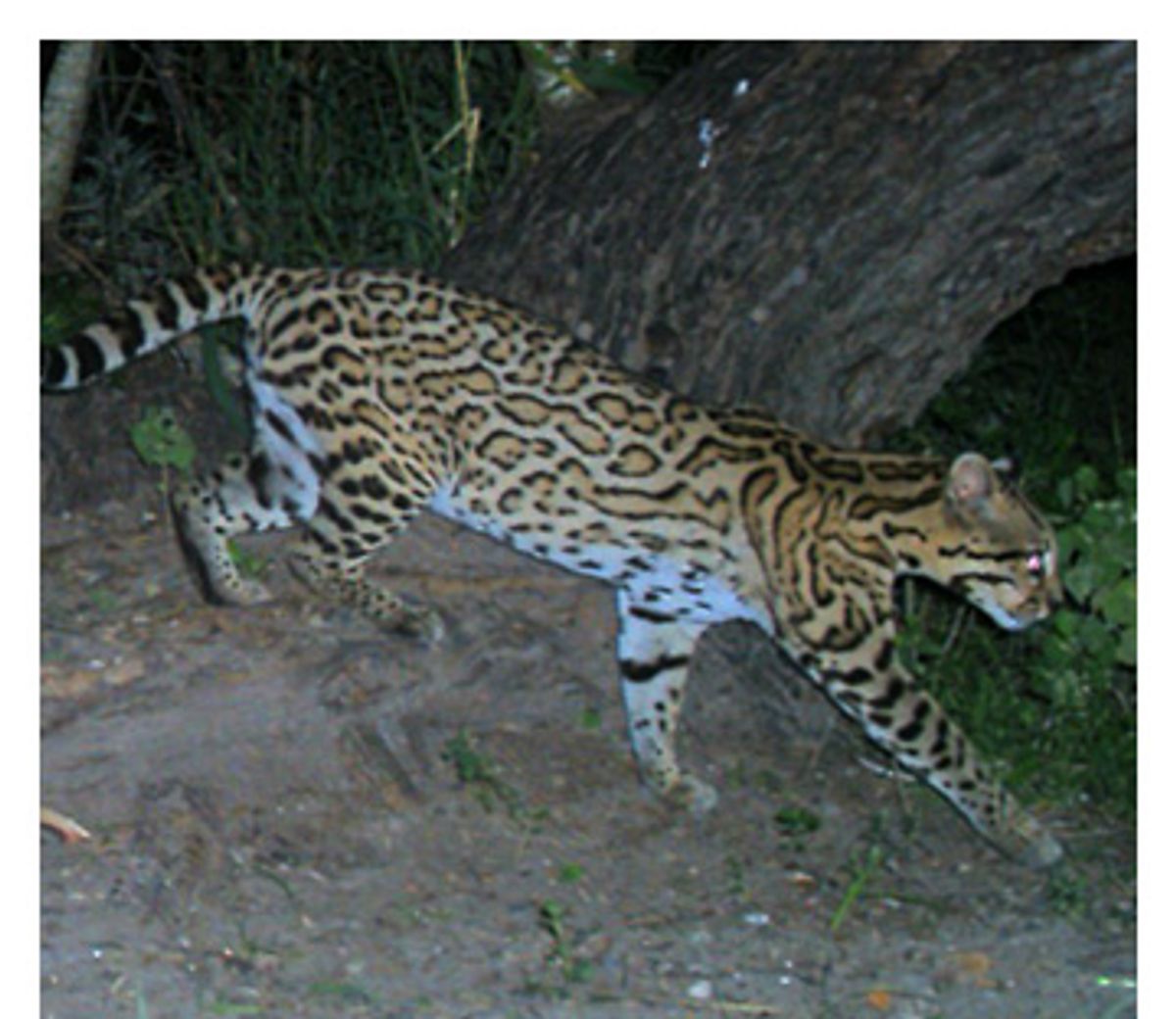
Najera, a wildlife biologist, also looks for tracks of the ocelot, the endangered wildcat with a signature rosette camouflage that allows it to hunt in sun-dappled canopy forests. No tracks today, or most days. Once the ocelot hunted all the way up through the woodland areas of eastern Texas and into Louisiana and Arkansas. Now the only two remaining family groups in the U.S., fewer than 100 individuals, can be found here.
The ocelot is not the only rare creature carrying on a precarious existence in this unique corner of Texas. Although not as well known as Yosemite or Yellowstone, the Lower Rio Grande Valley National Wildlife Refuge offers a variety of species unmatched in the United States -- 500 bird species, 300 butterflies, 700 vertebrates. "This is one of the crown jewels of the national wildlife refuge system," says Carter Smith, Texas state director of the Nature Conservancy. Saving and restoring this area took $70 million in federal land acquisitions and three decades of work by the Nature Conservancy, Audubon Society and local communities. But now the victories could go for naught.
At issue is the Bush administration mandate to build 700 miles of fence along parts of the U.S. border with Mexico. It's part of the Secure Border Initiative, a Department of Homeland Security program first funded by Congress in 2005 to address border security. While the fence has stirred a bonfire of debate over terrorism and illegal immigration, the fate of the area's unique wildlife has been lost in the uproar.
In Texas, 225 miles of fencing will begin to be installed this fall. A large percentage of that fencing will be built in the valley along the unique river bank and habitat that follows the Rio Grande. It would cut across more than a dozen refuges and parks totaling more than 100,000 acres. Critics warn the fence and its accompanying patrol roads will sever critical wildlife corridors on the animals' natural territories. Animals depend on these corridors to reach mates, and seek food and water. If the fence is installed, says Martin Hagne, director of the nonprofit Valley Nature Center, "it will be a huge catastrophe." Hagne is a member of an unusual coalition of environmentalists, local farmers, ranchers and local business interests fighting the fence.
Construction is slated to begin later this year, and opponents are worried they won't have a democratic voice to stop it. Homeland Security Secretary Michael Chertoff has vowed to seek community input and consider local concerns. But while department spokespersons in Washington say the consultative process is under way, folks in the valley say they haven't been heard. Even biologists with Homeland Security's sister agency, Fish and Wildlife, say they don't know where the fence is going to run or what it's going to look like.
The most likely route for the valley fence would run along a 1935 earthen flood control levee. The levee follows a straighter course along the river than do the tortuously winding banks of the Rio Grande. In some places it comes within yards of the river and in others, the levee is a mile inland. While the levee makes an easy natural crossing for animals, the construction of a secure fence or even hard-packed patrol roads would create small islands of land between the fence and the river and interrupt the natural movement of animals to the river, where they feed.
Jody Mays is a Fish and Wildlife biologist who has worked with ocelots in the valley for a decade. She explains that the open areas created by the fence would further limit the ocelots' hunting range because the cats, marked for forest and night hunting, simply will not risk exposure in the open. "The ocelot cannot adapt to open areas," she says. "They're vulnerable because of their markings. If an ocelot's standing in the middle of a clearing, it's going to stick out like a sore thumb."
Mays has seen the ocelot population in the U.S. fall to just two groups. One is a group of 25 to 35 individuals that live on the Laguna Atascosa wetlands, and the other is a smaller group of 10 to 12 cats that occupy a large private ranch nearby. Even though the two groups are separated by only a few miles, they cannot reach each other because of the habitat fragmentation caused by development.
Mexico has a healthier population of ocelots and jaguarundi. But the Laguna Atascosa ocelots continue to decline because the lack of wildlife corridors prevents them from breeding with ocelots in northern Mexico. Some bilateral programs are under way with Mexico to reopen some of the historic wildlife corridors that cross the Rio Grande. But a border fence would probably render those efforts useless. The isolation of ocelots on the U.S. side is already showing up in health problems, and has been seen in the degradation of their DNA quality. Inbreeding is taking its toll. "A simple flu could wipe them out," Mays says.
It's not just mammals that would be affected by fence construction, biologists say. They also point to the Texas indigo snake. Most wildlife tourists to the Rio Grande Valley might doubt the existence of a snake that reaches a length of 8 feet and eats rattlesnakes. But the Texas indigo snake is real. It used to be common in the valley but is now listed as endangered in Texas because of loss of habitat. Proposed security fencing could hinder its access to feeding grounds and water.
New roads would also increase the danger to valley wildlife. From 1983 to 2002, a study done by Texas A&M University found that 10 of the 29 ocelot deaths that occurred in the valley were due to road kills. The border fence would include construction of new roads to reach it, and some versions of the plan include high-speed patrol roads running alongside it. In places, the swath of fence and roads could become 150 yards wide. "Building a 150-foot wide strip of fencing and two roads is going to have a major impact on wildlife," says Ernesto Reyes, an ecology services biologist for Fish and Wildlife in the valley. At the Southmost Preserve, where Najera pointed out the animal tracks, it's easy to recognize an established watering spot. Yet the earthen berm where the security fence would likely be built is just yards away. Animals might have to travel miles out of their way to find a new watering spot. And road kills on improved patrol roadways will increase, Reyes says.
The final design of the fence is crucial. Will it be concrete and wire, or "ornamental," as Chertoff remarked about fencing he had seen in the valley? Will it look like Smuggler's Gulch in California -- a blend of old-fashioned strip mining and security fencing worthy of a supermax prison? Brad Benson, a spokesman for the Secure Border Initiative in Washington, D.C., says no final decisions on design or placement have been made.
Lack of information and conflicting statements by authorities in Washington irritate local residents. In July, Border Patrol agents announced at a local Audubon Society meeting that the style of fencing could be decided by individual property owners. When pressed on that point by valley teacher Scott Nicol, a local Sierra Club member, the agents backed away, saying they had no authority to say what kind of fencing would be acceptable. "So they promise the moon, but they have no authority to keep their promises," Nicol says.
This scenario is familiar to activists who have followed the border fence dispute in Arizona, near the Barry Goldwater military bombing range and the nearby Buenos Aires National Wildlife Refuge. In August 2006, Homeland Security and the Department of Defense announced that a "hybrid" fence with anti-vehicle features that would allow animals to cross would be built. Pygmy owls that live in cactus, Sonoran pronghorn antelope and the occasional jaguar crossing from Mexico are among the wildlife whose corridors would be cut by a wall.
Sean Scully, a Tucson member of the Sierra Club and the Sky Island Alliance, who closely monitors the Arizona wall, said that the local parties, including the military base commander, had agreed on vehicle-barrier fencing that would allow the passage of most wildlife. But Scully contends that in the spring, Homeland Security invoked its power to bypass federal requirements such as environmental impact statements, and announced that the fencing would be "upgraded" to an impenetrable wall, with sheet metal stretching between concrete posts along most of it. "The Border Patrol had never even consulted with Fish and Wildlife," he says. Fish and Wildlife biologists in the valley have voiced the same complaints about lack of consultation.
Chertoff has said -- and Benson reiterated this week -- that Homeland Security will comply with all environmental impact assessments, even though it was given special powers to bypass them because of its critical mission.
Homeland Security argues the Rio Grande fence will deter illegal immigration. Yet the Border Patrol's Rio Grande sector itself has raised questions about whether it would make much of a difference. Its sector office told the Government Accountability Office in 2005 that the rugged geography of the area in the Rio Grande sector, which includes the Lower Valley river corridor and especially the rugged thorn brush country inland from the river, creates its own impenetrable fencing.
"The brush (inland from the river corridor) is so dense with sage, scrub brush and cacti that it has created an inhospitable environment for … smugglers or illegal aliens," the report states. Because there are only two highways leading north from the Lower Valley, the local Border Patrol stated that it could intercept illegal immigration within its existing checkpoints. In fact, from 2000 to 2005, the number of apprehensions reported by the local Border Patrol climbed from 108,000 to 134,000, according to a report by Syracuse University.
Valley residents complain that Washington consultants and officials don't understand what's at stake. Nancy Millar, mayor of the border town of McAllen, points out that nature tourism now brings $34 million annually into the local economy and supports 2,500 jobs. Locals have also grown increasingly suspicious of federal officials. "We have always worked side by side with the Border Patrol," says the Nature Conservancy's Smith about local law enforcement. "They already have keys to all our gates and access to our refuges. The wall changes that dynamic. It isolates. It creates unnecessary friction and a hostile environment for landowners."
Smith adds that he is striving to create a truce with Washington. "This is not a choice between the fence and national security of the U.S. against the animals and the birds," he says. "It's about finding a solution that preserves the ability of animals to move back and forth along their river corridors."
One afternoon in his office at the Santa Ana National Wildlife Refuge, where the restored riparian forest looks like it might have when Spanish explorers first saw it, Reyes, the Fish and Wildlife Services biologist, explains that ocelots in the U.S. used to swim across the Rio Grande, and travel back and forth to Mexico. As recently as the 1990s, a pair of breeding ocelots regularly swam across a local shipping channel. But no longer. For seven years, Reyes has worked with his Mexico counterparts on a habitat management plan extending 60 miles on both sides of the border. Now he worries his project will be undermined by the border fence. "If they could build a fence that would let animals cross and keep people out, that would be great," Reyes says. How might that work? He says that building a gap at the bottom of a fence -- slither room -- with a concrete base could let rodents, snakes and small animals pass under. But what about the ocelots and jaguarundis and coyotes? How would they get through to find shelter and new mates? Reyes shrugs his shoulders. "Quien sabe? as they say in South Texas. Who knows?"
Shares