

Imagine this: You are a gay man or a lesbian woman who just can't stand Democrats. Maybe you are rich and you don't want anyone to raise your taxes. Perhaps you are just determined to stay the course in Iraq, privatize Social Security, and drop oil wells into the Alaskan wilderness. Jack Abramoff might even be an old drinking buddy.
It doesn't really matter. Whatever the cause, you are in a quandary. Your only viable choice in the coming presidential election is to vote for a Republican, and that means voting for a party that has spent much of the last decade casting you and your way of life as an assault on the wholesome goodness of the American family. "Homosexuality is incompatible with military service," declared the 2004 GOP platform. "Attempts to redefine marriage in a single state or city could have serious consequences throughout the country."
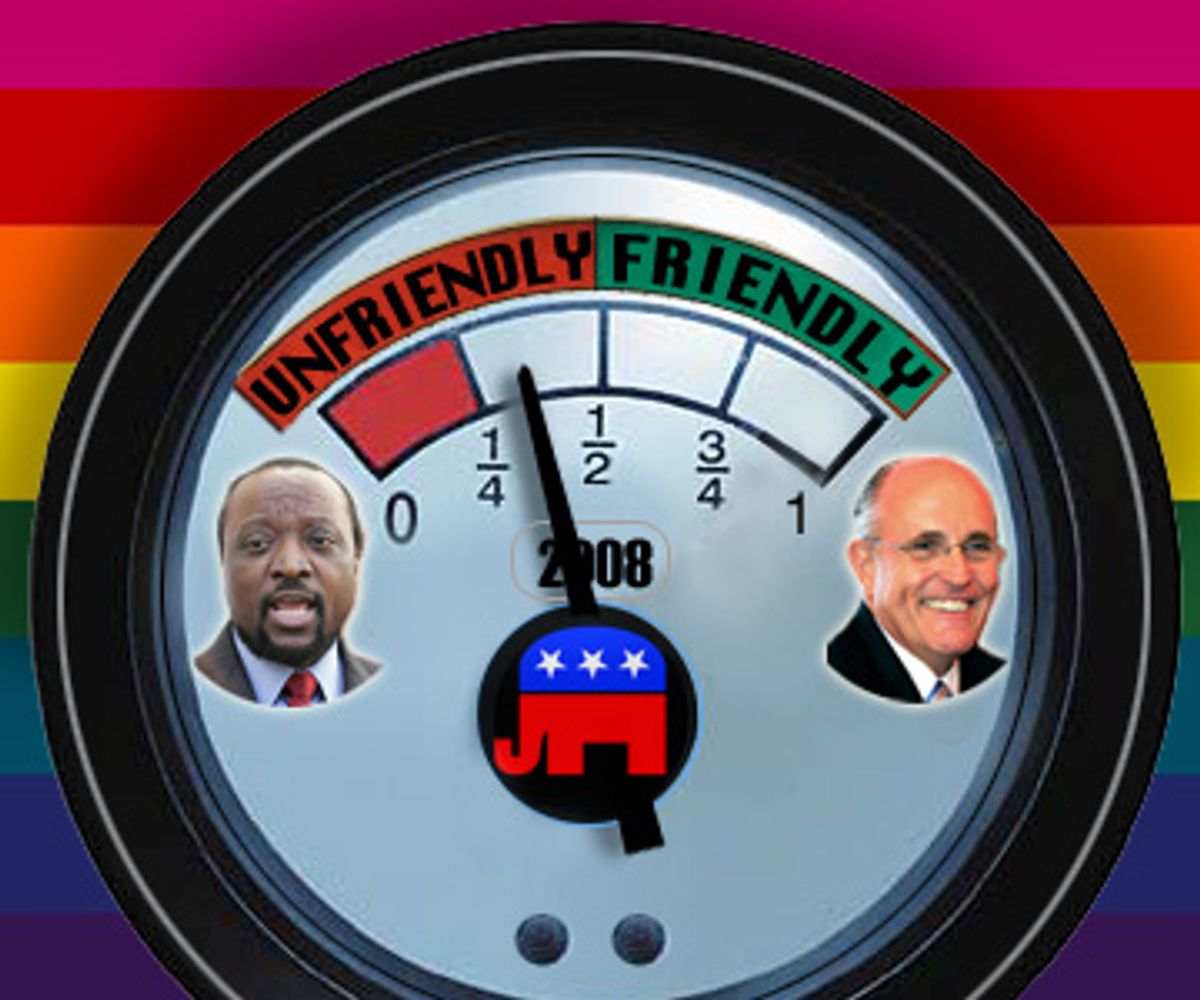
What is a right-leaning homosexual to do in this presidential election? Start by taking a closer look at the candidates in the Republican field. There is substantial variation, and not just in their positions on a constitutional amendment to ban gay marriage. Call it the Giuliani-Keyes Spectrum of Gay Friendliness. On one end, there is Rudy Giuliani, a former New York mayor who has lived with gay friends, favors gay domestic partnerships, and sometimes dresses in drag. At the other end, there is Alan Keyes, who calls lesbians "selfish hedonists," even though his only daughter is a lesbian. There exists, shall we say, a veritable rainbow of variation in between.
In service to the one in four gay voters who chose George Bush over John Kerry in 2004, and anyone else who might want to know, Salon now presents its first ever Gay Guide to the Republican Candidates.
Rudy Giuliani: The Party Bender
About a year before the terrorist attacks of Sept. 11, 2001, Rudy Giuliani donned a wig and a dress so he could squeal with girlish delight when real estate mogul Donald Trump nuzzled his fake breasts. It was a harmless comedy sketch for the charity dinner of the Inner Circle of City Hall, a press club for New York City reporters. But the mayor's antics spoke directly to his notable comfort with all things gender-bending and socially liberal. A few months later, after his estranged second wife, Donna Hanover, kicked him out of the mayor's residence, he moved in with two close friends, a wealthy gay couple. According to one of the men, Howard Koeppel, Giuliani even agreed to marry the men "if they ever legalize gay marriage."
As mayor, Giuliani marched in gay pride parades, and after he left office he continued to keep up relations with the community, even penning a 2002 letter to one gay group to commemorate the "triumph" of the 1969 Stonewall riots, when the New York gay community fought back against a police raid of a Greenwich Village gay bar.
Since becoming a presidential candidate, however, Giuliani has tried to distance himself from his socially liberal past. On the stump, he now emphasizes his opposition to same-sex marriage, though he also opposes a constitutional amendment to ban same-sex marriage, putting him in the same camp as most of the Democratic presidential candidates. In April, his campaign came out against New Hampshire's civil union law, even though Giuliani says he continues to support domestic partnerships that give gay and lesbian couples legal rights similar to those of marriage. Giuliani has dodged the issue of gays in the military, by saying "now isn't the time" to revisit the policy, given the war in Iraq. He pushed for a hate-crimes law in New York to punish crimes motivated by homophobia, but he has dodged questions about his support for the federal Employment Non-Discrimination Act, or ENDA. As for the Supreme Court, Giuliani says he plans to appoint judges to the Supreme Court in the mold of Antonin Scalia, who wrote a famous dissent arguing that the government should have the right to prosecute sodomy between consenting adults.
The specific issues aside, Giuliani's candidacy is seen by religious conservatives as a direct threat. Were Giuliani to win the nomination, many conservative Christian leaders, including Focus on the Family president James Dobson, have promised to withhold their support, suggesting the potential defection of many of the "values voters" so crucial to GOP victories.
John McCain: The Almost Agnostic
Back in March, John McCain sat in the Straight Talk Express, fielding questions from reporters about his views on gay and lesbian issues. As the coach coursed through Iowa, the Arizona senator mostly dodged and weaved.
Had he ever dressed in drag during college? "No. At the Naval Academy, it was frowned on." Did he have an opinion on Vice President Cheney's lesbian daughter, Mary, having a child? "No opinion." What did he think about recent comments by Gen. Peter Pace, chairman of the Joint Chiefs of Staff, that homosexual acts were "immoral"? "He said he regretted those statements ... so I don't want to say I wished I had said them." What would he do if one of his own daughters said she was gay? "That's one that really is a family matter."
Though the exchange was not satisfying for the press, it aptly summarized McCain's approach to gay and lesbian issues. With rare exception, he has avoided engaging in the politics of sexuality through much of his political career, evidently because he doesn't really see much role for government in these matters. As he put it, "I've never talked about people's private lives or their personal conduct."
During his 2000 run for the White House, he fused this sentiment with sharp attacks on the right-wing evangelical elements of his own party, whom he dubbed "agents of intolerance" for stoking the culture war. "Political intolerance by any political party is neither a Judeo-Christian nor an American value," he said at the time in Virginia Beach, a military community that is also home to evangelist and erstwhile Republican presidential candidate Pat Robertson. "We are the party of Ronald Reagan, not Pat Robertson."
As he prepared for the 2008 campaign, McCain attempted to rebuild some of the bridges he had burned to the party's religious base, though he has had little tangible success. At Pastor Jerry Falwell's invitation, he spoke at Liberty University, where homosexual relations can be grounds for expulsion. In 2006, he supported an amendment to the Arizona Constitution to ban gay marriage, which failed at the ballot box.
In the Senate, McCain has been an ardent opponent of a federal constitutional amendment to ban gay marriage, arguing his case on federalist grounds. "The constitutional amendment we're debating today strikes me as antithetical in every way to the core philosophy of Republicans," he declared in 2004. "It usurps from the states a fundamental authority." McCain has declined to take sides in the debate over civil unions in New Hampshire, though in the past, he has voted against the inclusion of sexual orientation in hate-crime laws. He also supports the current "Don't Ask, Don't Tell" policy in the military and opposes ENDA, because he thinks it could "open a floodgate of litigation."
That said, there is little doubt that a McCain presidency would avoid any crusades against gay and lesbian rights. For this reason, among others, Focus on the Family's Dobson has also promised not to vote Republican if McCain wins the party's nomination.
Ron Paul: The Libertarian
Rep. Ron Paul of Texas sees the issu e of homosexuality, as he sees most things, through the lens of his strict interpretation of the Constitution. He believes that government's role is to stay out of the lives of citizens. It follows, therefore, that he is against a constitutional amendment to ban gay marriage. In fact, he is not even sure that government needs to be involved in marriage in the first place. "Marriage only came about, and getting licenses only came about -- in recent history for health reasons," said Paul, who is a medical doctor, in a "Values Voter Debate" on Sept. 17. "True Christians, I believe, believe that marriage is a church function, not a state function. It's not a state function. I don't think you need a license to get married. We should define it."
This door swings both ways. He is also against federal laws that could protect gays and lesbians from discrimination, including hate-crime laws and ENDA. He says the current Don't Ask, Don't Tell policy is "a decent policy." If Paul becomes president, it is a safe bet that he will not do much to help or hinder the cause of gay and lesbian rights. "All individuals have the right to their life if they do no harm," he said at the debate, before a deeply religious crowd. "You don't try to do a whole lot about it."
Fred Thompson: The Third Way
During his announcement tour in early September, Fred Thompson told reporters that he had found a third way through the thicket of the gay marriage debate. He would not support amending the Constitution to ban gay marriage. But he did support amending the Constitution to prevent state or federal judges from legalizing marriage without the consent of state legislatures. He also wanted to amend the Constitution to make it clear that a same-sex marriage in one state did not have to be honored by any other states. "There have been no state legislatures that have affirmatively allowed gay marriages in the United States," he said on Sept. 7, as his campaign bus barreled through northern Iowa. "It's a judge-made problem."
His timing was unfortunate, because on the same day Thompson spoke those words, the California Legislature approved a bill to give gays and lesbians the right to marry, though the bill is likely to be vetoed by the governor. But Thompson's intent was clear. He was staking out a position to the right of Giuliani and McCain, without abandoning his belief that states should have autonomy to do what they want in a federal system. "A marriage is between a man and a woman, and that has been accepted through the millennia as the basis of civilization," he said. "But I am also a federalist."
At an event in Sioux City, he was asked by a voter to explain what he would do about sexual "deviancy." Again, he said government should take a mostly hands-off approach. "Society's position and the government position, and what the government ought to do to exercise the power of the federal government, is not necessarily the same thing," he said. On other gay-rights issues, he generally toes the larger Republican Party line. He opposes hate-crime laws to protect gays, opposes ENDA, and supports the military's policy as it stands today.
In his short time as a candidate, Thompson has seemed to downplay most social issues. He is hesitant to speak about his own religion. Though he grew up in the Church of Christ, he does not regularly attend church in his present-day hometown of McLean, Va. Predictably, these positions are not good enough for the Focus on the Family's Dobson. "Isn't Thompson the candidate who is opposed to a Constitutional amendment to protect marriage, believes there should be 50 different definitions of marriage in the U.S.?" Dobson wrote in a recent e-mail to supporters. "Not for me!"
Mitt Romney: The Switch-Hitter
This is a tough guy to figure out. More than any other top-tier Republican, former Massachusetts Gov. Mitt Romney has been running aggressively as the best candidate to protect the "traditional family" from the onslaught of gay and lesbian marriage. Back in 2005, Romney traveled to South Carolina to make his case. "Today same-sex couples are marrying under the law in Massachusetts," he warned a Republican crowd. "Some are actually having children born to them. We've been asked to change their birth certificates to remove the phrase 'Mother and Father,' and replace it with 'Parent A and Parent B.' It's not right on paper. It's not right in fact. Every child has a right to a mother and a father."
Strong words indeed. But Romney's own paper record tells a different story. Back when he ran for the U.S. Senate in 1994, he told the voters of Massachusetts that he would be a better leader for the gay community than his rival, incumbent Democrat Ted Kennedy. "I am more convinced than ever before that as we seek to establish full equality for America's gay and lesbian citizens, I will provide more effective leadership than my opponent," he wrote in a letter just before the election. In a debate with Kennedy, he said anyone should be able to participate in the Boy Scouts "regardless of sexual orientation." Back then, he supported adding sexual orientation to employment nondiscrimination laws. He called Don't Ask, Don't Tell the "first of a number of steps that will ultimately lead to gays and lesbians being able to serve openly and honestly in our nation's military." As recently as 2002, his campaign distributed a pink flier to celebrate Pride Weekend. "All citizens deserve equal rights regardless of their sexual preference," the flier read.

In more recent years, he has become one of the nation's most public supporters of amending the Constitution to ban gay marriage, even testifying before Congress on the issue. He has come out against ENDA and announced that he supports the current military policy as it stands.
In other areas, he has not completely reversed himself. In recent interviews, he has defended his appointment of gay judges as governor and maintained that he supports contractual domestic partnership benefits for gay couples. "There are other ways we raise kids, and that's fine -- single moms, grandparents raising kids, gay couples raising kids," he said at a high school in Concord, N.H., in June. "That's the American way to have people have their freedom of choice."
The Romney record on these issues is such a muddle that his performance in the White House is difficult to predict. On the one hand, he is clearly willing to exploit the culture war for political ends and make common cause with those parts of the Republican Party most opposed to homosexual rights. He has also reversed his positions on several major issues, like gays in the military and employment discrimination, when there was a political advantage to be gained. On the other hand, his history on the issues suggests that the ties to his new friends do not run deep. "If people are looking for people who are anti-gay, they aren't going to find that with me," he said at one stop in Iowa this year. "But I am going to fight to protect traditional marriage."
Mike Huckabee: The Kinder, Gentler Evangelical
As he travels around the country, former Arkansas Gov. Mike Huckabee likes to offer this two-line joke. "I'm a conservative," he says. "I'm just not angry about it." The phrase aptly describes his approach to gay and lesbian issues. In substance, the ordained Baptist minister matches up with most on the religious right in opposing reforms that would permit gay marriage. He says he will lead a effort to pass a constitutional amendment banning gay marriage, opposes hate-crimes bills and ENDA, and supports continuing the Don't Ask, Don't Tell policy. As governor, he led a state effort to pass a constitutional amendment defining marriage as a heterosexual union.
But on the trail, he tries to avoid coming off like a proselytizing preacher, downplaying his faith-based disapproval of homosexuality. "I want us to be very careful that we don't come across as having some animosity or hatred toward people, even [those] whose lifestyles are inexplicable to us," he said at the Values Voter Debate. In stump speeches, he often makes only passing reference to "traditional family" issues. He has told reporters that he is open to state-sponsored civil unions that would bestow the legal rights of marriage on gay and lesbian couples. [Editor's Note: Huckabee now says that he "either misspoke or misunderstood" the question asked by a Concord Monitor reporter in 2006. "I have never supported civil unions, and I don't. I don't think it is something that is a good thing," Huckabee said in a November 2007 interview with Salon.]
At the same time, his language for describing homosexuality can sometimes hit a wrong note. During a New Hampshire debate in June, he referred to homosexuality as an "attitude." He also supported a state ban on gay couples becoming foster parents in Arkansas. "That whole issue is more about the gay couple than it is the child. And I think that is the mistake," he said in a January interview. "I feel that we have got to do what is best for the child. I am not sure that putting them in an atmosphere that is still pretty controversial, or still anything but the mainstream, is the ideal situation for the child."
Tom Tancredo: The One-Issue Candidate
The campaign of Colorado Rep. Tom Tancredo is so devoted to a single issue -- ending illegal immigration -- that he hardly speaks about anything else. That said, he takes a hard-line view of most policy matters concerning homosexuality. "We have to remember that we are always just one kooky judge away from actually having homosexual marriage forced on all the rest of us," he warned at the Values Voter Debate on Sept. 17.
He supports a constitutional amendment to ban gay marriage, opposes ENDA and hate-crimes laws for sexual orientation, and once voted to prevent the District of Columbia from offering domestic partnership benefits to homosexual employees. But he rarely brings up the issue while campaigning. When asked recently how he would deal with the "homosexual agenda," he responded with a quasi-libertarian argument. "The president of the United States simply can't make a rule, sign an executive order, changing the morality of the country," he said at the debate. "It can't happen that way. You do so by leadership."
Duncan Hunter: The Straight Man
On the campaign trail, California Rep. Duncan Hunter boasts of having led the opposition to gays serving openly in the military. "I think it's only because we have been able to resist that particular attempt that we have the very best military in the world today," Hunter told the Values Voter Debate.
Hunter is among those few Republican candidates who advance the concept that homosexuality itself is immoral. To explain his opposition to ENDA, he says the Boy Scouts have a right to ban gay scout leaders. He is against hate-crime laws for sexual orientation and in favor of a constitutional amendment banning gay marriage. "Every American family should have the right to say it's a matter of moral principle that we do not accept homosexual activity," he said at the debate.
Sam Brownback: Defender of the "Family"
Soft-spoken and sincere, Kansas Sen. Sam Brownback has fashioned himself as the Senate's most outspoken opponent of same-sex marriage. He has spent hours on the floor of the Senate with charts showing the declining rate of heterosexual marriage in Scandinavian countries, where gay unions have been sanctioned for years, arguing that any redefinition of marriage in the United States could have devastating consequences on heterosexual monogamy.
A Catholic convert, Brownback has made marriage and abortion the two central issues of his campaign. At the Values Voter Debate, he criticized President George W. Bush for failing to spend more political capital on passing a constitutional amendment to ban same-sex couples from marrying. "I wish President Bush would have led on it," Brownback said.
When Gen. Peter Pace called homosexuality "immoral," Brownback was one of the few Republicans to offer his public support. "It was part of his faith, and he believed that this was the right thing to stand up for," Brownback said. "And I stood up for General Pace, because we should stand up for other people when they will stand up for these basics." He is against ENDA and hate-crime legislation and supports the current military policy on homosexuality.
In the wake of the Pace controversy, a reporter asked him to describe his feelings about homosexuality. "I do not believe being a homosexual is immoral, but I do believe homosexual acts are," he told the Associated Press. "The church has clear teachings on this."
Alan Keyes: The Lord's Messenger
A perennial political candidate and former State Department employee, Keyes announced his candidacy in mid-September. It has all the markings of a moral crusade, with gays and lesbians in the crosshairs. "Abandon God with respect to the family, and we have no claims to rights," he announced at the Values Voter Debate, during a discussion of same-sex marriage. He has called homosexuality the practice of "hedonistic self-gratification," and described Vice President Dick Cheney's lesbian daughter Mary as a "selfish hedonist." After his own daughter, Maya Marcel-Keyes, announced she was a lesbian, she said he stopped funding her college education.
Keyes' last turn in the spotlight came with his 2004 campaign for the U.S. Senate against Barack Obama. After losing in a landslide, Keyes refused to congratulate Obama, saying the Democrat stood for "a culture evil enough to destroy the very soul and heart of my country."
Shares