

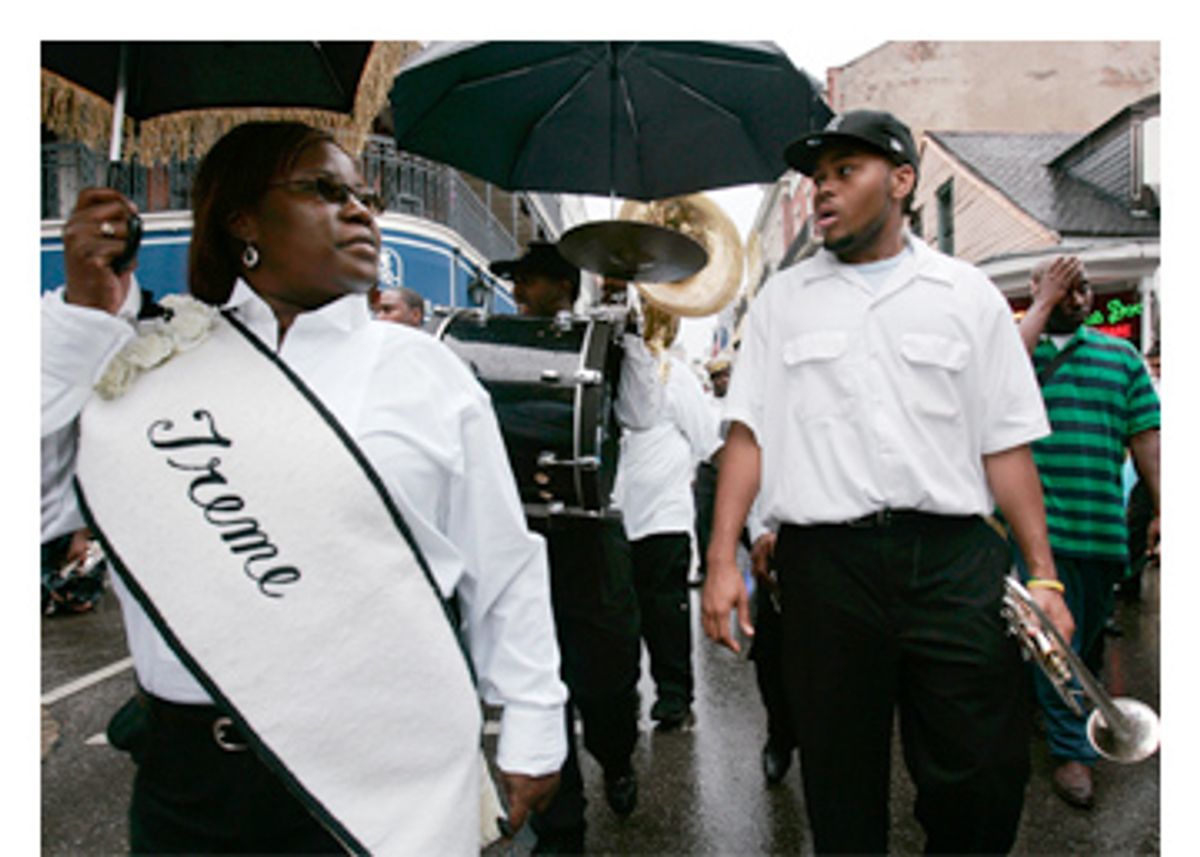
On the evening of Oct. 1, some two dozen of New Orleans' top brass-band players and roughly a hundred followers began a series of nightly processions for Kerwin James, a tuba player with the New Birth Brass Band who had passed away on Sept. 26. They were "bringing him down," as it's called, until his Saturday burial. But the bittersweet tradition that Monday night ended more bitterly than anything else -- with snare drummer Derrick Tabb and his brother, trombonist Glen David Andrews, led away in handcuffs after some 20 police cars had arrived near the corner of North Robertson and St. Philip streets in New Orleans' historic Tremé neighborhood. In the end, it looked more like the scene of a murder than misdemeanors.
"The police told us, 'If we hear one more note, we'll arrest the whole band,'" said Tabb a few days later, at a fundraiser to help defray the costs of James' burial. "Well, we did stop playing," said Andrews. "We were singing, lifting our voices to God. You gonna tell me that's wrong too?" Drummer Ellis Joseph of the Free Agents Brass band, who was also in the procession, said, "They came in a swarm, like we had AK-47s. But we only had instruments."
The musicians were no longer playing but instead singing "I'll Fly Away" when the cops converged and the cuffs came out. A New Orleans police spokesman claimed the department was simply acting on a neighborhood resident's phoned-in complaint. And the department maintains that such processions require permits.
But when they busted up the memorial procession for a beloved tuba player, arresting the two musicians for parading without a permit and disturbing the peace, they didn't just cut short a familiar hymn -- they stomped on something sacred and turned up the volume in the fight over the city's culture, which continues amid the long struggle to rebuild New Orleans.
In that fight, Tremé is ground zero. Funeral processions are an essential element of New Orleans culture, and the impromptu variety in particular --- honoring the passing of someone of distinction, especially a musician -- are a time-honored tradition in neighborhoods like Tremé, which some consider the oldest black neighborhood in America. For black New Orleans residents who have returned to the city, these and other street-culture traditions -- second-line parades and Mardi Gras Indian assemblies -- offer perhaps the only semblance of normalcy, continuity and community organization left. In a changing Tremé, within a city still in troubled limbo and racked by violent crime, long-held tensions regarding the iconic street culture have intensified. The neighborhood, the breeding ground for much of this culture, has a history of embattlement. And now more of that history is being written.
"I've been parading in the Tremé for more than 25 years, and I've never had to deal with anything like this," said tuba player Phil Frazier, who leads the popular Rebirth Brass Band. He's brother to James, who died of complications of a stroke at 34. "I told the cops it was my brother we were playing for, and they just didn't seem to care. He's a musician and he contributed a lot to this city in his short life."
Katy Reckdahl, a reporter for the New Orleans Times-Picayune, had rushed to catch up with the Monday-evening procession when her 2-year-old son Hector heard tubas in the distance. What she didn't expect was a sudden flood of patrol cars, sirens blaring. Her front-page, full-banner-headline report two days later described police running into the crowd, grabbing at horn players' mouthpieces, and trying to seize drumsticks out of hands. "The confrontations spurred cries in the neighborhood about over-reaction and disproportionate enforcement by the police, who had often turned a blind eye to the traditional memorial ceremonies," she wrote. "Still others say the incident is a sign of a greater attack on the cultural history of the old city neighborhood by well-heeled newcomers attracted to Tremé by the very history they seem to threaten."
It's unclear who called the police that night. But it's easy to sense the difference, longtime residents say, between North Robertson Street before and after the storm. With its proximity to the French Quarter and historic architecture, Tremé, which was not flooded, is newly attractive to home buyers within the city's shrunken post-Hurricane Katrina housing stock. Meanwhile, as in most of New Orleans, rents have sharply increased. Derrick Jettridge, who was born and raised in the Tremé, now lives in the Mid City section. "I'd never find something in Tremé for the $500 I was paying before," he says. On her New Orleans Renovation blog, Laureen Lentz wrote recently, "Since Katrina, the Historic Faubourg Tremé Association has gathered a lot of steam. Our neighborhood is changing as people have begun to realize that this area is prime, non-flooded real estate ... So much is happening in Tremé, it's hard to convince people that aren't here. You have to see it to believe it."
Home prices in Tremé rose nearly 20 percent immediately following the flood, settling at approximately 12 percent above pre-Katrina rates, according to Al Palumbo, branch manager for the historic districts office of Latter & Blum Realty. "Tremé, especially the area around North Robertson and St. Peter, would certainly be among my first choices for return on investment in New Orleans," he says.
But what might such development in the neighborhood ultimately cost? The intensity of the police response during the Kerwin James procession prompted a second-line of print voices, so to speak, in the Times-Picayune's pages.
"If somebody is blowing a horn in Tremé and somebody else is calling the police," wrote columnist Jarvis DeBerry, "only one of those people is disturbing the peace, and it isn't the one playing the music."
Nick Spitzer, creator of the public-radio program "American Routes," wrote in an Op-Ed piece, "in a city where serious crime often goes unprosecuted and unpunished, jazz funerals make the streets momentarily sacred and safer."
"New Orleans Police Department declared a resumption of its war against our city's culture," declared columnist Lolis Eric Elie.
The day following the skirmish, discussions between community leaders and 1st District police Capt. Louis Colin yielded a temporary agreement. The evening after the arrests, Andrews, Tabb and other musicians were back on those same streets, leading another procession, this time protected by a permit, which some residents viewed as a disappointing compromise. "We don't need anyone's approval to live our lives," one resident told me.
Efforts to curtail these neighborhood processions as well as the more formal Sunday afternoon second lines hosted by social aid and pleasure clubs, who apply for official permits, continue to threaten traditions already weakened by the loss of residents in Katrina's aftermath. Participants view this as deeply hypocritical, given that so much promotion of tourism for New Orleans includes images of brass-band musicians and second-line dancers.
In April, a federal lawsuit on behalf of a consortium of social aid and pleasure clubs, aided by the American Civil Liberties Union, protested the city's hiking of police security fees -- triple or more from pre-Katrina rates -- for second-line parades held September through May. The suit invoked the First Amendment right to freedom of speech and expression, claiming that parade permit schemes "effectively tax" such expression. "Should the law not be enjoined," the complaint stated, "there is very little doubt that plaintiff's cultural tradition will cease to exist."
At a street-corner press conference a few days after the musicians' arrests, Jerome Smith, who runs the Treme Community Center just a block from that scene, recounted the history of an embattled neighborhood. He invoked the memory of heavy-handed police intimidation at the 2005 St. Joseph's night gathering of Mardi Gras Indians, after which Allison "Tootie" Montana, the "chief of chiefs," famously collapsed and fell dead of a heart attack while testifying at a city council meeting. He referenced the "open scar" of nearby Louis Armstrong Park, for which the city demolished 13 square blocks of the Tremé. He spoke of how, in 1969, the creation of Interstate 10 replaced the stately oak trees of Claiborne Avenue, the neighborhood's main thoroughfare, with concrete pillars.
On the Sunday following the arrests, Councilman James Carter held a meeting with residents at Smith's center. One neighborhood activist, Al Harris, brought an enlarged copy of a photo, mounted on posterboard, of a Tremé second line in 1925. "We've been doing this a very long time," he said. Carter said that "under no circumstances is it acceptable for police to violate our cultural traditions." He announced plans for a task force organized through his Criminal Justice Committee to propose new city ordinances protecting the cultural practices under fire, and to initiate education and sensitivity training for officers and new residents of Tremé.
Such education could have easily been found in some documentaries screened last week during the city's 18th annual film festival. "Faubourg Tremé: The Untold Story Of Black New Orleans," created by filmmaker Dawn Logsdon and Elie, the Times-Picayune columnist, offered a powerful reflection of Tremé as a place of creative ferment and political resistance for some 300 years, which included Paul Trevigne's Civil War-era founding of the country's first black newspaper, and the unsuccessful 1896 Supreme Court challenge, in Plessy v. Ferguson, to racial segregation. At one point Elie wondered in the film's narration, "How can our past help us survive this time?" Glen David Andrews, one of the men arrested Oct. 1, was featured playing his horn and as an interview subject.
Andrews also figured in "Shake the Devil Off," filmmaker Peter Entell's chronicle of a particularly cruel twist in modern Tremé history: Six months after Katrina, the Archdiocese of New Orleans decided to close the neighborhood's St. Augustine church and to remove its pastor. The historic church was founded in 1841 by slaves and free people of color. After a 19-day rectory sit-in, the parish was restored, provisionally, though its long-term fate remains in question. Near the film's climax, after footage of Jerome Harris and Jesse Jackson speaking to a crowd, the camera moved in on Andrews, who launched into "I"ll Fly Away," offered as call-to-arms rather than memorial.
A question-and-answer session following a screening of "Tootie's Last Suit" -- filmmaker Lisa Katzman's gloriously insightful look at the world of Mardi Gras Indians through the story of Tootie Montana's final days -- drew some discussion of the recent Tremé arrests.
"We won't bow down," said Sabrina Montana, daughter-in-law of the film's main character, quoting a familiar Indian-song lyric. "This has nothing to do with our disrespect for authority and everything to do with our self-respect. Until what we do is on the city charter, second-line and Mardi Gras Indian assemblies will continue to be threatened by the whims of those who are in authority."
Following the public outcry, Sgt. Ronald Dassel of the New Orleans Police Department was quoted in the Times-Picayune saying, "We don't change laws for neighborhoods." But in fact the city does and always has. Special legislation protects the tourist-rich French Quarter, for example. The mostly white Mardi Gras carnival parades command a long list of specific ordinances (including much lower permit fees than for second lines). And a recent judge's order, which some critics consider unconstitutional, delineated police arrest and release protocols for municipal offenses specifically by neighborhood -- with the Tremé among the neighborhoods subject to the sternest treatment.
Recently, I was walking along the bayou with Andrews when he ran into a friend. "Did you hear what they're calling you two?" his friend asked, referring to Andrews and Tabb. "The Tremé 2! We're making T-shirts."
Andrews winced. "I'm not looking to be somebody's martyr," he said.
Sure enough, a couple of T-shirts emblazoned with "Free the Tremé 2" could be seen at Vaughn's bar during a Saturday fundraiser for attorney Carol Kolinchak, to support her pro bono work for Mychal Bell, one of the defendants in the Jena 6 case. Kolinchak is also representing Andrews and Tabb, who are due to appear in court in early December.
"Of course, I wouldn't compare the situation they are facing to Mychal Bell's," said Kolinchak. "However, the discretionary decisions by law enforcement and prosecutors -- on how and when to enforce the law -- require attention in both situations. And those issues lie at the heart of the problems surrounding culture in New Orleans."
Tabb, the drummer who plays in the Rebirth Brass Band and is raising money to create a nonprofit music school, recoils at the thought of children watching musicians hauled off by police for making music. And he says he thinks Andrews may have been singled out by authorities; in addition to leading his Lazy Six band, Andrews is a ubiquitous presence not only at second lines, but also at civic rallies.
New Orleans after Katrina may never fully return without its iconic street culture. And its renewal -- financial as well as spiritual -- may be more closely tied to those traditions than city officials grasp. But those who practice the traditions know it. On Friday, Oct. 5, the nightly memorial procession for Kerwin James wove through the neighborhood, culminating on the very spot of the arrests prior that week. Andrews put down his trombone and sang "I'll Fly Away," as Tabb snapped out beats on his snare. A tight circle surrounded the musicians, as a middle-aged black woman turned to the man next to her. "They say they want to stop this?" she asked softly. "They will never stop this."
Shares