

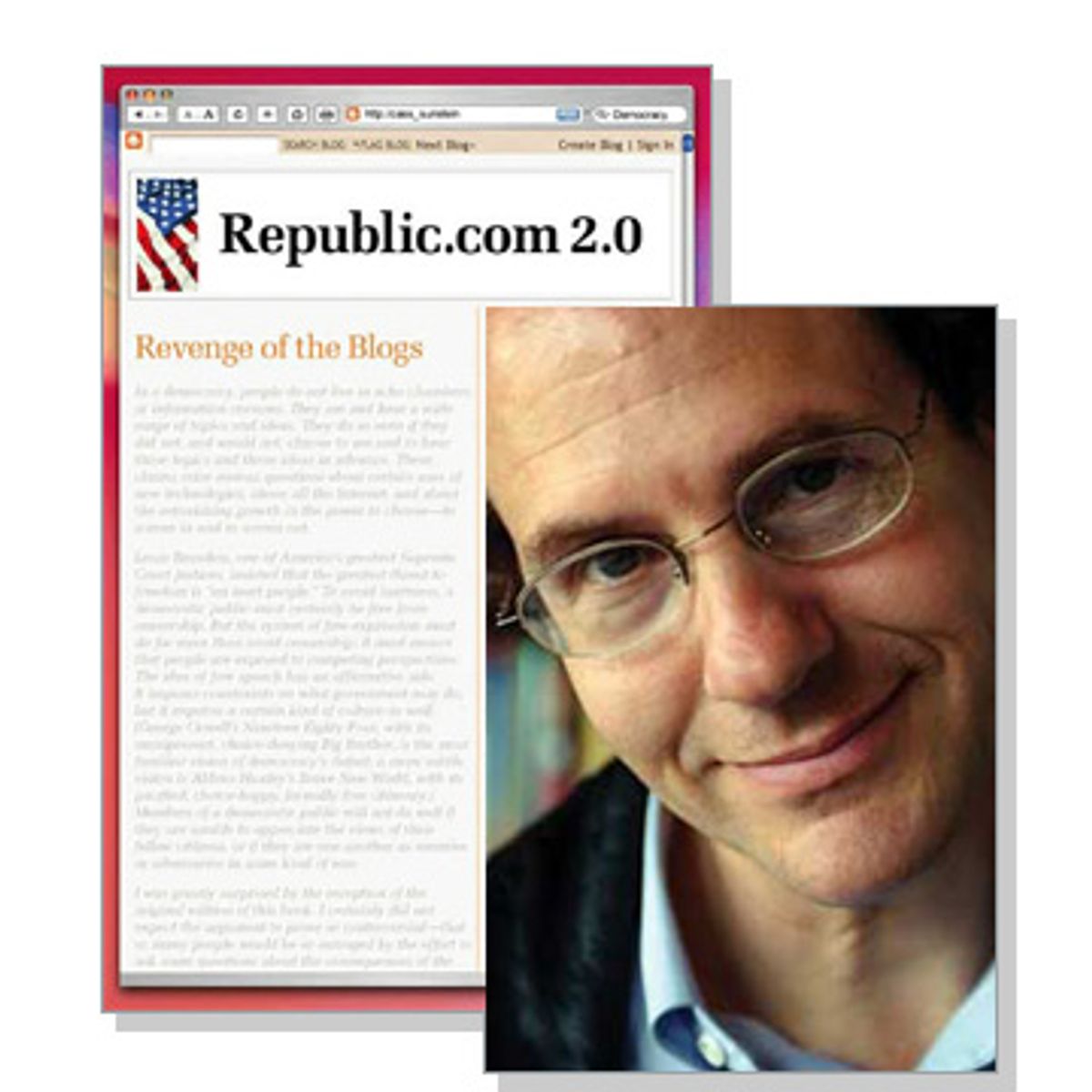
Freedom of choice is not always good for democracy. This observation is at the heart of University of Chicago law professor Cass Sunstein's book "Republic.com 2.0" (an update of "Republic.com" in 2001), which argues that our country's political discourse is fracturing in the information age. Sure, the Internet has been a boon to democracy in all sorts of ways, Sunstein acknowledges -- but if new technology gives us unprecedented access to information, it also gives us more ways to avoid information we don't like. Conservatives are increasingly seeking only conservative views, liberals are seeking only liberal views, and never the twain shall meet.
Sunstein's career has bridged the political divide. As an attorney in the Justice Department's Office of the Legal Counsel, he was an advisor to both Jimmy Carter and Ronald Reagan. He once clerked for the liberal Supreme Court Justice Thurgood Marshall and now teaches at the University of Chicago, known for some of its right-leaning faculty. In his free time, Sunstein advises Barack Obama, a former law school colleague.
What gets lost in these polarized times, Sunstein writes, are traditional civic virtues like civility, self-criticism and open-mindedness. He uses experiments and statistical analyses to back that up: One study of hyperlinking patterns on the Web shows that political bloggers rarely highlight opposing opinions -- of 1,400 blogs surveyed, 91 percent of links were to like-minded sites. A central problem, Sunstein argues, is that Americans now think of themselves more as consumers than as citizens. When it comes to the Internet, we demand the right to reinforce our own beliefs without embracing the responsibility to challenge them.
Salon spoke with Sunstein recently by telephone.
What inspired you to write this book? What sounded the alarm for you that there was a danger to democratic discourse?
What sounded it was all the excitement about personalization and customization, hearing people saying, "This is unbelievably great that we can just include what we like and exclude what we dislike." At the same time I was studying jury behavior. The empirical finding was that like-minded jurors, when they talk to one another, tend to get more extreme.
There's a book, "The Long Tail," by Chris Anderson, which celebrates the "niche-ification" of the world. I like the book -- I should say, I think it's a very good book -- but what's amazing to me is the extent to which Anderson and the Internet enthusiasts really can't even see a problem and can't see the individual and social benefits of being exposed to stuff you didn't choose.
Where do you see evidence that "niche-ification" is a problem?
I don't like that Rush Limbaugh listeners call themselves "dittoheads." It's funny, but it's kind of horrible. Fox News is a self-identified conservative outlet. The more extreme elements on the left treat their fellow citizens as if they're idiots, or as if they're rich people who don't care about anybody. So, I look at some of our culture, I see demonization, and I think, where does that come from?
The Clinton impeachment, I think, had an impact on the book. The impeachment was, it seems to me, constitutionally ridiculous. And yet a lot of people, at least publicly, seemed to agree with it, such that President Clinton was actually impeached. Where did that come from? Bush v. Gore had an impact: the fact that all Gore voters pretty much thought [the decision in] Bush v. Gore was wrong and that all Bush voters thought it was right.
The studies that you're talking about show that self-isolation breeds polarization on both the left and the right. A liberal might argue, though, that liberals are by definition more diversity-minded and more tolerant of the views of others.
Liberals are sometimes defined as people who can't take their own side in an argument. I actually don't think there's a difference, though. I would say that there are many liberals who think that, in the last few elections, to vote for a Republican presidential candidate is just mindless, that there's no rational reason that people would vote Republican. If liberals are thinking that, there's probably a problem. I think many liberals think that to vote for Bush, some part of their brain is on fire and the rest of it isn't functioning, or that they've been fooled in some way, or that they're not paying attention. So I think that a lot of liberals are in an echo chamber where they share a set of views, some of which are probably wrong.
Maybe now liberals think the U.S. should have signed the Kyoto Protocol, and that Bush's refusal to sign it was a big mistake. I think a lot of liberals believe that, but no Democrats in the Senate supported U.S. ratification of the Kyoto Protocol. A reasonable view is that it was a terrible idea for the United States. I think it's very plausibly the right view, at least as strong as the alternative view. Liberals tend to think increasing the minimum wage is a good idea. It's very complicated whether increases in the minimum wage are helpful to poor people.
There's a lot of echo-chamber-ism on both sides, and I don't know that it's worse on one side or the other right now.
In your book you observe that conservatives tend to congregate around an outlet like Fox News, while liberals tend to congregate around an outlet like NPR. Don't those outlets treat their ideological adversaries differently?
Air America maybe is more like Fox News, while NPR is not. It's too simple to say that NPR is a liberal outlet -- agreed entirely. I mean, Sean Hannity, who seems to me particularly mean and dumb -- and I'm happy to be quoted on that -- there's nobody like that on NPR.
I should say, I have a soft spot for O'Reilly, though. I've been on his show, and he's been fair and likable to me. I don't watch the show very often, so whether that's generally the case, I don't know.
To what extent is this polarization a part of human nature, and to what extent does it come from new technologies?
I think it's a very firm part of human nature that if you surround yourself with like-minded people, you'll end up thinking more extreme versions of what you thought before. So this group-polarization thing is robust -- it's been found in lots of different countries, and it's just in the nature of most people to do this.
How do you distinguish between what you're calling in the book a "general-interest intermediary" and a harmful "information filter"? For example, some people say the New York Times is intolerably liberal; other people say it's the paper of record.
There probably is a more or less objective standpoint, for example, that al-Qaida's statements are unreliable, while the Chicago Tribune, to give you an example of a not very partisan paper, is more reliable. And from the same standpoint that justifies greater faith in the Chicago Tribune than al-Qaida, we deserve to have greater faith in the conclusions of those who have read both conservative and liberal positions than those who restrict themselves to just one. Now, what I've just said depends on believing that neither conservatives nor liberals have a monopoly on wisdom.
As a law professor I would say, If you think there's nothing to be learned from Justice [Antonin] Scalia's opinions, then there's a real problem. Because some of his opinions are really good. And some of them are even right. And those that are wrong, you improve your thinking a lot if you grapple with what he has to say.
You're sounding a bit like Barack Obama. He was your colleague for a while, right?
Yes, 10 years. And I'm an informal, occasional advisor to him.
I'll tell you what I like about Obama, which is connected with the book. He really doesn't like to surround himself only with like-minded others. He really is someone who has never lived and wouldn't live in an echo chamber. His great skepticism about the red state, blue state divide is just the thought that no particular party has a monopoly on wisdom. He has an amazing line in the "Audacity of Hope" where he says, roughly, there are feminists in the United States who mourn their own abortions, and there are conservative women who have paid for their friends' daughters' abortions. And the reason I think this is so great is that it breaks down a sense that Americans come in two types.
Obama really understands that. I think Hillary Clinton probably does, too. Rudy Giuliani might. But Obama -- this is at the heart of his deepest convictions. So, one reason I'm excited about him is that he finds rigid distinctions unhelpful for citizens and public officials alike.
In contrast, in 2000 I had high hopes for President Bush. I thought he could be a very good president. I think he has failed terribly in part because his White House is like our Colorado experiment.
Could you explain to our readers what happened with that experiment?
The way our Colorado experiment worked is, we got people from Boulder, a liberal place, together in small groups to talk about climate change, same-sex civil unions and affirmative action. On the same day, we got people in Colorado Springs, a conservative place, to talk about the same three issues. We asked them to record their views anonymously first, then to deliberate on them in small groups, then to record their views anonymously afterward. What we found was that on these issues, the Boulder people, before they started to talk, were pretty liberal, but there was a distribution of views, a degree of diversity. After they talked, they were significantly more liberal and less diverse. So, deliberation among our liberal citizens of Boulder produced more extremism and less diversity. In Colorado Springs, after they talked to one another, they went far to the right. They started out somewhat open-minded on these issues, somewhat diverse, and after discussion the diversity was squelched and the extremism was increased.
I think this is a clue to what is happening in the political domain all over the United States: People through their own voluntary behavior are replicating our Colorado experiment. Or, savvy political entrepreneurs are creating the conditions of our experiment because they want to decrease internal diversity. Karl Rove could be described as a "polarization entrepreneur." The left isn't quite so good at this, but they're learning.
Where else have you seen this phenomenon?
This is our best real-world example: If you get three Republican appointees together on a three-judge federal court of appeals panel, then their voting patterns are very, very conservative. Much more so than how Republican appointees on the federal bench vote when there's a Democratic appointee there. And it's perfectly symmetrical. Democratic appointees show extremely liberal voting patterns when it's three Democratic appointees. What we observed in Colorado in an experimental setting is exactly what we found on the federal bench.
There's the same danger if a mayor or a governor or a president surrounds himself with like-minded others. A famous story about this is Kennedy's decision to invade the Bay of Pigs. People silenced themselves so as not to counteract the emerging consensus to invade. Afterwards, Kennedy said to himself, "How could I have been so stupid to let this go forward?" The answer was, he had an echo chamber there. [Franklin] Roosevelt, by contrast, is at the opposite pole of Bush. Roosevelt deliberately encouraged a lot of diversity of view, in a way that generated a ton of ideas and a lot of experimentalism. And Obama is much more like Roosevelt in that way.
How are your views here different from simple centrism? Does this amount to an aversion to extremes?
No, sometimes extremes are good. I think that every state in the union should recognize same-sex marriage. That's a pretty extreme position, but [I've heard the opposing views] -- I don't hold it because I haven't heard the opposing views. In my view, the idea that the Constitution protects commercial advertising is a mistake. And that's a pretty extreme position, but that's not because I live in a world in which everyone I know thinks the Constitution doesn't protect commercial advertising.
So, if extremism is generated after encountering competing arguments, by all means. The problem is when extremism emerges from the logic of social interactions.
The idea is that our system at its best is a deliberative democracy. And a deliberative democracy has preconditions. If we celebrate the capacity to self-sort, we'll lose sight of the value of deliberation.
What dynamics are at work with Hillary Clinton, the way she's treated by the right?
I think she has been turned into a cartoon by people who dislike her, and the cartoon really does involve an information cascade. There are things said about her character, her conduct, her plans, which have no basis. Once they start circulating they start being widely believed. Even if the particular fact isn't believed, there's a kind of odor that its dissemination produces.
There are legitimate questions that can be raised about anybody. The polarization with respect to her has something to do with her, but has a lot more to do with how information travels. An empirical answer would involve work that I haven't done. But, offhand, talk radio, Fox News and some parts of the blogosphere are responsible for the cartoonization of Hillary Clinton.
It's always easier to spread a simple story than a complicated story. With politics and with products, if there's a simple narrative that can take hold, it's very powerful. The people who hate Hillary Clinton have a narrative of her that is hateful, and the simplicity of it allows it to travel.
You start the book by arguing that there are constitutional grounds for limiting choice -- that the First Amendment is specifically designed to promote democratic deliberation, that it doesn't give us the right to do whatever we want. As I was reading, I thought you were clearing a legal path for some radical policy prescriptions. But you ultimately don't advocate for more government regulation of the Internet.
Not at all. I have thought over the years of whether it makes sense for the government to have a regulatory role. But the Internet is too difficult to regulate in a way that would respond to these concerns.
The first book ["Republic.com"] had suggestions that government should consider fairness-doctrine-type mandates on Web sites. It suggested that it's reasonable for government to think about creating the equivalent of linking obligations and pop-ups, so that you'd be on one site -- say, a conservative site -- and there'd be a pop-up from a liberal site. I now the believe that the government should not consider that -- that it's a stupid and almost certainly an unconstitutional suggestion.
What changed your thinking?
Hearing counter-arguments and seeing the nature of the Internet as it unfolded over time. "Republic.com" made a mistake of applying to the Internet some ideas that were developed in a world of three or four television networks.
The Internet is regulated heavily, by the way: The equivalent of trespass is forbidden. You can't libel people on the Internet. You can't commit fraud over the Internet. So that's good. But the kinds of regulation that would respond to my concerns [about deliberative democracy], they're not really feasible and they probably wouldn't help. Most problems are best solved privately, not through government. There's a problem of discourtesy in the world, which is best handled through social norms, which are indispensable. But you wouldn't want the government to be mandating courtesy.
So if you're not proposing regulation, what were your goals for the book?
The goals for the book were to help promote an appreciation for an aspect of our democratic tradition that emphasizes unanticipated encounters and shared experiences. The problem presented in the book has a cultural solution, not a legal solution.
Someone read my book recently and asked, "Is this a love letter to America?" I wouldn't put it that way, but it probably is -- to aspects of America, its teeming diversity, its receptivity, its heterogeneity, its curiosity, its amazement at itself, its youth. These aspects of the country aren't adequately captured by those who say, "Oh, now I can create a 'Daily Me,'" or by those who say, "I can buy the products and read the opinions and focus on the topics I like. I don't have to be bothered with other stuff."
The prologue of your book reminded me of Rachel Carson's "Silent Spring." Is the idea here to start something like the environmental movement, but for public spaces and civil discourse?
It's starting to happen. Web 2.0 is really concerned with niches in large part. But part of Web 2.0 -- and we can imagine a Web 3.0 -- is about public spaces. Wikipedia is a public space, in the sense that it's collectively produced, it has norms of civility, it is a place that maintains a degree of neutrality. And we're starting to see more civic spaces on the Internet.
The unacknowledged hero of the book is Jane Jacobs, with her book "The Death and Life of Great American Cities." Her argument, it's really a love letter to cities. They have a teeming diversity where you go around the corner and say, "What is that!" The next block, you see something in terms of people, or architecture, or groups -- something you could never have imagined and wouldn't have chosen, but that affects you and sometimes changes you. That is part of America's distinctive culture.
Shares