

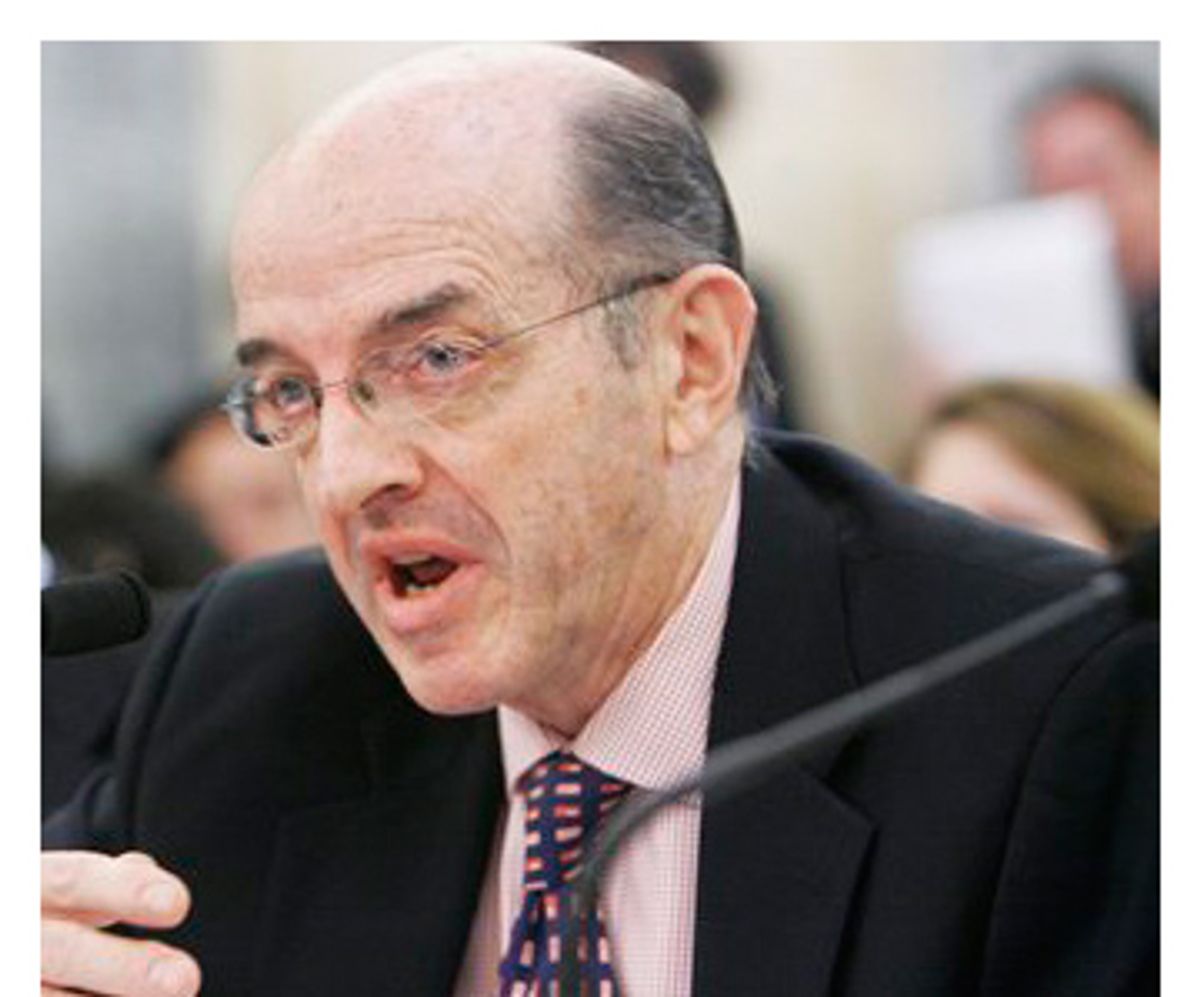
Michael Copps doesn't want to be called a crusader. But as one of the two Democrats on the five-member Federal Communications Commission, he's not shy about sounding biblical. He says he's "blowing a loud trumpet" for a "call to battle" to stop the FCC from giving big media a generous Christmas present.
Copps is trying to defeat FCC chairman Kevin J. Martin's last-minute proposal to loosen media ownership rules, which will be voted on by Dec. 18. As it stands now, a company can't own both a daily newspaper and a broadcast outlet -- a radio or TV station -- in the same market without a waiver. In an Op-Ed piece in the New York Times on Nov. 13, Martin wrote that media companies in the 20 largest markets should be allowed to own both in the same market to bolster journalism. "If we don't act to improve the health of the ... industry," he wrote, "we will see newspapers wither and die ... and have fewer outlets for the expression of independent thinking and diversity of viewpoints."
The public, however, won't have much time to express its own diverse viewpoints on Martin's proposed rules. He unveiled his plan in the Times four days after the FCC's sixth, and last, hearing of the year on media ownership. The public has only until Dec. 11 to comment on the new rules, with the FCC voting on them within the following week. The push for a quick decision prompted Sens. Byron Dorgan, D-N.D., and Trent Lott, R-Miss., to introduce bipartisan-sponsored legislation to halt the FCC's "fast march" toward easing media ownership rules. Why the rush? Last time the FCC proposed a relaxation of the rules in 2003, public outcry killed the plan. Copps thinks Martin wants to push them through now when voters -- and politicians -- are distracted by holiday hoopla and before the first presidential primaries and caucuses. Once everyone sobers up in January, Copps says, the issue will become a " hot potato." Copps, 67, was chief of staff to former Democratic Sen. Fritz Hollings of South Carolina and was an assistant secretary of commerce in the Clinton administration. He was sworn in as an FCC commissioner in 2001. Salon recently spoke with him by phone:
In his Op-Ed in the Times, FCC chairman Kevin Martin wrote that the loosening of the ban on cross ownership of newspaper and TV stations was "relatively minor." You have characterized these new rules as the "camel's nose in the tent." What do you mean by that?
Number one, it's not the modest proposal that he would have us believe, because I find it is riven with loopholes. For example, he says that it is only going to affect the top 20 markets. That, by the way, is 42 or 43 percent of all of our households. But point in fact, there is a major loophole that would allow companies in smaller markets, just about any market, to apply for a similar exception on the basis of meeting a few loose criteria. So what you could wind up with is newspaper-broadcast cross-ownership in many, many more markets.
And number two, I said it was the camel's nose in the tent because I think that if they get away with this one proposal with newspaper-broadcast cross-ownership, they'll come back for changes in more of the rules, like allowing more duopolies or triopolies like the ones [FCC] chairman [Michael] Powell proposed back in 2003. You might remember that his scheme, which he actually succeeded in getting through the FCC, though it was later reversed by Congress and the courts, would have allowed in some of the larger markets a company to own up to three television stations, eight radio stations, a newspaper -- which is already a monopoly in most cities -- a cable system, and even an Internet provider. I just fail to understand how that kind of control over our media enhances democracy or works to the benefit of the American people.
What do you think could be the effect of these rules on the political system?
It's bad for the political system whether you're a liberal, a conservative or a moderate, when the number of voices and diversity is diminished in our country. That's bad for our civic dialogue, if a few companies have too much control. We've witnessed a tremendous amount of consolidation already. This consolidation involves not just owning the various channels of distribution, stations and the channels, but also vertical concentration, so they control the production and the content. If you have a lock on the content and a lock on the distribution, that's a recipe, and it always has been, for a monopoly or at least an oligopoly. That's what we have in our media.
Our Communications Act is premised on the idea that we should have more localism in our programming, that we should have more diversity of content, diversity of voices, and that includes diversity of ownership and competition. We're going in exactly the wrong way. And I might point out, I've been pretty adamant that we should not vote until we do something about minority ownership and localism.
Before we vote to loosen old rules, governing media ownership, we should take proposals that have been pending for so long on how we can increase minority ownership of our media properties. We live in a country that is one-third minority right now in the United States of America. People of color own 3.26 percent of all full-power commercial television stations, so is it any wonder then that their issues are not given the kind of coverage that they may like to have? Is it any wonder that they're so characterized that when you see a news story about an African-American it's often about crime? Or when you see a news story about a Latino, it's about jumping over a fence to get into the United States? What about the many million more stories that have to do with the contributions that these groups make to the country and what's going on in their communities? And what are their issues? And this applies to women when it comes to ownership too. Diversity of voices depends on ownership. If you don't have diversity of ownership, you're not going to have diversity of voices. So it's important to the future of our country. Our future is our diversity. That's our strength. That's our opportunity going forward. Why should we have a media that doesn't reflect that?
What do you mean by "localism"?
I mean that that in the face of consolidation too much of the programming comes from the networks or comes from afar. The owners, instead of being members of the community, are often people who live hundreds or thousands of miles away. Too many stations aren't even inhabited by human beings. They're run by computers or by mechanical means. That's why nobody's there. Localism means that you go out and talk to people locally about the kinds of issues and programming that they want. We don't do that anymore.
Martin wants a ruling by Dec. 18. Why do you think he wants it so soon?
Well, the rush is on. I can't speak for him or his motivations, but people have said that this could be a really politically hot potato if decided next year during the campaign season. Three million Americans contacted the FCC and the Congress in 2003, when [former FCC chairman Michael Powell wanted to loosen ownership rules]. And 99.9 percent were against what Powell was doing. There is a realization that this is a grass-roots issue and that it does spark some volatility. Some folks are at least implying that they want to get this out of the way before then. Do it in mid-December, and maybe Congress is going home and maybe we'll be wrapping our holiday gifts and not paying attention to it.
Who would be the beneficiaries if these new rules take effect?
I think there would be lots of them. Most of the major newspaper chains would be looking to buy some of these very profitable broadcast outlets. Although you have to be careful that you don't fall too easily to the newspaper [companies'] claim that they're essentially a hemorrhaging industry. I think Merrill Lynch put the average return on newspapers at 17 or 18 percent. I wish I had some investments that were making 17 or 18 percent. In addition to outright transactions, there will be all kinds of swaps. I'll give you my station here for your station there, and then I'll have a newspaper-broadcast cross-ownership. All of that is going to drive out a lot of smaller stations from the news business. They'll figure, "How can I compete now if they have the newspaper and television station in town? I might as well get out of this business." Oddly enough, not oddly, but interesting, a lot of those tier-four and below stations will be the ones that are going to be allowed to be sold. If women and minorities are lucky enough to own stations, that's where they are. So we're encouraging the buyouts of those stations too. We could wind up with a real loss of diversity.
What about Rupert Murdoch's News Corporation? You expressed reservations about its purchase of Dow Jones, which owns the Wall Street Journal.
I'm so disappointed in that. This is a major transaction involving a company that owns 35 television stations, studios, and so many other different things. And now they're going to take over Dow Jones and the Wall Street Journal in New York City, where they already own a couple of television stations and the New York Post. The Federal Communications Commission says we don't have any jurisdiction to look at that, so we're not even going to examine that. I think that's irresponsible. They based that on some kind of precedent from the 1980s, when the commission decided in a very different media environment that USA Today was a national newspaper and not a local newspaper. I think, number one, our public interest obligations give us ample room to look at that merger. But number two, and even more importantly, we ignored the local impact that that merger has in New York City. That's squarely in our jurisdiction. I don't think anyone should be able to get away with denying that. There are hundreds of thousands of issues of the Wall Street Journal that get circulated in New York City every day. Don't tell me that doesn't have some effect on control in New York, loss of diversity and all the rest.
Do you think that the Bush administration has made it a priority to put these changes into effect before the end of his presidency?
Clearly it's a priority for Chairman Martin to get these adopted as early as he can. Now I must say, they might have gone even further if the political environment hadn't changed a year ago in Washington. If we had less congressional oversight than we're getting right now, I suspect the forces of consolidation would probably have asked for more.
Do you see yourself as being on a crusade?
That [word] is invested with religious overtones. My No. 1 priority issue at the FCC has been the media environment. I find abhorrent what some of the effects of consolidation have been upon our culture, our entertainment and our civic dialogue. I think it's important for our country to change that.
When I go around and talk to people, I say, people in this audience may have a lot of different issues that they think are the most important issue confronting America. Maybe it's the war in Iraq, or maybe it's, how do we create high-paying jobs? or how do we insure our 40 million people who don't have healthcare? how do we educate our kids? how do we pry open the doors of equal opportunity further? If those are your priorities, that's fine.
But then I say, your No. 2 issue has to be this media issue, because all those other issues you care about that I just mentioned are funneled and filtered through big media, if they're lucky enough to get in that funnel at all. They're lucky to even be covered by big media. Then they're covered with the slant of a few particular companies. And it's not so much a political slant as it is a commercial slant. It's a commercial bias of all this that I think is the problem, selling products to a particular demographic.
So you're not a crusader, but at a conference in New York earlier this month, you said you were sounding a "call to battle" and "blowing a loud trumpet."
You've got to do that if the media is not giving you coverage. You've got to rely on using your bully pulpit. There are a lot of good groups that are working on this issue. The Internet is a marvelous tool for getting this story out. And the folks on the Internet side are beginning to see that their new media is beginning to be compromised by consolidation too. A lot of content is being bought up by people who have too much control over distribution, so I think Internet outlets are getting worried about their future. This is a not a debate about yesterday's media or about something passing into history. This is about new media as much as it is about old media. If you're interested in the future of the Internet, you ought to be mightily involved in this issue over media consolidation.
Do you think there are any specific issues that will not get sufficient coverage because of media consolidation?
Issue No. 1 would be media consolidation [itself]. I can't tell you how many different cities I go into where there is a strongly consolidated environment and you read so little about media consolidation. A few years ago, I went to Phoenix, Ariz., to attend a hearing [on media consolidation]. Someone else was holding the hearing [not the FCC]. It was in the middle of the afternoon. I would guess 300 people showed up for it, but it had not been very much discussed in the local media, as you can imagine. Yet all these people showed up. I talked to some of them in the audience and asked, "How did you find out about this hearing?" And one of them said, "I heard it on the BBC." I thought that was pretty revealing with one company controlling so much of the media market. Maybe that company wasn't so keen on covering this consolidation issue. But the BBC thought it was newsworthy enough to broadcast about it. I've seen that in many other places.
I visited the editor of the editorial page of a major newspaper in this country not too many weeks ago, and we got talking about this issue. I think the person in his heart was on my side of the issue, but he said they can't cover that issue. And I said, "Oh, why not?" He said, "The publisher wouldn't let us do that. It would be against the interest of the company. I have a lot of freedom to cover what I want issue-wise on my editorial page, but I'm not going there." It wasn't almost chilling; it was downright chilling.
Why won't the FCC hold hearings on Martin's proposal?
I had asked originally for a dozen hearings or so, and he committed to six. And this was the sixth one. Interestingly enough, it sounds confusing, because we did have a hearing a couple days before in Washington on localism, because [former FCC] Chairman Powell had kind of promised that there would be six hearings on localism also. There was one of those outstanding, so they wanted to get that done too, so they could say localism hearings are done and the media ownership hearings are done. They had the localism hearing at the end of October in Washington, D.C., on relatively short notice, and then just a few days later we all packed up and had another hearing in Seattle. To me that just said we're just checking the boxes; we're in a hurry to hold these hearings.
What did we learn from Chairman Powell's attempt to allow greater media consolidation in 2003?
That citizen action in this country can still work. A lot of people think, "Oh, with so many large impersonal forces, I'm not even a cog in the wheel, so how does my voice count?" But the fact that 3 million people found out about that and contacted the FCC, which led to congressional action ... and to people taking it to court, [which] sent those rules back to the FCC, was a victory. We're back to starting all over, but at least we kept those rules from going into effect. Recent history shows that citizen action still works even in the 21st century. History shows that we go through these cycles of consolidation and reaction.
Do you think the public response now will be similar to what we saw in 2003?
I think it's building. Some of the candidates in the presidential election already are talking about this issue. I think that if the media did a better job of explaining that this is queued up right now -- if [Martin] really insists on going ahead with this vote on Dec. 18 -- that would spark a grass-roots movement. And in the final analysis, if we are going to move toward airwaves of, by and for the people, and a good stewardship of the airwaves, it'll be because of a grass-roots effort. That's what worked in 2003. A lot of congressmen and senators went home and went to town meetings, and people would ask them about media consolidation. They had never seen that before. It made a difference. I think that had something to do with the fact that the Senate voted so quickly to overturn and reverse what Chairman Powell was attempting to do. That's what we need now. We need to send messages to the FCC and to the White House. You asked how involved is the White House in this. I don't know 100 percent the answer to that, but [those in the White House] should know clearly that this is an issue of importance to many people.
Do you think Chairman Martin underestimated the Senate's concern about further media consolidation?
Again, you'd have to speak to him. He seems determined to do this. If I were sitting where he is and I got this kind of bipartisan pushback, where you hear not only from Byron Dorgan on the Democratic side, but Trent Lott on the Republican side, when you hear not only Bill Nelson on the Democratic side, but Olympia Snowe on the Republican side, I'd really be a little bit cautious myself. I'd be fearful of running into a buzz saw with Congress and running into a buzz saw with the American people.
Shares