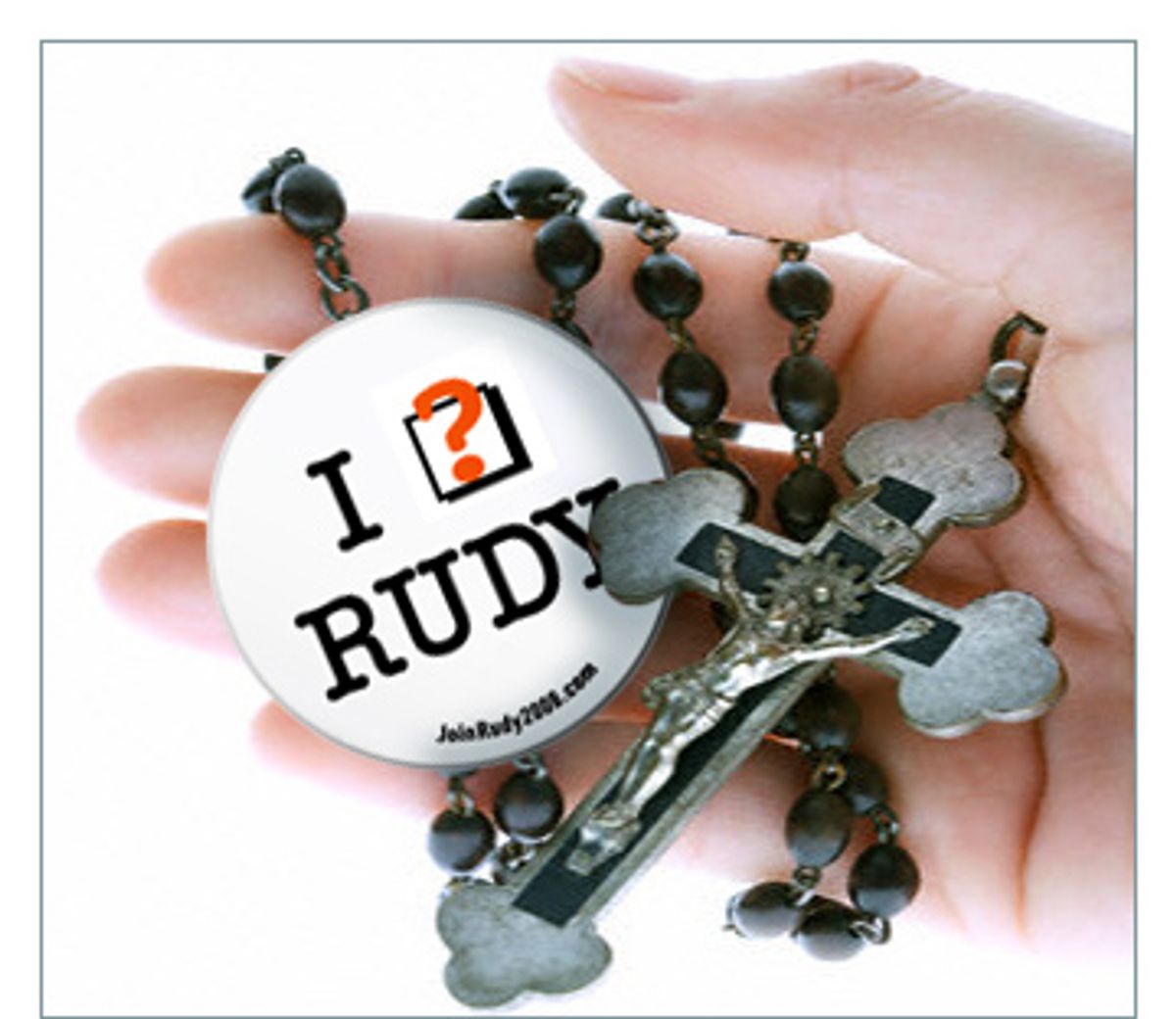
Late last spring, Bishop Thomas J. Tobin of the Roman Catholic Diocese of Providence opened his mail to find an invitation to a local fundraising event for Republican presidential hopeful Rudy Giuliani. Tobin made national headlines when he responded to the invitation by penning a column for the Rhode Island Catholic about Rudy Giuliani's abortion views, chastising the former New York mayor for saying he believes abortion is morally wrong yet supports reproductive choice for women as a matter of public policy.
"Rudy's public proclamations on abortion are pathetic and confusing," wrote Tobin. "[His] preposterous position is compounded by the fact that he professes to be a Catholic. As Catholics, we are called, indeed required, to be pro-life, to cherish and protect human life as a precious gift of God from the moment of conception until the time of natural death. As a leader, as a public official, Rudy Giuliani has a special obligation in that regard."
Catholics, who cast almost a quarter of all votes nationally, and higher shares in swing states like Ohio, are one of the most important voting blocs in the American electorate. In fact, in every presidential election since 1972 the winner of the Catholic vote has won the overall national popular vote, something no other religious group -- Jews, evangelicals, Protestants -- can boast. If Republicans nominate him, barring a surprising late surge from Democrats Joe Biden, Chris Dodd or Bill Richardson, Giuliani would be the only Catholic in the general election. And part of Giuliani's supposed "electability," a selling point to the party faithful, is that he would draw support from "Reagan Democrats" in crucial, and heavily Catholic, Democratic and swing states in the Northeast and Midwest.
Polls of likely Republican primary voters have long shown that Giuliani is a favorite among Catholic Republicans. But if Giuliani's electability in the general election hinges in any way on his co-religionists, he may be in trouble. Problems with Catholics like Bishop Tobin were not hard to predict. It was inevitable that during Republican primary season, some conservative and observant Catholics would raise questions about Giuliani's checkered marital history and his stands on abortion and gay rights. But if he is the nominee next fall, he will also have to contend with three other Catholic constituencies in the general election -- less-observant Catholics, politically moderate Catholics and Latino Catholics -- all of whom may find fault with him for very different reasons.
The short history of Catholic presidential nominees begins in 1928. At that year's Democratic National Convention in Houston, New York Gov. Al Smith overcame resistance by Catholic-wary delegates from Texas and the South to win the nomination on the first ballot. If not for his religion, Smith's progressive platform might have been better received during the general election. Instead, by a 58 percent to 41 percent margin Republican Herbert Hoover crushed Smith, who became the first Democratic nominee since Reconstruction to lose more than one Southern state.
In the wake of the Smith debacle, neither party would run a Catholic for the presidency for another 32 years. John F. Kennedy's religion continued to be a concern for Democrats even after he'd secured the party's nomination in 1960. Today, JFK's famed "the Church does not speak for me" speech to the Greater Houston Ministerial Association in September of that year is viewed as a glass ceiling moment for Catholic politicians, but at the time some still believed the candidate's faith made him unelectable. The bootlegger's son proved his doubters wrong, if barely so. He won nationally by fewer than one vote per precinct -- squeaking to victory because of wide margins in Catholic neighborhoods in the closely contested states of Illinois, Missouri and New Jersey.
Forty-four years after Kennedy, the Democrats again nominated a Catholic senator from Massachusetts with the initials JFK. Despite facing an incumbent, John Kerry performed rather well nationally in 2004 against President George W. Bush. Following the more recent historical pattern, in losing the general election by less than 3 percentage points, he also lost the overall Catholic vote by 5 percentage points.
If nominated to run in the general election next fall, Rudy Giuliani would be the first Republican Catholic presidential candidate in history. But to predict how he might perform, it's actually instructive to look at how Democrat John Kerry fared in 2004.
Catholicism in and of itself is probably no longer much of a factor, positive or negative, for voters. Despite those early polls showing that Catholic Republicans prefer Giuliani to his GOP rivals, Clemson University political scientist Laura Olson doesn't think the simple fact of Giuliani's religion will prove a boon at the voting booth come next November. "Catholic voters aren't going to turn out en masse for Giuliani any more than they did for Kerry, which they didn't," predicts Olson, author of "Religion and Politics in America: Faith, Culture, and Strategic Choices." At the same time, says Olson, Rudy's faith won't hinder him. "Being Catholic isn't much of a stigma anymore in the United States -- except at the margins, like some corners of the rural South -- in large part because Catholics have assimilated so thoroughly."
What matters today, instead of denomination, is devotion, and that's where Giuliani's fortunes may parallel Kerry's. To understand the intersection of religion and politics in America, as Akron University's John Green explains in his new book, "The Faith Factor: How Religion Influences American Elections," it is now more important to focus on "behaving" and "believing" than "belonging." Put simply, it's more instructive to know how often people attend church than what type of church they attend.
Frequency of church attendance, regardless of denomination, corresponds with conservatism on social issues like abortion. Sixty-three percent of Catholics who go to Mass weekly are antiabortion. In 2004, John Kerry's pro-choice stance was a clear liability among devout Catholics. White Catholics who attended church weekly were 9 percentage points more likely than less frequent attenders to vote for George Bush.
Rudy Giuliani, like John Kerry, is pro-choice. "As a pro-choice former mayor of New York City, it's hard to see how his Catholicism helps him," asserts Sean Casey, associate professor of Christian ethics at Wesley Theological Seminary. "Among moderate and conservative Catholics, because of his position on abortion, Giuliani does nothing for them. In fact, he looks like a turncoat of a worse variety than Kerry because he's a Republican."
As proved by Bishop Tobin's column, and the existence of anti-Giuliani conservative groups like this one, a few dissenting voices will be enough to generate controversy. "It's becoming ever more clear that Rudy Giuliani suffers from John Kerry syndrome," Joseph Cella, president of Fidelis, a Catholic advocacy group, told the New York Times earlier this year. "[H]e shares the identical position on abortion as John Kerry and Hillary Clinton." Fidelis ran ads slamming Giuliani's pro-choice stance in Iowa prior to August's straw poll.
Giuliani is also, after one annulment and one divorce, on his third marriage. His marital history exacerbates his problems with devout Catholics. "Rudy's a lousy Catholic," said Casey. "He hasn't taken communion in years because of his marital problems. I think the Catholic bishops are gunning for him. If he's dumb enough to show up asking for communion, they're going to whack him." Several Catholic bishops have already signaled that they would deny Giuliani this sacrament. Giuliani may come to regret saying, as he did in August, "The degree to which I am a good or not so good Catholic, I prefer to leave to the priests."
But if the Tobin episode hinted that a more general rebuke might be forthcoming from the U.S. Conference of Catholic Bishops, that possibility became a bit more remote after the 300-plus bishops assembled in Baltimore in November. They ratified a new political document, "Forming Consciences for Faithful Citizenship," which provides a bit of wiggle room on abortion for Catholics. "Can a Catholic in good conscience vote for a candidate who is pro-choice?" The Rev. Thomas J. Reese of Georgetown University's Woodstock Theological Center asked rhetorically in the New York Times. "What [the Bishops] are saying is, 'Yes.'"
Moreover, Giuliani's anti-terrorism profile could be an asset among conservative Catholics, especially white Catholics. "In 2004, when the rest of the electorate told exit pollsters that 'moral values' was their top issue, white Catholics cited terrorism," observes Scott Winship, a social policy analyst and frequent contributor to "the Democratic Strategist" Web site.
Whites, however, now account for fewer Catholic voters than they once did. In November 2008, one out of four Catholic voters will be Latino. Kerry easily won Latino Catholics in the last election cycle. They chose him by 5-to-3 over Bush, with little difference in the behavior of "weekly attenders" and the "less devout." Should he reach the general election, Giuliani could be helped or hindered by Latino Catholic voters, depending on whether he runs on his record or his primary-season rhetoric. As mayor of New York, Giuliani presided over a so-called sanctuary city. As a contender for the Republican nomination, he has tried to out-flip-flop Mitt Romney by talking tougher-than-thou on illegal immigration. If he became the GOP candidate, would he tack back to the center to make amends with Latinos? Would the GOP base let him?
Finally, one of the reasons that Kerry remained competitive with Bush is that he ran even among another one of Catholicism's fastest-growing cohorts: the less devout. And less observant, younger and more politically moderate Catholics may have no problem with Rudy's views on social issues, but they may not like the fact that he has Norman Podhoretz on his foreign policy team. "I think Rudy might have a difficult time appealing to many white Catholics not only because of his positions on abortion and gay rights, but also because he is so hawkish on foreign policy," predicts Olson. "The abortion and gay rights positions would hurt him with one distinct group of white Catholics -- those who are most observant and most conservative -- but the foreign policy positions might hurt him with more moderate-to-progressive white Catholics."
Come November 2008, will any of these factors change the electoral map? Looked at on a state-by-state basis, the most favorable scenario for Giuliani is in his home region. Among white Catholics, there is a slight Republican skew to weekly attenders, men and those with higher incomes. This could conceivably help Giuliani in the Northeast, which is heavy on both high-income households and Catholics and where Bush's reliance on the security issue, Giuliani's strong suit, had some traction in the last presidential contest. According to 2004 exit polls, Catholics cast at least 31 percent of the vote in nine Northeastern states: New Hampshire, Vermont, Rhode Island, Massachusetts, Connecticut, New York, New Jersey, Pennsylvania and Delaware. Realistically, in a close election, only New Hampshire and Pennsylvania would truly be in play next fall. But both would represent GOP pickups, and Pennsylvania alone would be a crucial loss of electoral votes for Democrats.
Giuliani's success with Catholic voters in the Southwestern swing states, meanwhile, would depend on which Giuliani shows up for the general election, the sanctuary-city mayor or the anti-illegal immigration GOP primary contender. Among the dozen states decided by 5 percent or less in 2004, the most notable in terms of Catholic populations are Ohio, Florida and three Southwestern states: Colorado, Nevada and New Mexico. Though Latino Catholics cast fewer than 5 percent of all votes nationally in the last presidential election, Latinos account for significant chunks of the Catholic population in all of these swing states except Ohio.
But Bush won all five of these states in 2004 anyway. The potential value of Giuliani's Catholicism among Latinos is therefore reduced to helping Republicans protect what they already have. It might be safer to assume the momentum will go in the other direction. Hispanic voters are swinging back toward the Democrats and, as Olson notes, any Democratic nominee is certain to have an immigration position more attractive to Latinos than that of Giuliani, no matter how much he tamps down his present rhetoric.
In short, the Republicans might be able to open up the electoral map in 2008 with the right Catholic candidate. But that person would have to be pro-life, immigration-friendly, and still on his or her starter marriage. Unfortunately for the GOP, no such candidate is available, because Rudy Giuliani fails on all three counts. "Bush won Catholics in 2004, but they broke Democratic in the 2006 midterm elections," says Casey. "But I'm not sure that a pro-choice NYC mayor is the guy to swing them back to the Republicans. The irony of the situation is that the Republicans may finally nominate a Catholic, but the wrong Catholic."
Shares