

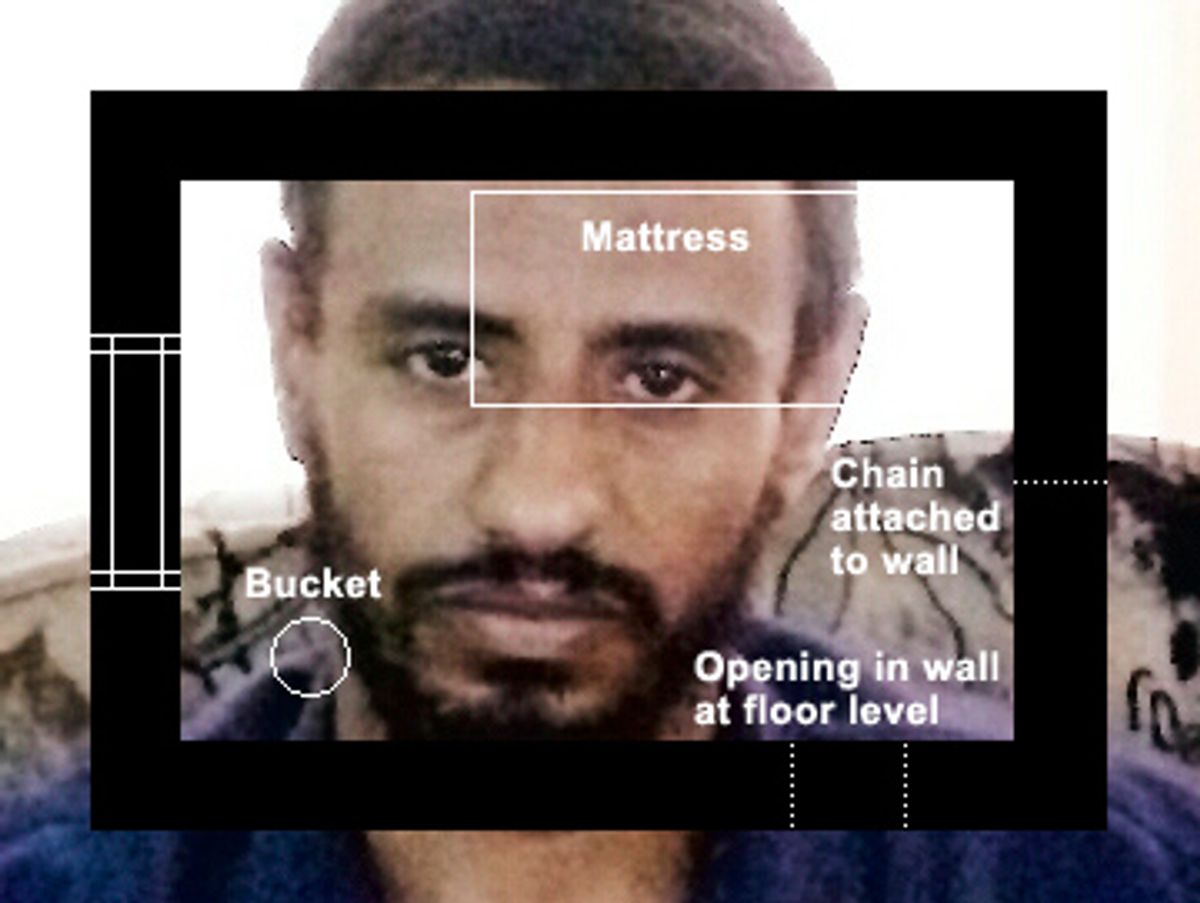
The CIA held Mohamed Farag Ahmad Bashmilah in several different cells when he was incarcerated in its network of secret prisons known as "black sites." But the small cells were all pretty similar, maybe 7 feet wide and 10 feet long. He was sometimes naked, and sometimes handcuffed for weeks at a time. In one cell his ankle was chained to a bolt in the floor. There was a small toilet. In another cell there was just a bucket. Video cameras recorded his every move. The lights always stayed on -- there was no day or night. A speaker blasted him with continuous white noise, or rap music, 24 hours a day.
The guards wore black masks and black clothes. They would not utter a word as they extracted Bashmilah from his cell for interrogation -- one of his few interactions with other human beings during his entire 19 months of imprisonment. Nobody told him where he was, or if he would ever be freed.
It was enough to drive anyone crazy. Bashmilah finally tried to slash his wrists with a small piece of metal, smearing the words "I am innocent" in blood on the walls of his cell. But the CIA patched him up.
So Bashmilah stopped eating. But after his weight dropped to 90 pounds, he was dragged into an interrogation room, where they rammed a tube down his nose and into his stomach. Liquid was pumped in. The CIA would not let him die.
On several occasions, when Bashmilah's state of mind deteriorated dangerously, the CIA also did something else: They placed him in the care of mental health professionals. Bashmilah believes these were trained psychologists or psychiatrists. "What they were trying to do was to give me a sort of uplifting and to assure me," Bashmilah said in a telephone interview, through an interpreter, speaking from his home country of Yemen. "One of the things they told me to do was to allow myself to cry, and to breathe."
Last June, Salon reported on the CIA's use of psychologists to aid with the interrogation of terrorist suspects. But the role of mental health professionals working at CIA black sites is a previously unknown twist in the chilling, Kafkaesque story of the agency's secret overseas prisons.
Little about the conditions of Bashmilah's incarceration has been made public until now. His detailed descriptions in an interview with Salon, and in newly filed court documents, provide the first in-depth, first-person account of captivity inside a CIA black site. Human rights advocates and lawyers have painstakingly pieced together his case, using Bashmilah's descriptions of his cells and his captors, and documents from the governments of Jordan and Yemen and the United Nations Office of the High Commissioner for Human Rights to verify his testimony. Flight records detailing the movement of CIA aircraft also confirm Bashmilah's account, tracing his path from the Middle East to Afghanistan and back again while in U.S. custody.
Bashmilah's story also appears to show in clear terms that he was an innocent man. After 19 months of imprisonment and torment at the hands of the CIA, the agency released him with no explanation, just as he had been imprisoned in the first place. He faced no terrorism charges. He was given no lawyer. He saw no judge. He was simply released, his life shattered.
"This really shows the human impact of this program and that lives are ruined by the CIA rendition program," said Margaret Satterthwaite, an attorney for Bashmilah and a professor at the New York University School of Law. "It is about psychological torture and the experience of being disappeared."
Bashmilah, who at age 39 is now physically a free man, still suffers the mental consequences of prolonged detention and abuse. He is undergoing treatment for the damage done to him at the hands of the U.S. government. On Friday, Bashmilah laid out his story in a declaration to a U.S. district court as part of a civil suit brought by the ACLU against Jeppesen Dataplan Inc., a subsidiary of Boeing accused of facilitating secret CIA rendition flights.
Bashmilah said in the phone interview that the psychological anguish inside a CIA black site is exacerbated by the unfathomable unknowns for the prisoners. While he figured out that he was being held by Americans, Bashmilah did not know for sure why, where he was, or whether he would ever see his family again. He said, "Every time I realize that there may be others who are still there where I suffered, I feel the same thing for those innocent people who just fell in a crack."
It may seem bizarre for the agency to provide counseling to a prisoner while simultaneously cracking him mentally -- as if revealing a humanitarian aspect to a program otherwise calibrated to exploit systematic psychological abuse. But it could also be that mental healthcare professionals were enlisted to help bring back from the edge prisoners who seemed precariously damaged, whose frayed minds were no longer as pliable for interrogation. "My understanding is that the purpose of having psychiatrists there is that if the prisoner feels better, then he would be able to talk more to the interrogators," said Bashmilah.
Realistically, psychiatrists in such a setting could do little about the prisoners' deeper suffering at the hands of the CIA. "They really had no authority to address these issues," Bashmilah said about his mental anguish. He said the doctors told him to "hope that one day you will prove your innocence or that you will one day return to your family." The psychiatrists also gave him some pills, likely tranquilizers. They analyzed his dreams. But there wasn't much else they could do. "They also gave me a Rubik's Cube so I could pass the time, and some jigsaw puzzles," Bashmilah recalled.
The nightmare started for him back in fall 2003. Bashmilah had traveled to Jordan from Indonesia, where he was living with his wife and working in the clothing business. He and his wife went to Jordan to meet Bashmilah's mother, who had also traveled there. The family hoped to arrange for heart surgery for Bashmilah's mother at a hospital in Amman. But before leaving Indonesia, Bashmilah had lost his passport and had received a replacement. Upon arrival in Jordan, Jordanian officials questioned his lack of stamps in the new one, and they grew suspicious when Bashmilah admitted he had visited Afghanistan in 2000. Bashmilah was taken into custody by Jordanian authorities on Oct. 21, 2003. He would not reappear again until he stepped out of a CIA plane in Yemen on May 5, 2005.
Bashmilah's apparent innocence was clearly lost on officials with Jordan's General Intelligence Department. After his arrest, the Jordanians brutally beat him, peppering him with questions about al-Qaida. He was forced to jog around in a yard until he collapsed. Officers hung him upside down with a leather strap and his hands tied. They beat the soles of his feet and his sides. They threatened to electrocute him with wires. They told him they would rape his wife and mother.
It was too much. Bashmilah signed a confession multiple pages long, but he was disoriented and afraid even to read it. "I felt sure it included things I did not say," he wrote in his declaration to the court delivered Friday. "I was willing to sign a hundred sheets so long as they would end the interrogation."
Bashmilah was turned over to the CIA in the early morning hours of Oct. 26, 2003. Jordanian officials delivered him to a "tall, heavy-set, balding white man wearing civilian clothes and dark sunglasses with small round lenses," he wrote in his declaration. He had no idea who his new captors were, or that he was about to begin 19 months of hell, in the custody of the U.S. government. And while he was seldom beaten physically while in U.S. custody, he describes a regime of imprisonment designed to inflict extreme psychological anguish.
I asked Bashmilah which was worse: the physical beatings at the hands of the Jordanians, or the psychological abuse he faced from the CIA. "I consider that psychological torture I endured was worse than the physical torture," he responded. He called his imprisonment by the CIA "almost like being inside a tomb."
"Whenever I saw a fly in my cell, I was filled with joy," he said. "Although I would wish for it to slip from under the door so it would not be imprisoned itself."
After a short car ride to a building at the airport, Bashmilah's clothes were cut off by black-clad, masked guards wearing surgical gloves. He was beaten. One guard stuck his finger in Bashmilah's anus. He was dressed in a diaper, blue shirt and pants. Blindfolded and wearing earmuffs, he was then chained and hooded and strapped to a gurney in an airplane.
Flight records show Bashmilah was flown to Kabul. (Records show the plane originally departed from Washington, before first stopping in Prague and Bucharest.) After landing, he was forced to lie down in a bumpy jeep for 15 minutes and led into a building. The blindfold was removed, and Bashmilah was examined by an American doctor.
He was then placed in a windowless, freezing-cold cell, roughly 6.5 feet by 10 feet. There was a foam mattress, one blanket, and a bucket for a toilet that was emptied once a day. A bare light bulb stayed on constantly. A camera was mounted above a solid metal door. For the first month, loud rap and Arabic music was piped into his cell, 24 hours a day, through a hole opposite the door. His leg shackles were chained to the wall. The guards would not let him sleep, forcing Bashmilah to raise his hand every half hour to prove he was still awake.
Cells were lined up next to each other with spaces in between. Higher above the low ceilings of the cells appeared to be another ceiling, as if the prison were inside an airplane hanger.
After three months the routine became unbearable. Bashmilah unsuccessfully tried to hang himself with his blanket and slashed his wrists. He slammed his head against the wall in an effort to lose consciousness. He was held in three separate but similar cells during his detention in Kabul. At one point, the cell across from him was being used for interrogations. "While I myself was not beaten in the torture and interrogation room, after a while I began to hear the screams of detainees being tortured there," he wrote.
While he was not beaten, Bashmilah was frequently interrogated. "During the entire period of my detention there, I was held in solitary confinement and saw no one other than my guards, interrogators and other prison personnel," he wrote in his declaration. One interrogator accused him of being involved in sending letters to a contact in England, though Bashmilah says he doesn't know anybody in that country. At other times he was shown pictures of people he also says he did not know.
"This is a form of torture," he told me. "Especially when the person subjected to this has not done anything."
In his declaration, Bashmilah made it clear that most of the prison officials spoke English with American accents. "The interrogators also frequently referred to reports coming from Washington," he wrote.
After six months he was transferred, with no warning or explanation. On or around April 24, 2004, Bashmilah was pulled from his cell and placed in an interrogation room, where he was stripped naked. An American doctor with a disfigured hand examined him, jotting down distinctive marks on a paper diagram of the human body. Black-masked guards again put him in a diaper, cotton pants and shirt. He was blindfolded, shackled, hooded, forced to wear headphones, and stacked, lying down, in a jeep with other detainees. Then he remembers being forced up steps into a waiting airplane for a flight that lasted several hours, followed by several hours on the floor of a helicopter.
Upon landing, he was forced into a vehicle for a short ride. Then, Bashmilah took several steps into another secret prison -- location unknown.
He was forced into a room and stripped naked again. Photos were taken of all sides of his body. He was surrounded by about 15 people. "All of them except for the person taking photographs were dressed in the kind of black masks that robbers wear to hide their faces," Bashmilah wrote in the declaration.
He was again examined by a doctor, who took notations on the diagram of the human body. (It was the same form from Afghanistan. Bashmilah saw his vaccination scar marked on the diagram.) The doctor looked in his eyes, ears, nose and throat.
He was then thrown into a cold cell, left naked.
It was another tiny cell, new or refurbished with a stainless steel sink and toilet. Until clothes arrived several days later, Bashmilah huddled in a blanket. In this cell there were two video cameras, one mounted above the door and the other in a wall. Also above the door was a speaker. White noise, like static, was pumped in constantly, day and night. He spent the first month in handcuffs. In this cell his ankle was attached to a 110-link chain attached to a bolt on the floor.
The door had a small opening in the bottom through which food would appear: boiled rice, sliced meat and bread, triangles of cheese, boiled potato, slices of tomato and olives, served on a plastic plate.
Guards wore black pants with pockets, long-sleeved black shirts, rubber gloves or black gloves, and masks that covered the head and neck. The masks had tinted yellow plastic over the eyes. "I never heard the guards speak to each other and they never spoke to me," Bashmilah wrote in his declaration.
He was interrogated more. Bashmilah recalls an interrogator showing him a lecture by an Islamic scholar playing on a laptop. The interrogator wanted to know if Bashmilah knew who the man was, but he did not. It was in this facility that Bashmilah slashed his wrists, then went on his hunger strike, only to be force-fed through a tube forced down his nose.
The CIA seems to have figured out that Bashmilah was not an al-Qaida operative sometime around September 2004, when he was moved to another, similar cell. But there was no more white noise. And while his ankles were shackled, he wasn't bolted to the floor with a chain. He was allowed to shower once a week. He was no longer interrogated and was mostly left alone.
Bashmilah was given a list of books he could read. About a month before he was released, he was given access to an exercise hall for 15 minutes a week. And he saw mental healthcare professionals. "The psychiatrists asked me to talk about why I was so despairing, interpreted my dreams, asked me how I was sleeping and whether I had an appetite, and offered medications such as tranquilizers."
On May 5, 2005, Bashmilah was cuffed, hooded and put on a plane to Yemen. Yemeni government documents say the flight lasted six or seven hours and confirm that he was transferred from the control of the U.S. government. He soon learned that his father had died in the fall of 2004, not knowing where his son had disappeared to, or even if he was alive.
At the end of my interview with Bashmilah, I asked him if there was anything in particular he wanted people to know. "I would like for the American people to know that Islam is not an enemy to other nations," he said. "The American people should have a voice for holding accountable people who have hurt innocent people," he added. "And when there is a transgression against the American people, it should not be addressed by another transgression."
Shares