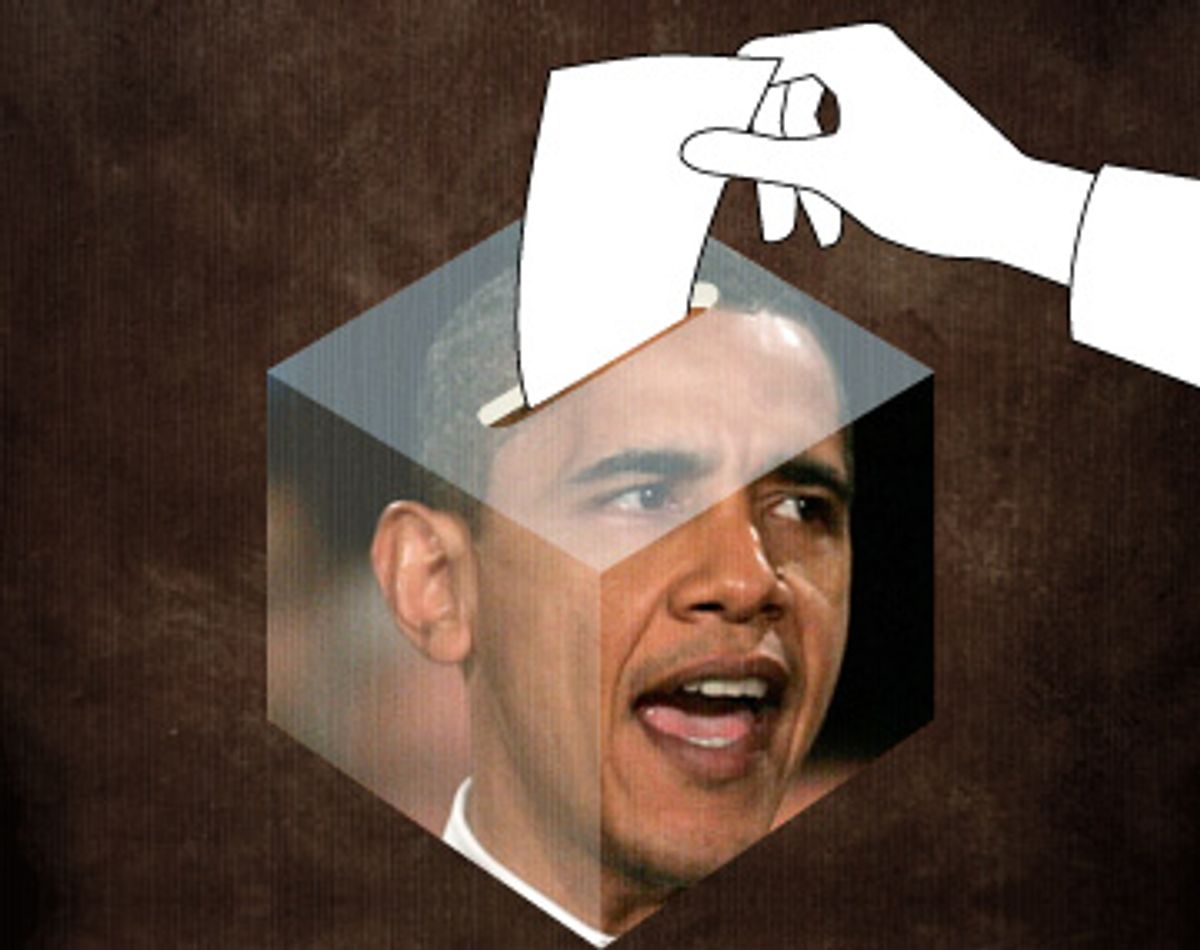
Discussions of race have become a constant in the discourse about the upcoming Democratic primary in South Carolina, and not just because Hillary Clinton and Barack Obama have been sparring over the issue. Saturday's primary will be the first Democratic contest in a state with a large black population; African Americans, in fact, could well comprise a majority of the voters who show up at polling places. Blacks make up 29 percent of the state's population but provided 63 percent of John Kerry's South Carolina vote total in the 2004 general election. If they make up a similar percentage of Saturday's electorate, and if current polling resembles the final outcome, Obama could conceivably win South Carolina before a single white vote is counted.
But Obama will have to win plenty of white votes nationwide if he wants to be the Democratic nominee, not to mention win the general election in November. In Iowa and New Hampshire, he's already proven himself capable of attracting certain kinds of white voters, namely the young, affluent and educated voters so well-represented in the Democratic party's base. But can he also do well among the white electorate at large if he becomes the nominee? And if he does become the nominee, given the controversy over polling in New Hampshire, should we trust any future poll numbers that purport to show him doing well, especially in key battleground states that could be decided by narrow margins? The answers to both questions, at least according to most observers, are "yes" and "yes." Most experts believe that whites now respond honestly when asked whether they'll vote for a black candidate. And when it comes to willingness to vote for and elect African American candidates in a bi-racial election, the United States seems far ahead of where it was just a decade ago. But this may have as much to do with a change in African-American candidates as with a dramatic change in voter attitudes.
After Hillary Clinton's surprise victory in New Hampshire's primary, which seemed to contradict polls taken just days earlier, many pundits and pollsters reached for race as an explanation. They referred to the "Bradley Effect," the possibility that polls -- even those restricted to Democratic voters in a Northeastern state -- could be skewed simply by the presence of an African-American candidate in the race and whites' reluctance to appear racist by telling pollsters they would not vote for him.
The Bradley effect is named for Tom Bradley, the former mayor of Los Angeles. In 1982, Bradley, an African-American, ran for governor of California; pre-election polls gave him a clear lead, but when it came to Election Day, Bradley lost a close race. A similar phenomenon was observed the next year in Chicago, where Harold Washington, also an African-American, eked out a victory in a mayoral election despite pre-election polling that had Washington walking away with the race. In the late 1980s and early 1990s, five other biracial elections featured similar disparities between polls and the actual vote. Social scientists and pollsters theorized that this might have to do with something called "social desirability bias." When called by pollsters, especially African-American pollsters, this hypothesis goes, whites who do not want to vote for an African-American candidate will feel embarrassed about being perceived as racist if they express that sentiment, and they will lie. Then, when they head to the voting booth, their real preferences are exposed.
With the rise of Obama this election cycle, the return of discussion of the Bradley effect may have been inevitable. But the shock of Hillary Clinton's victory in the New Hampshire primary earlier this month, when polls had shown her trailing badly in the days just before the vote, jump-started the debate about the issue. Commentators looked at a host of potential factors in the failure of polling to accurately predict the race and dismissed many of them -- for example, they said the turnout models looked accurate, since the polls had called the Republican side of the equation correctly, and exit polls purportedly showed that there was no last-minute swing to Clinton -- before landing on the Bradley effect as one possible explanation.
Andrew Kohut, the president of the Pew Research Center, was one of the experts most willing to posit the Bradley effect as a cause for the discrepancy in New Hampshire. But what Kohut proposed was something of a corollary; rather than asserting that poll respondents had lied to their questioners, Kohut said that the problem could be a lack of response altogether. In an Op-Ed piece for the New York Times, Kohut wrote, "Poorer, less well-educated white people refuse surveys more often than affluent, better-educated whites. Polls generally adjust their samples for this tendency. But here's the problem: these whites who do not respond to surveys tend to have more unfavorable views of blacks than respondents who do the interviews."
In a recent interview with Salon, Kohut reasserted the hypothesis from his Times Op-Ed. "What occurred to me, and this still rings true, is that a lot of the other logical explanations could be, if not ruled out, then they're not so persuasive," Kohut said. "So it could be that we had a systematic problem based on an old issue. What led me to that possibility is the profile of [Clinton's] support. The only thing that I didn't have in that piece, and I have looked at since, is if you look at the gap between what Gallup is showing in terms of socioeconomic status and the exit poll, the biggest differences are among poor people. Poor people were supporting Obama, and Hillary less, at much higher rates in the pre-election poll than in the exit poll. That's where the big gap is."
Still, Kohut cautions against jumping to any conclusions, saying he wasn't asserting the Bradley effect as an absolute in his Op-Ed, and that those interested in explaining what happened in New Hampshire will have to wait for other results to come in. "We're going to have a whole bunch of primaries on February 5, and if the polls have a problem, then we can explore along these lines or other lines. If, on the other hand, the polls do reasonably well on the Democratic side, then we'll chalk it up to the irascibility of New Hampshire voters," Kohut said.
Additional experts who spoke with Salon uniformly emphasized that they consider Kohut one of the leading lights of the profession, but were at best hesitant about agreeing with his position on this question. Gary Langer, the director of polling at ABC News, was one of those. He dismissed the idea of the Bradley effect, saying there has never been enough science to prove its existence, whether in one New England state two weeks ago or two decades ago anywhere else in America.
"The argument of a specific 'Bradley effect,'" insisted Langer, "still looks to me to like a theory in search of data ... I don't see why this effect would be limited, before now, to a handful of elections 15 to 25 years ago. And I don't know how to understand its absence in so many other black-white races -- five [Senate and governors'] races in 2006 alone, as I note -- in which pre-election polling was dead on."
"Newton's Law of Gravity doesn't just work on Thursdays," Langer said. "You want an effect to be clearly established as an effect through analysis of empirical data, and maybe in more than one election. And to call it an effect you want it to be a consistent effect, or to explain its inconsistency."
In a piece for the Washington Post, Andrew Cline, the editorial page editor of the New Hampshire Union Leader, made a different observation in arguing that the Bradley effect was not responsible for what happened in New Hampshire. "For the Bradley effect to have caused the New Hampshire Democratic primary results, New Hampshire voters would have to have decided on the weekend of Dec. 15-16 to begin hiding their latent racism by lying to pollsters," Cline wrote, noting that for a full year prior to that weekend Clinton had led in nearly all state polls. "It defies explanation to assert that white New Hampshire voters suddenly decided to start hiding their racism on that weekend after publicly supporting Clinton for a year."
Other experts believe the Bradley effect did exist at one time, but even they tend to say its influence is past. David Bositis, a senior research associate specializing in black electoral politics at the Joint Center for Political and Economic Studies, a think tank that "focuses exclusively on issues of particular concern to African-Americans and other people of color," says there's "plenty of evidence" that the Bradley effect is "long dead." And, importantly, the first example Bositis cited was from a Southern state, Tennessee.
Tennessee went 57-43 for Bush in 2004, and Harold Ford, the black Democrat who ran for Senate in 2006, didn't win. No Democrat has represented Tennessee in the U.S. Senate since 1995. But five of its nine representatives in the U.S. House are Democrats, and it may be a competitive state for the Democratic presidential nominee in November. In fact, Bositis cited several likely "purple" or "battleground states" as examples of the end of the Bradley effect and of a new willingness on the part of white voters to elect an African-American. "Colorado has had two black lieutenant governors, one Democrat and one Republican ... They had two black statewide elected officials at the same time -- remember I'm talking about a state that's 4 percent black, and most people don't think of Colorado as being some liberal bastion. In the mid-'90s, Denver, a city that is 10 percent black, had a runoff for mayor, and both the candidates in the runoff were black. Are there other states like that? Yeah, there are ... In 2004, Ohio had both a black lieutenant governor and a black secretary of state."
More generally, according to a 2001 study by Bositis, since 1970 the number of black elected officials nationwide has grown every year, increasing ninefold, from fewer than 1,500 to nearly 10,000. There can't be a Bradley effect if white people get over their fear of black politicians and actually vote for them. And over the past 50 years, even just the past 20, white people have become -- or at least, they say they've become -- much more willing to consider voting for an African-American candidate. Since the late 1950s, Gallup has been asking Americans some variation of the question, "If your party nominated a generally well-qualified person for president who happened to be black, would you vote for that person?" In December 2007, 93 percent of all respondents said yes, a dramatic difference from 20 years before, when 79 percent said yes and 13 percent said no. In an August 2007 poll by Pew, results from white respondents only showed very similar results: 85.6 percent of the 2,374 whites responding said race didn't matter, 7 percent said they'd be more likely to support a black candidate, and just under 1 percent refused to answer.
Of course, there's a Catch-22 here: If voters are hesitant to appear racist by admitting a preference against an African-American candidate, imagine the potential social pressure not to admit they wouldn't even vote for a hypothetical African-American candidate. But another possibility is that a change in the nature of black candidates could be responsible for the change in voter attitudes. African-American candidates in previous elections sometimes ran as the "black candidate," and not always by choice. And, in part because of the history of segregation, some candidates -- like former New York City Mayor David Dinkins and former Virginia Gov. Doug Wilder, both of whom ran in races in which the Bradley effect was purportedly observed -- came from backgrounds not traditionally conducive to national electoral success. Dinkins and Wilder went to historically black colleges, for example, but our presidents tend to come from the Ivy League. The new breed of African-American candidate, though, is much more likely to have a background similar to his or her white opponents.
Without dismissing the influence of possible demographic shifts, Keith Reeves, an associate professor at Swarthmore College, said that "since the late '80s, early '90s, when we've seen the Bradley effect, the African-American candidates who've been running have been very different. They're not the sort of traditional African-American, particularly male, candidates that you can stereotype. If you look at Deval Patrick, you look at Barack Obama, these are Ivy-educated African-American men who've had enormously diverse careers before coming into the political sphere, and they're much more moderate and are not easily stereotyped to be ultra-liberal." He added, "The African-American candidates who've been running have run de-racialized campaigns, and that I think has made all the difference."
Bositis agrees. "When Jesse [Jackson] ran, he was principally trying to appeal to poor people, black people and disenfranchised people ... He knew he wasn't going to be elected president." He contrasts that with today's group of candidates, who, he says, "are not black candidates in the sense of candidates who are seeking to appeal principally to black voters ... they're really able to compete in terms of appealing for white voters." Regarding Obama, he said, " Like any other candidate, no one's going to give him the election. But if you're asking, does race represent some kind of barrier that he's not going to be able to overcome, so that simply being black would keep him from being elected to office, I think the answer is no."
But there is a note of caution for the Obama campaign amid the good news about the growing tolerance of the white electorate. Democratic success in 2008 hinges on winning the electoral votes of purple states in the Midwest, in the mountain regions, and on the edges of the South -- states not always characterized by as many young, educated, affluent white voters as on the blue coasts. Whether there ever was a Bradley effect, there are still some white voters who admit they are less likely to vote for a candidate simply because that candidate is black. In the August 2007 Pew poll, it was 6.4 percent. And that number was slightly higher for respondents who had less than a high school education (15.4 percent), made less than $30,000 a year (just under 10 percent), were over 65 (10 percent) and lived in the South (9 percent).
Shares