Wisconsinites have a colorful nickname for their neighbors to the south: FIBs. Short for Fucking Illinois Bastards, it's usually applied to Chicagoans who gun their luxury SUVs around Door County, the Wisconsin Dells and other summer resorts.
Evan Read, a Milwaukee defense lawyer, didn't think he'd ever be excited to see an Illinoisan -- "as long as the Illinois people stay south of the border, I'm OK with them" -- but last Friday morning, he skipped work to bring his wife and daughter to a Barack Obama rally.
"It's the typical irrational prejudice. You get to know someone, and they're not so bad." Read even bought a $10 T-shirt from a hawker outside the center. Now, he confessed, "I'm kind of a drooling fanboy."
Obama is favored to win the Wisconsin primary on Tuesday, but when it came to embracing the state's blue-collar Ya Hey culture, he finished dead last. John McCain spoke at a Friday night fish fry. Hillary Clinton held a town hall meeting in a bratwurst-and-beer joint. Mike Huckabee went bowling. Obama -- who is trying to attract Milwaukee professionals and Madison progressives who find those images hokey -- rallied his supporters at the Midwest Airlines Center, a convention hall that also hosted an auto parts trade show that morning.
The senator could at least have hired Dick Blaha, Milwaukee's Polka Ambassador, as his DJ. Instead, he took the stage to U2's "City of Blinding Lights." But he did call out a special Milwaukeean.
"Some of you may know I have a friend who has a talk show," he said. "She has a funny name: Oprah Winfrey. Her mom lives in Milwaukee, and she is here today."
That was Vernita Lee, who moved her family from Mississippi when Oprah was 6, and took a job in a hospital kitchen. Thanks to her daughter's success, Lee now lives in a high-rise condo. But in his speech, Obama addressed himself to those people who are still struggling.
Obama markets himself as the candidate of hope, but he made the deepest connection with his audience when he spoke to their fears -- fear of losing their jobs, of getting sick without healthcare, of failing to pay the mortgage. At a speech last week in Madison, Obama praised Wisconsin as the birthplace of the progressive movement. In Milwaukee, he pressed on with the message that government has a duty to help the needy. That's bound to be well received in a city that's elected three Socialist mayors, and a state that elected Russ Feingold, the current avatar of Upper Midwestern good-government liberalism. (Feingold, curiously, has not made an endorsement.)
"The American people are struggling right now," he boomed.
"A-men!" came a shout from in front of the bleachers.
"All across Milwaukee and all across the country, there are people who don't have enough to buy healthcare. They don't get it on the job, and they stop going to the doctor."
"That's right!" It was the same Sunday-morning voice.
"We can restore a sense of economic fairness in this country. I believe in capitalism, but when you've got CEOs making more in 10 minutes than ordinary Americans make in a year, that's not right. I want a $10 billion package to prevent foreclosures, and a mortgage deduction for those who don't itemize."
"Yyyesss!"
"We shouldn't raise the minimum wage every 10 years, we should raise it every year, to keep up with inflation. If you work in this country, you should not be poor."
"Amen!"
Responding to Obama's call was Marica Tipton, an administrator at Milwaukee Area Technical College. Tipton has a Ph.D., but her parents are struggling. Her mother was laid off by Master Lock when the company moved its assembly operations to Mexico. Shortly after losing her job, she was diagnosed with cancer. Obama had told a story about losing his mother to the disease at age 53 -- the same age as Tipton's mother.
"I can resonate with him because my mother's also battling cancer," Tipton told me. "She's doing really bad. She just had radiation. She's on Medicare, but that limits her ability to get quality care. The innovative treatments, they won't pay for."
Standing near the temporary fence was Jacqueline Callari, a nurse at Aurora Sinai Hospital. I'd always considered Laverne and Shirley a bogus portrayal of Milwaukee, because one of its characters was an Italian girl with a Brooklyn accent. But Callari fit that description to a T. She and her husband, an emergency room physician, moved here from jobs at Kings County Hospital.
"Healthcare is the most important issue for me," Callari said. "My husband and I, we're seeing the emergency room used as a clinic, because people are so desperate for care. They'll come in with colds, fevers, sore throats."
Callari's daughter, Alessandra Robinson, had passed her copy of "The Audacity of Hope" to an Obama staffer. She got it back with Obama's signature -- giant, loopy versions of the candidate's unfortunate initials. Robinson attends a private school, which means that, unlike most high school students, her Obamamania marks her as an outsider.
"I'm getting a lot of bad looks because on my blazer, I have an Obama button," she said. "A lot of my friends are for McCain."
The McCain dinner wouldn't start until 7, so in the afternoon, I had an ice cream at Leon's Frozen Custard, the 1942 drive-in that inspired Arnold's in the TV show "Happy Days." Dairy is only one cornerstone of the Wisconsin diet. For beer, I stopped at the Holler House, the south Milwaukee tavern with the oldest bowling lanes in the United States. Installed in 1909, they're challenging enough to take 20 pins off any score.
At opening time -- 4 o'clock -- I pushed through the door with the hand-lettered "No Public Restroom" sign, and found Marcy Skowronski alone behind the bar. Eighty-two, and barely tall enough to see over the beer bottles, she was wearing a red sweat shirt with the words "Holler House" above a giant Polish eagle. Skowronski has been into politics ever since Eleanor Roosevelt. In fact, her bar got its nickname because of a loud political debate.
"One day, this guy comes in and says, 'My wife's in California. You want to get bombed?'" Skowronski said. "So I says, 'Sure.' Anyway, the next time, he brings his wife in. It's during a political convention, everybody was talking politics, the jukebox was going. So the next week, the guy asks his wife where she wants to go. She said, 'Take me to that holler house!'"
Skowronski is a Clinton supporter -- "I just listen to her all the time and I think she'd make a good president" -- which has led to more high-volume discussions across the bar.
"Politics, you can get to arguing about that," she said. "We got one guy, he'd vote for Hitler if he was on the Republican ticket. I told him this place was gonna be Hillary Clinton headquarters, and he got so mad he slammed the door."
It was a Friday evening, during Lent, so the cars were backed up at the drive-through window of the American Serb Hall, which claims the largest fish fry in America.
"Fifteen hundred dinners a night," boasted manager Bob Milkovich, who sports an Eastern European accent and a Serbian Eagle ring that bulges from his finger like a gold-plated knuckle. "On Good Friday, we served 480 pounds of fish and 55 gallons of tartar sauce."
Serb Hall is also Milwaukee's classic political venue. In "Fear and Loathing: On the Campaign Trail '72," Hunter S. Thompson caught George Wallace's act here.
"They say if you want to become the president, you have to go to Serb Hall," Milkovich said. "This is kind of a blue-collar, Democratic Midwest kind of facility. Going back to Eisenhower, the only president who hasn't been here is George W. I tried. Reagan was here in '84. Humphrey. George H.W. Bush, the old man, was in the bowling alley and he fell down. It was on presidential bloopers."
McCain would be speaking in the Hall of Presidents, which was decorated with oil paintings of every visitor, and fragrant with sizzling cod. Outside the hall, a group of College Republicans were clutching calendars devoted to their political pinup. They'd road-tripped down from the University of Wisconsin -- Whitewater, not Madison, although the Obamamania is just as bad, said Ashley Carrington. It's the latest campus fad, like phone-booth stuffing in the '50s, draft-card burning in the '60s, hacky sack in the '80s, and Facebook last year.
"I try to talk to people about McCain, but a lot of them are closed-minded," said Carrington, who likes McCain because "I have quite a few friends and family over in Iraq, and I don't think it's fair to them to leave. I think we owe it to the people over there not to blow up their country and leave."
McCain slipped into the fish fry while the Republicans were reciting the Pledge of Allegiance, facing a flag at the far end of the hall. When they turned around, there on the dais was the 5-foot-7 McCain, half-hidden by a pair of state legislators.
After former Wisconsin Gov. Tommy Thompson ripped into Republicans who think McCain isn't conservative enough -- "John McCain is pro-life!" -- the candidate told a fish joke.
"I notice we're having fried fish tonight, and it's wonderful, and it's a great Serbian custom. I'd like to ask you if you know the difference between a lawyer and a catfish? One is a scum-sucking bottom dweller, and the other is a fish."
Most of the Republicans I talked to at Serb Hall named national security as the most important issue in this year's election. So McCain attacked the House of Representatives for failing to renew the Protect America Act, which gives the government authority to monitor foreign calls without a warrant.
"In case you didn't notice, the House of Representatives decided to close down and leave town when we had not reauthorized this nation's ability to monitor communications of the people who are dedicated to destroying everything we stand for and believe in," McCain said.
The crowd groaned and booed.
The last Republican to carry Wisconsin was Ronald Reagan, whose picture hung behind McCain, glowing under the stage lamps. McCain promised to be the next, promised to take the fight to the Democrats in every state, and on every issue.
"My friends, they want to raise taxes. I want to lower taxes. They want the government to take over the healthcare system in America --"
"No!" the diners cried. "No!"
"-- I want American families to decide. We're going to talk about national security -- whether you want to set a date for withdrawal and surrender in Iraq, or whether you're going to support this great general and all the young men and women who are succeeding."
McCain left to a standing ovation, but he didn't shake hands, or sign autographs. Republicans aren't smitten with McCainia, said Beau Moore, a circuit-board salesman from Brookfield, but that's because they're less gushy than Democrats.
"I would like to think that Republicans are more grounded, practical, pragmatic," Moore said. "Democrats, especially those followers of Obama, are fanciful, non-realistic swallowers of vague, vacuous platitudes. They're just trite statements that mean absolutely nothing."
"We told Bill that Hillary will not win Wisconsin unless she comes to Kenosha," declared Brian Miller, the local Democratic party chairman.
Miller was standing on the floor of the Brat Stop, a restaurant that serves six styles of bratwurst, and even has its own cheese shop, with display cases full of pecan cheddar, pepper jack and cheese curds -- cubes so fresh they squeak when rubbed together. The Brat Stop sits on Highway 50, known locally as the 50-yard-line, because it divides Bears fans and Packer fans. It ought to be Hillary country. A blue-collar town, Kenosha has lost the Snap-On tool factory, the Chrysler factory and the Jockey underwear factory. It now survives as a commuter suburb for Chicagoans seeking cheap housing.
Ron Frederick, president of the Kenosha AFL-CIO Central Labor Council, worked 32 years as a crane operator at the American Brass foundry.
"You know what it is now?" he said, indignantly. "A grocery store."
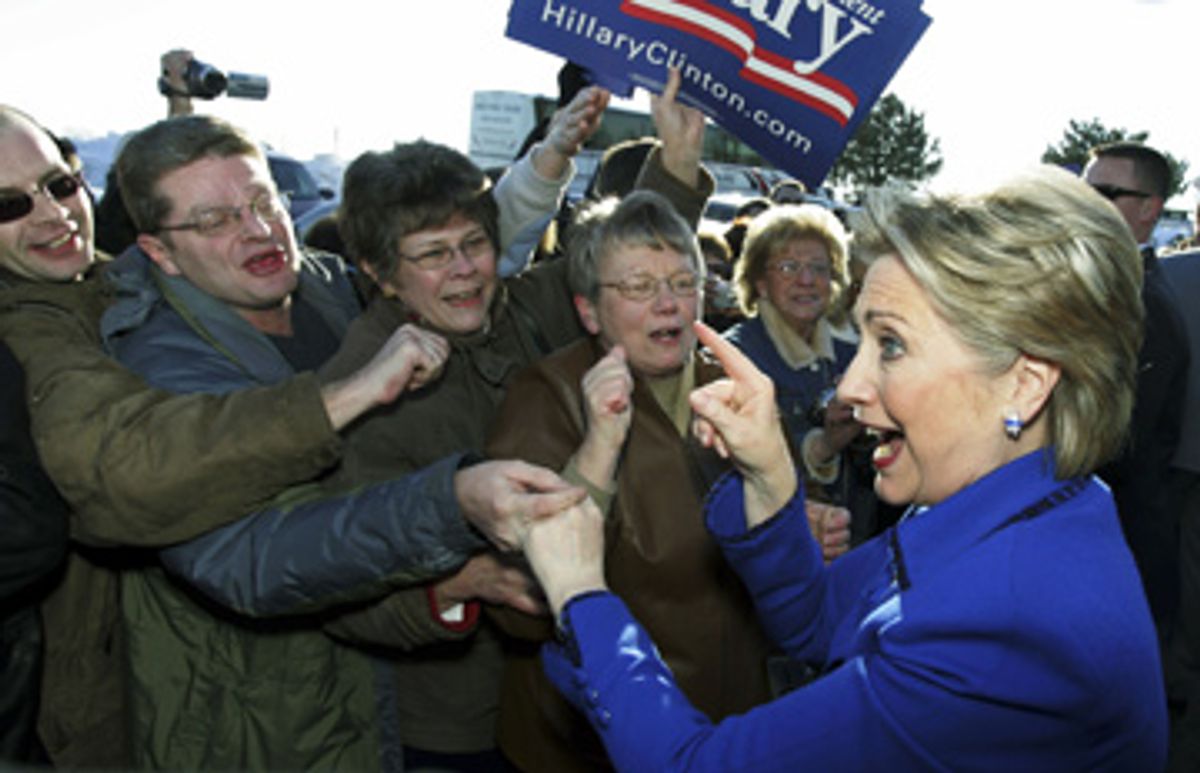
The Brat Stop was packed to its balconies. Heavyset men and women in quilted XL jackets held signs reading "Madam President" and "Hillary's the One." A woman dressed as the Statue of Liberty -- complete with silver face paint -- clung to a pillar.
When Clinton walked into the restaurant, preceded by her Secret Service detail, the room was ecstatic. These people had known her for 15 years, they'd missed her in the White House for seven years, and everyone wanted a handshake, or an autograph.
Clinton is a FIB from way back, but a lot of Kenoshans grew up in Illinois, or work there, so no one minded.
“I spent a lot of time in Wisconsin,” she reminisced. “We used to go to Lake Geneva. We used to go to church retreats. My Scout troop went all the way to Green Bay.”
In high school, Hillary Clinton was the girl who always did her homework. And in this election, she’s the candidate who has a plan for everything. Briefing books read her. Clinton didn’t just talk about creating jobs with clean renewable energy. She talked about how Germany -- “and I know there are a lot of people of German descent in Wisconsin” -- created hundreds of thousands of jobs by investing in solar energy.
When she promised to make college more affordable, she recalled that in the 1960s, she paid 2 percent on her student loans. Now, it’s 25 to 30 percent. Clinton declared she would “end the subsidized student loan industry” and give students a chance to earn $10,000 for college through national service.
Clinton is a number-cruncher on the stump, but one on one, she’s capable of great personal empathy. The most moving moment of the afternoon didn’t come in her speech. It came afterward, in the question-and-answer session.
Towards the end, 11-year-old Jade Bailey stepped forward to ask a question. Jade's mother would tell me later that neither Jade's question nor what followed was preplanned.
“What about people who don’t have food or housing?” she asked.
“I’m glad to hear that you care about the less fortunate,” Clinton said.
“We’re going to lose our house,” the girl replied.
Clinton invited the girl and her mother onstage. As Clinton put an arm around the girl’s shoulder, Jade’s mother, Donna, told the family’s story. Donna is a hairdresser, and a single mom. A few years ago, hoping to get a better rate, she refinanced her home with an adjustable-rate mortgage. The payments have crept from $600 a month to $1,000 -- more than she can afford. Business is suffering, because her customers’ husbands are losing their jobs.
“The economy’s down, and we have all of these hard working people losing their mortgages,” Clinton fretted, tightening her grip on Jade’s shoulder. “We should be freezing the interest rates on these adjustable-rate mortgages.”
Obama has the young, McCain has the rich, and Clinton has the people who aren’t lucky enough to be either. This was explained to me by the woman dressed as the Statue of Liberty. I’d figured the Statue as a Clinton supporter -- she’s a woman, she’s from New York, and she’s 122 years old.
“I did it because she’s a New York senator,” said Donna Dewitz, who was standing in the bar. She set a cigarette between her silver lips, sucked out the smoke, then explained why folks like her would vote for Clinton.
“Obama goes for the higher-echelon,” said Dewitz, a receptionist whose boss is an “Obamacan” -- an Obama Republican. “Hillary’s for the down-to-Earth people. She’s from us. She’s from the Midwest. I don’t think I’d fit in with Obama’s circle.”
As mentioned earlier, Mike Huckabee went bowling, at Olympic Lanes in Milwaukee. I wasn’t able to be there, but I understand he rolled an 86. That’s okay for an Arkie. But it’s probably not good enough to win Wisconsin.
Shares