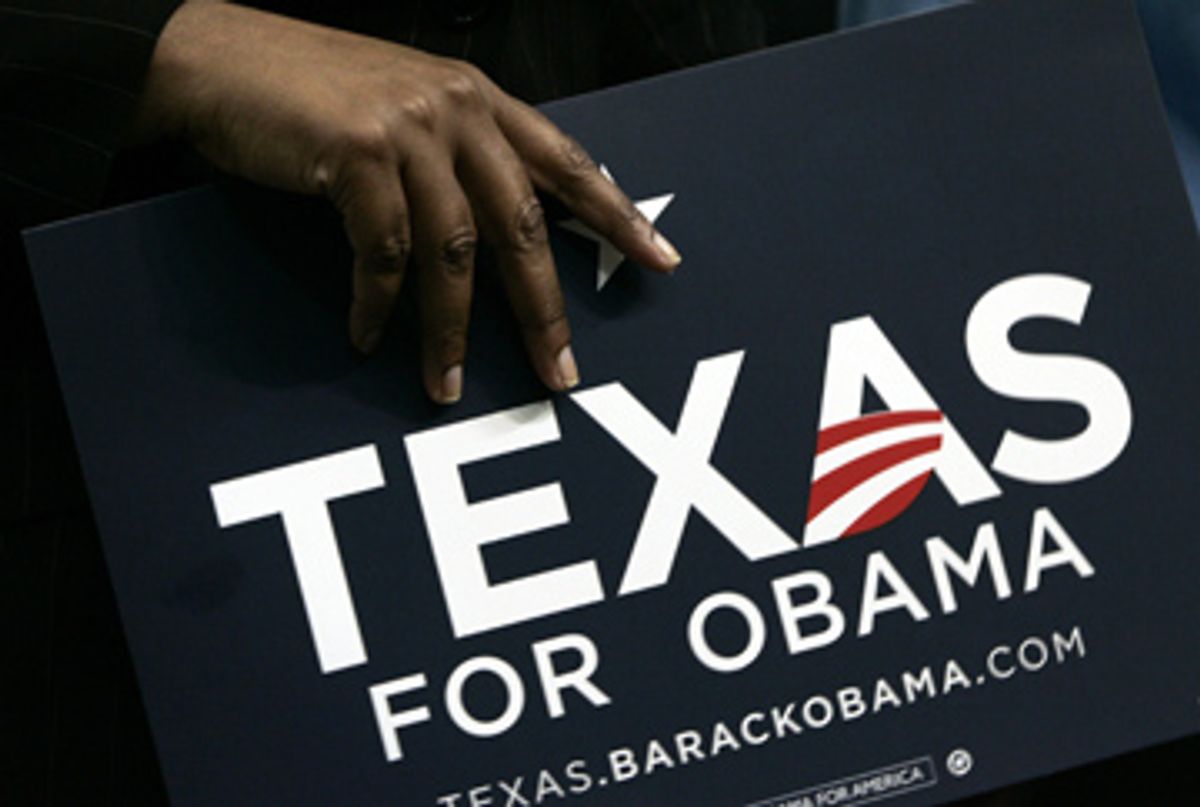
Walk into Barack Obama's Texas headquarters down the street from the state Capitol, and you're immediately reminded of the complicated rules of the weird primary/caucus hybrid coming up here next week. "Ask us about the Texas Two-Step," says a huge sign painted to look like the state flag, with a giant Obama smiling down from the blue stripe on the left. Running phone banks, volunteers remind early voters to save the receipt showing they've already cast a ballot if they want to caucus on March 4 after the polls in the primary close. (Texas Democratic Party rules allow for participation in both.) Obama's staff here calls preparation for the Texas election "the Olympics" of field organizing, but they seem more than ready for it.
The emphasis on organizing -- which has helped the campaign harness enthusiasm about Obama and propel a nationwide political movement -- has been one of the keys to Obama's success so far. Beginning with the 23 caucuses and primaries on Feb. 5, Obama has steadily built a delegate lead by simply playing to win just about everywhere the calendar took the campaign. Hillary Clinton's wins have been blunted by Democratic Party rules that award delegates proportionately -- and Obama racked up blowout wins in states where Clinton never gave him a serious run.
Obama's winning streak left Clinton aides floating a line of spin that has flown about as well as the Hindenburg: "Well, of course he won there -- he tried to." Now, grass-roots organizing could wind up being the deciding factor in the campaign, unless Clinton surprises and pulls out big wins in Texas, Ohio, Rhode Island and Vermont next Tuesday.
From the start, Obama's campaign devoted more resources to field work in far more states than Clinton's did. One of the first advisors to sign up with Obama was deputy campaign manager Steve Hildebrand, one of the Democratic Party's top grass-roots organizers. Obama won the Iowa caucuses in part by drawing out new voters who hadn't shown up in previous elections. His campaign built subsequent wins in similar fashion in states that followed. Months before Super Tuesday, Obama had paid staffers operating in every state -- including nine employees working out of four offices in North Dakota, where a Democrat hasn't won the general election since 1964.
In the Super Tuesday states, by primary day, Obama had more than 500 paid campaign employees working on the ground. He even had two staffers in Alaska; Obama won the state's caucus 75 to 25, taking nine of the 13 delegates up for grabs. The Obama ground game rolled on. Throughout February, it deployed across Midwestern states -- some of which rarely vote Democratic in the fall -- with staff (18 in Kansas alone) and reaped big victories.
The day after Obama won the South Carolina primary by a bigger than expected margin, South Carolina field organizers headed to Virginia, Maryland and D.C., which voted Feb. 12. Clinton's strategy, meanwhile, was pegged to wins in big states on Feb. 5. But she was so unprepared for what came next that a week later, she lost Virginia -- where Clinton's national campaign is headquartered -- by 29 points. That loss said it all: Polls in January had her up big there.
Considering Obama's background as a neighborhood organizer in Chicago, his campaign's focus on the ground game isn't surprising. "The value [placed on] community organizing comes from the top down," said Buffy Wicks, the deputy field director in Texas, referring to her employer's paradigm. "For us, it's people talking to their neighbors; that's the premise of our program."
Indeed, the strategy is built on frequent, personal contact with voters. In the first few weeks working in Texas, for example, supporters called more than 15,000 voters. "We don't want people to get all stressed out about worrying about Social Security policy section 8.47," Wicks said. "We want them to say, 'This is why I'm concerned about this issue, because of my own experience,' and we really try to foster that with our activists," she said. "We believe politics is personal, and the things that happen to you in your life shape your views." At a session in Austin for precinct captains last week, organizers told more than 20 volunteers to tell voters why they like Obama: "Remember, it's not kumbaya-ish, it's really powerful."
In Texas, Obama is relying on a network of precinct captains that has been growing daily. The campaign trained more than 4,000 of them (Texas has about 8,300 precincts) in statewide sessions last week that sometimes drew overflow crowds. The campaign is also shrewdly leveraging technology: Its 29-page info packet takes volunteers through the Texas Obama Precinct Captains Web site, which the campaign set up to give activists direct access to a massive database on voters. They can print out address lists that help them walk their neighborhood looking for Obama voters, or read from scripts while doing outreach by telephone from home. Whatever they find then gets uploaded to the Obama database through their own computers, which frees up field staffers who, in previous campaigns, might have spent hours typing in the same information. "The campaign should be there as a space to invite people to become involved in it, as opposed to giving people busywork," Wicks said.
At Obama rallies with overflow crowds, the campaign collects e-mail addresses and invites people to join the precinct captain network. All the online tools also tell volunteers how to quickly get in touch with organizers offline, and they let the campaign keep track of what its activists are up to without having to check in on them constantly. By the time aides opened their 10 regional headquarters around Texas last week (which, in turn, will supervise smaller satellite offices), there were already volunteers on the ground working all over the state.
Part of Obama's advantage, of course, also comes from how readily voters appear to be flocking his way -- the momentum has been feeding on itself. Now that he's on a winning streak the campaign doesn't have to seek out supporters so much as it needs to figure out what to do with them when they show up. "I wanted to be a part of it," said Mark Barker, 27, an advertising copywriter in Austin, who came to the precinct captain training and signed up to make 200 calls to strangers in his neighborhood even though he'd never been active in politics before. "I didn't want to look back and leave anything on the table" in this election, he said.
This field campaign has seized opportunity in the groundswell. Around the country, Obama staffers have linked up with networks that supporters built up themselves long before paid field organizers even arrived. "It was a seamless thing, where the campaign kind of came here, kind of stood outside the doors, and said, 'Knock knock, tell us what you need,'" said Mark Keam, a lobbyist for Verizon who, on his own time, organized Fairfax County, Va., for Obama three months before a campaign worker showed up there.
The campaign kept working with the lists of voters and volunteers that Keam's group had put together on its own. The volunteers had already set up their own field structure in each of the county's nine smaller jurisdictions, so the official Obama organizers rolled with it. "You normally see this omnipresence of the heavy hand of the national campaign, all the way down to much more local organizational efforts, but that is not the case here," said former Senate Majority Leader Tom Daschle, a national chairman of the campaign who barnstormed small Midwestern states including Kansas and North Dakota before Super Tuesday. (Obama deputy campaign manager Hildebrand ran Daschle's losing 2004 campaign for reelection in South Dakota.)
Obama aides suggest their field plan illustrates a broader point about leadership. "We netted more delegates out of Kansas than [the Clinton campaign] did out of New Jersey," said Obama strategist Robert Gibbs. "For the candidate or the campaign that seems to discuss that they're ready from Day One, they didn't seem to have a plan from Day One for this campaign."
Clinton, meanwhile, is finally now putting serious muscle into organizing -- but it may be too late. The one-time front-runner, who by most accounts must win Texas to stay alive in the race, said last week of the state's complicated setup, "I had no idea how bizarre it is. We have grown men crying over it." (Besides the two-part voting, Texas Democrats award a greater number of delegates for winning precincts where the party did well in the last two elections -- many of which are currently Obama strongholds.) But any joking aside, her campaign says it'll be ready for the Tuesday vote; it has since deployed Ace Smith, who ran her victorious California operation, to handle Texas. (Likewise, Robby Mook, who ran her Nevada caucus organization, is in charge in the other crucial state Tuesday, Ohio.)
But it's hard to escape the conclusion that the Clinton campaign stumbled badly by failing to organize and compete more forcefully in a number of states. Her campaign's spin now, after the fact, also suggests that caucuses inherently favor Obama's wealthier, better-educated base, because caucuses are harder for night-shift workers or single parents to attend. "I don't know that we could have overcome the challenges in the caucus states," one Clinton strategist said. But that assessment fails to acknowledge that Obama has shattered demographic barriers throughout the race, including building support among working-class voters in states such as Wisconsin.
An inferior ground game could make it hard for Clinton to emerge with the most delegates in Texas, even if she wins the statewide popular vote (which recent polls show she might not do, anyway). "We're not going to give up on the process, we're not going to bend to the process, we're not going to whine about the process," said Rep. Sheila Jackson Lee, a Clinton-supporting Democrat from Houston. But then she proceeded to ask whether caucuses should be eliminated in future nomination fights. "From my perspective, it is not the fully democratic process." It is, however, the Democratic process -- and the one by which the well-organized Obama campaign appears to be closing in on the nomination.
Shares