


To listen to a podcast of the round table, click here.
To subscribe: Click here to add Conversations to iTunes or cut and paste the URL into your podcasting software:

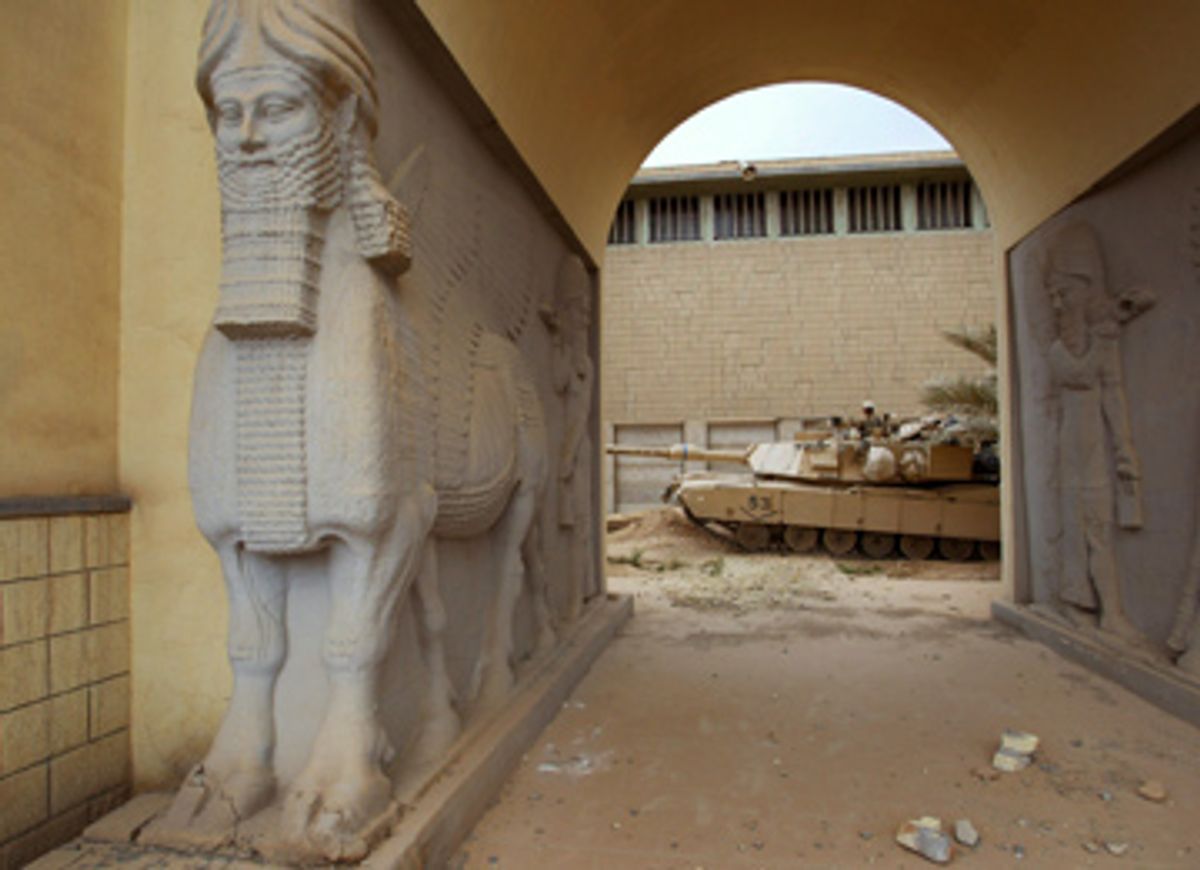
Among the many unintended and unforeseen consequences of the U.S. occupation of Iraq that began five years ago this week was the wholesale looting of Iraq's museums and archaeological sites. Iraq has been called the cradle of civilization. Starting with the Sumerian civilization, which more than 5,000 years ago produced what may be the world's first examples of writing and math, the area centered on the Tigris and Euphrates rivers and known as Mesopotamia has been home to a succession of cultures -- Akkadian, Babylonian and Assyrian. Many believe southern Iraq was the site of the biblical Garden of Eden. But within weeks of the first American airstrike, the cradle of civilization had been robbed. Baghdad's National Museum of Iraq, among the globe's premier repositories of antiquities, was ransacked over the course of a week in April 2003. Statues were dragged down the steps, artifacts six millennia old were carried off in plastic bags. American soldiers were not dispatched to protect the museum until the thieves were long gone.
It was partly in response to media queries about the unimpeded looting of Iraq's cultural heritage that former Secretary of Defense Donald Rumsfeld uttered the infamous and cavalier rejoinder, "Democracy is messy." Five years after the sacking of Iraq, we decided to ask the experts how bad it really was, how many priceless antiquities have come back to their homeland, and what, if anything, has changed about the Bush administration's approach to protecting Iraq's history.
On behalf of Salon, Brian Rose, professor of archaeology at the University of Pennsylvania and president of the Archaeological Institute of America, conducted a round table with Donny George Youkhanna, former chief of antiquities for the Iraqi government and director general of the National Museum of Iraq; Cori Wegener, an associate curator at the Minneapolis Institute of Arts who, as a major in the U.S. Army Reserve, was called up in 2003 and sent to Iraq to assess the damage to the museum; and Micah Garen, a documentary filmmaker, photographer and journalist who went to Iraq shortly after the invasion to document the looting of archaeological sites. Youkhanna, who is known as Donny George in the West, was forced to flee Iraq in 2006 and is now a visiting professor at the State University of New York at Stony Brook. Wegener is presently president of the U.S. Committee of the Blue Shield, which was formed in 2006 to protect cultural property worldwide during armed conflict. Garen, who wrote a book about his experience as a hostage in Iraq called "American Hostage," is working on a feature-length documentary about the looting. The round-table participants spoke by phone on Friday, March 14.
-- Mark Schone, Salon
Rose: We're here to assess what's actually happened in Iraq, especially involving cultural property, five years after the inauguration of the war in Iraq. I wanted to turn first to Donny George, who was then the director general of the National Museum of Iraq. What was it like when you stepped into the museum right after the looting?
George: Oh my god, Brian. You're bringing up the worst memories I have in mind, really. It was as if a hurricane had hit the whole building and the rooms and the galleries and the storerooms from inside. Imagine. A hurricane on the inside of a museum and the storerooms and the administration areas. It was exactly like that. It was terrible. Over 120 doors in the administration areas were completely destroyed. And a lot of furniture appeared to have been taken away. But our problem was with the antiquities. Some of the materials that were displayed and still displayed at the gallery were taken away, such as the Warka Vase. And some of the cultural material from the galleries there. But we could not then, in those very early days, could not check what had happened to the storerooms because we did not have electricity in Baghdad. It was completely in the dark. We did not have enough fuel to start our generators. But afterward, when we went into the storerooms that were in the basement of the museum, those were another tragedy. The looters had gone into some places, it looked like they knew what they were looking for, in some places they got the smallest and most precious material. Those were the cylinder seals and a good [amount] of jewelry. From there, they took over 5,000 cylinder seals and as I said, [jewelry] too.

Rose: Cori Wegener, you were actually there on the ground in Iraq. To what extent was the U.S. military aware of how much had been looted from the museum and how endangered Iraq's archaeological sites were?
Wegener: When I arrived on May 16, 2003 -- so kind of well after -- Col. Matthew Bogdanos and his team were already there, and by that time they had realized that everything was not gone but that it was still quite a bad situation. [Bogdanos, a Marine reservist, organized a team of American troops to protect the museum and recover Iraqi antiquities.] And they were still trying to get a handle on the potential for inventories using some of the old card systems that had been ransacked and overturned. And using log books that many objects had been logged into. But we still didn't know the full extent of the looting at that time, because we didn't have a comprehensive inventory to go by. And also, many of the storage areas that Donny mentioned, some of those objects hadn't been inventoried when they were brought into the museum because the staff hadn't been able to work at full operating power under the sanctions they were under. So it was a really difficult situation to figure out, about what exactly had been looted and what the numbers were. As far as the archaeological sites go, that was not a huge issue in those early days and it was only later when we did the helicopter flyovers that you have John Russell's excellent photos of the looting of the sites.
Rose: And I have to say from the point of view of the Archaeological Institute of America, we really didn't know what to do when this had all first developed, when the museum had been looted, when we became aware that the archaeological sites were being looted with great rapidity. The archaeologists, not just in the U.S., but also in the world were, in a sense, running around in a confused way. The archaeological institutes hadn't really collaborated with each other. And most of us hadn't collaborated with the military in the past. So we didn't have the kind of guide or the established mechanisms for interfacing with the military and lending our expertise. It was something we tried to correct in the meantime. But in the beginning, I'm afraid, our responses were not as rapid or as adept, as expert, as we would have liked them to be.
Micah Garen, you were also on the ground in Iraq and you had an occasion to actually speak to some of the looters who were active in looting archaeological sites or perhaps in looting the museums.
Garen: I was there for a period of about eight months total, between early June 2003 until August 2004, and we met and spoke with everyone. So we spoke with people in the military, people who were involved in looting, people in the Iraqi police, people with the museum. We got this incredibly detailed picture of it, and we actually were able to film a lot of what was going on, which is what we're working on now for a documentary. But I'd like to say first off that the U.S. military knew exactly what the problem was back in June of 2003 with the looting at the sites. And the reason I know that is because I personally presented a colonel in the U.S. Army back in June of 2003 with a series of images of the looting, and the New York Times broke the story, front page, on May [23], 2003. So there's no question that the issue was very prevalent. It was just a question of priorities. And it was very clear that protecting archaeological sites was not a priority. And I think that was the problem and continues to be the problem.
... We were on the ground for four months down in southern Iraq in the Dhi Qar region and al-Qadisiyyah region, and there was absolutely no effort in the time we were there for the U.S. Army to send patrols out to protect the archaeological sites. The only group that was doing that was the Italians. And the Italians -- it was entirely by virtue of the commanders who were on the ground. So when you had a very good commander who really cared and understood, because Italy has a long history of caring about its culture, he would send three or four patrols a week and the looting would stop. When you had a commander who didn't care, the patrols would stop and the looting would come back.
We were filming 200 looters a night working at sites such as Umma, which are some of the most important sites in the world. And they were just digging with impunity. They were actually just walking around. People were selling cigarettes to the looters. They had electrical generators, lights going on all night. One helicopter patrol, literally, we went on one helicopter, a little four-seater helicopter, and it was simply just a tour of the sites, that scared away looters for three days. Just the presence of one helicopter. There were dozens of helicopters at the [Coalition] air base in Nasiriyah, for the entire four months we were there, and that was the only patrol.
When you speak to soldiers individually, people really care. But it doesn't mean anything unless it's a policy at the highest level. Unless at the highest level of the administration and the Army, there's a mandate that says we need to spend X dollars to protect the cultural heritage of Iraq and we need to do regular patrols, nothing happens.
Wegener: I have to say, it's not just at the highest levels of the Army. The civilian-manned element of our government has to have that priority and translate that down to the military. Because it has to come from the highest levels in the Department of Defense and not just the Department of the Army, but the highest levels. And that's the really important part, because that's what's going to make it a mandate.
George: I want to add something about this issue exactly. I was there all the time, and one of the first times when I started having contact with the American administration in Iraq, with the American liaison officers, I offered to them that I would give them the best way to protect the archaeological sites. To contact our inspectors ... in every province we have an inspector of antiquities who actually has maps, who knows the archaeological sites in his province, who knows all the details of what's happening there. I gave lists of the names and the telephone numbers of everybody covering the whole country to the cultural section in the U.S. Embassy. And to some of the liaison officers, I said, this would be the best way to go and contact your civilian affairs sections of the Army, contact these people, and they will guide you and tell you how to protect these sites there. But as Micah has said, it was not a priority. I was always faced with the subject, "Yes, we have the priority of security, the water, the electricity. Protecting the archaeological sites is not our priority now."
Rose: Donny, there were a lot of different estimates on how much was actually lost from the museums at the time of the looting. Some estimates were over 100,000 artifacts. If you had to estimate how much was lost, what would you say now?
George: Well, finally, I can say that first, the number that was taken over the very first few days, "over 170,000 objects were looted from the museum," was incorrect. This was a mistake. In those days, as I said, we did not have electricity. We could not see the storeroom. How could we estimate that number? So we were always saying, "We don't know that. We have to check." But after some time of checking, I would say that we have lost, even though our checking is not finished yet, over 15,000 objects have been taken and looted from the Iraq museum [National Museum of Iraq]. And all with the efforts of the American MPs, and the law enforcement all over the world and the law enforcement in Iraq, we have got, I would say, 50 percent of those back. Some 4,000 are actually back in the museum now, and the others are seized by Jordan and Syria and the United States and Spain and Italy and Holland. So it will make the number, with the ones we know about and that have been seized, almost 50 percent.
Rose: One reads now that much of the most significant material stolen from the museum has been returned. Are there still a lot of significant objects that were stolen from the museum that have not yet been found?
George: Well, yes. Some of the great masterpieces have come back, but we still are missing some wonderful pieces. Especially the Ivory Plaque that came from Nimrud, discovered ... by Sir Max Mallowan. It's what we call "The Lioness and the Nubian." It's a beautiful piece, covered in gold in some parts and inlaid with precious stones in some other parts. This one was taken and has not come back. Again, there are some heads of statues, some very important ones, from the city of Hatra, and that's an interesting city, 200 B.C. to 200 A.D. We have a good number of those heads of statues that were taken and are not back. And together with a lot of smaller items. But these are the most significant materials that were looted and have not come back yet.
Rose: When looted art is actually seized at the borders, let's say it's seized at U.S. Customs, what happens to it then? Is it repatriated to Iraq immediately? Where does it go?
George: In fact, when I was in office [as Iraq's chief of antiquities], I was always contacted by these people. I always said, thank you very much, send us documents about these things, and keep them there. It's not a good time to bring these things back to Iraq or to the Iraq museum. And this is the case, there are still a good number of Iraqi antiquities that sit in the storerooms in New York, and one of the major objects that was taken from the Iraq museum -- that is, the statue of a Sumerian king, Entemena -- was found in the customs bay. They had seized it but they have delivered it to the Iraqi embassy, and it's sitting now in the Iraqi embassy in Washington. It's not the right time to take these things back to Baghdad. But they're all documented, and the Iraq museum knows everything about these seized materials.
Rose: Who actually do you think is selling the artifacts? How is it that the material actually gets out of the country?
George: This is one of the reasons that [I believe] it was an organized crime. It was not ... just normal Iraqis came and looted the museum. Yes, there were some who looted, but in the very first weeks, materials started surfacing in Europe and the United States. So it must be, 100 percent, that it was an organized crime. The other evidence we have found, I myself have found, that in the galleries of the museum, those who went inside the galleries were well-prepared to go inside and get materials, and these must have connections that have taken material outside the country. Now, I'm not fearing anytime that this material may end up in one of the museums, because I know that museums all over the world would not do that. But, my fear is that this material would go to some special private collectors who will just dump the material, keep it for their own sake, just to keep for 20 years. It's a money investment.
Rose: Micah, when you were talking with people, to the average Iraqi in the streets, did the subject of these precious antiquities, the loss of archaeological sites, the loss of cultural heritage, often come up in the course of your conversations?
Garen: We would ask people on the streets what they thought about it, because we thought it was a fairly esoteric issue that they might not be concerned with. But literally, with people who made maybe a thousand dollars a year, who lived in complete impoverishment, almost all of them universally said, "This is a terrible thing. This is our heritage." The problem is that they're facing such enormous problems. Clearly, they couldn't do anything [other] than say how they felt about it.
I think one of the big challenges with the looting, which really dates back to 1991 or '93, following the first Gulf War -- and this is the looting of the archaeological sites and not the museum -- but as the south became impoverished with the sanctions, that's when the opportunity for looting came up. And as well, Saddam was losing power in the south, so the area became ripe for the possibility of this organized crime. So the looting really did start to take off in the '90s and went through various periods of time. Even Donny George was involved in trying to do salvage explorations to try to combat this. But during that period, it was up and down depending on the security situation. And Elizabeth Stone, interestingly, has done a study of the patterns of the looting over the past 10 years that she just recently published, and it shows that one of the strongest periods of looting was just prior to the war, in the year leading up to the war. So as all the attention started focusing on the war, the security situation became very weak in the south, and that's when, right up to the period starting the war, when the looting really became very concentrated and heavy.
Rose: Micah, when you were talking about the looting at the sites and observing the looting, it sounded almost as if when you visited particular archaeological sites, the looters could take note of you and then continue looting.
Garen: It is extremely dangerous. And we actually only went with patrols when one of the inspectors of antiquity from Nasiriyah would go out on patrol or the Italians would go. It was far too dangerous. So what we did, we actually trained Iraqi cameramen who, over a period of months, could actually get close enough to film this. And they would start maybe a mile away and you'd just see tiny lights in the distance at night and they'd sort of work up their courage and get closer and closer. But it was far too dangerous for us to ever do that ourselves. So that's how we got the images and the information.
Rose: Cori, from your perspective, when you were there, was there much discussion about whether the sale of artifacts was being used to fund the insurgency or fund al-Qaida in Iraq?
Wegener: Not as much at that time. I think it wasn't until after I had left, which was March 2004, that I really started to notice news stories about that and that that was a possibility. As I said, I was really pretty much focused on the museum for my part of the mission there.
Garen: I think this is an important point about the link between looting and terrorism, and I know that that was made in a New York Times Op-Ed piece, but we were actually the ones that discovered that potential link. We never published it. We were freelancing for the New York Times. We never wrote a story about it because there's no proof. And I think it was a bit of a red herring. You see slogans in support of the Madhi Army scrawled all over the archaeological sites, and stuff like that, but the connection was never a direct connection.
In other words, the looting was happening prior to the war, and the looting was happening after the war, and the looting was really about poverty and money. And whatever someone's political agenda was at the moment, it wasn't as if people were saying, "Ah, we're going to go out and loot and get money and then fight the Coalition." There were rumors of that, but there was never any proof of that, and I think that's a very politically charged thing to say, because it has very strong political implications when you say that looting is about terrorism. But it's not. Looting is not about terrorism. It's about money. It's a criminal activity. It's like the drug trade. I just want to make sure that's understood for the record.
Rose: I think that's an important point. People often have a sense of looters as romantic characters, someone like Lara Croft or Nicholas Cage in "National Treasure." These are people who sell guns and drugs and women and children and antiquities for one reason, which is to make money. And I know Matthew Bogdanos has told me a number of times that when they were on patrol in the region of Afghanistan with all the caves, they would frequently find drugs and guns and antiquities all together. It's part of a major money-making operation with no great love for aesthetics in evidence on the part of any of the looters.
Rose: During face-to-face conversations with the looters, have any of them tried to justify their actions?
Garen:It took months and months to try and arrange something in a safe way, but we were finally able to interview somebody that was involved in the looting, and this person was absolutely the opposite of what we thought. We thought this was going to be some very frightening individual criminal, and [this person was] a very well-educated man with children, and it was a complete shock. The person justified the actions by saying, "We have no money." And at the same time, I should point out that a lot of people in the streets in Nasiriyah and Fedra, who you would speak to about the looting, when we would ask that question, Is anyone justified? people who are incredibly impoverished, a lot of them would say, "Absolutely not. I'm impoverished and there's no justification for it." Everyone sort of makes that moral decision at some point, but the pressure on these people living in abject poverty with families -- and they're literally just a few miles from these incredibly precious and valuable archaeological sites that aren't being protected -- it's a very strong temptation for them.
Rose: Donny, I know that archaeological sites throughout the country have been severely damaged. If you had to point to two or three that were far more damaged than any of the others, would you be able to do it?
George: Yes, the site that Micah has mentioned, Umma -- that's the ancient Umma, the modern name is Jokha. It's a very important site from the Akkadian period and toward the end of the third millennium B.C. This site is eight square kilometers, and this site, I would say, from seeing the aerial photos, has almost completely been dug. Imagine around eight square kilometers completely dug. Every single mound in that city has been dug with thousands of picks, and this site has produced thousands and thousands of clay tablets with cuneiform inscriptions that are flooding markets in the United States and in Europe. This is a very important site for humanity, for the field of archaeology, for science, but it's completely destroyed by these thousands of picks. There's the site next to it, Um al-Aqarib, that I myself have dug. It is again one of these sites that is so heavily looted. That site is around five square kilometers. And the site of Isin, where the German expedition had worked there. The site of Larsa, the French expedition, had been looted, but not heavily. ... Most of the very important Sumerian sites in the south are always targeted, as everybody is mentioning, even this moment we are speaking.
Rose: Donny, if you were to describe the museum now, five years after the beginning of the war, how does it look?
George: Well, one thing is that all the traces of destruction have gone out. Thanks to actually money coming from the State Department and donated from the Packard Foundation, we could really have the whole thing, we could have our staff back. The staff is back, but the matter is that we only have 50 percent of the staff that comes to the offices, and it's because of the security situation. They cannot risk, and this is a system that I started when I was there in 2006, and they're continuing doing that. This is one thing. The other thing is that the museum, in fact, is closed. It's not as it was mentioned in some of the media: Oh, they're open. No, it's only that we've opened some of the galleries, to continue the work that I stopped when I closed the museum in May 2006. We have opened those galleries to continue the work of the Italians to refurbish the lighting systems in the Assyrian Gallery and some of the material in one of the large Islamic galleries. And that is all. We have not opened the storerooms. The museum is not open to the public. Maybe some VIPS can see into those two galleries from the back door. Nothing else. Otherwise, it's still an attention area, the museum is behind Haifa Street. Sometimes, when I was there, we even received a Katyusha rocket in the gardens of the museum. So it's a critical situation for the museum. It's not ready for opening at all.
Rose: If you were to hazard a guess as to when you think the museum will open again, would you even attempt a guess at that?
George: My idea about that is that the museum should be the last place, the last building that can be opened for the public after everything is secured in the whole country. Because the country now is going through a very delicate situation of security. So I believe that the museum is not a place that can be opened now. The museum is a very soft target. The museum receives visitors, children, families, different kinds of people, so it is a very soft target, and it can never be opened in this situation. Until everything is completely safe, 100 percent, in the whole country, I believe it's not a wise decision to reopen the museum.
Rose: Cori, when you speak to the troops today or even when you speak to people in the Bush administration, what do you find the attitude is toward the cultural heritage of Iraq? Have you noticed a change over the years since the beginning of the war?
Wegener: Yes, definitely. I think particularly when you're talking to civil affairs units, who have the primary responsibility for dealing with civilian affairs issues -- and cultural property is one of those issues -- they have a real hunger to learn more about the culture. They're very interested in learning about the important aspects that need to be protected there still. A lot of them aren't as aware of the looting at the archaeological sites and the problems that that brings. These units go to various parts of Iraq and take on responsibilities for their areas. They're anxious to learn who the people are, who the Iraqis are who are in charge of cultural property in those areas, what significant cultural sites are in their area of responsibility. I think it was a very good lesson for everybody to understand the importance of cultural heritage. Seeing the crisis that that caused, the looting of the Iraq museum and the public outcry, was definitely a wakeup call.
Rose: I have to say, when I do archaeological briefings at the bases, and in fact I just did one at Fort Bragg, I've rarely seen such an interested group of people. Far more interested, with far better questions than any of my students at the University of Pennsylvania. These people are hungry for information about cultural heritage in a way that initially surprised me.
Rose: Donny, what is the attitude of the current Iraqi government toward the protection of the archaeological sites and cultural heritage and museums of Iraq?
George: I am sorry to say that the field of antiquities is not getting that much attention from the government. I'm very sorry to say that. One of the things is that they have cut off the budget for the patrolling police that I have started. Police that belong to the antiquities and who are patrolling the archaeological sites. They are cutting the budget for the fuel for the cars. They do not provide them with extra cars. They do not provide them with weapons needed for patrolling the archaeological sites. And this is a tragedy. It's not something big. They can just raise the budget so they can get fuel and go and protect the archaeological sites. In practice, our police have been doing an excellent job when they do have fuel, when they go patrolling. They could stop the looting of the sites. But it's not happening anymore now. It's because of the budget. they do not provide the state board of antiquities with enough budget to support this kind of police for patrolling the sites.
Rose: So in the course of the last year, would you say the lootings have increased exponentially as a consequence of that?
George: Yes, now the looters know a lot ... I think they even know that those patrol police don't have enough budget for their fuel. Or even if the patrolling police would come to one place, they would move to the next province, which they would know they don't have enough cars to patrol all their sites. It's just a kind of, if you stop them here, they will move here. If you stop them, if you go after them. So the idea is that they do not have enough patrolling police, enough cars to stop the looting in the whole country. It's just patches here and there, and it's not enough really.
Garen: I have ... talked to different people in the administration, and I always try to talk about the issue of the looting. If the question is, What is the [attention] to this issue in the administration? it's the same as it was five years ago, which as far as I can tell, is none. No interest. That's just a dead-end for me. And I think numbers speak louder than anything else. And the entire budget for protecting the museum and the archaeological sites in the period when I was in Iraq was $2 million. And that budget came as a donation of $1 million from the Packard Humanity's Fund and $1 million from the State Department. Now when you think today that the budget for the Iraq is $16 billion a month, there's still no budget for protecting archaeological sites five years later.
Rose: Cori, in the course of your conversations with officials, do you have the same sense as Micah?
Wegener: In some respects, with certain people ... I think that we're all aware of this, because we're in this community that pays attention to these issues, but on a greater scale, in the U.S. government, it's kind of not an issue. And when you raise awareness, and when I go to give talks to public groups and at museums, etc., as well as our military training, when I show these photos of the looting and where these vast areas look like craters of the moon where the looters have dug up antiquities, they're shocked and amazed and don't really understand that yes, this is going on as we speak, and I always use those terms. We're sitting here in this auditorium, and as we speak, this is happening in Iraq at over 10,000 archaeological sites that we know of, that are registered. I think there does need to be quite a bit of awareness-raising about this issue.
Rose: We should add that there are a few new programs that have been developed in the wake of the war. One by AIA and another by the U.S. Committee of the Blue Shield, of which Cori serves as president. And then there are a few more in addition. We now go to military bases in the U.S. and actually give briefings on the archaeology of Iraq and Afghanistan, the cultural heritage, on preservation, to the troops that are about to be deployed. So what we've been trying to do is to create a greater sense of cultural awareness on the part of the military. We've done this at a number of bases: Fort Bliss, Fort Bragg, Fort Drum, the list goes on and on. So, it's certainly something we've been trying to work on as extensively as we can. But as I said at the beginning, there was no type of interface between archaeologists and officials involved in cultural heritage and the military, which we now hope will be corrected.
By way of conclusion, I could say that certainly now the archaeologists and the military have the basis for a good working relationship that they didn't have before. And there certainly is a far greater level of awareness of Iraqi culture throughout the world. But of course, as you've all said, looting continues at an increasingly rapid pace, and we still have a considerable distance to go before the plundering of the history of this area is ameliorated in any way. But I want to thank all of you for being part of this conversation.
Shares