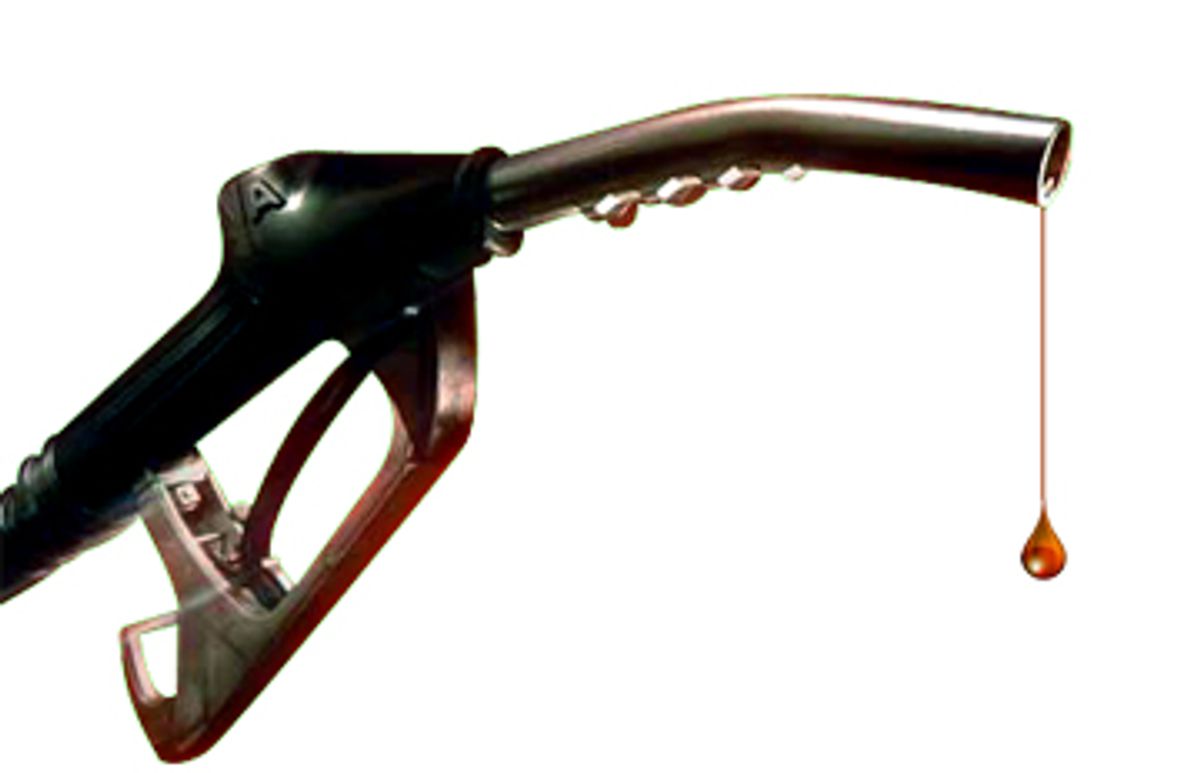
For more than a decade, a fierce debate about peak oil has been raging between those who think a peak in global oil production is at hand and those who think the world is not close to running out of oil. The debate is moot for two reasons. First, the growing threat of global warming requires deep reductions in national and global oil consumption starting now, peak or no peak. Second, relying on unconventional oil like tar sands and liquid coal to make up a supply shortage, as the oilmen say we must, would be climate catastrophe. More supply is not the answer to either our oil or our climate problem -- reducing consumption of oil is. And right now we have two feasible solutions: greatly increase our vehicle fuel economy and find alternative fuel sources that are abundant, low-carbon and affordable.
Make no mistake about it: Soaring global oil consumption has brought the nation and the world to a point of reckoning. Last year, consumption was 86 million barrels a day, up from 78 million in 2002, roughly a 2 percent annual rise. Where is all the demand coming from? Hint: It's not just the rapidly developing countries. From 1995 to 2004, China's annual imports grew by 2.8 million barrels a day. Ours grew 3.9 million. China now sucks up about 6 percent of all global oil exports. We demand 25 percent. American's trade deficit in oil alone is nearing $500 billion a year.
That said, if by 2050, the per capita energy consumption of China and India were to approach that of South Korea, and if the Chinese and Indian populations increase at currently projected rates, those two super giant countries by themselves would consume more oil than the entire world used last year.
This massive, unsustainable consumption has more than peak oil doomsayers like James Kunstler worried. In January, Jeroen van der Veer, chief executive officer of Royal Dutch/Shell, e-mailed his staff that the world will peak in conventional oil and gas within the decade. He wrote: "Shell estimates that after 2015 supplies of easy-to-access oil and gas will no longer keep up with demand." It used to be unheard of for oil executives to talk about limits to oil production. Now it happens all the time.
John Hess, chairman of Hess Corp., a global oil and mineral exploration company, said recently, "An oil crisis is coming in the next 10 years. It's not a matter of demand. It's not a matter of supplies. It's both." In October, Christophe de Margerie, CEO of French oil company Total S.A., said that production of even 100 million barrels a day by 2030 will be "difficult." In November, James Mulva, CEO of ConocoPhillips, the third biggest U.S. oil company, told a Wall Street conference: "I don't think we are going to see the supply going over 100 million barrels a day ... Where is all that going to come from?"
The problem is graver than it appears for one simple reason: Replacing oil in the transportation sector requires strong government action two decades before a peak because of the time needed to replace vehicles and fuel infrastructure. That was the conclusion of a major study funded by the Department of Energy in 2005 -- yes, the Bush DOE -- on "Peaking of World Oil Production." The report notes: "The world has never faced a problem like this. Without massive mitigation more than a decade before the fact, the problem will be pervasive and will not be temporary. Previous energy transitions (wood to coal and coal to oil) were gradual and evolutionary; oil peaking will be abrupt and revolutionary."
Ouch! The same central point is true about global warming. If we want global carbon dioxide emissions to peak and start declining, the planet will need to start aggressive mitigation policies two decades in advance. We're at about 30 billion tons of annual CO2 emissions and rising 3 percent per year. By 2020, we'll be over 40 billion tons annually. If we average more than 18 billion tons of CO2 a year this century, we risk widespread desertification, sea level rise (of 80 feet or more) and the loss of up to 70 percent of all species.
To preserve the livability of the planet, we must cut liquid fossil fuel use more than 50 percent by 2050. That is a central reason that more supply is not the solution to peak oil. That is why it is crucial we don't adopt the strategy that most in the oil industry prefer for dealing with the peak in conventional oil -- ramping up unconventional oil. Most of the major forms of unconventional oil will make global warming worse -- and some would make a climate catastrophe inevitable.
The world has a number of viscous oils called bitumen, heavy oil and tar sands (or oil sands). There is more recoverable oil in Canada's tar sands than there is conventional oil in Saudi Arabia. Tar sands are pretty much the heavy gunk they sound like, and making liquid fuels from them requires huge amounts of energy for steam injection and refining. Canada is currently producing about 1 million barrels of oil a day from the tar sands, and that is projected to triple over the next two decades.
Tar sands are doubly dirty. On the one hand, the energy-intensive conversion of tar sands generates two to four times the amount of greenhouse gases per barrel of final product as the production of conventional oil. On the other hand, Canada's increasing use of natural gas to exploit the tar sands is one reason that its exports of natural gas to the U.S. are projected to shrink in the coming years. So instead of selling clean-burning natural gas to the U.S., which we could use to stop the growth of carbon-intensive coal generation, Canada will provide us with a more carbon-intensive oil to burn in our cars. That's lose-lose.
Even more oil can probably be recovered from shale, a claylike rock, than from the tar sands. Most of the world's shale is found in the U.S., notably in Colorado and Utah. After the oil shocks of the 1970s, billions were spent exploring the possibility of shale oil, but those efforts were abandoned in the 1980s when oil prices collapsed. Shale does not contain much energy per pound: It has one-tenth the energy of crude oil and one-fourth that of recycled phone books. Converting shale to oil requires a huge amount of energy -- possibly as much as 1,200 megawatts of generating capacity to produce 100,000 barrels per day. What a waste of energy just to create a fuel that would spew more greenhouse gases into the air when burned in a car. We must leave the shale in the ground.
The recovery of conventional oil from a well can be enhanced by injecting carbon dioxide into the reservoir. Estimates for potential recovery are 300 billion barrels to 600 billion barrels. When carbon capture and storage from coal generation becomes commonplace -- which might occur as soon as two decades from now -- we may be awash in carbon dioxide that could be diverted to enhanced oil recovery. It would be a tragedy if that carbon dioxide was not put into deep underground aquifers (permanently reducing the amount of heat-trapping gas in the atmosphere), but instead used to extract more fossil fuels from the ground (which would ultimately release carbon dioxide into the atmosphere when burned in internal combustion engines). Again, more oil supply doesn't solve the climate problem.
Coal can be converted to diesel fuel using a chemical conversion process called Fischer-Tropsch. During World War II, coal gasification and liquefaction produced more than half of the liquid fuel used by the German military. But the process is incredibly expensive.
You need to spend $5 billion just to build a plant capable of producing 80,000 barrels of oil a day (the U.S. currently consumes more than 21 million barrels a day). You need about five gallons of water for every gallon of diesel fuel that's produced -- not a particularly good long-term strategy in a world facing mega-droughts and chronic water shortages. Worse, the total carbon dioxide emissions from coal-to-diesel are about double that of conventional diesel.
You can capture the carbon dioxide from the process and store it underground permanently. But that will make an expensive process even more expensive, so it seems unlikely for the foreseeable future, certainly not until carbon dioxide is regulated and has a high price and we have a number of certified underground geologic repositories. More important, even if you capture the CO2 from the Fischer-Tropsch process, you are still left with diesel fuel, a carbon-intensive liquid that will release CO2 into the atmosphere once it is burned in an internal combustion engine.
Coal to diesel is a bad idea for the planet. If the U.S. or China pursues it aggressively, catastrophic climate change will be all but unavoidable.
A 2006 study by the University of California at Berkeley found that meeting the future shortfall of conventional oil with unconventional oil could increase annual emissions by more than 7 billion tons of carbon dioxide for several decades. That would be fatal to any effort to keep average annual emissions this century below 18 billion tons of CO2. Indeed, it would probably drive us past dangerous tipping points toward CO2 levels whose consequences have barely been imagined.
Thus we come to one of the biggest questions of our time: Is humanity wise enough not to pursue carbon-intensive alternative fuels, even though pretty much all of them are economically profitable at current oil prices? Let me assume, optimistically, that we are. Let me also assume that we have more than a decade before the peak in conventional oil. We must act now. And by now I mean when we have a new president who actually cares about these issues and believes in government-led solutions to prevent economic losses from a major oil shock and devastating climate change, each of which would cost the U.S. trillions of dollars.
Clearly we now have only two realistic strategies: increase our vehicle fuel economy and develop affordable alternative fuel sources that are low in carbon. In 2050, the planet may well have 2 billion cars on the road or more, three times the current number. To avoid dramatic climate impacts, we must use at least 60 percent less total liquid fossil fuels -- and that assumes we have essentially eliminated carbon dioxide emissions in the electric sector. The average car on the road will need to put out under one-fifth the emissions of current cars, or the equivalent of five times the "miles per gallon" of today.
If we achieve just half of that emissions cut through greater fuel efficiency (and the other half through a low-carbon alternative fuel), we'll need new cars and SUVs in 2040 to get at least 60 miles per gallon. Of course, that assumes people don't drive greater distances, even though they will be wealthier, and a nation's per capita wealth has historically correlated with vehicle miles traveled.
Increased fuel economy can be achieved either by mandates, such as the corporate average fuel economy (CAFE) standards, or by higher prices achieved through higher taxes. Certainly new technology can help. But no country has ever substantially increased its fuel economy with new technology without relying on much tougher fuel economy standards, higher prices or both. I have never been a big fan of higher gasoline taxes, not just because they are a political non-starter, but also because you would have to jack up taxes an absurd amount to get the desired impact. So that leaves tougher standards -- mandates. Even Europe, with much higher gasoline taxes than us, uses mandates.
Late last year, after some two decades of trying, Congress passed a new 35-mpg standard -- after tough fighting with conservatives in both parties. That great achievement will take us in 2020 to where the Chinese are now (but not to where Japan and Europe were six years ago). It is worth noting that China has a minimum-allowable efficiency standard, not a "fleet-average" standard like ours. As the Toronto Star nicely explained: "No gasoline-powered car assembled in North America would meet China's current fuel-efficiency standard."
Since we're being optimistic, let's assume we can get fuel economy standards for cars and SUVs of 60 miles per gallon by 2030. We would still need more than half of vehicle fuel to be zero carbon. And for that only one alternative fuel is even remotely plausible -- carbon-free electricity. Plug-in hybrids and electric cars are the cars of the future, especially as a climate solution. What's more, with plug-ins and electric cars on the roads, oil peakers like Kunstler -- who has claimed that when the oil runs dry, suburbia "will become untenable" and "we will have to say farewell to easy motoring" -- can relax.
Suppose that by 2020, oil blew past $300 a barrel and gasoline rose to $9 dollars a gallon (still not much higher than current gasoline prices in England). You could replace your car with a plug-in hybrid, and trips less than 30 miles, which have made suburbia what it is today, would actually cut your fuel bill by a factor of more than 10, even if all the electricity were from zero-carbon sources like wind and nuclear power. The extra cost of the vehicle would be paid for in fuel savings in under five years.
The big question is how we accelerate plug-ins and E.V.s into the marketplace to stave off the worst of the peak oil and climate catastrophes. No country has ever introduced a mass-market consumer alternative fuel vehicle without government mandates. So again we are going to have to turn to progressive policies.
Clinton and Obama (but not McCain) have detailed policies to jump-start the transition to plug-in hybrids. Clinton, for instance, plans to offer consumers tax credits of up to $10,000 for purchasing a plug-in hybrid. I would offer the tax credit for the first 1 million plug-ins purchased. The effort would cost under $10 billion over several years -- about what this country now spends on imported oil in a single week! And of course we'll need a very aggressive push toward efficiency and zero-carbon electricity, which both Democratic candidates support. That is the very least we can do given the twin multitrillion-dollar threats of peak oil and global warming.
Shares