

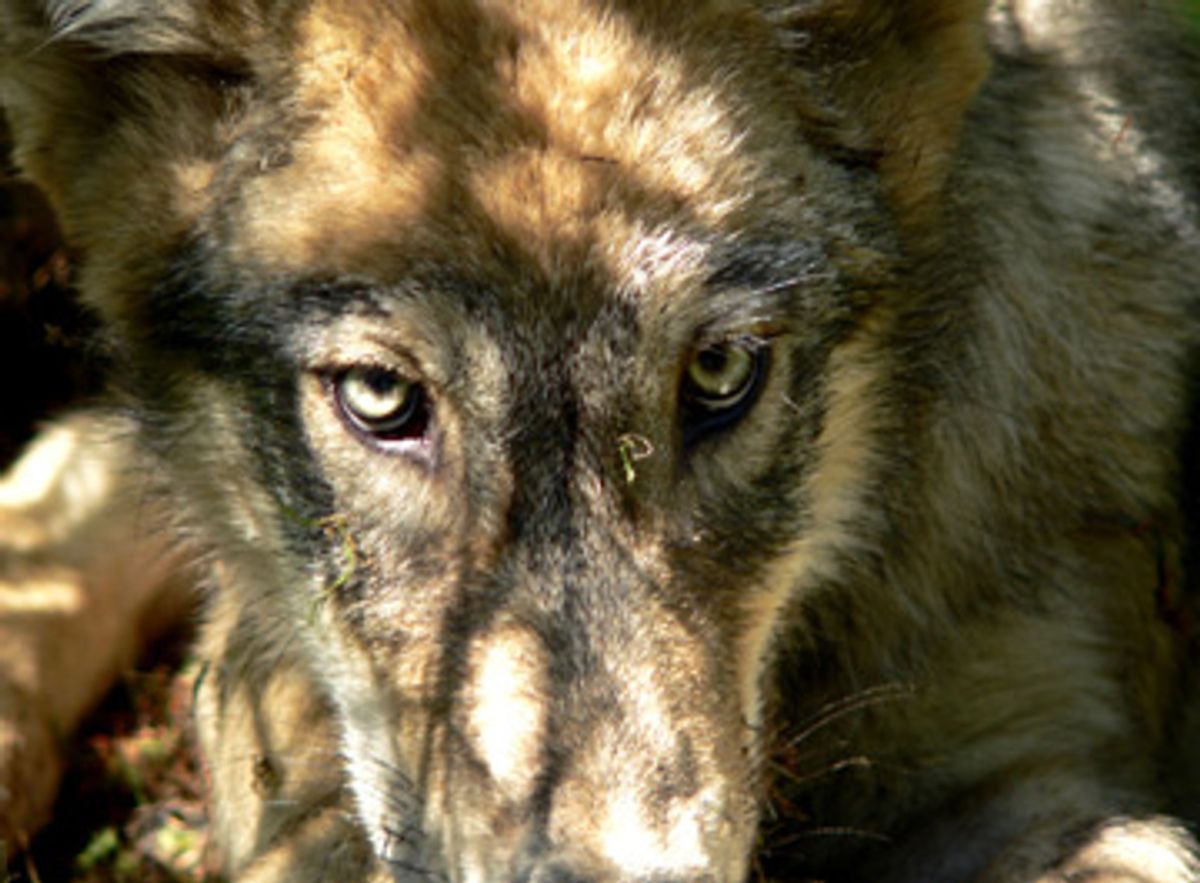
In Yellowstone National Park's Lamar Valley, the return of gray wolves has turned the wild canines into celebrities. At dusk, scope-toting wildlife watchers and photographers stake out the valley to observe the crepuscular predators. One of the most popular wolves in the valley, known to wildlife biologists as 253M, won the affectionate nickname Limpy, because of a pronounced limp from an injury.
Born to the Druid Peak pack, Limpy was wounded in a fierce fight with a neighboring pack, the Nez Perce, before he was a year old. After the injury, he could hardly use his back left leg for the rest of his life. "This is a wolf that could easily have just died, but he fought back, and he was able to still hunt," says Brian Connolly, a children's book author, who spends four months a year in Yellowstone wolf watching.
In 2002, Limpy's renown grew when he wandered to Utah and got caught in a coyote trap. It was the first confirmed wolf sighting in that state in 70 years. Shipped back to Wyoming in the back of a U.S. Fish and Wildlife truck, Limpy became the beta male of his pack. His dark coat made it easy for wildlife watchers and awestruck tourists to pick him out as he roamed the valley, hunting elk, tending pups and defending the pack's den from bears, all despite his bum leg.
To wildlife biologists and conservationists, Limpy embodies the success of the $30 million federal project to reintroduce the charismatic predator into the northern Rockies. Today, after an exhausting political battle that has lasted decades, 1,500 wolves thrive in Montana, Wyoming and Idaho. But there's a flip side to the victory.
This year, on Feb. 27, given the reintroduction's success, the Bush administration removed the gray wolves of the northern Rockies from the federal Endangered Species List. It's now legal to shoot a wolf in more than 85 percent of the state of Wyoming, even if the wolf being shot has no history of preying on livestock or domestic animals.
On March 28, the day that new state wolf policies went into effect, a hunter stationed near elk feeding grounds in Daniel, Wyo., shot and killed Limpy. In the parlance of wolf management, Limpy was a "clean" wolf who'd never been known to prey on livestock or domestic animals.
Limpy is not the only victim. In the past two months, wolf-hunting parties in Wyoming have been gathering near elk feeding grounds. "They're having weekend wolf-hunting parties by snowmobile," says Suzanne Stone, Defenders of Wildlife's northern Rockies wolf conservation specialist. "It's very easy to kill wolves during this time of year because they're so stationary. The whole pack tends to keep very close to their den sites." Some wolves have been chased by snowmobiles for miles before being gunned down.
In Idaho, wolves suspected of "molesting or attacking livestock or domestic animals" can be killed without a permit. Montana and Wyoming have also made it easier to shoot a wolf that threatens livestock, and all three states plan to hold wolf-hunting seasons this year. While the wolves that stay in national parks, like Yellowstone and Grand Teton, are still protected, those that stray out of them are at risk of being shot. Since late March, at least 40 wolves in Montana, Wyoming and Idaho have been shot dead.
The wave of killing has raised the absurd specter that while the United States spent millions to bring wolves back to the region in the name of conservation, and to restore a fraction of the West to its former wildness, now the wolves will be slaughtered again. On April 28, a coalition of 12 environmental groups, including the Sierra Club, Defenders of Wildlife and Jackson Hole Conservation Alliance, filed suit in federal court against the Bush administration, challenging the U.S. Fish and Wildlife Service's decision to remove protections for the animals. The lawsuit contends that because the wolves occupy several distinct areas, there's not enough genetic diversity within the small number to ensure the wolf's future. The states' hunting policies will likely drive down that number even further.
"The states legally could kill down to a total of 300 wolves," says Doug Honnold, a lawyer for Earthjustice, lead attorney on the case. "We could have 1,200 wolves killed before the federal government would say relisting this population is appropriate. People have worked so hard to promote wolf recovery, and just as we have victory within our grasp, or approaching our grasp, we're throwing it away and heading in the opposite direction."
With so many wolves already being shot, a federal judge in Montana has rejected a request by the federal government to delay the lawsuit, saying he's "unwilling to risk more deaths." A hearing will be held on May 29 in Missoula to decide if the wolves will be placed back under federal protection for the duration of the case.
The gray wolves have come a long way from being the most reviled predator in the American West to being a beloved symbol of the region's wild heritage. Western settlers sought not only to make their land safe for cattle ranching but to eradicate wolves with a violence that bespoke a deeper antipathy. During westward expansion, hundreds of thousands of wolves were trapped, shot and poisoned. Others died more ghastly deaths, according to Renee Askins, a wildlife ecologist who spent 15 years working for the return of the carnivores to Yellowstone. Some wolves were doused with gasoline and set on fire, others had their legs tied to four horses and were quartered to death, while still others slowly died of starvation, after their jaws were cruelly wired shut. The extermination of the gray wolves represented not only the taming of the West but its conquest.
The wolves now living in the northern Rockies are a small fraction of the wolves that once populated the American West. Yet their storied return has been embraced by conservationists as that rare hopeful tale of how Homo sapiens can repair its past sins against the environment. After years of heated debates, in 1995 and 1996, some 66 wolves from Canada were reintroduced to the region. The wolves took to their new territory better than wildlife biologists had dared hope -- mating, forming new packs and expanding their territory.
Thirteen years and $30 million in federal funds later, 1,500 wolves now roam the northern Rockies. Wolves bring about $35 million annually to the region from tourists who come to catch a glimpse of the wolves, and spend on hotels, restaurants and even kitschy wolf-souvenir coffee mugs, according to a paper by John Duffield, a mathematician at the University of Montana at Missoula, and colleagues.
But the wolves have done more than give nature lovers the thrill of visiting a landscape with all the great predators it had when Lewis and Clark traveled there. Wildlife biologists have been fascinated to observe the effect that the wolves have had on the local ecology. Native vegetation, such as cottonwood and aspen, has rebounded, a phenomenon scientists attribute to an "ecology of fear": newly skittish elk now avoid browsing in some streamside areas frequented by wolves, allowing seedlings to once again take hold. The reintroduction of wolves has also reduced coyote populations by more than 30 percent in some areas. That hasn't been good for the coyotes, but it has been for pronghorn antelopes, as coyotes prey on pronghorn fawns while wolf packs rarely do.
As for humans, the reintroduction has unleashed the pent-up enmity of some Westerners who never wanted the wolves to be brought back in the first place. They include elk hunters who resent competing with the wolves for their prey, ranchers who don't like defending their livestock from wolves, and don't-tread-on-me types who resent the federal government telling the states what to do. No less an official than Gov. Butch Otter of Idaho wants to all but eradicate wolves from his state. He told a rally of cheering hunters in January 2007: "I'm prepared to bid for that first ticket to shoot a wolf myself."
Elk hunters and the livestock industry lobbied for Wyoming's lax wolf policies. In the past decade, hunters have blamed dramatic declines in elk populations on the wolves. But scientists argue that it's drought and elk hunters themselves who have caused the elks' decline. Nevertheless, the anger of the livestock industry and the hunters now has an outlet. "I think a lot of people didn't like reintroduction in the first place and now they're taking revenge," says Louisa Willcox, senior wildlife advocate for the Natural Resources Defense Council. "They resent the federal intrusion."
Not so the public. Willcox stresses that of the 200,000 comments that the federal government received on wolf delisting, the overwhelming majority were opposed to it. "This is an administration catering to a minority of ranchers, a minority of interests in the states, who simply want to gun the wolves down," she says.
At the same time, many environmentalists concede that wolves that attack livestock should be killed. "I don't think that there is a wildlife person out there who wouldn't agree that if 253, or any wolf, was interfering with livestock, then you need to take him out," says wolf watcher Connolly. "Any rancher or farmer deserves to be able to do that." Before the delisting in March, and under federal protection, a rancher could get a permit to kill a wolf that preyed on livestock. Defenders of Wildlife also paid ranchers for the value of livestock lost to wolf predation.
What horrifies the wildlife watchers is killing a wolf just for being a wolf. "For anyone to just go out and shoot a wolf without any reason, [a wolf] which hasn't gotten into any trouble, is criminal," says Connolly. "It's dishonorable, disrespectful of nature, and it shows an extreme lack of understanding of how the natural world works."
Ted Kerasote, an author who writes about nature and wildlife from Kelly, Wyo., where he can hear wolves howling near his home at night, sees the battle over wolves taking place against the backdrop of changing land use patterns in the West. Throughout Montana, Wyoming, Idaho and Colorado, ranches are being sold off and subdivided for ranchettes, while natural gas development expands in Wyoming and Montana, decreasing and degrading wildlife habitat. It's really a debate about what the land is for, and where animals should be allowed to live.
"Many ranchers don't mind wolves as long as they stay in Yellowstone or Teton National Park," says Kerasote. "That says a lot about how we see nature now. In the same way that many of us look at museums in urban places, many of us also look at national parks as repositories for our wildlife heritage. The environmental community is trying to push out the boundaries of the parks, and the livestock community is trying to keep the boundaries as they are, saying, 'We have this nice museum, that's enough.'"
Wolves, though, have a way of straying out of the boundaries that humans draw for them. And when they do, they are, once again, caught in the crossfire.
Shares