

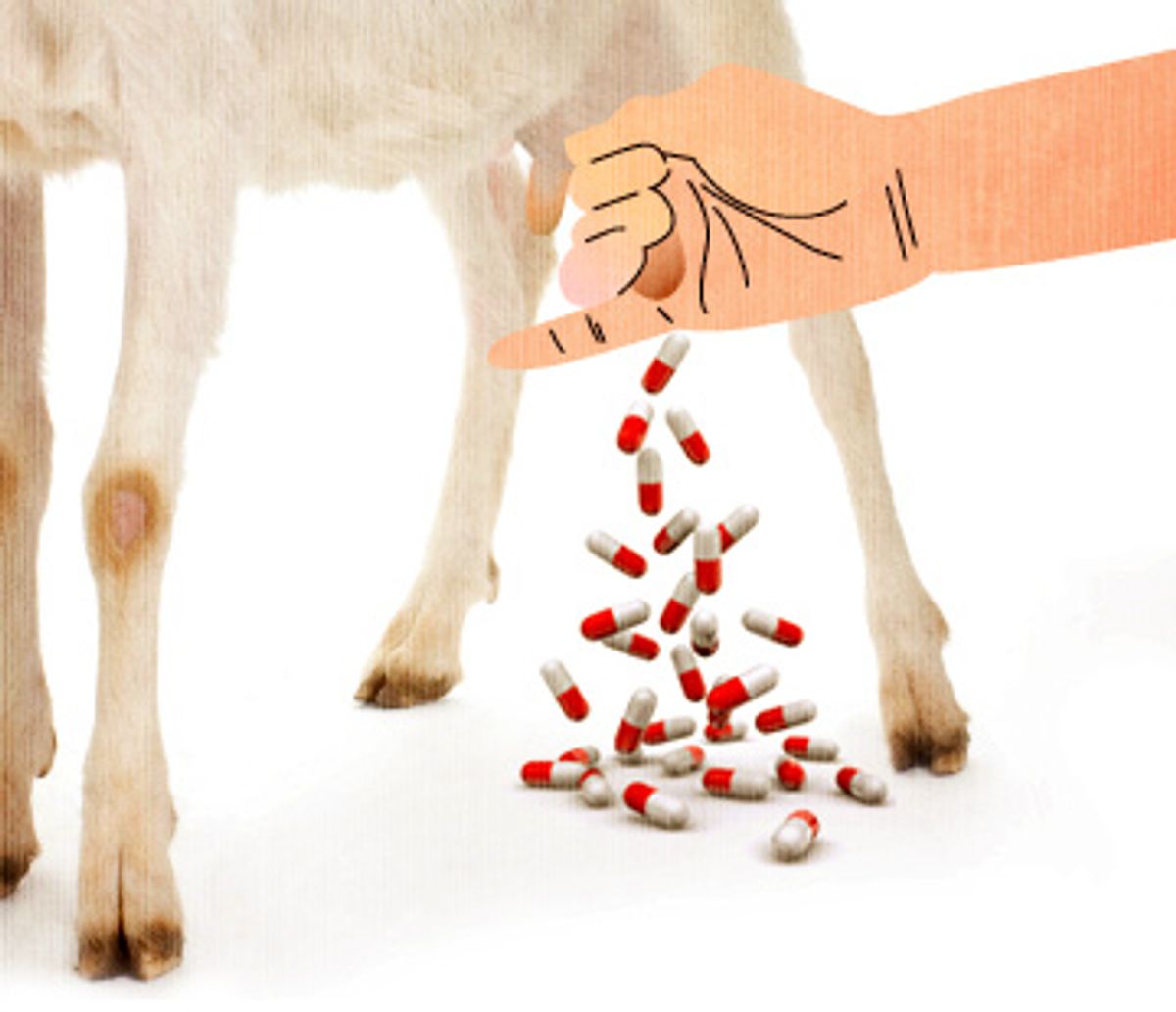
Encompassed by pastoral green fields, the headquarters of GTC Biotherapeutics looks like any other New England farmstead. But its serenity is deceiving. Behind barn doors, the farm's most valuable employees -- a herd of pygmy goats from New Zealand -- are working round the clock, their milk glands churning out hundreds of gallons of high-grade pharmaceutical compounds.
The white gold extracted from the goats' udders will someday command big bucks in the American healthcare marketplace -- or so GTC hopes. The company's genetically modified animals possess a human gene that allows them to produce milk rich with a protein called antithrombin, which helps prevent blood clots from forming and staves off related conditions like heart attacks and strokes.
Tom Newberry, GTC's vice president of corporate communications, leads me into a corrugated-metal hutch. Goats enclosed in pens train inquisitive rectangular pupils on us and poke their heads through the bars. "They're looking for a handout," Newberry says, chuckling. But we can't give these goats kibble or even a pat on the head; that would be a breach of strict sanitary regulations.
ATryn, GTC's goat-derived antithrombin, cleared its first regulatory hurdle in 2006 when the European Commission approved it for sale in all 25 European Union countries. This past fall, GTC successfully lobbied the U.S. Food and Drug Administration to designate ATryn as a "fast-track product," making it eligible for accelerated review on this side of the Atlantic.
But GTC is out to prove it's no one-trick ruminant. Staff scientists have created transgenic goats that can churn out a smorgasbord of human proteins, including compounds that halt tumor blood-vessel development and blood-clotting factors for hemophiliacs. Protein-based human antibodies that protect against all kinds of diseases -- from SARS to incurable cancers -- could be next in the dairy pipeline.
A bevy of biotech companies is crowding the drug market with takes on the transgenic-remix concept. Origen, located in Burlingame, Calif., is developing a transgenic production line that employs chickens instead of goats as drug incubators. The company has bred birds that produce a range of human anticancer proteins and other antibodies in their eggs. In Athens, Ga., AviGenics is using a transgenic-chicken system to make a protein compound that stimulates the bone marrow to make more white blood cells -- essential in helping cancer patients bounce back after chemotherapy.
"Transgenic drug technology has been in the incubation stage for a long time," says Robert Kay, president and CEO of Origen. "But within the next five to 10 years, we should be seeing many new products in the clinic and pushing their way toward approval." Future drug-producing menageries, he predicts, will include pigs, cows and rabbits.
While these transgenic pioneers might seem to be cruising toward FDA approval, the road is hardly without obstacles. To the frustration of executives like Kay and Newberry, most of the snags are not financial or logistical but arise from people's reflexive reactions -- as in, Omigod, they're putting human genes into animals! It's "The Island of Dr. Moreau" made real.
But the revulsion to transgenic animals is more than reflexive; some animal biologists say biotech companies are overselling the safety of the resulting drugs. Meanwhile, ethicists question whether we should be restyling animals as drug producers at all.
GTC transforms goats into drug factories thanks to a recently perfected biological sleight of hand. Once a goat embryo is artificially fertilized in the lab, technicians zero in on the portion of the goat's genome that codes for a sugar found in goat milk and insert a human gene that codes for a naturally occurring protein. When the animal reaches maturity and begins producing milk, every cup of the white stuff contains large quantities of the therapeutic protein, which can be chemically extracted in pure form. "The mammary gland is nature's way of making proteins that are nutritious for offspring," Newberry says. "All we're doing is placing extra DNA coding in this natural pathway."
Before transgenic breeding, pharmaceutical companies normally extracted such protein compounds from donated blood plasma. But to get the same kilogram of antithrombin that a single transgenic goat produces each year, you'd have to get 50,000 people to donate blood -- a time-consuming process with its own inherent risks. "It's so bloody expensive, excuse the pun," Newberry says, "and the Red Cross just got hit with another set of fines for insufficient screening. Now, would you rather have a drug derived from human blood donors, or from our goats, given that we know where they slept last night?"
That question ignores a key fact. "Using goats for drug production has unpredictable effects, and the genetic inheritance of the modified genes is not a given -- 90 to 99 percent of the animals bred are killed immediately because they don't incorporate the desired gene," says Jessica Sandler, director of the regulatory testing division at People for the Ethical Treatment of Animals.
Creating transgenic animals does indeed have a high failure rate. With the technique known as pronuclear injection, only about one to 10 of every 100 attempts results in transgenic offspring, producing a high number of animals typically earmarked for euthanasia. The more sophisticated nuclear-transfer method that GTC uses ensures that virtually 100 percent of viable offspring are transgenic. Still, the transgene does not always land in the targeted section of the genome, and some offspring end up with severe birth defects for reasons that are still not well understood.
Tom Regan, a philosophy professor emeritus at North Carolina State University and author of "Empty Cages," sees the death and suffering of defective animals as a grave ethical misstep. "The animals used for these purposes are in fundamental ways like us -- their behavior tells us they're like us, evolutionary theory tells us they're like us," he says. "What we have with transgenic research is another incentive for reducing animals to something whose purpose for being in the world is to serve human interests. And that's fundamentally flawed."
Others contend that raising animals to produce drugs is no crueler than raising them for agricultural purposes. "I've been involved in this for a long time, and the animals we have are positively spoiled," says dairy scientist Robert Bremel, founder of transgenics company ioGenetics. "If the drug product is innocuous to the animals themselves, they do fine."
Debates over animals' welfare and self-determination aside, there's the question of whether transgenic animals will produce drugs that create unexpected side effects in humans. "We have to be careful about the activation of retroviral or pathogenic agents," says Doug Gurian-Sherman, a senior scientist with the Union of Concerned Scientists' food and environment program, adding that human drug products derived from animals could potentially pass on such pathogens to recipients.
Spurred by similar worries, the National Academy of Sciences' research council formed a committee to assess the safety of animal biotechnology products. "The mere fact that something is produced by a genetically altered animal does not make it harmful," says John Vandenbergh, a biologist who chaired the committee. "But there was concern that some of these new proteins could induce allergic reactions in people." The report the committee issued in 2002 recommended controls to keep transgenic animal products out of the food supply. (GTC adheres strictly to such standards, Newberry says: "We don't sell our milk, and we give our dead goats to a licensed contractor that incinerates them.")
To be sure, squeamishness about human-animal hybrids has a storied pedigree: Geryon of Dante's "Inferno," who dwells in the lowest circles of hell, is a fearsome crossbreed with a human face and a scaly tail. But is equating chimerism with fallen virtue still justified? What rules should govern foisting part of the genetic code that makes us human -- no matter how small -- onto chickens, goats and rabbits?
"With chimeras, we are challenging our concepts of what it means to be 'human,'" bioethicist Linda MacDonald Glenn, a former ethics fellow at the American Medical Association, said in a 2003 speech. "We need to be prepared to ask, 'How can we preserve our human rights and dignity despite the fact that our "humanness" may no longer be the exclusive possession of Homo sapiens?'"
Today, Glenn still struggles with questions about what "humanness" signifies. "If you say, 'Humans are the ones who can reason,' what happens when you have a child who's born with mental deficiencies?" she says. "It's insulting to say that child's not a person. On the other hand, there are also animals that have high cognitive abilities." The lack of a clear-cut distinction between humans and animals, Glenn says, makes it difficult to justify the process of drastically modifying animal genomes, though she feels some genetic alterations may be appropriate if they stand to improve human health and well-being significantly. "We are all interconnected. It's important that we treat the goats with respect, because they're really not that far away from us."
In Newberry's view, this kind of deep-waters philosophy is unwarranted. He scoffs at the implication that GTC's operations are even in the Dr. Moreau ballpark. "People say, 'Are they breeding centaurs out there, some kind of man-goat beast?' No, of course not. We put a control sequence in the transgene to make sure it's only turned on during lactation. And there's a big difference between manipulating a single gene, like we're doing, and manipulating a whole chromosome. Treating them the same is like saying, 'I moved my brother-in-law into his new apartment with a pickup truck. Now I'm going to move all of New York City with that same truck.'"
Despite the deeply ingrained public perception that, darn it, there's something just not right about this kettle of fish, companies like GTC may succeed if they can make a lights-out case for the medical necessity of their products. After all, even conservative grande dame Nancy Reagan became a stem-cell research crusader once she realized the treatment was the best hope to reverse her late husband's Alzheimer's.
"The bottom line is that people do these trade-off calculations," says Edna Einsiedel, a communications professor at the University of Calgary. The World Organization for Animal Health commissioned her to write a 2005 survey report assessing the tenor of public opinion regarding transgenic animals. "There seems to be a hierarchy in terms of preferences -- people view medical-related applications more positively than food-related ones. But there's still some discomfort with the idea that you're taking genes from one species and putting them into another. People ask things like, 'What kind of animal will you end up with?'" At the same, Einsiedel continues, "Sometimes when you explain things to people in greater depth, their initial reluctance can change."
Naturally, Newberry is at the ready with examples illustrating how transgenic drugs can transform patients' lives. If hemophiliacs had an unrestricted supply of factor-7 protein -- a drug that currently costs more than $1,000 a milligram -- courtesy of his goats' mammary glands, the drug "could be used as a prophylactic, not just a rescue therapy," he says. This development, he adds, could markedly improve sufferers' prospects, as they'd no longer have to endure the pinpoint bleeds that cause debilitating joint damage over time.
In reality, though, transgenic drug development simply isn't far enough along for the public to perceive it as a medical grand slam. Being able to treat clotting disorders more cheaply and effectively is great, but whether transgenic medicines will ever vanquish intractable tumors or keep drug-resistant tuberculosis in check is still an open question.
Still, extrapolation -- warranted or not -- is one of the things visionary firms do best, and GTC is no exception. The company's current full-tilt focus is on shepherding ATryn through the FDA approval process. When Newberry looks ahead, he likes to picture the day when GTC's goat herd will become the pharmaceutical equivalent of a soft-drink machine, dispensing a vast array of life-giving substances on command.
"You can make hundreds of different proteins this way, and the system is linearly scalable: If you need more, you breed more," he says. "This is like 'Back to the Future.' It's Buck Rogers combined with farming, the oldest trade known to man."
Shares