

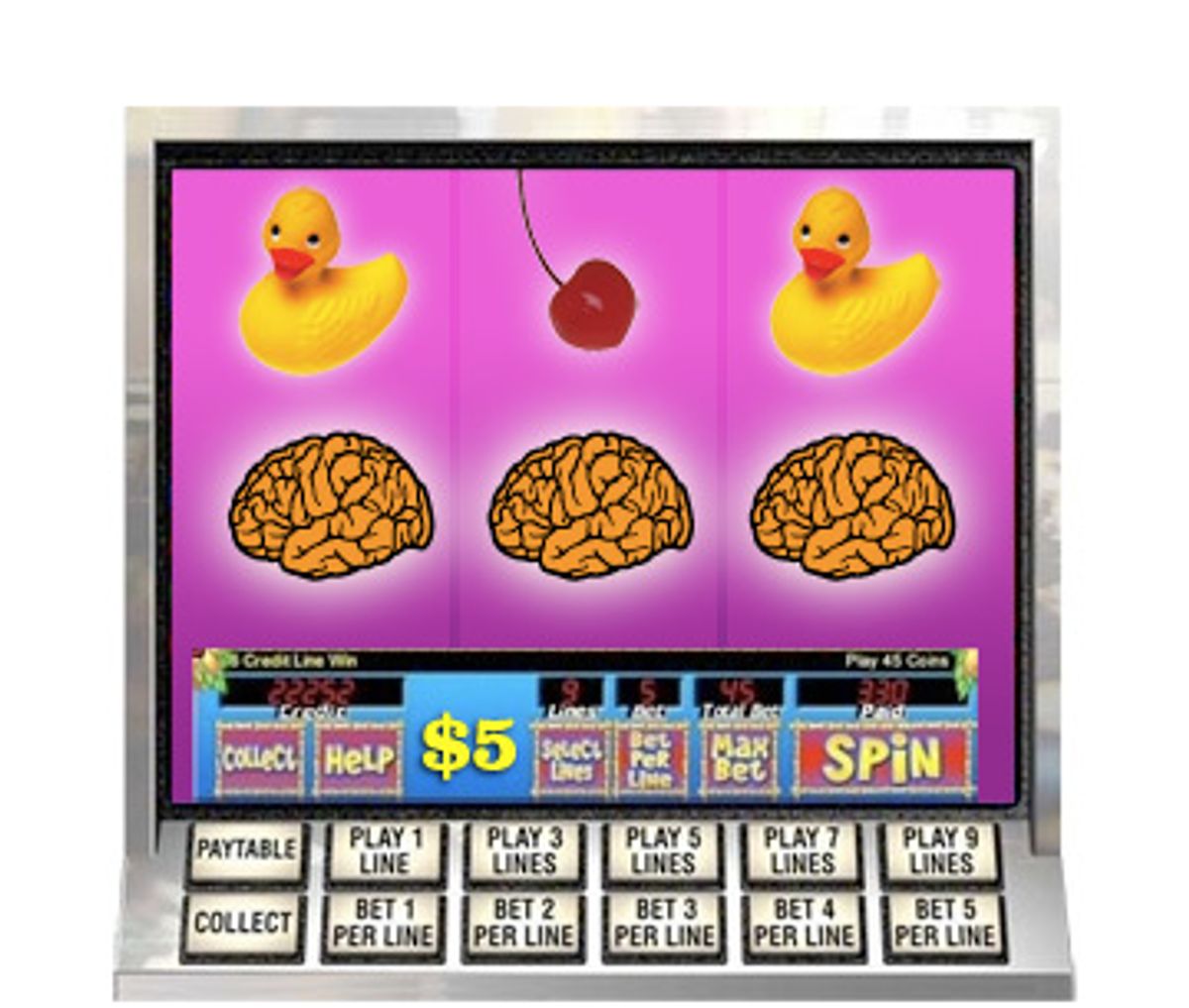
Jean Brochu was a respectable attorney in Quebec with a wife and two kids. That was before he first punched the button on a video slot machine in 2000. Within 15 months, Brochu says he was losing $500 a day to the machines. He plunged headlong into debt, and lost his car and his house. He stole $50,000 from his union, and was consequently disbarred for three months. He claims that in several dark moments he contemplated suicide. He also says it was all the fault of those slot machines.
Now Brochu is the lead plaintiff in a massive class action lawsuit against Loto-Quebec, the government agency that runs all forms of gambling in the province. Brochu's lawyer, Roger Garneau, says he filed the suit on behalf of the estimated 119,000 gambling addicts in Quebec province. Garneau says the slot machines dragged these citizens into addiction. "They have been conceived and constructed for trapping the mind," he says. The suit asks for almost $700 million in damages.
For Garneau to win at trial this year, he'll have to prove not only that Brochu and his fellow plaintiffs are gambling addicts suffering from a diagnosable mental illness, but also that their illness is a direct result of playing the 15,000 video slot machines scattered in bars and restaurants throughout the province.
The plaintiffs' lawyers will argue that these nefarious machines lured in unsuspecting citizens, dazzled their eyes with flashing lights, and drowned out the murmurs of guilt and responsibility in the back of their heads with the sound of cascading coins. They'll try to show that the casinos and video slot machines turned Brochu and the others into junkies, unable to think of anything expect their next chance to score big. With their lawsuit, the plaintiffs will be taking aim at one of the gaming industry's most cherished talking points, which sounds a bit silly when you strip it down to basics: Gambling doesn't cause gambling addiction.
On the other side, lawyers for Loto-Quebec will base their argument on what also might seem a far-fetched notion: Casinos and slot machines aren't the culprits -- genetics and brain chemistry are. In essence, they'll argue that the fault, dear gambler, lies not in our Stardust casinos, but in ourselves. In doing so, the industry will set up a rock-solid defense against troubling lawsuits and arm pro-casino legislators with scientific data.
With the ugly specter of gambling addiction, of ruined lives and families, hanging over their heads, gaming advocates will bolster their cases with research from the National Center for Responsible Gaming (NCRG), a nonprofit group, associated with Harvard University, that funds most of the scientific research on gambling addiction. The research will show that only a few unfortunate souls -- those predisposed to addiction -- will get into trouble, while everyone else can gamble for entertainment with no ill effects. The center's studies were exhibited last fall in Boston, where lawmakers wrestled over bringing three casinos to Massachusetts. They will also be on display in the coming year, as lawmakers across the country consider legalized gambling and new casinos, with literally billions of dollars hanging in the balance.
But there's a serious kink in the studies: The NCRG is a wing of the casinos' main trade group, the American Gaming Association, which has committed a total of $22 million to the center. To ethicists and casino critics, that relationship is a cautionary tale of science getting too close to industry. While NCRG leaders say they fund independent science, it's not a coincidence that the science aligns so well with the interests of the casinos. It's not that gambling executives are tampering with research findings, or scientists are skewing results. Rather, gaming executives are drawing extravagant conclusions from the studies. By trumpeting these conclusions, the gaming industry is helping casinos gain a legal foothold across the country -- and covering up the ways casinos profit from gambling addiction.
In 2007, American consumers spent $34 billion on gambling in commercial casinos (a category that doesn't include Native American casinos), according to a report by the American Gaming Association. That's up from $20 billion a decade before. Small wonder, then, that casino executives worry that addiction could harm their golden goose. Between 6 million and 8 million Americans are thought to have trouble walking away from the casinos each year, with a full spectrum of consequences, according to the National Council on Problem Gambling, an advocacy group.
Frank Fahrenkopf, president of the American Gaming Association, laid out the gaming industry's lines of defense at a 1996 speech before industry bigwigs in Las Vegas. He called problem gambling the "Achilles' heel" of the industry and told the assembled executives that their "enemies" would use the issue in a "crusade to crush our livelihood."
Fahrenkopf said the issue hits home with state legislators, who could be turned against the expansion of gambling or convinced to pass restrictive regulations. (Regulations proposed in other countries include mandatory clocks on casino walls, "time out" periods after a certain amount of money is lost and maximum bet limits.) Meanwhile, media stories of gamblers who had lost everything tugged at the public heartstrings, jeopardizing support. "The growth of our industry is certainly endangered by the issue, and it is not hyperbole to say that the industry's very existence is at stake," Fahrenkopf warned.
The plan he proposed owed a debt to the tobacco industry executives who had spectacularly lost public support just a few years before, when they raised their hands before a 1994 congressional committee and testified that nicotine was not addictive. "Our industry cannot afford to make the mistake made by the tobacco industry," Fahrenkopf said. He told his colleagues that the gaming industry must not only admit that gambling addiction existed, but also lead the discussion of its origins, symptoms and social impacts.
To investigate those origins, the American Gaming Association created the NCRG, and the casinos keep it flush with money. This past September, the NCRG announced $7.6 million in new funding commitments for the next five years, including $2 million from Harrah's, $2 million from MGM Mirage and $1 million from International Game Technology, the largest slot machine manufacturer in the world. Its board of directors includes executives from MGM Mirage, Harrah's and the casino company Boyd Gaming Corp., as well as Judy Patterson, executive director of the American Gaming Association.
Four years into the NCRG's existence, it established a spinoff organization, the Institute for Research on Pathological Gambling and Related Disorders. Patterson said in a speech that the industry wanted to "adhere to a system of scientific peer review modeled after the federal government's National Institutes of Health." Today, the institute is housed at the Harvard-affiliated Cambridge Health Alliance.
Christine Reilly, executive director of the institute, says she's heard all the complaints about the institute's funding and supposed conflict of interest. She explains that the institute's contract with the NCRG stipulates that the industry can't interfere with decisions. NCRG leaders "don't even see what we're doing until it's published," she says. "Once the papers are published, anyone can use them however they want."
Indeed, when the Massachusetts Legislature held hearings on the governor's proposal to legalize gambling last fall, gambling foes accused the state's public health officials of drawing talking points from institute-funded studies. They pointed to one official who used an institute study to support his claim that gambling could provide stimulating cognitive benefits to the elderly.
Industry leaders are bullish on the research prospects of the institute. "I was just reading an article the other day about a new biomarker test for ovarian cancer," Phil Satre, the chairman of the NCRG's board and former CEO of Harrah's Entertainment, told the trade publication Responsible Gaming Quarterly in 2006. "I would like to see the development through our research of a similar test for problem gamblers."
That may sound far-fetched, but not to Reilly. "Diagnosing mental illness is more of an art than a science, especially with addictions," she says. "So wouldn't it be great to have an objective measure? That would be a blood test, maybe a genetic marker, saying this person is predisposed to addiction."
While the institute funds research on the social determinants of gambling addiction, it focuses on genetic and neurochemical causes. It draws on a study by psychiatrist Donald Black of the University of Iowa, who found that pathological gamblers were more likely to have other pathological gamblers in their immediate families than were control subjects; they were also more likely to have alcoholics and substance abusers in their families.
On the neurochemical front, researchers home in on dopamine, the neurotransmitter associated with rewards and motivation. Using a functional MRI machine, Alain Dagher of McGill University has shown that giving test subjects a monetary reward activates the ventral striatum, a part of the brain that also lights up when a cocaine addict uses cocaine. The ventral striatum is known to have many dopamine receptors, and other studies have shown that gambling addicts flood the zone with dopamine when they win, while control subjects have a smaller release.
To Reilly, this kind of research undermines the point raised in the Canadian court case that video poker machines are addictive. "Things are not addictive, they're just not," she says. "Addiction is a relationship between the object and a vulnerable person, and if you don't have that vulnerability, the odds are you won't get addicted. I play a slot machine for 10 minutes and I'm so bored I want to shoot myself."
Neurologist Dagher cautions against jumping to such conclusions. It's far too soon to say that some people are programmed at birth to respond to gambling with addiction-inducing rushes of dopamine. "People always think if we find an abnormality in the brain, it must be something inborn," he says. "But the brain is very plastic. If you see an abnormality, it's probably a combination of something inborn and a response to environmental factors. And the dopamine system is tremendously affected by life experiences, especially stress."
If the casino industry can defend itself against gambling addiction by pointing to neurobiology, it might also be argued that it has learned how to profit from addiction. Natasha Dow Schull, a cultural anthropologist and assistant professor at MIT, and a prominent critic of the gaming industry, points out that casinos are booming thanks in large part to increasingly sophisticated and highly addictive slot machines and video poker machines. These machines are the gaming industry's cash cow -- they occupy more than 75 percent of casino floors -- and one of the most efficient systems that humans have ever devised for delivering a dopamine rush to your brain while extracting money from your wallet.
Schull has studied the interface between slot machines and the players who throng to them. As she explains, the old one-armed bandits are gone: Players were wasting too much time pulling the lever. Now push-button and touch-screen games are the rule, where a hardcore customer playing at top speed can play a game every five seconds. When you consider the slot machine makers, says Schull, "It's clear their ideal customer is the addict. They have a term, 'player extinction,' which means you lose all your money. They're talking about this as a goal!"
Schull has also tracked the work of the NCRG since its founding in 1996. In her forthcoming book, "Machine Life: Control and Compulsion in Las Vegas," she dives into the experience of gambling addicts, and argues that the industry acted deliberately to defuse the threat it poses by funding science that casts them in an unflattering light.
"The NCRG is committed to the idea that most 'normal' people aren't at risk of developing a gambling problem," says Schull. "They're trying to show that all addicts share a common pathway, which involved the reward system of the brain. This really helps the industry because the idea is, if these people were not to gamble, they would find something else to be addicted to. They come into the world with the brain disposition of an addict, so you can't blame casinos."
Schull says the industry has successfully defined the terms of gambling addiction; it's telling that we speak about problem gamblers, she says, but not problem machines, problem environments, or problem business practices. Currently, Schull is working in the young field of "neuroeconomics." She says that brain scans and genetics studies are producing fascinating data, but can't fully explain the complicated problem of gambling addiction. "Doing this research, I've become a behaviorist in a weird way," she says. "I've come around to thinking that if you put any rat in a cage, under the right circumstances, you can addict it. Some of us have greater liability than others, but that doesn't mean that it's not on a continuum."
The gambling treatment field has warily accepted the statistics produced by Howard Shaffer, director of the Cambridge Health Alliance's Division on Addictions. He found that 1 percent of American adults meet the criteria for "pathological gamblers" in any given year, as defined by the psychiatry bible, the Diagnostic and Statistical Manual of Mental Disorders. That 1 percent is the figure casino executives frequently cite, and that the NCRG highlights on its Web site.
However, critics say that the industry's embrace of the 1 percent statistic hides the full brunt of gambling addiction. "The industry's ability to downplay the social costs has been a continual frustration," says Henry Lesieur, a psychologist at the Rhode Island Hospital's gambling treatment program. "As if one suicide isn't too many, or as if divorces mean very little." Lesieur says he also sees plenty of tragedies among the 2 to 3 percent of adults who qualify as "problem gamblers," meaning they don't have enough symptoms to qualify as pathological gamblers.
Lesieur originally sat on an advisory board for the NCRG, but resigned in 1997 over concerns about the industry's influence over the research. Lesieur says that by conservative estimates, 30 percent of the profits from gambling machines come from problem gamblers. Yet NCRG and the institute have avoided such sensitive topics. "You don't see any research into the addictive nature of different games, and why people who play video machines seem to get addicted faster," Lesieur says. The gambling addicts who play the machines exclusively bottom out very quickly -- typically, within a year of beginning their habit, he says.
Lesieur says that he sees three different types of problem gamblers in his counseling center. The first set, he agrees, do seem to be genetically predisposed, and respond too strongly to the stimulus of gambling. The second group consists of social gamblers who get carried away with the excitement of betting big, and lose more money than they intended. However, these people usually rein themselves in once they feel the consequences.
Then there are people who are depressed and anxious, he says, people who are struggling with a dramatic life change, like a divorce or a new disability, and who gamble for distraction and a temporary rush. "If you go gambling when you're depressed, you're putting yourself at enormous risk, because you're using gambling to treat your depression," he says. The majority of the people who walk through his office door fall into this third category, he says. "They haven't been able to tie all alcohol use to genetics, and the same thing's going to happen to gambling," he says. "If you look for biological markers, you're only going to find the first type."
Despite their concerns about how the institute's studies are paid for and broadcast by the gambling industry, critics don't want the funding for brain scans or genetics studies to dry up. "The institute will probably say to you, 'No one else wants to fund this work, this is important work,'" says David Blumenthal, director of the Harvard-affiliated Institute for Health Policy, and an expert on academic-industrial relationships "'We're trying to understand how the phenomenon of addiction occurs, and you want to stop us from doing that.' There may be some truth to that."
Regardless, Blumenthal adds, the studies are inherently compromised as a result of being funded by the casino industry. "My opinion is that it's unwise to accept those grants. No matter how scrupulous the investigators are, they're always open to suspicion. And if you have results that are positive to the industry, it looks even more dubious. So in a way, it's harmful to the industry."
The ideal solution, says Blumenthal, would be for the federal government to step in and give a big pile of money to the NIH for research on all aspects of gambling addiction, from nature to nurture. "If the institute is funding really good research, what should happen is that research will rise to the top under a public system," says Blumenthal. "We'll get to the same point without the stigma of industry association."
In fact, in 2007, several members of the House of Representatives introduced a bill that would give the National Institutes of Health $20 million for research on gambling addiction. "It would be the most money ever given to the NIH for gambling research," says Keith Whyte, executive director of the National Council on Problem Gambling, which supports the legislation. "The NCRG was specifically invited by the sponsor of the bill to support it, and they declined," says Whyte. "That was disappointing to us because they talk about 'the NIH model' all the time."
The bill is currently stuck in committee and appears to be going nowhere. For the gaming industry, that seems to be a lucky break, as it can continue to battle in court and state legislatures with NCRG research on its side. And that leaves little room for other views of gambling addiction. "When research is being funded by the industry, through NCRG, there aren't many surprises," Lesieur says.
Shares