
To listen to a podcast of the round table, click here.
To subscribe: Click here to add Conversations to iTunes or cut and paste the URL into your podcasting software:

The presidential elections of 2000 and 2004 were unique in American history in how little changed on the electoral map. States that were red in 2000 stayed red four years later, and states that were blue remained blue. Only three states changed hands. Will 2008 be more of the same, or will the candidacy of Barack Obama transform the map? Which states will prove crucial to the outcome? We asked a panel of analysts to give us their short lists of swing states for November. Frequent Salon contributor Tom Schaller agreed to moderate the round table. Participants include Democratic pollster Paul Maslin, co-founder and principal of Fairbanks, Maslin, Maullin & Associates, who was Howard Dean's pollster in 2004 and worked for Bill Richardson this cycle, and who wrote on a similar subject for Salon in May; Andres Ramirez, who is vice president for Hispanic Programs and director of the Hispanic Strategy Center at the progressive think tank NDN; and conservative blogger Ross Douthat, who is a senior editor at the Atlantic. --Mark Schone
Tom Schaller: We have our two nominees now and people are starting to look at the electoral map again very closely. We have had the two most stable presidential elections back-to-back in American history. Only three states changed colors from red to blue or blue to red between 2000 and 2004, those being New Mexico and Iowa and New Hampshire. That's the fewest states to change in back-to-back presidential elections since George Washington ran the table twice in the first two elections and there wasn't popular voting. But a lot of pundits and analysts and the candidates themselves are talking about a looser, more open map. So that's where we're going to start this conversation today. I would like to ask each of our participants to give us a general sense of what parts of the map look most intriguing to them in terms of where either Obama or McCain will be on offense and/or on defense.
Ross Douthat: There's sort of an emerging conventional wisdom on this front, but I think the conventional wisdom is correct, which is always helpful. Basically, the idea being that McCain has the best chance to expand the Republican map in the eastern Rust Belt, in states like Pennsylvania and Michigan. Those are probably the places that he has the best chance to pick off a state that went blue last time around. And then Obama seems to have more potential options and we're still looking at the polling data to see how stuff shakes out. But he's clearly going to run stronger than Kerry and Gore did in the old Northwest -- by which I mean the Minnesota, Wisconsin, Iowa area. And I think that means that Minnesota and Wisconsin, which both went for Kerry last time but were very competitive, will be less competitive this time. And Iowa, which went for Bush last time, will almost certainly flip. There's been some loose talk about that pattern extending westward in the Plains states -- that seems less likely than that Obama will do better in the Southwestern region. New Mexico, obviously not Arizona, Colorado, Nevada, states like that. There's also Virginia, where Obama did tremendously well in the primary against Hillary Clinton, did very well in the suburbs of Northern Virginia, which have been trending Democratic for a while. That's how I see things shaping up.
Paul Maslin: I'll talk about Virginia later, which is clearly in play. I look at three troikas here: the Southwest, mountain desert states that were just mentioned -- clearly, I think one of these candidates is going to wake up the day after and say, "What happened?" because they both have opportunities in Colorado, Nevada and New Mexico. It could be a sweep for either side. But that's going to be a place where McCain and Obama both go all out. [Then w]hat I'll call the flood plain -- again just mentioned. I wouldn't say yet that the Republicans are just going to give up. They have a convention in Minnesota, they're going to make a major effort in Wisconsin, which has been decided, where I live, by less than 10,000 votes two times in a row. I agree that Iowa has a good chance of changing. But those three states are going to be battled over. And then coming east to where I think, ultimately, John McCain's hopes will either rise or fall, and that is in the three industrial states of Ohio, Pennsylvania and Michigan. Republicans have always viewed Ohio as their critical, have-to-win state -- in fact, no Republican has ever won the presidency in recent years without winning Ohio. But I do think McCain and the Republicans perceive an opportunity in either Michigan or Pennsylvania. They're going to make a major effort in both states. They may be in a situation where they have to break through in one of them to get to 270 electoral votes. And if Obama can hold two of those three states, and certainly all three, but if he can hold two of those three states, there may be enough pickup elsewhere for the Democrats to win this thing.
Andres Ramirez: I'm based out of Nevada, Las Vegas. I certainly think that the movement that we're seeing out in the Southwest and the DNC's and the Democratic Party's efforts to make the Western region much more competitive by putting the DNC convention in Colorado, adding Nevada to the early calendar -- we've seen a lot of movement. So I think that in terms of states that will likely flip and change, we will see some tremendous movement, at least in Nevada and New Mexico. Colorado will be a lot tougher. But it still has a likelihood of moving over to the Obama camp. I also think that one of the states that Bush picked up in 2004, Virginia, will switch. If you look at the Quinnipiac poll that was released early this week, Florida is going to be much more in play and much more advantageous for Obama than many people had been assuming.
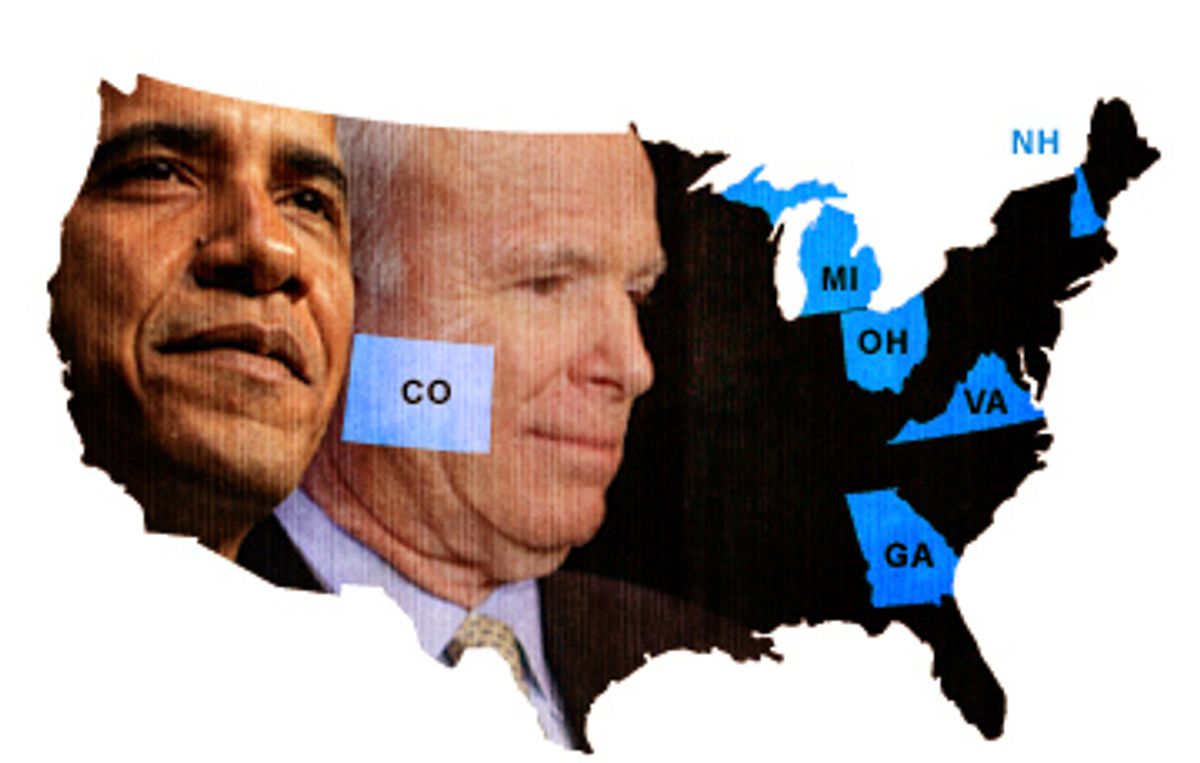
Schaller: We've covered quite a bit of territory there. Let's take a look at six states in particular that come from all parts of the country. They are Colorado in the Mountain West or Southwest, depending on how you define it; New Hampshire in the Northeast; Virginia, which has already been mentioned several times, in the border or rim South; Georgia, a Deep South state that some people actually think will be in play; Ohio, from the traditional Rust Belt area; and Michigan, a state where John McCain seems to be doing better than expected. Anyone want to take a shot at any or all of those states, or a couple of them and talk about what specifically is putting them into play and where the risks and opportunities are for either candidate?
Maslin: One point about New Hampshire. You're talking about only four electoral votes. But as we've seen before, and certainly in 2000, four electoral votes could be everything. That's the one place where if John McCain has a second political home, it's in New Hampshire. It basically propelled his candidacy in 2000 against George Bush. It saved his candidacy in many ways this time. It's a place where he has terrific appeal to independent voters. I think, by the way, that Barack Obama also, even though he lost that primary, because Hillary Clinton brought people back to her in a way when she was being counted out, I do think he is a popular candidate there. And certainly, I'm not going to rule it out as a prospect for the Democrats. But if there's one place in the Northeast, which has trended very Democratic in recent years, where McCain could swing back and win four votes that have been Democratic, it is New Hampshire. It's a natural fit for him; they like him there. And John Kerry did better in New Hampshire last time than Al Gore did, largely because of a New England, Boston connection that doesn't exist this time. I think New Hampshire is a decent shot for McCain.
Douthat: One of the things people have been talking about recently is Georgia, where you have this interesting dynamic: On the one hand, Bob Barr, former Georgia representative, Republican turned Libertarian presidential candidate, is running reasonably strongly in the initial polls there, picking up 5 to 6 percent of the vote. On the other hand, Georgia has a very large African-American population. The Obama people are talking up the voter registration drives they're doing and there have been polls that show, with Barr factoring in, that state being very close. I'm pretty skeptical about it, only in the sense that when push comes to shove, even in Georgia, Bob Barr is not going to get 6 percent of the vote. He's going to get 1 to 2 percent of the vote and I don't think that's enough to tip that kind of state. Over the long run, Barr is not your ideal third-party candidate. He's not a sort of celebrity figure, he's not a terribly appealing figure. So I don't think that will be in play at the end, but it is an interesting potential dynamic.
Maslin: Kerry lost by 16 points in Georgia. If Barack Obama wins Georgia, he won't be worrying about the Electoral College on election night. It'll be a 400-vote Electoral College landslide.
Douthat: Which is possible. I don't think people should discount that possibility at this point.
Schaller: Andres, the Latino vote is growing in parts of the South but it's still pretty small. Is it enough, along with the Bob Barr factor and increased black turnout, to move a state like Georgia or only a state like Virginia?
Ramirez: I think Virginia is a much more likely state, especially because you have Jim Webb, who just won, and you have Mark Warner on the ballot. In Mark Warner's gubernatorial race in 2001, he did a phenomenal job of organizing and mobilizing a Latino constituency in Northern Virginia that was really put to use during his campaign. Obviously, he had the resources to organize them. But the fact that he's on the ballot again means Hispanics will play a much larger role in Virginia. And again, we need to recall, Virginia was one of the few states where Obama actually won the Hispanic vote during the primary. He's incredibly popular with that community there; it's increasingly getting more active. There's a significant African-American population in Virginia as well, and so I think with that combination of facts you have a trending state. You have Governor Kaine in there, you have Mark Warner on the ballot and you have Obama's appeal to the African-Americans and Hispanics. I think Virginia is one of the states that was red that will likely benefit Obama this election.
Maslin: I agree with that. But I think you also have the colossus of the Northern Virginia suburbs, which are growing year by year and are clearly a moderating [influence] on that state. And where Obama ran extremely well; remember he won by huge margins in Virginia and Maryland over Hillary Clinton in the primary. You can't always extrapolate primary results, but I think that was a hint of some real potential for this Democratic ticket, which may end up with a Virginian as vice president. I think McCain's going to fight back, though. Obviously there's a military component in the Tidewater area in the Southeast; parts of Virginia, the mountains and elsewhere, are still pretty strongly Republican. It's clearly a battleground; McCain will fight to the death there. It is the best chance in the South, leaving Florida aside -- which is not really a Southern state -- and I agree with the earlier comment about Florida, which we're not going to talk about much here, but there's clearly better prospects for Obama in Florida than some people give him credit for. But there's no question that Virginia is going to be a real close fight all the way.
Schaller: I'm wondering on Ohio and Michigan, two states that are very similar. They're usually one-two in terms of the economic deprivation numbers we've seen in recent years; they've really struggled as post-Rust Belt economies. And yet Ohio went for Bush twice. Michigan went for Kerry and Gore, and yet, it looks like McCain is extraordinarily competitive in Michigan. Is that just because of the fallout from the primary where Obama wasn't on the ballot there? Or is there something happening that's distinctly different in one or the other of those states that is potentially making Ohio more blue and Michigan more red?
Maslin: I'd be real wary of polls at this point, and I'm the pollster on this call. I just think it's way too early to draw too many conclusions from polls. The traditional order of Michigan, Pennsylvania and Ohio has always been Ohio as the weakest state for the Democrats. The last time that was not true was with Jimmy Carter in 1976 and that's because Gerald Ford was from Michigan. So I'd be wary of thinking that Ohio is a better prospect for Obama than Michigan. I do think there has been some fallout because of the way the Democratic Party botched -- and I'm not blaming anyone in particular, just the overall net effect was to botch this Michigan primary horribly. And I think that's given an opportunity for McCain. Clearly, the one thing I've said before, I do think that Ohio is more problematic simply because of geography. I do think that white voters in southern Ohio are going to be, not just for racial reasons, but culture and class as well, are going to be tougher to win over for any Democrat, and certainly for Barack Obama, than their counterparts in the Upper Peninsula or similar demographic areas of Michigan. There is a slightly bigger African-American population in Michigan as well. At the end of the day, I still think Ohio is the tougher one, but there's no question that McCain and his campaign perceive an opportunity in Michigan and Pennsylvania. If they had to pick one of those two, they'd probably think that Michigan might be the better chance.
Douthat: One other dynamic that Paul just touched on a bit. There's a dynamic in the race that we haven't seen before and may not see again, which is the age dynamic and the extent to which Pennsylvania, for example, is one of the oldest states in the union. And to the extent that the race issue ends up mattering in this campaign, it's going to end up mattering, it seems like, to 40 and older, 50 and older, 60 and older voters. That's the demographic where you're more likely to see people who usually vote Democratic not being willing to vote for a black candidate for president. I don't think that's a particularly huge chunk of the electorate; it's a slice of a slice that will tip that way. But in so far as it matters, it will probably end up mattering in those Rust Belt states and that's an advantage for McCain, obviously.
Schaller: So that's the scenario, that despite the economic situation and despite the percentage of people who are saying they are unhappy with the direction of the economy, that Ohio and Michigan could still go Republican? Is that what you're saying, Ross?
Douthat: That's part of the dynamic. I think there's a broader cultural component, especially in Ohio, the closer you get to that Appalachian belt that everybody talked about in the Obama-Clinton campaign; there's a dynamic there that isn't just about race. It's about patriotism and nationalism and the military vote and so on. That's the dynamic, for instance, where Jeremiah Wright matters not because he's a crazy-seeming black preacher but because he's a very left-wing, anti-American-seeming black preacher. So I don't want to overstate the not-voting-for-a-black-guy racial dynamic, but that obviously plays in as well there.
Maslin: One thing we should understand is, if the economy and the performance of the economy will dictate ultimately the outcome of this race, then again we're looking at, maybe not an FDR-like, but certainly a historic Democratic victory of large proportions. The polls are closer than that and there's some belief that this still could be a very close race. That's sort of the assumption of this call. And that must mean that McCain and the Republicans, through some mechanism -- Bush did it essentially by scaring people about the war in 2004, about terrorism -- but through some mechanism [McCain] is going to convince people who otherwise would vote Democratic because of their beliefs about the economy to stick with the Republicans. And that is one of the central dramatic pieces of this race, how that could happen.
Ramirez: I think the other dynamics we need to look at as well. We talked about the race issue and, as you mentioned, there's a slice of a slice who will play that. We've also seen the Obama phenomenon be able to bring out extraordinarily much larger numbers of voters who had not participated before. And I think that many of these pollsters are conducting their modeling based on traditional demographics of who had voted in the past. We're seeing more millennials vote, we're seeing more Hispanics vote, we're seeing a lot more new demographics vote, but I don't think the pollsters are actually calculating them in their new numbers, which could throw a lot of these numbers and a lot of these assumptions out the window come November. It's a dynamic we also need to keep in mind.
Maslin: Andres is absolutely right. Some are and some aren't. You don't really know which poll is and which poll isn't. I think that's part of what makes this whole process very strange. I think that if you take the Kerry-Bush margin, which was 2 and a half points, that turnout alone of young people and African-Americans and potentially Latinos as well wipes that margin out. That's Obama's advantage right from the start. And in some cases, he may even do better than that. Even before we get to whether the same people will vote the same way from 2004 to 2008, I just think the interest and the enthusiasm and the Obama campaign's proven ability to get that vote out virtually wipes out the Bush-Kerry margin right from the get-go.
Douthat: And then you factor in the flip side of that, which is the extent to which there was an enthusiasm for Bush in 2004 in certain demographics -- conservatives in general, evangelical Christians in particular -- [and] I think it's clear that the McCain campaign isn't going to have anything near the kind of ground game in terms of turnout and organization that the Bush campaign did in '04. So the McCain campaign is sort of getting it from both directions there. The Democrats are more excited and turnout is probably going to be up. Republican turnout is probably going to be down from what the Karl Rove, Ken Mehlman machine was able to gin up for Republican in '04.
Ramirez: And then the third dynamic is that Obama obviously will raise more money than McCain this cycle, which puts the Democrat at a huge advantage that we haven't been able to do in the past three cycles.
Maslin: He's taking all the editorial hits for public financing, but believe me, [the Obama campaign has] already factored that into their equation.
Douthat: There's no voter in America who casts their vote based on whether or not a candidate takes public financing. Or if there are, I'd like to meet them.
Schaller: Let's use that as a transition point. I'm going to ask you to play political prognosticator, Electoral College forecaster. I'm going to handicap all of you. Obama's team let it be known that they thought they could win without either Florida or Ohio. We know that in the last two elections, you sort of had to have two of the big three for the tiebreaker -- those three being Florida, Ohio and Pennsylvania. So I assume that means they'd still have to win Pennsylvania, but could win without the other two. And so I want to open it up, and we can take either McCain or Obama or both of them -- is it possible that Obama can win without Florida and Ohio and if so, how and where? And alternatively, could McCain theoretically win without, say, Pennsylvania and Ohio, holding Florida, of course? And if so, how and where and with what sort of voters could he do it?
Maslin: I'll take the Obama side of this. I happen to believe that if this happens, he'll probably win Florida or Ohio as well and maybe both of them, but the states we just talked about, if you flip Ohio and win Virginia and you win either Colorado or Nevada and you hold everything else, there you are. It gets a little more complicated if you lose New Hampshire, but basically, you're holding Michigan and Pennsylvania as well, but Virginia and Colorado, Nevada become sort of the key states here. I think there's an assumption that he's going to win Iowa and I think he will. He was strong there in the caucuses, it's close to Illinois. I think there's a regional advantage. But you win Virginia and Colorado and Nevada, you've made up for any failure to win Ohio and Florida. But I happen to believe that if he won those states, he's going to win either Ohio or Florida and maybe both of them. Sometimes there are individual nuances with states, but generally everything is going to rise and fall with an overall national trend and Ohio and Florida were both close enough last time that if Obama is showing that kind of strength elsewhere, he'll probably win one or both those states as well.
Schaller: Andres, do you see it that way as well?
Ramirez: I would say there is some opportunity for Obama to win without winning Ohio and Florida. If you're looking at the Kerry map from '04, he lost both of those states but he ended up with 252 electoral votes [Editor's Note: 251 because of a so-called "faithless elector" in Minnesota]. So if you simply add New Mexico, Nevada, Colorado, the Southwestern states where Obama is playing very strongly right now, that gives him the 19 electoral votes to put him at 271. That's even if he loses Florida and Ohio, and that's just maintaining the states that Kerry won, and there's an assumption that Obama will perform just as well if not better than Kerry. Nevada has seen a profound transformation from where it was in 2004 when Republicans outnumbered Democrats statewide. That has now flipped. Democrats outnumber Republicans by more than 50,000 votes in that state. New Mexico has also increased their voter registration. We've seen incredible momentum in Colorado. I think it's definitely possible with his appeal in the Southwest and the polling that's showing he's doing well in New Mexico and Colorado, and with McCain's stance on nuclear waste in Yucca Mountain, Nevada, especially with his opposition to sports wagering in Nevada. Those are just two issues that will hurt him even among Republicans in that state.
Schaller: Ross, do you want to take a crack at McCain? I mean, if you subtract Ohio's 20, it still only puts Bush's number from 286 to 266, so in theory it's not that far if McCain can hold every state but Ohio, right?
Douthat: In theory, it's not that far, but here's the thing. Not to be overly pessimistic about McCain, but the fact is if you look at the areas where he could pick up votes and pick up states, it seems most likely it's going to be in the Appalachian corridor that stretches up into Ohio, Pennsylvania and Michigan. So, essentially you have a situation where if he loses Ohio then he needs to probably tip Pennsylvania or Michigan, and the trends that will make him lose Ohio will presumably make him lose those other states as well. It seems pretty unlikely. I think McCain's best hope is that this is still an '00, '04 election. And I think it's also easy to get caught up in the way the last two elections played out, which was very unusual. In general, trends in the Electoral College tend to track trends in the popular vote and if Obama is dramatically expanding the Democratic edge in certain regions, it'll probably be a sign that he's headed for a landslide and then he'll win Ohio too.
Schaller: Let's talk a little now about V.P.s. We've had a lot of talk about Hillary Clinton, obviously, on the Democratic side. There's always talk each year about a V.P. being selected who will in and of him- or herself deliver a particular state -- the quintessential example being LBJ in 1960 giving Texas to Kennedy, crucially. Maybe Al Gore helps Tennessee. But your Dan Quayles, your Dick Cheneys, they're delivering states that are already delivered. So I'm wondering if in the field of people who are under consideration, there's some candidate out there on either side who you think, boy, if so and so picks that person, it delivers the state to the Republicans or the Democrats.
Maslin: I think we've mentioned the one place for the Democrats that seems most likely to produce a victory, [Virginia] ... [The] two names that make the most sense to me, one may surprise you, but actually one would be either Jim Webb, who we've talked about obviously because of his military background and his recent victory in that state. But also Mark Warner. [Former Democratic Gov. Mark Warner is running for the Senate seat being vacating by retiring Republican incumbent John Warner, no relation.] And people may squawk and say we're giving that Senate seat away. Well, Democrats are going to have a pretty big victory in the Senate anyway. We're not going to be up to 60 members in the Senate and a filibuster-proof margin, but we'll certainly be better off than we were. Warner is the architect of a lot of the Democratic gains, and a lot of the growth in that state came from his first race for governor. He preceded Kaine and, in some ways, he may be the best of the three. Either of those two, even more so than the current Governor Tim Kaine, would be enough to tip the balance in Virginia. And with 13 electoral votes, it's not a minor consideration. It may not be as much as LBJ was in '60, which may be the last time that a vice-presidential candidate -- for some reason, the Republicans have this predilection to go for people who have no electoral impact whatsoever. I can't understand that and I think McCain may try to throw a long ball here. He may be more in the mold of I've got to show something and I'm not going to just bow down to the conservatives. I have to show something in this choice of vice president that may be a breakthrough. And there's an obvious person who comes to mind, who happens to be in the current administration. Which is Condoleezza Rice. I think there is a legitimate chance for Obama to go into Virginia and secure those votes with a choice that would help him on other grounds as well.
Douthat: I would like to hear the case for McCain picking Condoleezza Rice. Because I agree with you, he may want to throw a long ball. But what does picking Condoleezza Rice get him?
Maslin: Suburbs. It's partly for women, it's not for African-Americans, but it's by saying in this context where there's been so much discussion about gender and race -- by going for a two-for, he's essentially saying to the suburbs, Listen, I'm new and moderate as well. I may be 71 years old but I can also play on this turf. And by the way, I'm also getting someone who's an extremely experienced hand in what is my biggest asset versus this newcomer Barack Obama, which is national security. That's the play. It comes with risks. It's not perfect. But, you know, he's got to do something. We're all talking here, if not a double digit, but certainly the possibility that this race is headed toward a 5, 6, 7, 8-point win for Barack Obama when you look at the structure of it. And McCain, I don't think they're naive over there. I don't think they think it's automatically 2000 and 2004 and will revert to a close election again; they may have to cause it to happen. That's the one thing about throwing a long ball, which Condoleezza Rice would be, that makes me wonder if he wouldn't end up going in that direction rather than a more traditional choice.
Schaller: I was going to raise the issue of Charlie Crist. Andres is pointing out that Florida may come back; it's a state that moved away from the Democrats. I don't think McCain will pick him, but just for the sake of argument, let's say that he does. Does that take Florida out, or can Obama still win despite the McCain-Crist ticket?
Ramirez: I would think that adding Crist to the ticket will help McCain secure Florida. I don't think it will make it automatic, but Governor Crist's operation in Florida helps and will make it much more competitive for Obama. On the converse ... I'm not saying Obama will pick him, but someone like an Evan Bayh from Indiana -- I think if you add an Evan Bayh to a ticket, Bayh would help deliver a state like Indiana for a candidate. Now, Obama is already strong in the Midwest, so I'm not sure adding Evan Bayh helps him overall. But in terms of flipping a state that historically has been for another party, I think a candidate like Bayh would help accomplish that task.
Douthat: I'm pretty skeptical, and maybe this is why Republicans haven't been doing it because conservatives are skeptical of the idea, but I think if you look at the attempts to pick running mates who would deliver states, it hasn't worked out well for either party really in decades. The most important thing a vice-presidential pick does is to establish some kind of narrative. If you look at the successful picks, Bill Clinton picking Al Gore in 1992, in a sense it seemed like too much of a good thing; you were picking another Southern white guy. But in the end, it turned out, doubling down on the theme of youth, generational change and so on. And Joe Lieberman is obviously persona non grata in the Democratic Party these days, but I actually think Al Gore picking Lieberman in 1999 and 2000 was a similarly savvy move. It got him the kind of separation, however temporary, from the Clinton administration that he was looking for. I look at McCain and I look at a pick like Rice, and yes, on sort of a demographic level you can see how it makes sense. But [not] for a campaign that's doing everything in its power to disassociate itself from the Bush administration and to say this is not another Bush term. Now obviously Rice isn't a hate figure like Dick Cheney or Donald Rumsfeld, but some of that issue is that she just hasn't been exposed to press criticism in the same way because she's not a target like Rumsfeld and Cheney. I think there may be some narrative out there for McCain and I completely agree that he needs to consider long balls, but it's hard for me to see how the Rice pick would manage that.
Maslin: But he can't double down on age.
Douthat: No, he can't double down on age. My wild-card pick, not in the same league as Rice or Lieberman, but Sarah Palin, the governor of Alaska, is actually one of the more interesting wild-card choices out there for McCain. It gets you a young, female reformist Republican. She's enormously popular. She's attractive, which obviously never hurts. She's somebody that nobody knows anything about, [and she has an] interesting political story, running against a corrupt Republican machine in Alaska, a former high school athlete and beauty queen turned mother of five. I think you can see how that story helps McCain in a way that picking Eric Cantor or Rob Portman or some of these safe, white male conservative choices wouldn't.
Maslin: But I tell you, just listening to this, you got a bunch of unknowns. Not that these Virginia Democrats or even Evan Bayh are tremendously well known nationally, they're not. But I'll tell you, if McCain is forced to go for somebody who essentially has no standing with the American people whatsoever --
Douthat: There's a Dan Quayle problem.
Maslin: Yeah and with an early September convention, with only two months to go, she's going to be behind anyway; that's a dicey proposition for him. Anyway, we'll see.
Schaller: OK. We're at the bonus round here. I want to go around the horn, sort of John McLaughlin style. Four questions; you can clarify your answers but keep them quick. I want you to tell me predictions: 1) the state you think will most likely flip from red in 2004 to blue; 2) the other, blue to red; 3) which state, whether it changes parties or not, will be the big surprise because it was closer than we expected or more of a blowout or whatever; 4) and then finally, from 0 to 100 percent, what is the chance that we have 2000 repeat, where one candidate is the popular vote winner but is not the president because he loses the electoral vote. And who is the George W. Bush candidate finishing second but still president-elect in your scenario?
Ramirez: The most likely state to flip from red to blue would be New Mexico. As I discussed earlier, New Hampshire is the most likely state to flip from blue to red. I think you have to put Virginia in there; it's going to be a big surprise, it's going to be much more for Obama than people think.
Schaller: Any chance we have what political scientists like me call a "misfired election," where the popular vote winner loses the Electoral College?
Ramirez: With the demographics we're looking at, with Latinos and younger voters participating in the states where they concentrate, I don't think this time it will actually be possible to win the popular vote and lose the Electoral College.
Maslin: I agree. Iowa slightly over New Mexico, though I think both will flip. I also agree that it'll be New Hampshire most likely to go the other way. And I'm going to come up with a state that no one has mentioned today for a surprise, not because Obama is going to carry it, but I think the margin is going to be greatly reduced, and that is the state of Texas. The last time there was not a Bush on the ballot, and there's only been one time since 1980, was 1996, and Clinton only lost the state by 5 points. I think Obama will come surprisingly close in Texas and everybody will sort of shake their heads and say, Wow, looking down the road. I think there's about a 2 percent chance that there's any kind of Electoral College, 2000-like nightmare. It would obviously be Obama winning the popular vote. He will gain in the South in a lot of places where he won't win, so those votes from an electoral standpoint are kind of thrown away, but overall, no, not much of a chance that it's going to happen.
Douthat: To be unoriginal, I'd say, yeah, Iowa followed by New Mexico flipping from red to blue. New Hampshire followed by Pennsylvania flipping from blue to red. I agree with what the others have said, but I would throw out the possibility of one of the plains states, Kansas, for instance, or one of the upper plains states in the Dakotas being closer than people think as well. With Obama coming closer. Five percent, 3 percent, 2 percent on the Electoral College question. I think it would be a disaster, though, for American democracy, at least in the very short term, if that happened in a way that simply wasn't the case in 2000. 2000 was obviously a disaster of sorts in its own right. I think if McCain won in that situation there would be enormous pressure on him to make some kind of strange, unprecedented gesture -- whether it's the composition of his cabinet or whatever it may be. And obviously there was some pressure like that on Bush, but it wasn't the case where the national media was anywhere near invested in Al Gore's candidacy at that point, as they would be; in fact I think the media was kind of happy to see Al Gore concede in Florida. Whereas, I think with Obama, barring something dramatic changing, there's just going to be a flood of coverage in the lead-up to the election on the historic nature of this race, and for him to win the popular vote and lose the Electoral College, well, it would be interesting to say the least.
Schaller: Well, that was great and while I'm tempted to yell, "Wrong!" and call on Eleanor Clift to clear up all the answers on your responses, I think it's exactly right in terms of New Mexico, Iowa and New Hampshire. And I'm with Ross; I think North Dakota will be the big surprise. And I don't think we'll have an Electoral College misfire. I want to thank all of our guests.
Shares