

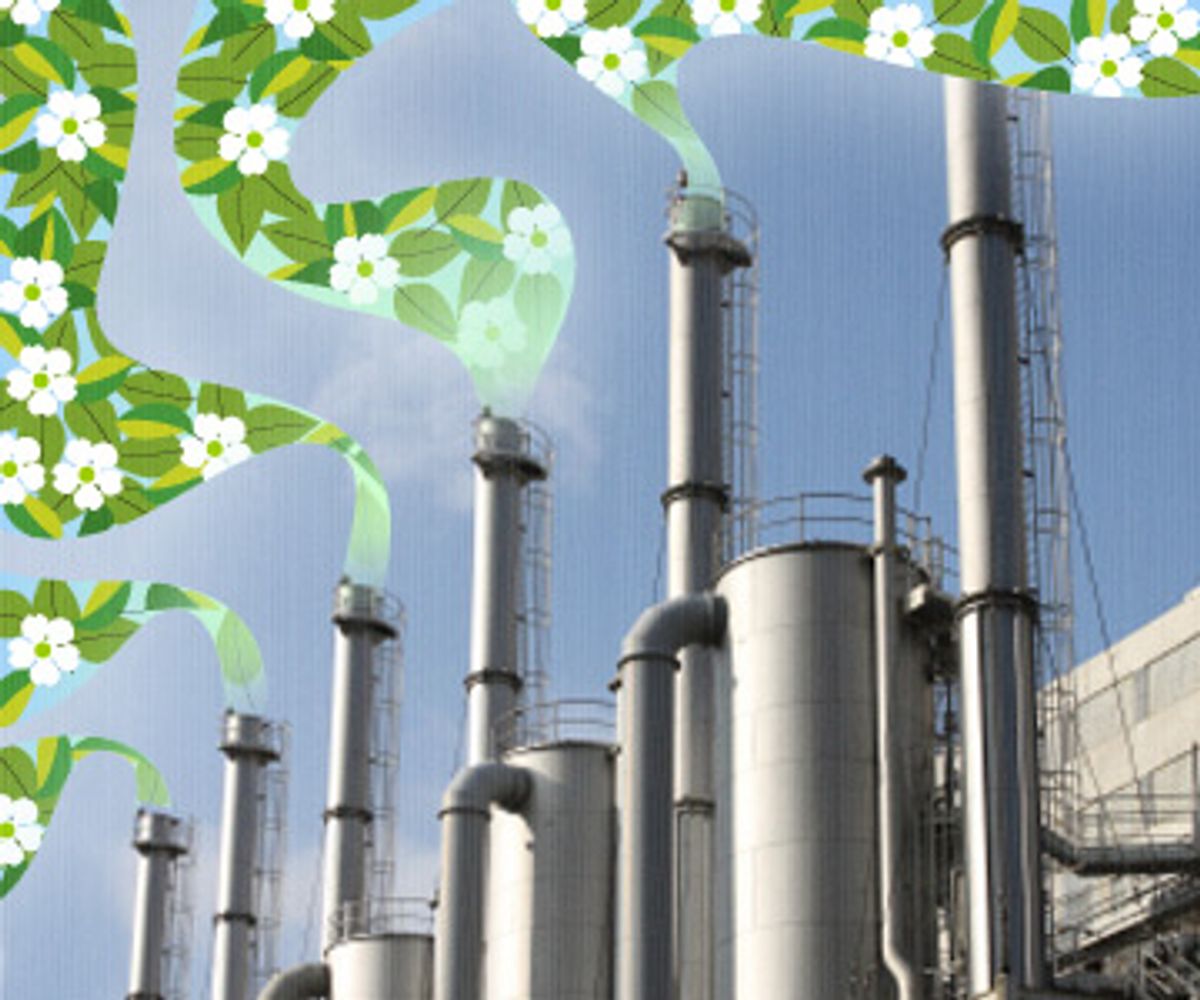
Suppose I paid you for every pound of pollution you generated and punished you for every pound you reduced. You would probably spend most of your time trying to figure out how to generate more pollution. And suppose that if you generated enough pollution, I had to pay you to build a new plant, no matter what the cost, and no matter how much cheaper it might be to not pollute in the first place.
Well, that's pretty much how we have run the U.S. electric grid for nearly a century. The more electricity a utility sells, the more money it makes. If it's able to boost electricity demand enough, the utility is allowed to build a new power plant with a guaranteed profit. The only way a typical utility can lose money is if demand drops. So the last thing most utilities want to do is seriously push strategies that save energy, strategies that do not pollute in the first place.
America is the Saudi Arabia of energy waste. A 2007 report from the international consulting firm McKinsey and Co. found that improving energy efficiency in buildings, appliances and factories could offset almost all of the projected demand for electricity in 2030 and largely negate the need for new coal-fired power plants. McKinsey estimates that one-third of the U.S. greenhouse gas reductions by 2030 could come from electricity efficiency and be achieved at negative marginal costs. In short, the cost of the efficient equipment would quickly pay for itself in energy savings.
While a few states have energy-efficiency strategies, none matches what California has done. In the past three decades, electricity consumption per capita grew 60 percent in the rest of the nation, while it stayed flat in high-tech, fast-growing California. If all Americans had the same per capita electricity demand as Californians currently do, we would cut electricity consumption 40 percent. If the entire nation had California's much cleaner electric grid, we would cut total U.S. global-warming pollution by more than a quarter without raising American electric bills. And if all of America adopted the same energy-efficiency policies that California is now putting in place, the country would never have to build another polluting power plant.
How did California do it? In part, a smart California Energy Commission has promoted strong building standards and the aggressive deployment of energy-efficient technologies and strategies -- and has done so with support of both Democratic and Republican leadership over three decades.
Many of the strategies are obvious: better insulation, energy-efficient lighting, heating and cooling. But some of the strategies were unexpected. The state found that the average residential air duct leaked 20 to 30 percent of the heated and cooled air it carried. It then required leakage rates below 6 percent, and every seventh new house is inspected. The state found that in outdoor lighting for parking lots and streets, about 15 percent of the light was directed up, illuminating nothing but the sky. The state required new outdoor lighting to cut that to below 6 percent. Flat roofs on commercial buildings must be white, which reflects the sunlight and keeps the buildings cooler, reducing air-conditioning energy demands. The state subsidized high-efficiency LED traffic lights for cities that lacked the money, ultimately converting the entire state.
Significantly, California adopted regulations so that utility company profits are not tied to how much electricity they sell. This is called "decoupling." It also allowed utilities to take a share of any energy savings they help consumers and businesses achieve. The bottom line is that California utilities can make money when their customers save money. That puts energy-efficiency investments on the same competitive playing field as generation from new power plants.
The cost of efficiency programs has averaged 2 to 3 cents per avoided kilowatt hour, which is about one-fifth the cost of electricity generated from new nuclear, coal and natural gas-fired plants. And, of course, energy efficiency does not require new power lines and does not generate greenhouse-gas emissions or long-lived radioactive waste. While California is far more efficient than the rest of the country, the state still thinks that with an even more aggressive effort, it can achieve as much additional electricity savings by 2020 as it has in the past three decades.
Serious energy efficiency is not a one-shot resource, where you pick the low-hanging fruit and you're done. In fact, the fruit grows back. The efficiency resource never gets exhausted because technology keeps improving and knowledge spreads to more people.
The best corporate example is Dow Chemical's Louisiana division, consisting of more than 20 plants. In 1982, the division's energy manager, Ken Nelson, began a yearly contest to identify and fund energy-saving projects. Some of the projects were simple, like more efficient compressors and motors, or better insulation for steam lines. Some involved more sophisticated thermodynamic "pinch" analysis, which allows engineers to figure out where to place heat exchangers to capture heat emitted in one part of a chemical process and transfer it to a different part of the process where heat is needed. His success was nothing short of astonishing.
The first year of the contest had 27 winners requiring a total capital investment of $1.7 million with an average annual return on investment of 173 percent. Many at Dow felt that there couldn't be others with such high returns. The skeptics were wrong. The 1983 contest had 32 winners requiring a total capital investment of $2.2 million and a 340 percent return -- a savings of $7.5 million in the first year and every year after that. Even as fuel prices declined in the mid-1980s, the savings kept growing. The average return to the 1989 contest was the highest ever, an astounding 470 percent in 1989 -- a payback of 11 weeks that saved the company $37 million a year.
You might think that after 10 years, and nearly 700 projects, the 2,000 Dow employees would be tapped out of ideas. Yet the contest in 1991, 1992 and 1993 each had in excess of 120 winners with an average return on investment of 300 percent. Total savings to Dow from just those projects exceeded $75 million a year.
When I worked at the Department of Energy in the mid-1990s, we hired Nelson, who had recently retired from Dow, to run a "return on investment" contest to reduce DOE's pollution. As they were at Dow, many DOE employees were skeptical such opportunities existed. Yet the first two contest rounds identified and funded 18 projects that cost $4.6 million and provided the department $10 million in savings every year, while avoiding more than 100 tons of low-level radioactive pollution and other kinds of waste. The DOE's regional operating officers ended up funding 260 projects costing $20 million that have been estimated to achieve annual savings of $90 million a year.
Economic models greatly overestimate the cost of carbon mitigation because economists simply don't believe that the economy has lots of high-return energy-efficiency opportunities. In their theory, the economy is always operating near efficiency. Reality is very different than economic models.
In my five years at DOE, working with companies to develop and deploy efficient and renewable technologies, and then in nearly a decade of consulting with companies in the private sector, I never saw a building or factory that couldn't cut electricity consumption or greenhouse-gas emissions 25 percent to 50 percent with rapid payback (under four years). My 1999 book, "Cool Companies," detailed some 100 case studies of companies that have done just that and made a great deal of money.
There are many reasons that most companies don't match what the best companies do. Until recently, saving energy has been a low priority for most of them. Most utilities, as noted, have little or no incentive to help companies save energy. Funding for government programs to help companies adopt energy-saving strategies has been cut under the Bush administration.
Government has a very important role in enabling energy savings. The office of Energy Efficiency and Renewable Energy at the U.S. Department of Energy has lots of (underfunded) programs that deliver savings every day. Consider, for instance, Chrysler's St. Louis complex, which recently received a DOE Save Energy Now energy assessment. Using DOE software, Chrysler identified a variety of energy-saving measures and saved the company $627,000 a year in energy costs -- for an upfront implementation cost of only $125,000.
The key point for policymakers now is that we have more than two decades of experience with successful state and federal energy-efficiency programs. We know what works. As California energy commissioner Art Rosenfeld -- a former DOE colleague and the godfather of energy efficiency -- put it in a recent conversation, "A lot of technology and strategies that are tried and true in California are waiting to be adopted by the rest of country."
So how do we overcome barriers and tap our nearly limitless efficiency resource? Obviously, the first thing would be to get all the states to embrace smarter utility regulations, which is a core strategy of Barack Obama's plan to reduce greenhouse gases. But how does the federal government get all the states to embrace efficiency?
We should establish a federal matching program to co-fund state-based efficiency programs, with a special incentive to encourage states without an efficiency program to start one. This was a key recommendation of the End-Use Efficiency Working Group to the Energy Future Coalition, a bipartisan effort to develop consensus policies, in which I participated. The first year should offer $1 billion in federal matching funds, then $2 billion, $3 billion, $4 billion, and finally stabilizing at $5 billion. This will give every state time to change their regulations and establish a learning curve for energy efficiency.
This program would cost $15 billion in the first five years, but save several times that amount in lower energy bills and reduced pollution. Since the next president will put in place a cap-and-trade system for greenhouse gases, the revenues from auctioning the emissions permits can ultimately be used to pay for the program.
We should restore a federal focus on the energy-intensive industries, such as pulp and paper, steel, aluminum, petroleum refining and chemicals. They account for 80 percent of energy consumed by U.S. manufacturers and 90 percent of the hazardous waste. They represent the best chance for increasing efficiency while cutting pollution. Many are major emitters of greenhouse gases other than carbon dioxide. A 1993 analysis for the DOE found that a 10 to 20 percent reduction in waste by American industry would generate a cumulative increase of $2 trillion in the gross domestic product from 1996 to 2010. By 2010, the improvements would be generating 2 million new jobs.
For these reasons, in the 1990s, the Energy Department began forming partnerships with energy-intensive industries to develop clean technologies. We worked with scientists and engineers to identify areas of joint research into technologies that would simultaneously save energy, reduce pollution and increase productivity. The Bush administration slashed funding for this program by 50 percent -- and keeps trying to shut it down entirely.
Indeed, conservatives in general have cut the funding or shut down entirely almost all federal programs aimed at deploying energy-efficient technologies. Conservatives simply have a blind spot when it comes to energy efficiency and conservation, seeing them as inconsequential "Jimmy Carter programs."
I recently testified at a Senate Environment and Public Works Committee hearing on nuclear power and spoke about how alternative technologies, particularly energy efficiency, were a much better bet for the country. Senator George Voinovich (R-Ohio) said this was "poppycock," and then asked all the pro-nuclear witnesses to address the question, "If nuclear power is so uncompetitive, why are so many utilities building reactors?"
Voinovich apparently has forgotten about the massive subsidies he himself voted to give the nuclear industry in 2005. He seems to be unaware that states like Florida allow utilities to sharply raise electric rates years in advance of a nuclear plant delivering even a single electron to customers. If you could do that same forward-pricing with energy efficiency, we would never need to build another polluting plant.
Although he is a senior member of the Senate and a powerful voice on energy and climate issues, Voinovich doesn't seem to know the first thing about the electricity business; namely, that a great many utilities have a huge profit incentive to build even the most expensive power plants, since they can pass all costs on to consumers while retaining a guaranteed profit. But they have a strong disincentive from investing in much less costly efforts to reduce electricity demand, since that would eat into their profits.
The next president must challenge the public service commission in every state to allow utilities to receive the same return on energy efficiency as they are allowed to receive on generation. That single step could lead the country the furthest in solving our ever-worsening climate and energy problems.
Shares