

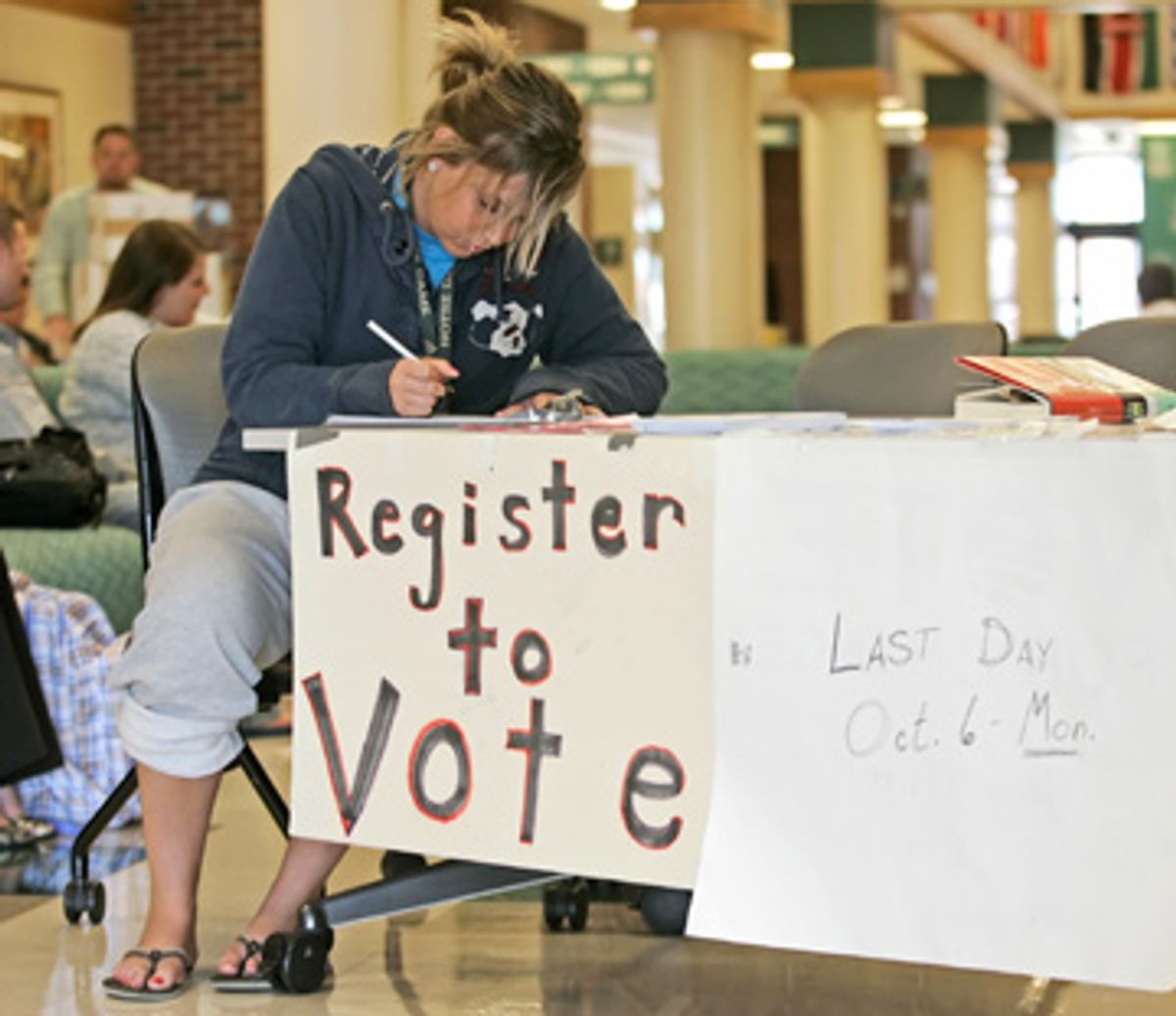
Warnings about voter fraud prior to a U.S. presidential election are nothing new. But to listen to conservative Republicans lately, you might expect Nov. 4 to bring a voting catastrophe of epic proportions. Writing in the New York Post in early October, Ken Blackwell -- yes, the former Ohio secretary of state of 2004 election infamy -- warned about "the kind of chaos you expect from a category-five hurricane -- with radical groups sending the nation into a protracted legal battle even worse than the mess back in 2000."
"To prevent it," Blackwell urged, "we must act now." Many Republicans, including operatives from the McCain campaign, have indeed been raising the specter of voter fraud across battleground states, from Nevada to Michigan to Pennsylvania, and pushing for action by government authorities.
But according to Lori Minnite, a professor of political science at Barnard College, who has spent the last eight years studying the role of fraud in U.S. elections, the Republican crusade against voter fraud is a strategic ruse. Rather than protecting the election process from voter fraud -- a problem that barely exists -- Minnite says the true aim of Republican efforts appears to be voter suppression across the partisan divide. According to Minnite, investigating voter fraud has become a Republican cottage industry over the last 20 years because it justifies questioning the eligibility of thousands of would-be voters -- often targeting poor and minority citizens in urban areas that lean Democratic. Playing the role of vigilant watchdog gives GOP bureaucrats a pretext for obstructing the path of marginalized and first-time voters headed for the polls.
On Sept. 10, the 240,000 Wisconsin voters who had registered by mail since 2006 found their voting status up in the air as the state's attorney general, J.B. Van Hollen -- a McCain campaign co-chair -- sued the state’s Government Accountability Board. In Michigan that same week, Macomb County GOP party chairman James Carabelli allegedly told a reporter that he would use publicly available lists of foreclosed home addresses to “make sure people aren’t voting from those addresses.” In early October, the Montana Republican Party challenged the eligibility of 6,000 voters in university towns and heavily Native American counties.
And last week, Nevada officials raided a Las Vegas office of the Association of Community Organizations for Reform Now, a 38-year-old grass-roots political group known as ACORN that advocates on behalf of low-income Americans. News of the raid, following allegations that ACORN workers had submitted fraudulent voter registrations, prompted cheers from many on the right and objections from many on the left -- as did an announcement last Friday, by ACORN itself, that 2,100 of 5,000 registrations forms submitted by ACORN workers in Lake County, Ind., were invalid.
But Minnite says that the latest Republican uproar over ACORN is part of "a far broader effort to corrode public confidence in the electoral process." Minnite is a co-author of the forthcoming book “Keeping Down the Black Vote: Race and the Demobilization of American Voters" and a research fellow at Demos, a public policy think tank based in New York. She predicts that as Nov. 4 approaches, Republican allegations about voter fraud are certain to continue. Minnite spoke with Salon by phone recently from her office in Manhattan.
Do you believe that voter fraud poses a threat to the validity of American elections?
No. No threat.
The statistics bear me out. From 2002 to 2005 only one person was found guilty of registration fraud. Twenty people were found guilty of voting while ineligible and five people were found guilty of voting more than once. That’s 26 criminal voters -- voters who vote twice, impersonate other people, vote without being a resident -- the voters that Republicans warn about. Meanwhile thousands of people are getting turned away at the polls.
Political parties and corrupt election officials, on the other hand, do seem to present a potential problem. We should be a great deal more worried about who has access to the ballots. In terms of illegal aliens voting and people voting twice -- the popular images of voter fraud -- no I don’t think that there is any risk at all.
How did you come to this conclusion?
It is very difficult to find information on voter fraud. I’m quite fluent with political science data sets, but the more I would look, the less I would find. There was simply no information.
People were also uncooperative. Starting in late 2000 -- under state open-election laws -- I sent letters to all the attorneys general and secretaries of state in the U.S. asking them for statistics on voter fraud and those sorts of election crimes. Pennsylvania said they wouldn’t respond to me because I wasn’t a citizen [of the state]. I got the same from Virginia and Oklahoma. The attorney general of Michigan wanted me to pay $1,400 for the information because "it was going to take this many hours and this outrageous copying fee." I started to realize why there were no studies on the incidence of voter fraud, no criminal justice statistics. I also sent Freedom of Information requests to the Department of Justice. That became a two-year deal of delay and obstruction as well.
Under the “Voting Rights Act of 1965,” the Department of Justice’s Voting Section is legally bound to stop “voting practices and procedures ... that discriminate on the basis of race, color or membership in a language minority group.” Do you think the Bush administration's Justice Department has fulfilled this mission?
Threatening localities for not taking enough names off voter rolls in reaction to nothing and based on no evidence of fraud -- while increasing the possibility of disenfranchisement -- suggests a department more interested in furthering a political agenda than following that legal outline.
Let’s talk about the Ballot Access and Voting Integrity initiative that was started under Ashcroft in 2002. It was advertised as a program that would combat voter fraud and voter suppression equally. But if you look at the program, it actually was geared almost entirely toward voter fraud. They wanted to see if they could bring cases against individual voters. The [federal] government has spent a lot of money pursuing this over the years and convicted almost no one. Then we hear all this propaganda about how much voter fraud there is.
At the very least the Department of Justice has had its priorities backward. There are thousands of people having trouble casting ballots and the federal government has decided to go after poor people in Milwaukee and Florida to create the impression that there is voter fraud. The U.S. attorney firing scandal made it hard for anyone to claim that the Bush Justice Department wasn’t politicizing voter fraud.
In Michigan, the GOP has been using foreclosure lists to challenge the eligibility of voters in Macomb County, according to a recent news report, questioning whether voters are actually local residents. What do you make of this strategy?
Republican Party officials have denied that there was any plan to do this, but I think that the genie is out of the bottle. Raising the specter of fraud and threatening new rules can create confusion among voters, election officials and poll workers. Just the possibility of getting turned away -- of humiliation and inconvenience at the polls -- could have been the only effect they wanted to achieve.
It is statistically hard to prove that allegations of voter fraud keep people away from the polls because the census data we use to determine voter turnout is not extremely accurate. If 2 percent of people decided not to go, we wouldn’t be able to tell. But I have talked to people who have told me -- after being turned away by poll workers who claimed that they weren’t eligible to vote -- that they would never try to vote again. Most people don’t entirely understand their rights.
Those most likely to be affected are new voters, less educated voters and marginal voters, whose decision to vote might be more easily swayed by rumor and misinformation.
So, under the guise of protecting elections from voter fraud, the GOP is seeking to disenfranchise new, poor and minority voters?
Most newly registered voters, especially this year, are Democrats. African-Americans give 90 percent of their votes to the Democratic Party. I think it has proven irresistible for the GOP to attempt to suppress the votes of blacks in places like Cleveland and Milwaukee and Jacksonville, Fla.
Is it a racist strategy? Yes, absolutely -- but I am by no means saying that Republicans are [overtly] racist, because prejudice isn’t the motivation here. It is simply easier to target minorities because they are the more recognizable Democratic voters and because neighborhood segregation allows Republicans to quite effectively focus their voter suppression efforts. In short, African-Americans and Latinos are perfect targets.
The McCain campaign and Republican pundits have been trumpeting the threat of ACORN over the last few weeks. Do you think that ACORN presents a real threat of voter fraud?
I am struck by the ferocity of the attack on ACORN. I am not privy to the campaign strategy of the Republican Party, but I have to assume that it is the result of a coordinated disinformation campaign aimed not only at undermining ACORN's work, but also as a part of a far broader effort to corrode public confidence in the electoral process.
We see the repetition of wildly exaggerated allegations about ACORN's "criminality" by people like Michelle Malkin, a right-wing blogger; John Fund, who's been attacking ACORN for years from his vantage as a Wall Street Journal columnist; and Roger Stone, a longtime Republican operative so devoted to Nixonian dirty tricks that he's tattooed an image of Nixon's face on his back. His blog, by the way, is sponsored by the same law firm that launched a phony voter fraud attack on ACORN in Florida during the last presidential election.
These are the people that seize on faulty registrations as proof that massive voter fraud is going on. This is an obviously faulty assumption. Do fake registrations equal fake ballots? No. They waste election officials' time ... we don’t elect people through registration. Confusion, on the part of election officials, while unfortunate, still has more to do with our convoluted laws than with any effort to deceive or manipulate by ACORN.
Let’s remember, as the Republicans make a furor over the Indiana registrations, that ACORN itself separated out those registrations -- found the 2,000 faulty ones and flagged them for election officials -- in the first place. They try to work with elected officials. The fact is that ACORN has been smeared by the Republican Party. Some of their employees do seem to fake registrations, sure, but when Macy’s has some of their employees stealing from them, we would not call them a quasi-criminal organization -- we still call them a department store. ACORN is trying to help underprivileged people vote.
I believe that what we are seeing are efforts to create mass public confusion, to turn people off, and to create chaos on Election Day. This is a campaign strategy to distract people from the voter suppression efforts that actually distort electoral outcomes and to preemptively discredit the potential Obama presidency as fraudulent.
What can Barack Obama’s campaign do to counteract GOP suppression efforts?
The Democrats should be watching urban black working-class neighborhoods in key states where the Obama and McCain campaigns are running strong field operations -- Cleveland being a good example. These are prime spots for voter suppression. College students will also be targeted, especially minority students. College towns in places like North Carolina, Indiana and Florida may come into play. Election officials in Blacksburg and Fredericksburg, Va., and El Paso County, Colo., have already spread some disinformation about student voting. Similarly, areas that have added large numbers of new Latino voters might be challenged if they are in key states where anti-immigrant fervor is high, which could open the door in New Mexico and Texas.
The Obama campaign should also expect long lines and confusion at the polls and try to figure out where confusion is most likely to arise -- where voting process rules have changed most recently, and where there are likely to be equipment shortages. They need to know which cities and towns have disproportionately high numbers of new voters and those places where election officials are likely to challenge legal ballots. They should watch places like Milwaukee, Seattle, St. Louis and Cleveland, which were labeled as voter fraud "hot spots” by the discredited and now defunct American Center for Voting Rights that spread disinformation during the 2006 election. These places should receive extra attention and efforts now to resolve predictable problems before they occur on Election Day.
Most importantly, the Democrats should devote resources to mobilizing vulnerable voters in particular -- newly registered and first-time voters, students, minorities -- so that if they do face challenges or problems at the polls they will be motivated to stick it out and work through them.
How did you become interested in voter fraud as an issue?
After the 2000 election; that was a bit of an eye opener, even for a political scientist. I was struck by how the issue of voter fraud seemed to be given so much weight, even more weight than other potentially more serious issues. In Florida thousands of ballots weren’t counted and then Caltech came out with a study that said 3 to 5 million ballots hadn’t been counted for various reasons -- but everyone was talking about voter fraud. I couldn’t help but feel like that was the wrong conversation. I started looking into voter fraud and began a large-scale study.
Why do you think the incidence of fraud is so low?
I’ll give two reasons. First of all, what is the motivation for someone to vote twice when we often have a hard time getting people to vote once? There is no rational basis for someone to risk getting arrested for a crime like that. Additionally, I think that a lot of the cases that get labeled fraud can be explained in other ways. Election officials make mistakes and so do voters. I think we don’t have a clear conception of how confusing and mismanaged the whole voting process is. Confusion is often a better excuse for the irregularities that are seized upon and used to convince the public that fraud is taking place.
Have there always been voter suppression efforts?
Voter suppression has long been an issue. This is what I will be arguing in “The Politics of Voter Fraud,” a book I’ll have coming out next year. There is a well-reasoned argument in favor of party competition, but political scientists may be wrong when they say that political parties mobilize voters. There is a logic that suggests that demobilizing your opponent’s voters is actually more efficient than building up your base. When you get new voters you run the risk of destabilizing your coalition, whereas there is less of a hazard in depressing your opponent’s voter turnout.
Republicans may be the ones doing this right now, but Democrats certainly did it in the past. You mix that with race, and the role race has had with voters' rights in the United States, and the underrepresentation of minorities doesn’t exactly come as a great surprise. It was actually the Democratic Party that stripped freed slaves of their right to vote after the Civil War. Now African-Americans are a standard bearer for the party.
The Democrats in this age have no reason to pretend that voter fraud is a serious issue, but the Republicans, particularly this year, have a very good reason to say that voter fraud is rampant. It is a simple three-step process. Fraud allegations lead to restrictive voter laws, which lead to a class-skewed electorate. As the Democrats try to get out the vote, Republicans will try to stop it.
Shares