

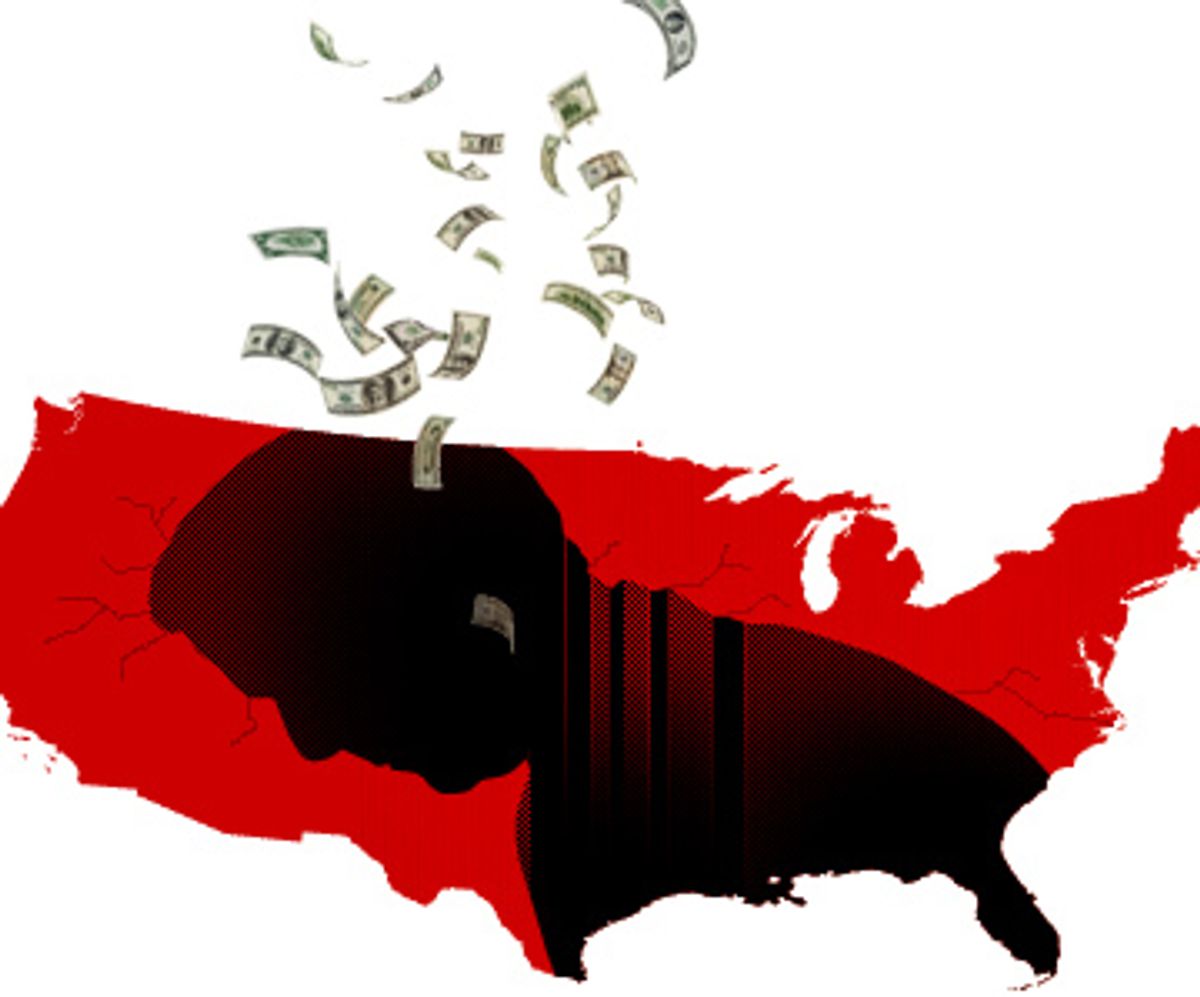
After a couple of presidential terms, mismanagement in every area of policy -- foreign, domestic, even extraterrestrial -- starts to add up. When George W. Bush entered the White House in January 2001, he inherited peace and prosperity. The military, the Constitution and New Orleans were intact and the country had a budget surplus of $128 billion. Now he's about to dash out the door, leaving a large, unpaid bill for his successors to pay.
.JPG)
To get a sense of what kind of balance is due, Salon spoke to experts in seven different fields. Wherever possible, we have tried to express the damage done in concrete terms -- sometimes in lives lost, but most often just in money spent and dollars owed. What follows is an incomplete inventory of eight years of mis- and malfeasance, but then a fuller accounting would run, um, somewhat longer than three pages.
THE ECONOMY
Until not too long ago, President Bush's supporters could be heard to argue that the economy was the unheralded success story of his administration. In 2006, Larry Kudlow called it "The Greatest Story Never Told." While praising Bush, Ramesh Ponnuru decried the unfairness of it all. "It seems to happen every week: Some new piece of good economic news comes out, and Republicans sink a little deeper in the polls." To share their admiration, it helped if you ignored the way the wealth was being distributed. Or if you were a repo man.
But the whole debate became moot on Sept. 15, with the collapse of Lehman Brothers. Now the economy may be the most burdensome of all the Bush legacies that Barack Obama will have to shoulder.
The current financial and economic crisis has grown so massive, consuming everything in sight, that one might be able to forget that it started with bad mortgages. Well, one could try to forget, as long as one still has a home, or is not among the nearly one in four mortgage-holders whose homes are worth less than the debt on their homes.
How bad is it? "An average recession is one in which we lose about 3 percent of GDP. Three percent of GDP is about $500 billion," UCLA economist Lee Ohanian told Salon. "It's not inconceivable that this could be twice as worse, which would be close to a trillion."
How much poorer are we going to get before we start getting richer again? Here are some (scary, morbid, gruesome) clues.
Expected shortfall of gross domestic product below normal growth path in 2009: $900 billion
Decline in the Dow Jones Industrial Average from its decade high to its value at the close of business, Jan. 7, 2009: 5,394.83, or 38.1 percent
Number of manufacturing jobs lost since 2000: 3.78 million
Increase in number of unemployed workers from 2001 to 2008: 4 million, a jump of 2.7 percent in the unemployment rate
Real median household income according to the 2000 census, adjusted for inflation: $51,804
Real median household income as of August 2007: $50,233
Of course, the government didn't sit idly by while our financial future was disappearing down the drain. Instead, the feds have pumped in hundreds of billions of taxpayer dollars, hoping to juice lending and public spending.
Cost of finance industry bailout: $350 billion, with another $350 pending congressional approval
Cost of auto industry bailout: $17.4 billion, so far
And even though there's widespread agreement among economists that the government needs to be spending a large sum of money on an economic stimulus package, it still won't look pretty on the public balance sheet.
National debt: $10.6 trillion
Amount of that debt owned by China: At least $800 billion
INFRASTRUCTURE
When that bridge in Minneapolis collapsed, killing 13 and injuring 145, we started to remember that the prosaic details of infrastructure policy matter. Nuts and bolts can mean, quite literally, life and death. And the I-35 bridge over the Mississippi is not the only American thoroughfare suffering from underfunding and neglect.
Number of bridges judged structurally deficient: 70,000.
Number of major roads in mediocre or poor condition: Roughly one-third.
Meanwhile, the roads aren't only worn down, they're overcrowded. In part, we can thank an administration that gave tax credits to SUV buyers while targeting public transit for cuts.
The Bush White House's proposed cuts in public transit funding for fiscal year 2009: $202.1 million.
Though he capitulated in the face of overwhelming congressional majorities in favor of Amtrak, Bush threatened repeatedly to defund the national rail system altogether.
Target level of federal funding for Amtrak proposed by Bush in 2005: $0.
Budget cutting on that scale causes a decaying, obsolescent infrastructure. Fixing it won't come cheap. On Dec. 6, during his weekly address to the nation, President-elect Obama promised t0 make "the single largest investment in our national infrastructure since the creation of the federal highway system in the 1950s."
President-elect Obama's proposed infrastructure program: $375 billion to $475 billion.
Amount spent by FDR's Works Progress Administration, up through 1941: $11.4 billion -- adjusted for inflation, that's about $170 billion.
IRAQ
How many times have you heard, "With the money we spend in Iraq in just one week ..."?
So how much has that been, exactly? Linda Bilmes, a professor at Harvard's Kennedy School of Government, and co-author with economist Joseph Stiglitz of "The Three Trillion Dollar War," thinks the figure in her book's title is, if anything, too low. (Bilmes and Stiglitz put the full price of all Bush administration debacles at $10 trillion in their own excellent damage report for the January issue of Harper's.)
"I think it's still a good figure. It was always a conservative figure. We essentially just took the amount of money that we spent to date, the sort of minimum that we are going to need to spend on veterans' disability benefits, veterans' disability, weapons that have been used up, interest on the money we've borrowed. And then there are some of the economic costs. There are social costs, like parents or spouses of wounded veterans who have to leave their jobs after parents come back. And there are economic costs, such as oil disruption."
Cost: From the start of the war through 2017, "You can't get any lower than $3 trillion."
And a gradual drawdown of troops isn't going to make it better, Bilmes says. Maintaining any presence at all in Iraq entails what economists call high fixed costs. Whether we've got 10,000 troops or 15,000 at a base, that base is still going to cost a lot to maintain. Hence, when the British withdrew half their forces from Basra, their costs fell by an almost imperceptible 3 percent.
Since $3 trillion is hard to digest, let's itemize some of the costs in Bilmes and Stiglitz's comprehensive figure.
Amount of money earned by a married U.S. Army sergeant with children per day in Iraq in 2007: $170
Amount of money earned by a Blackwater military contractor per day: $600
Number of U.S. military deaths as of Jan. 7, 2009: 4,222
Average cost of a Bradley Fighting Vehicle: $3.166 million
Cost of the new U.S. Embassy in Baghdad: $592 million
Cost to conduct the war per month: $12 billion
Amount the Bush administration estimated the war would cost from start to finish: $60 billion
The cost to "fix" the military: Meaning, to restore battered and depleted personnel and materiel. Larry Korb, a defense analyst at the Center for American Progress, thinks we're talking about $250 billion. "In terms of materiel, obviously, if you're talking fiscally, you've got the reset cost of the equipment that's been destroyed, used up, burned in the wars in Iraq and Afghanistan, you've got at least $100 billion. So that's one cost, because you assume this is going to last longer, when you bought it." And then there's personnel: recruitment bonuses, the new GI bill, pay raises. Korb's guess is about another $150 billion there. And this isn't money that we'll necessarily recoup when the war ends. "You can never roll those back," he says of the GI bill and bonuses.
And, while these estimates overlap with those made by Bilmes, they don't even account for most of the increased defense spending. The Pentagon's budget is up about 40 percent since Bush's inauguration, says Korb. "I'd only say about one-quarter is due to the things we spoke about. The other is just poor management. You have the cost overruns in weapons systems, $400 billion in weapons systems since they came in."
HUMAN RIGHTS
One of President Obama's important early tasks will be dismantling the culture of Abu Ghraib and Guantánamo, the web of white papers and executive orders that jeopardized habeas corpus and allowed -- encouraged -- torture.
The damage to the image of America may be long-term. Karen Greenberg, the executive director of New York University's Center on Law and Security, says that the stain on America's reputation among foreigners and, for that matter, Americans can never be removed.
"And it sullied -- not so much our reputation, because that's the obvious -- it sullied on some level how we think of ourselves," says Greenberg. "You can't undo the damage that torture's done. You took something out of a box that has vast repercussions, and gave people a chance and a reason to defend a practice that brings out rather horrific things about human beings for very little, for no gain. So the way to go about the torture thing is in a very definitive way. Which is, we're not going to do it. The policy prescription is not to have a policy. We don't torture."
Our methods in the war on terror, says Greenberg, expose a fundamental lack of faith in the ability of democracy to achieve policy successes. "The biggest cost of torture was that it eroded the confidence of the American people. Because if you choose bullying as your method, you are saying, we don't trust ourselves to have the skills, whether they are the intelligence skills, or the law enforcement skills, to be the best in the game and the best and the brightest on the issues that are part of our national security."
But there are also quantifiable costs to holding enemy combatants indefinitely, and creating military commissions to try them.
Number of detainees who have died in U.S custody: Human Rights First claimed that as of February 2006, nearly 100 had died, a figure the Pentagon disputes. In addition, Amnesty International says that more than three dozen individuals believed to have been in U.S. custody have essentially disappeared.
Cost of building and staffing detention facilities at Guantánamo: More than $400 million as of December 2008. Yet to be determined: the price for trying the 250 detainees who remain, or any civil suits that might be forthcoming.
HURRICANE KATRINA
When Katrina's winds were finally quiet, they had left in their wake a mountain of statistical testimony to the power of a hurricane and the incompetence of the government officials who were supposed to deal with it. Fifteen million people on the Gulf Coast were affected and 400,000 jobs and 275,000 homes were lost. The most important statistic of all is the number of deaths. Estimates vary greatly, but deaths directly caused by the August 2005 storm are generally believed to be in excess of 1,100, perhaps about 1,500, with total direct and indirect deaths in excess of 1,800. Another 700 or so people are still missing. Many thousands more, however, who fled Louisiana to escape the storm have never come back. The city's population is still only at 72 percent of its pre-Katrina level of 450,000. Louisiana and North Dakota are the only two states whose populations declined between 2000 and 2008.
But let's talk about money.
Cost to the federal government: As of mid-2006, Congress had approved $122 billion in funds for the region. FEMA had paid $19 billion.
Cost to insurers: A month after the storm, the insurance industry gave the preliminary figure of $34.4 billion. A year later, the number was $40.6 billion. Harry Richardson, a professor of public policy at the University of Southern California and editor of a collection of scholarly articles called "Natural Disaster Analysis After Katrina," notes, grimly, that any assessments of the storm's impact should also include financial losses because of fatality. "Generally we estimate the value of life -- even for poor people -- at about $5 million per person. So if you wanted to estimate the cost in human life, you could multiply that [times the number of deaths]." At 1,800 deaths, that's another $9 billion or so.
There has also been a financial impact on people who were spared the wrath of Katrina, who have never heard of a levee and live far from Louisiana and Mississippi. Home insurance has become more costly and/or more difficult to procure. After the storm, many national insurers simply stopped issuing policies for homes that were too close to coastlines.
Cost to repair the levees in New Orleans: $1 billion, with no guarantee, as sea levels rise and hurricanes increase in intensity, that they will hold.
HEALTHCARE
Americans are ambivalent about healthcare reform. They consistently cite it as a top issue in polls, and promising action on healthcare helped Bill Clinton get elected in 1992 and Barack Obama win 16 years later. But they've proved skittish about the actual details, as Clinton learned once in office. Victor Fuchs, an emeritus health economist at Stanford, says that "the public has shown no disposition to support any significant reform."
The Bush administration embodied this schizophrenia. Public concern about the rising cost of heathcare led Bush to push for the the Medicare Prescription Drug, Improvement, and Modernization Act in 2003, which included a prescription drug program called Medicare Part D that went into effect on Jan. 1, 2006. It was a somewhat compassionate idea, since it helped seniors pay for needed medicine, but it wasn't exactly conservative. Sure, it protected profits for drug companies, but only by forcing the government to pay the high prices that consumers had been paying. To the chagrin of Republicans who helped pass it, Bush's drug plan has turned out to be one of the biggest new entitlement programs of the past 40 years. (It only won enough Republican support to pass Congress because the Bush administration lowballed the actual price.)
Cost of implementing Medicare Part D: $534 billion
Difference in price of brand-name drugs, U.S. and Canada, in 2004: 70 percent more expensive in the U.S.
Increase in average prescription drug price between 1997 and 2007: From $35.72 to $69.91
While buying drugs for seniors, Bush denied healthcare to kids. In 2007, he vetoed an expansion of the State Children's Health Insurance Program, which gives federal money to the states to help provide health insurance for families with children.
Number of children kept off of SCHIP because of Bush's veto: 4 million
Meanwhile, the nation's underlying healthcare problems remain unaddressed. Healthcare grows more expensive, and the number of uninsured Americans, as a percentage of the population, is not decreasing.
Number of uninsured Americans: 46 million, or 18 percent of the population under 65. Says Roger Hickey, founder and co-director of the progressive political organization Campaign for America's Future, "That's about 16 percent of the population. A larger and larger percentage of the public is losing their employer-sponsored healthcare because it's become so expensive for employers to insure their people. And that's the backbone of our system."
Increase in the amount that the average employee pays toward employer-provided healthcare since 2000: 120 percent
According to Hickey, the number of uninsured has fluctuated over the past eight years, but the figure is deceiving. "I can't say that it's gotten dramatically worse. [B]ut there was an analysis when the latest numbers came out about three months ago that showed the only thing that kept it from getting worse is that more and more people are signing up for public programs like Medicaid." Hickey expects the number to spike upward very soon. "People are losing their jobs -- there's about to be a huge leap in the uninsured as the recession hits."
Hickey characterizes Bush's expansion of Medicare as "a wasted opportunity," because of corporate influence on drug pricing. "The legislation was written by drug company lobbyists and lobbyists-to-be like Billy Tauzin of Louisiana, who wrote the bill and then took a job as the head of PHRMA, the pharmaceutical lobbying organization ... There are actually provisions in that law that protect drug companies from competitive pricing."
Harvard Business School professor Regina E. Herzlinger, author of the book "Who Killed Health Care?," says that the scariest American healthcare stat is probably how much we spend on it as a percentage of our economy.
Cost of healthcare as a percentage of GDP: 16 percent
Ratio of cost of healthcare to cost of national defense: 4.3-1
"As an economist," says Herzlinger, "I am tremendously concerned about the ever increasing fraction of our GDP that's taken up with health care. Most of the countries that we compete with average 9 to 10 percent of their GDP on health care. We spend about 70 percent more and I cannot honestly say that we're getting 70 percent better health care in the U.S."
"I put this squarely at the foot of the Bush Administration. They were purportedly people who were interested in helping consumers but they didn't do a lot of the things that could have helped the consumer."
CLIMATE
Number of nine warmest years on record that have occurred since 2000: Seven.
How much has the Arctic ice cap shrunk? 50 percent since the turn of the century.
By now, the stories of global warming denial and outright censorship of government scientists by the Bush administration are well known. The incoming Obama administration admits the existence of climate change, but a decade has been lost. Meanwhile, there is both a tremendous and growing financial impact from existing climate change, and the specter of the enormous economic commitment that would be required just to return global temperatures to status quo.
"It's difficult to put a cost on sea level rise of 40 feet, or the Southwest becoming desertified," says physicist and Salon contributor Joseph Romm. "[But i]f you were to ascribe to Bush a significant fraction of the cost of catastrophic climate change, then it's a number that's going to dwarf all the numbers you have."
The Stern Review, a report commissioned by the British government, pegs the potential cost of unaddressed climate change at 20 percent of world gross domestic product. While that's an immense figure, it doesn't adequately conjure the Armageddon we're facing, Romm says.
"From my view, you have to start talking, at some point in the second half of the century, about triaging coastal cities. You're certainly not going to try to save every coastal city. Galveston is probably a write-off, but you're certainly going to try to save Houston. You're not going to save the Florida Keys but you'd save Miami, certainly, New York, the island of Manhattan. But it's one thing to save them from a few feet of sea level rise. It's another thing when we're talking about 20 or 100."
So, what's it going to run us to save Manhattan from the sea? It means the replacement in the next three or four decades of all the infrastructure of the developed world, followed by a similar effort in the rest of the world in the second half of the century.
Cost to fix: 2 or 3 percent of global GDP, a couple trillion a year.
The good news: "Because we're so rich," says Romm, "avoiding catastrophe is a huge amount of money in absolute terms, but it's pocket change relative to our wealth."
Shares