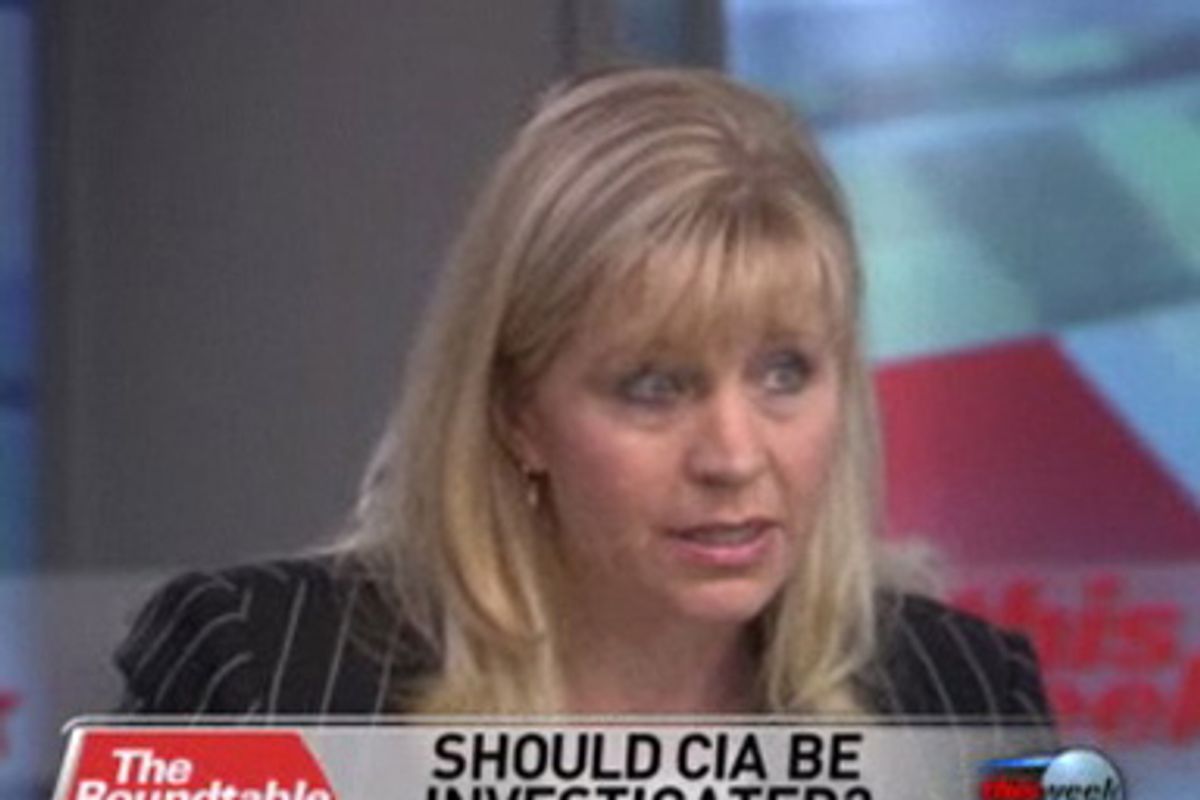
Liz Cheney, the easily exasperated eldest daughter of former Vice President Dick Cheney, has become a one-woman TV juggernaut in 2009, racking up more airtime than a cloud as she defends her daddy's administration records.
And boy, is she wrong. Unlike so many TV pundits who spin and slide around the facts, Cheney makes no fuss about completely ignoring them, and sticking to talking points that have little relation to the truth.
Take her appearance Sunday, on ABC's "This Week," which was riddled with the sort of misstatements, obfuscations and downright lies that have now become a staple of her TV performances (video of the show is below).
When the discussion turned to Attorney General Eric Holder's decision to investigate the CIA's interrogation practices used on suspected terrorism suspects during the Bush administration, Cheney adamantly argued against the probe. She said, "But this investigation has already been done. This was looked at for five years by career prosecutors. They decided not to prosecute except in one case where a contractor has been convicted and is in jail."
The Justice Department's ethics office, the Office of Professional Responsibility, which handles attorney misconduct, recommended that nearly 12 prisoner abuse cases be revisited by Holder. This clearly suggests that the OPR is not satisfied with the previous investigations into the cases that occurred during the Bush administration. As, according to the Justice Department Web site, the OPR “is responsible for investigating allegations of misconduct involving Department attorneys,” it is likely the office concluded that the Bush-era attorneys who made the previous decisions erred in some way.
During her appearance on ABC, Cheney also said directly that waterboarding "isn't torture." However, those in the Bush administration privately acknowledged that waterboarding was torture and President Obama has said it definitely violates the Geneva Conventions -- as has Republican Sen. John McCain. There seems to be near-universal agreement that waterboarding is, in fact, torture.
In a video made by ABC of the round-table participants talking after the show, Cheney then invoked the "ticking time bomb" scenario to justify using "enhanced interrogation techniques" and said that torture had worked in the past to prevent attacks on the U.S. However, recently released documents on the CIA's use of torture on detainees did not show that torture worked.
From just mid-May to early June, Cheney appeared on television news programs at least 22 times. And nearly every time she's been on, she's taken the opportunity to criticize President Obama -- but has often done so by reiterating factually dubious claims or flat-out lies. As MSNBC's Rachel Maddow quipped in June, "Liz Cheney is still on TV -- making news by apparently making stuff up." Yet, when asked why Cheney is continually booked on MSNBC, despite her problems with the truth, a network spokesperson called Cheney a "great guest."
Indeed. Here's a look at some of the recent times Cheney has strayed from the truth:
- On July 21, Cheney defended the Birther movement on CNN's "Larry King Live" -- despite the fact that those behind the movement and their claims about President Obama's birth certificate have been thoroughly debunked.
- On July 13, when it was revealed that former Vice President Cheney directed the CIA to keep information on a secret program to assassinate al-Qaida leaders from Congress for eight years, some Democrats called for an investigation into the matter. In response, Liz Cheney misrepresented what Democrats wanted to look into and told the Washington Times, "I am really surprised that the Democrats decide that that’s what they want to fight over. I mean, if they want to go to the American people and say that they disagree with the notion that we ought to be capturing and killing al-Qaida leaders, I think it’s just going to prove to the American people one more time why they can’t trust the Democrats with our national security."
- During an appearance on CNN on June 10, Cheney blasted Obama for his foreign policy positions. She said, "I would say one of the things that is troubling to Americans, I think, is the extent to which this administration is focused on the president's popularity overseas. We've now seen several different occasions when he's been on the international trips, where he's not willing to say, flat out, 'I believe in American exceptionalism. I believe unequivocally, unapologetically, America is the best nation that ever existed in history, and clearly that exists today.'" However, as the Washington Monthly's Steve Benen pointed out at the time, on April 5, Obama in fact stated clearly, "I believe in American exceptionalism, just as I suspect that the Brits believe in British exceptionalism and the Greeks believe in Greek exceptionalism. I'm enormously proud of my country and its role and history in the world."
- Salon's Joan Walsh took her on for a variety of false claims during an appearance on CNN on June 9. Cheney argued that Obama's decision to close Guantánamo and possibly bring the detainees still held there to U.S. soil to stand trial would "make us less safe." Walsh pointed out that in 2006, President Bush had advocated for the very same thing, which Cheney denied, despite all evidence to the contrary. Walsh also discussed the numerous former Bush officials who are staunchly in favor of closing Guantánamo even as Cheney tried to depict the closing of the prison as a completely partisan decision.
- On June 4, Cheney appeared on NBC and said that her father never made a link between 9/11 and Iraq in justifying the decision of the U.S. to oust Saddam Hussein from power. This is flatly false.
Shares