Editor: Mark Schone
Updated: Today
Topic:

Mortgage Crisis

On housing crisis, Wall Street feels no shame

While Americans suffer, glutted banks refuse to renegotiate mortgages or scale back bonuses

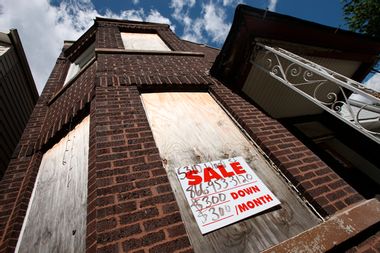
One out of four homeowners is now under water, owing more on their homes than the homes are worth. Why? The biggest single factor behind the housing crisis is rising unemployment. According to the latest ABC-Washington Post poll, one out of every three Americans has either lost their job or lives in a household with someone who has lost a job. Today it takes two and sometimes three incomes to buy the groceries and pay the mortgage or the rent. So if one of those incomes is gone, a homeowner can't make the payment.

The scourge of unemployment is splitting America into three groups: (1) the third just mentioned, whose households are in danger of losing their homes and whose kids are surviving on food stamps (that's up to one in four children in America today); (2) the vast majority of Americans who are managing but worried about keeping their jobs and homes; and (3) a small number who are taking home even more winnings than they did in the boom year 2007.

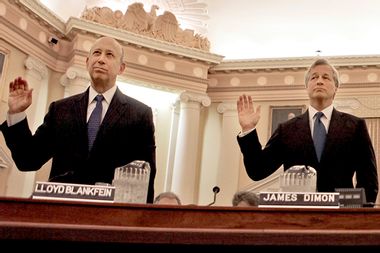
Prominent among category (3) are Wall Street bankers, many of whom are now concluding their most profitable year ever. Goldman Sachs is so flush it's preparing to give out bonuses in a few weeks totaling $17 billion. That will mean eight-figure compensation packages for lots of Goldman executives and traders. JPMorgan Chase is rumored to have a bonus pool of around $5 billion. The three other major Wall Street banks are ratcheting up their compensation packages so their "talent" won't be poached by Goldman or JPMorgan.

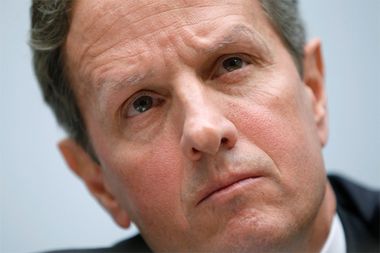
Wall Street is booming again in large part because the rest of America -- categories (1) and (2), above -- bailed it out to the tune of $700 billion last year. The Street has repaid some of that but, according to the bailout program's inspector general, much of it is gone forever. For example, the taxpayer money that bailed out giant insurer AIG went directly through AIG to its "counterparties" like Goldman Sachs -- to whom Tim Geithner, according to the inspector general, gave away the store. As Goldman Sachs prepares to dole out some $17 billion to its executives and traders, it's worth noting that Goldman received $13 billion a year ago from the rest of us via AIG and Geithner, no strings attached.

Which brings us back to homeowners who are falling further behind. The $75 billion federal program designed to bribe banks to modify mortgages has been a bust. No one knows the exact number of mortgages that have been modified (that will be reported next month) but housing experts I've talked with say it's a tiny fraction of the number of homeowners in trouble. Seems that the big banks can't be bothered. "Some of the firms ought to be embarrassed," Michael Barr, the assistant Treasury secretary for financial institutions told the New York Times.

Barr says the government will try to use shame as a corrective, publicly naming institutions that have moved too slowly. But the banks have done almost nothing to date. "We've made dramatic improvements, and we continue to try to get better," says a spokesman for JPMorgan Chase, but as a practical matter JPMorgan has done squat.

Shame? If we've learned anything over the last year, it's that Wall Street has none. Ten months ago Wall Street lobbyists beat back a proposal to give bankruptcy judges the right to amend mortgages in order to pressure lenders to reduce principle owed, just like Wall Street lobbyists are now beating back tough regulations to prevent the Street from causing another meltdown.

Shame? For Wall Street, it all comes down to PR, at minimal cost. Goldman Sachs, attempting to preempt a firestorm of public outrage when it dispenses its $17 billion of bonuses, is setting up a crudely conceived $500 million PR program to help Main Street.

Shame won't work. Only political muscle and courage will. Congress and the Obama administration should give homeowners the right to go to a bankruptcy judge and have their mortgages modified.

And while they're at it, resurrect the Glass-Steagall Act that used to separate investment from commercial banking, so Wall Street can't continue to use other people's money to gamble.

Finally, before Goldman hands out $17 billion in bonuses, claw back the $13 billion Goldman took from AIG and the rest of us and add it to the pool of money going for mortgage relief.

"A crisis of unprecedented proportions is approaching"

Notes from a California meltdown, cont. Tax revenue rises unexpectedly, but a commercial real estate tsunami looms

California Controller John Chiang's monthly summary of the state's cash situation starts on a happy note. (Found via Calculated Risk.) Unexpectedly, General Fund revenues for October beat budget estimates, mainly because of a boost from corporate taxes.

Chiang, whose monthly missives warning of impending bankruptcy have been a staple of California life for the last year, becomes positively ebullient:

October's numbers may contain some signs that California's economy is gradually beginning to heal. Both personal income and corporate taxes beat monthly estimates, while corporate and sales taxes also came in higher than October 2008.

As California goes, so goes the nation? If we're talking budget paralysis and dysfunctional politics, that might not be a good thing. But if we're talking economic recovery, a return to health out West would be a welcome prospect for the entire country.

However, after lulling our fears with his happy talk, Chiang appends a "guest article": "Overview of the Commercial Property and Capital Markets with Implications for the State of California," by Dr. Randall Zisler.

The message from Dr. Zisler is quite different. Nationally, the commercial real estate market is in big, big trouble.

A crisis of unprecedented proportions is approaching. Of the $3 trillion of outstanding mortgage debt, $1.4 trillion is scheduled to mature in four years. We estimate another $500 billion to $750 billion of unscheduled maturities (i.e., defaults). Unfortunately, traditional lenders of consequence are practically out of the market and massive amounts of maturing debt will not easily find refinancing. Marking-to-market outstanding debt will render many banks, especially regional and community banks, insolvent, especially as much of the debt is likely worth about 50 percent of par, or less.

Stated baldly: Banks are on the hook for loans to commercial real estate developers that will never be paid back and can't be refinanced. Zisler doesn't break down the figures to tell us how much of that $3 trillion in outstanding mortgage debt is California's, but one can guess that it is a significant fraction.

California's faltering steps forward, in terms of rising tax revenue for October, could just be the calm before the commercial real estate storm finally hits. Double-dip recession, with a California topping, anyone?

The economic crash and its aftermath are affecting all sectors of the economy, real estate being no exception. Real estate, especially in the transactional sub-sectors (e.g., brokers, etc.), accounts for a significant share of the California labor force. The downturn has created a vicious negative feedback, a symptom of which is still ongoing property deflation and tenant defaults. Attendant symptoms are reduced property tax revenues, failing businesses, decimated transactions volume, and reduced income and sales tax revenues. The extent to which the recovery is delayed will depend on a number of factors, not least of which is the extent and timing of loss recognition by owners and financial institutions.

Bear Stearns' subprime hedgies: Not guilty!

Two fund managers who received some very bad press in the wake of the financial crisis beat the rap

Two former Bear Stearns hedge fund managers who made very, very bad bets on subprime mortgages, Ralph Cioffi and Matthew Tannin, were found not guilty of securities fraud in Brooklyn federal court on Tuesday. The verdict invites a look back at how the history of the financial crisis is being written in real time.

William D. Cohan's riveting account of the fall of Bear Stearns, "House of Cards: A Tale of Hubris and Wretched Excess on Wall Street" was one of the first books published on the financial crisis to hit the market. It also held pride of place as one of the best, at least until the publication of Andrew Ross Sorkin's "Too Big To Fail." Full of detail from numerous interviews and copious access to company e-mails, Cohan's account is noteworthy not least for the compelling and lengthy circumstantial case that it makes against Cioffi and Tannin. If you were judging from "House of Cards" then Cioffi and Tannin seemed obviously guilty of telling investors in their funds one thing while doing another.

Just one example of how Cohan tells the story;

The problem was that none of it was true. Cioffi had not been avoiding residential mortgage-backed securities, as he had suggested to his investors on their monthly statements. Actually, he had done precisely the opposite and had started to load up on these toxic securities at exactly the wrong moment.

The indictment of both men on charges of conspiracy, securities fraud, and wire fraud is part of the last chapter of "House of Cards." The case against them, from Cohan's telling, seems airtight.

Two months after the publication of "House of Cards," Wall Street Journal reporter Kate Kelly's book on Bear Stearns, "Street Fighters: The Last 72 Hours of Bear Stearns, The Toughest Firm on Wall Street," finally made it to stores. Although Kelly broke some important stories for the Journal on Bear Stearns, "Street Fighters" -- about half as long as "House of Cards" and much less comprehensive -- suffered in comparison. The saga of Cioffi and Tannin only occupied two pages near the beginning of her story, and the fact that they had been indicted for securities fraud in federal court wasn't even mentioned, a point I noted with several exclamation points written in the margins of my reviewer's copy.

At the time, I thought this was a pretty serious flaw in "Street Fighters." But now, after seeing Cioffi and Tannin acquitted in a court of law, I wonder. Maybe it was Cohan who gave their misadventures too much attention, while Kelly got it just right.

How do right-wingers explain the commercial real estate meltdown?

Paul Krugman says government policy can't be blamed for the mall-and-office-space bust. Conservatives will disagree

It is a rare thing indeed to criticize Paul Krugman for being overly optimistic, but his contention in a blog post today that the ongoing implosion in the commercial real estate sector once and for all refutes the argument that all our economic ills can be blamed on Fannie and Freddie and the Community Reinvestment Act, is too hopeful.

One of the enduring myths of the financial crisis has been the claim that it was the result of (a) Fannie and Freddie (b) the Community Reinvestment Act, which forced poor, helpless bankers to make loans to you-know-who. It's a myth that won't go away -- I get asked about it almost every time I give a public lecture -- even though it has been extensively debunked. (See, e.g., here.)

But reading this scary piece about commercial real estate, I realized that CRE offers yet another debunking. After all, there was no federal act driving banks to lend money for office parks and shopping malls; Fannie and Freddie weren't in the CRE loan business; yet 55 percent -- 55 percent! -- of commercial mortgages that will come due before 2014 are underwater.

The lenders didn't need government urging to dive deep into a property bubble, and drown.

In his haste to pile debunking upon debunking, I think Krugman is missing a crucial link in the right-wing logic chain. I can hear the conservative bloggers typing madly away at their keyboards even as I write these words. The downfall of the commercial real estate sector, they will argue, is a consequence of the financial crisis, which was caused by the subprime mortgage meltdown, which itself was, you guessed it, an inevitable result of the passage of the Community Reinvestment Act in 1977. There's no winning this argument. The best you can do, as with the birthers and 9/11 Truthers, is mock mercilessly, and then move on.

Goldman Sachs lesson: The house always wins

The bank sold toxic waste to pension funds while secretly betting against the subprime market. Was that illegal?

Goldman Sachs dismissed Matt Taibbi's "vampire squid" assault in Rolling Stone last August as a "witches' brew of conspiracy theories" and continued merrily going about its business of making insane amounts of money while everyone else was lining up at the soup kitchen. But the investment bank will have a harder time shrugging off the punches landed by McClatchy Newspapers' Greg Gordon in a major broadside delivered this morning: "How Goldman Secretly Bet on the U.S. Housing Crash."

Gordon's piece wraps up a grab bag of Goldman criticism into one package, but the key assertion is one that is likely to have Goldman lawyers on DefCon 1 high alert.

In 2006 and 2007, Goldman Sachs Group peddled more than $40 billion in securities backed by at least 200,000 risky home mortgages, but never told the buyers it was secretly betting that a sharp drop in U.S. housing prices would send the value of those securities plummeting.

At the very least, it looks very bad for an investment bank to be selling bonds to pensions funds that its executives knew were toxic waste -- to the point that the bank was actively placing bets that the subprime market in mortgage bonds was due for a crash. The key question is: Was Goldman's behavior illegal? Goldman spokesperson Michael DuVally -- a very, very busy guy these days -- says no.

DuVally told McClatchy that Goldman "had no obligation to disclose how it was managing its risk, nor would investors have expected us to do so ... other market participants had access to the same information we did."

But a host of securities experts say, well, maybe, citing the Securities Act of 1933, which "imposes a special disclosure burden on principal underwriters of securities, which was Goldman's role when it sold about $39 billion of its own risky mortgage-backed securities from March 2006 to February 2007."

Numerous lawsuits filed by pension funds and other institutional investors who were burned by Goldman are now making their way through the judicial system. It will be years before there is any closure on the issue of Goldman's guilt. It would be nice if there was a Elliot Spitzer-type still around who could add some political juice to the process (The People versus Goldman, coming soon to a federal court near you -- Andrew Cuomo, are you listening?) But maybe this is a mess that will be ultimately resolved "within the family," so to speak. Some of the biggest pension funds in the country bought into Goldman's junk. Unlike you or me, they can afford the type of legal counsel that Goldman has to pay attention to.

Oops, sorry I broke the economy

John Reed, Citigroup's former CEO, and one of the men responsible for the demise of Glass-Steagall, wants a do-over

Almost exactly ten years ago, on Oct. 22, 1999, the Clinton administration reached a deal with Republican Senator Phil Gramm, the chairman of the Senate Banking Committee, to effectively repeal the separation between commercial and investment activities mandated by the New Deal-era legislation, Glass-Steagall. Upon hearing the news, John Reed and Sanford I. Weill, the co-CEOs of Citigroup, issued "a statement congratulating Congress and President Clinton, including 19 administration officials and lawmakers by name."

Reed and Weill were naturally pleased, because without the repeal of Glass-Steagall, the mega-merger orchestrated a year earlier between Reed's Citicorp and Weill's Travelers Group would technically have been illegal.

Ten years later, after surveying the wreckage wreaked upon the global economy by "too-big-too-fail" financial institutions that might have been kept in check had Glass-Steagall continued as the law of the land, John Reed wants a do-over.

In a letter to the editor commenting on an New York Times article on Paul Volcker, Reed wrote:

Volcker's Advice

To the Editor: Re "Volcker's Voice, Often Heeded, Fails to Sell a Bank Strategy" (front page, Oct. 21):

As another older banker and one who has experienced both the pre- and post-Glass-Steagall world, I would agree with Paul A. Volcker (and also Mervyn King, governor of the Bank of England) that some kind of separation between institutions that deal primarily in the capital markets and those involved in more traditional deposit-taking and working-capital finance makes sense.

This, in conjunction with more demanding capital requirements, would go a long way toward building a more robust financial sector.

John S. Reed, New York, Oct. 21, 2009

The writer is retired chairman of Citigroup.

Barry Ritholtz at The Big Picture says "this is pretty amazing." Noam Scheiber says, a la Simon Johnson, "maybe the consensus on [breaking up the banks] really is starting to change."

Everybody loves a whopping big "oops," and this appears to be one. But could there be another explanation? A look back at the history of the Citigroup merger suggests that Sanford Weill was the real driving force who made it happen. Weill, by some accounts, then pushed John Reed out of power. Maybe Reed is still mad, and attempting to disassociate himself fromresponsibility for the entire sorry saga.

When Sanford I. Weill comes out in favor of bringing back Glass-Steagall, then we'll know that the consensus really has changed.

Page 1 of 9 in Mortgage Crisis Earliest ⇒

Mortgage crisis in the news

Loading...

Recommended Reads

My Own Personal Credit Crisis
By Edmund L. Andrews

The subprime New York Times reporter
The curious case of Edmund Andrews, who covered the mortgage meltdown as a journalist, while living it as a deadbeat.
By Andrew Leonard

"Busted" author gets busted, for real
The strange case of the subprime N.Y. Times reporter gets much stranger.
By Andrew Leonard

"Busted" author responds to criticism
Times reporter Edmund Andrews tells PBS his wife's bankruptcies were not relevant to his personal credit crunch
By Andrew Leonard

Currently in Salon