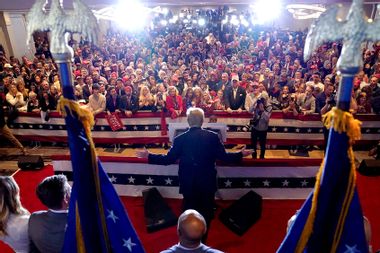
In 2009, the energized right-wing base of the Republican Party transformed American politics. Nationwide protests against Barack Obama and his political agenda have forced establishment conservatives and the Republican Party power structure to make a strategic decision about whether listening to their core voters will help them or hurt them in coming elections.
What does the revolt of the GOP base mean? Does it represent a long-term structural change in American party politics? Will it alienate or attract the independents that Republicans need to return to power? We're likely to learn something about the short-term appeal of red-meat right-wing politics in next Tuesday's elections, particularly from the results of a special election in New York's 23rd Congressional District, where a third-party conservative has won the endorsement of national Republican figures and may well win the election too. For the longer view, we've assembled a panel, from both left and right, of keen observers of national politics.
Karl Agne is a founding partner of Gerstein|Agne, a Washington-based strategic communications consulting firm. Karl also serves as senior advisor to Democracy Corps, a nonprofit advocacy group he helped found in 1999 with James Carville, Stan Greenberg and Bob Shrum. Rick Perlstein is the author of "Nixonland: "The Rise of a President and the Fracturing of America," and "Before the Storm: Barry Goldwater and the Unmaking of the American Consensus" -- the first two installments in a trilogy about the postwar conservative movement he is currently completing. Byron York is the chief political correspondent for the Washington Examiner and the former White House correspondent for National Review. Byron is the author of "The Vast Left Wing Conspiracy," the first book to trace the new political movement created by activists like MoveOn.org, George Soros and the liberal blogosphere. Salon spoke to them by phone earlier this week.
Tom Schaller: I'd like to start with Rick and Byron, and ask that they provide some perspective on conservatism and its relationship to the GOP, as a way of putting the conservative angst we have witnessed in 2009 into a broader historical context.
Rick Perlstein: I hold no illusions that the number of folks who believe that there are sinister forces in Washington or the East that are kind of conspiring against ordinary folks on the right [has decreased] -- it's pretty constant in American history, or at least the 20th century. In the '20s it was the Ku Klux Klan, in the early '60s it was the John Birch Society. Now we know -- the stories the folks are telling on Fox News.
The big difference, I think, is how well they're able to kind of convince a margin of the American people that their agenda should be shared by them. In the 1920s, the Klan was fairly successful in taking over the Republican Party in a bunch of Midwestern states, like Indiana, but then in the early '60s, the John Birch Society was basically seen as verboten and beyond the pale. And I think a lot of it had to do with how the establishment media at various times treated these phenomena. I think one of the things that happened in the early '60s was the media -- and even the right-wing media people like William F. Buckley -- drew some boundaries about what was reasonable and unreasonable discourse.
And right now, with Obama pointing out the things that Fox News makes up, you're getting a lot of the mainstream media and the folks in Washington saying, "Well, why are you attacking someone who is part of our tribe, part of our team." So you get people like Howard Kurtz kind of aghast that this kind of faux pas has happened. But, you know, the faux pas is very similar to what William F. Buckley was doing, all the way through the 1960s, saying the John Birch Society's saying that America's foreign policy has gone astray because it's infiltrated by secret communists is not reasonable discourse.
Schaller: Byron, do you see analogues, historically, on the right side or the left side or both?
Byron York: I think it's pretty clear that the bases of both parties have moved farther apart over the years. If you go back to 1980 and just look at the ideological ratings of members of the House, relatively small numbers of Democrats, and small numbers of Republicans -- and Democrats were in the majority at the time -- relatively small numbers got 100 percent ratings, perfect ratings from either Americans for Democratic Action or the American Conservative Union or the other groups that rate them on their ideological purity. Now, the number of perfect scores is three, four times larger. So I think there's no doubt that each side has moved. This brings fights over ideological purity -- there's one going on right now in New York State over a House seat, New York 23, in which you have a liberal Republican and a conservative going at it. But I think you saw it a couple years ago in the netroots' attempt -- pretty darn close attempt -- to defeat Joe Lieberman with their chosen candidate, Ned Lamont. So these things crop up.
Schaller: I wonder if what we're seeing in the tension between the right and the center-right, between establishment Republicanism and agitators, is not different from what we saw in the earlier part of this decade within the Democratic Party between the Clinton wing and the other elements. Is this the natural state, when you've become a minority party, and you're trying to re-identify yourself, to fight within the party before you figure out how you're going to fight the other party?
Karl Agne: I think there are a couple things here. First, to Byron's point about the increase of polarization, I think it's impossible to overstate the role of redistricting in this. The redistricting process has become so technically advanced and so hyperpartisan that well over half the seats in this country now are won in the primary contest. So there's a natural incentive to go as far to either side, in order to win that, and just become a safe incumbent, than to go to the center and have to win general elections. And so that creates very different dynamics and very different pressures on those incumbents. To the same extent, there's a real pressure toward isolation on both sides.
What I think is the real fundamental difference here with what we're seeing in the conservative movement today, and what we saw with the Democratic Party and the progressive wing even a few years ago, is the centrality of Fox News to all of this. When we spoke with these conservative Republicans in the focus groups we did for Democracy Corps recently, what was really striking was we asked them specifically, who is the leader of the Republican Party, who speaks for the Republican Party today? And none of them in the groups we did named a single elected official. They didn't name George W. Bush, they didn't look to past presidencies the way Democrats did when Bush was in the White House and they looked back to Clinton-Gore and those times. Who they named was Fox News. Who they named was Glenn Beck, Rush Limbaugh. Those are the people who speak for the Republican Party in the minds of the conservative base voters that we're talking about. So the centrality of -- first of all, a media entity, not a partisan or ideological entity, but a media entity. And second of all, the fact that it's so large, and so organized.
You know, when there was this progressive anger bubbling up to the '04 election, it was from the netroots. It was a very grass-roots and a very disorganized voice, that became organized through the medium of the Internet. But there was not a well-established multibillion-dollar business driving it, the way there is on the conservative side. So it's a really fundamental difference in my opinion.
York: I would take one issue with that, as far as the netroots in '04. We all know about George Soros and his personal crusade that he undertook. But it was an enormous amount of money. Rick can correct me on this, but I think back in the '70s, W. Clement Stone, Nixon's friend, had contributed, I think $2 million to the Nixon campaign. And it so horrified reformers that it was one of the reasons that we ended up with campaign finance reform in the 1970s. I think if you translate that $2 million into 2004 dollars, you get $8 million or $9 million. Soros poured $27 million of his own dollars into this attempt to unseat Bush. It was not into a particular campaign, because that's not legal. It was into 501C3 and -4 groups, 527 groups, I should say. So it was actually an extraordinarily well-funded operation.
Agne: But that was about a campaign. And that was one of the great failings on the progressive side in '04, was all this money was poured into a campaign infrastructure. When the campaign ended on Election Day, there was nothing left. There was no footprint, as if all that money had gone down a drain. The structure that was created in '08, the Organizing for America and the understanding of voter files, and all the technological advances going into the '08 election, were much more about creating a long-term infrastructure to parallel what was happening on the right as far back as 20 years ago.
Schaller: What is the status of the institutionalized conservative movement, as opposed to the Tea Partyers, and so forth?
Perlstein: I think there's a lot of confusion. There's a lot of distrust certainly. The New York 23rd District race shows that. We have politicians like Sarah Palin and now Fred Thompson bidding for conservative bona fides by coming out quite explicitly for the non-Republican, Conservative Party line candidate in the race, who's associated with the Tea Party movement. And the Republican Party's candidate finds herself with the infrastructure of the Republican Party but without the insurgent energy which has been so powerful for the Republican Party over the years. I would compare it to what happened when Code Pink got fed up with Nancy Pelosi. They ran one of their people against her. The difference is, they're up to what, 22, 23 or 24 percent of the vote in polls up there in New York? Obviously, the Code Pink bid against Pelosi was just a gnat bite on an elephant. But the ecologies of the relationship between the establishment and the grass roots on the left and right are very different. I thought it was very little symmetry between them.
York: Rick, how would you compare the New York 23 race to the Connecticut race of a few years ago?
Perlstein: You know, I think actually it's a decent comparison. I think that the insurgents in that race have a pretty good point. The Republican candidate did vote for some very important Obama initiatives, just like Lieberman allied himself with some very important Bush initiatives. The question is, how prototypical it's going to be. I don't think that you're going to find as many -- let me put it this way. Every Republican who's in elected office and wants to stay in elected office, it really finds them on the horns of an enormous dilemma. They can join the coalition that's being built to govern the country, and contribute to debates over how healthcare is going to go forward, and things like that -- how cap-and-trade is going to go forward, how stimulus spending is going to go forward. Or they can join the Tea Party people and just refuse. I wouldn't want to be a Republican elected official right now, because it's really a zero-sum choice for these guys.
Schaller: I want to come back to Karl, who mentioned briefly the focus group studies put out by Democracy Corps, which you were involved in producing. Karl, could you just give us the quick 60- or 90-second study summary of what you did, what kind of questions you asked, who you focus-grouped, and what the key results are? And then your reaction to what your findings are. And then maybe we can bring Rick and Byron again to respond to it.
Agne: Sure. What we did was, we conducted groups among real conservative base voters, and then parallel groups among older, white, non-college voters in Ohio. The goal really being, that these are the most conservative independent voters. These are the independent voters Republicans really have to have to win any election, in 2010 or beyond. And then looking at the conservative base voters and seeing how large the gap was. In 2008, that was one of the most underreported stories, in our opinion, was the huge and growing gap between the Republican base and even the most conservative independents. Obviously, Democrats at the congressional level and Obama both won clear majorities of independents and won the election convincingly.
What we found was that even as these independents have started to pull back from Obama and the Democrats in Congress a bit -- some concern about healthcare, some concern about spending, a few other things -- they still fundamentally want them to succeed. They want to see the edges come off some of these policies, but they want to see it go through. They want the change that Obama promised them in the election, they're just not quite sure what that change should look like. The Republican base voters fundamentally want Obama to fail. They believe that he is intentionally trying to lead the country into a ditch, essentially, that he is trying to lead the country to failure, and thus to socialism. And so they see it as a moral responsibility to oppose every single step of his agenda. There's no sense of compromise. There is a clear moral obligation to stand firm and oppose him, no matter what. And that's really the fundamental dilemma that we were just discussing.
Schaller: Now, Rick, is this a new new right? Or is it just a splinter group that's getting an unusual amount of attention?
Perlstein: Well, like I said, the concerns are fairly continuous across the 20th century. What is different is that the Republican Party, and the Republican establishment, has kind of invested so much energy and so much passion and so much sincerity in the idea that conservatism is the name for everything good in politics, and compromise is the name for everything bad in politics, that they've kind of created this Frankenstein monster. During the Reagan years, you had pretty strong leadership at the top, once again, drawing the boundaries, and doing things like massaging the concerns of a very passionate base, but [the party didn't let] the tail wag the dog. I mean, I think of Ronald Reagan only giving video messages to pro-life rallies, instead of showing up in person. But there's this insurgent energy that the Republican Party kind of needs to keep going -- and without this constituency, there is no Republican Party, let's face it.
Schaller: Byron, is this a new new right? Is it some kind of pygmy cousin to what we've seen in conservative politics in the past? Or is it just a continuation that's getting an unusual amount of attention by a liberal media that's trying to denigrate and defang this movement?
York: After the 2008 election, there was an enormous debate, and a kind of anguished debate -- as there always is among losers -- among Republicans about why they lost. And there were basically two factions. There was the "we abandoned our true conservative principles" faction. And there was "the world is changing, there are demographic and political changes in the United States, and we as Republicans have not kept up with them." So, both of them argued for real change, but it wasn't the same kind of change. That question was not resolved. And I think if you look at conservative politics these days, you see that it's actually beginning to fade into the background, and it began to fade into the background beginning Jan. 20, 2009, with the inauguration of Obama, which gave Republicans a lot to oppose.
I think, now, if you look at a lot of polls -- public polls, and private polls that have been done for the parties -- you're seeing independents behave a little more like Republicans than they have in the past. What you saw in 2006 and 2008 was independents were sick of George Bush, they were sick of Republican leadership, they began to behave more like Democrats, although they remained independents. What you're seeing now, in the last nine months, is they're moving a little the other way.
I did have one question for Karl, which is, how do you characterize someone who wants all of the current versions of health reform in the House and Senate to fail, to be replaced by something that they would like more, with, say, changes to portability, tax structure and tort reform? And who would like to see the current cap-and-trade legislation that's passed the House but not the Senate fail? Is that someone who's on the extremes? Or is that a legitimate policy position?
Agne: Certainly that position as a piece of legislation would be a legitimate policy position. What we're talking about is a more fundamental worldview. The folks we talked about, you know, they are not sitting here reading line-by-line this legislation. The point is, they're looking at one thing: Did Obama propose it? It must be anti-American, it must be to the detriment of our country, if Obama stands for it. And that's really all that they need to know, and then from there, that is the bias with which they enter the conversation. And every piece of information that they pick up is fitted into that framework, and that's really the key to understanding it.
One point I want to make is -- because we do hear this a lot -- that independents are starting to look more like Republicans. That's, I think, a misunderstanding. Independents are starting to pull back from the strong support they had for Obama at the beginning of the administration. But they're not moving towards Republicans. This is the key. The Republican Party -- there was just a big release -- in one of the public polls had its lowest numbers in history this past week. The Republicans' favorability has not gone up, the way that it did in 1994, the way the Democratic Party's favorability went up before 2006, 2008. The Republican Party remains at its lowest point in history in public polling, and that's consistent across public and private polling. So there is some doubt and concern about Democrats, but no one's moving towards Republicans yet, no one's embracing their policy positions. And the frustration of the Republican base is that the Republican Party does not, in their opinion, stand for anything right now. They view the Bush administration as a real failure of conservatism. They saw it as high-spending growth of government. They think it was a real embarrassment and betrayal of conservatism. And they don't see anyone, including the Republican Party itself, standing for conservative values, conservative principles and conservative policies right now.
York: It is true that the Republican Party is at a various low point with voters. When I say that independents are starting to behave like Republicans, or move toward Republican positions, I think that's just true. But they don't like Republicans. Republicans were roundly rejected across the board in 2008 and a party does not get back into favor that quickly. So I would agree that these are independents who don't particularly like Republicans, they certainly don't call themselves Republicans, they're not joining the Republican Party. But I think it's true that their positions seem to be moving a little bit in the direction of the Republican Party, more so than the Democrats.
Perlstein: Are you saying that the lion's share of grass-roots conservatives who oppose what Barack Obama and the Democrats are doing on healthcare reform are doing so because of policy disagreements about policy differences on things like portability and tort reform?
York: Are you talking about in Congress?
Perlstein: No, I'm talking about conservative voters.
York: Well, you mean the conservative voters who voted for McCain?
Perlstein: No, I'm saying, the conservatives who oppose Barack Obama on health reform, are you really maintaining that it's just because they have different ideas about how portability should work, and whether or not there should be tort reform?
York: Oh, absolutely. Well, the biggest thing is they're worried. Most of them have healthcare, or healthcare insurance. They're either satisfied with it, or they're afraid of change. They seriously believe -- and I think they're right -- that it will lead to some sort of rationing.
Perlstein: You think that's policy? I mean, when Rush Limbaugh goes on the radio and says, "What Barack Obama says, he means the opposite in most cases." That's not a policy argument. This is what Karl says. This was a question of existential dispositions about legitimacy.
York: I would disagree with you. I think that they believe -- and you look at the poll numbers people 65 and older, they're very concerned --
Perlstein: You say people 65 and older because they're conservative.
Schaller: Let him finish, Rick.
York: If you look at people's concerns about healthcare, it is because they're worried that the quality of their care, and the cost of their care -- that the quality will diminish and the cost will go up. They are worried about that kind of change.
Agne: Let me point out one thing in the polls, which is the question of whether or not we need major healthcare reform. This has been asked in a few different ways. The polls that asked it consistently over time show that before Obama proposed healthcare reform, across the electorate -- conservatives to liberals, Democrats, Republicans -- majorities of all groups agreed that we needed major healthcare reform. Now that the debate has taken place, the number of independents who believe that we need major healthcare reform remains over 75 percent. The number of Republicans who believe we need major healthcare reform has dropped off the table, and now a large majority says we don't need reform. Obviously, the details of the healthcare reform debate have shaped that to some point, but independents still overwhelmingly maintain that we need some sort of reform. Republicans say, "We don't even need it anymore." So their attitudes about the fundamental issue have changed as Obama has come to champion it. I think there's something unmistakable there.
York: I think their attitudes about the issue have changed now that we have concrete arguments on the table. An argument always changes once there are concrete proposals on the table.
Schaller: I want to get to the fate of the GOP in the near-term or medium-term future. And I want to start with Byron because he's probably the best-sourced person here on the right, obviously. What's your sense of how establishment Republicans are viewing what we've been seeing in 2009? Are they worried about it? Are they encouraged about it? And then we'll get a response from Karl and Rick.
York: You can't separate what you saw in 2009 from what you saw in 2008. I think if you talked to almost any of them, they would say that they're in far better shape today -- not good shape, but better shape -- than they were after the election. I mean, clearly, 256 Democrats in the House, and 60 in the Senate, Republicans are a powerless minority in the government. But -- I'm trying to remember exactly when it was -- several months ago, the first Hill Republican said to me, "You know, we might be able to win next year." They were looking at trends thinking that Democrats were going to hurt themselves with a number of things they're pushing. This was after the cap-and-trade vote, where a lot of House Democrats felt they'd kind of walked the plank on it, and wanted to make sure the Senate had their back on it. So they began to see possible electoral success next year.
Now, whether that means they actually win: Some are that optimistic, some are not. But I think you're seeing -- tell me if I'm wrong, I think Charlie Cook is talking about a Republican pickup of 20 seats. None of us knows what's going to happen in the future. But my sense is that if you talk to these Republicans, they're actually a bit more -- much more optimistic than they were when they were dragged into office in January of this year.
Schaller: Karl? Rick?
Perlstein: The generic congressional ballot is basically the same as it was in 2006, 2008. Still about Democrats by 12, and you see that in the data.
York: This was in the most recent Wall Street Journal poll, in September. The Journal asked, "Would you rather see the elections next year result in a Congress controlled by Democrats or a Congress controlled by Republicans?" Democrats won, 48 to 45. That's a three-point lead. That lead was 19 points last year.
Schaller: Karl, you have anything to add?
Agne: Strategically, you have to look at this. As someone who's done these campaigns all over the country, Democrats are going to have a lot of difficult seats to win. They won a lot of seats that lean naturally more to the Republican Party. The problem for the Republicans here is that those voters threw out, in most cases, an incumbent or a party that had come to represent Washington and the establishment, and put in someone who was talking change, and in most cases who was younger and had more progressive and new ideas. I don't believe that most of those districts are now ready to turn around and embrace the Republican Party again. For the most part, they feel pretty favorable about the people they put in there. They don't expect them to change Washington overnight, and those folks who were elected in 2006, 2008, I believe are still in pretty good position in their districts.
There are certainly some seats that are going to be very hard for Democrats to hold on to. There are some seats that Republicans are going to lose too. I'll guarantee that they lose at least, probably, half a dozen seats that they hold right now. So the Republicans have difficulties there. But they're also running against people who are relatively new, don't carry a lot of the baggage of Washington yet, and are going to be harder to beat than those big-scale national numbers are going to tell you, when you get into those individual districts.
Schaller: All right, we have a couple minutes left, I'm going to give you guys an exit question. You can go in any order you want. Between the New York 23 Scozzafava-Hoffman race, and the Virginia or New Jersey gubernatorial and, I guess, state legislative races, what story line or lesson or surprise might you predict or foresee coming next week?
Perlstein: I think the story line is that the Republican Party is facing an insurgency on the part of voters who don't trust it.
York: My line would be that I think Republicans are actually, while not in good shape, are in better shape than we're led to believe. I think Karl earlier referenced a Washington Post poll that showed, I believe, Republican self-identification at 20. I personally do not believe that Republican identification could be at 20, and the party have such a strong lead in Virginia -- won by Barack Obama a couple months ago -- and be very competitive in New Jersey. So I think these numbers, again, while not good, are not as bad as you might think.
Agne: I think the most important thing, coming out of the three elections you named, all of which are rather anomalous in different ways, is the rise of third-party candidates. Daggett in New Jersey, Hoffman in New York 23 -- I think there's a message for both parties there. I think that the message is more alarming and more difficult for the Republican Party, given its minority status already, and the fact that it really should be contracted to its base supporters at this point. But its base supporters are even rebelling. And so the real question is, where is the center of gravity in the Republican Party, if they can't even hold folks in these elections?
Schaller: I want to thank our three panelists today.
CEDAR CREEK, Texas -- Finding the epicenter of the looming Republican comeback is pretty easy, at least this week. As it happens, you can drive there from Austin-Bergstrom International Airport in less than 30 minutes, and with only two turns. Once you get to the massive golf and spa complex with signs warning pedestrians and bicyclists to stay off the road, you're in the right place.
Here at a fancy resort on the outskirts of Austin, Republican governors and the corporate sponsors who love them gathered to celebrate their recent victories and look forward to what -- they're quite sure -- will be many more to come. "I was chairman of the party 16 years ago when we were last similarly situated," said Mississippi Gov. Haley Barbour, the chairman of the Republican Governors Association, who was chairman of the Republican National Committee when the GOP swept to control of Congress in the 1994 elections. "This feels better this early than it did then."
Win a couple of odd-year gubernatorial contests, it turns out, and the future suddenly looks a lot brighter. Bright enough, in fact, that the RGA had no problem Thursday morning showing attendees a "Saturday Night Live" clip spoofing Fox News Channel's coverage of the 2009 elections. The point of the skit was that the GOP and its friends at Fox were delusional, giddily declaring the 2008 elections overturned on the basis of two statewide elections with low turnout -- which the speakers at the RGA conference then proceeded to come close to doing themselves. It wasn't clear how intentional the irony was.
"For all the hype, [2008] was not a transitional campaign, it was not a transitional year," GOP pollster Ed Goeas said at a panel about the 2010 elections, after promising to pick apart some of the "many" myths about President Obama's victory a year ago. "After $700 million being spent by the Obama campaign, it was not a new electorate."
That was, in essence, the message of the RGA conference: So what if the only thing voters like less than the Democrats in Congress might be the Republicans in Congress? Who cares if the GOP has been reduced to a rump minority in the House and Senate, left on the sidelines with not much more to do than root for Democrats to fight among themselves? In politics, what matters is momentum, and right now, Republicans -- and quite a few Democrats, especially in private -- think they have it.
So Bob McDonnell and Chris Christie, the winners in Virginia and New Jersey a few weeks ago, were hailed as the heralds of a new GOP majority -- a majority of governors, granted, which doesn't really mean anything in terms of being able to pass legislation or implement policy on a national scale, but a majority nonetheless. (Both winning candidates demurred when asked whether Obama fatigue had helped them to the statehouse; it was local issues that won the day, they insisted.) No one mentioned that the party in the White House almost always loses the New Jersey and Virginia elections the year after a presidential race.
And Barbour came armed with a new poll by Zogby International that showed Obama's approval ratings and reelection numbers were perilously low in states with competitive gubernatorial races on tap for next year. Hawaii Gov. Linda Lingle said there was no reason the GOP shouldn't aim to win every single state. "There's no state that we can't win," she said. "Talking to a Republican from Hawaii -- the first Republican elected in 40 years -- I'm telling you, we could win in every state."
But the most telling numbers may have been the ones Barbour touted a little later, in a press conference, after he'd shared them with governors and Republican loyalists Thursday morning. Forget the polling; what really got the RGA excited was another kind of stat. "We spent $23 million in 2006," Barbour said. "We're going to start 2010 with $25 million in the bank."
Raising and spending money is, after all, the main thing a group like the RGA does. Which is why the big "Victory Barbecue" on Wednesday night was sponsored by the Corrections Corporation of America, whose Web site proclaims it's "the private corrections management provider of choice for federal, state and local agencies." And why Indiana Gov. Mitch Daniels apologized to "the vendors in the room" for boasting of his love of bidding state contracts out using reverse auctions. Everywhere you looked, corporate sponsors popped up. A mining company, an information technology company and a supply chain logistics company teamed up with CCA and the liquor lobby to sponsor a bash at Cindy's Gone Hog Wild, a bar down the road from the conference resort. A "trunk show and fashion boutique" was set up in one hallway Thursday afternoon, so attendees could take a break from hearing about the Obama administration's nefarious healthcare reform plans to get a little shopping in. (The governors, meanwhile, headed out for some skeet and trap shooting on the resort's grounds.)
That's not to say Democrats will have it easy next year, especially if the economy doesn't recover faster. Incumbents in either party are likely to struggle; fairly heavy losses in the House and Senate are probably on the horizon, though Democrats took so many seats in 2006 and 2008 that their majority in both houses is likely safe. Midterm elections almost never bring good news for new presidents, just like the New Jersey and Virginia results.
But the GOP crowing in Texas this week doesn't mean Republicans have it all figured out again, either. The candidates on the Republican line in major races next year may include Ohio's John Kasich, who was the House Budget Committee chairman after the 1994 elections; New York's Rick Lazio, who tried, and failed, to beat Hillary Clinton for the Senate in 2000; and Iowa's Terry Branstad, whom you may have heard of because he already served as governor of the state from 1983 to 1999. That lineup doesn't exactly scream out "new and improved," no matter how much Barbour talked up the GOP comeback.
"One of the things that really does separate this Republican Party from the Republican Party of 1993 is that this one is utterly devoid of ideas," said Nathan Daschle, the executive director of the Democratic Governors Association, the RGA's counterpart. "You can say a lot of things about Newt Gingrich, you can say a lot of things about the Republican Revolution; one thing you can't say is that it lacked some kind of ideological base or agenda."
By contrast, Barbour boasted Wednesday that Republicans in New Jersey voted for a moderate, Christie, and in Virginia, they voted for a conservative, McDonnell. The main thing they had in common was their party label. As GOP governors gathered to bash the healthcare reform bill Thursday morning, they ran through the same litany of Republican "solutions" to the problem that their comrades in Washington have offered for months -- tort reform, insurance portability, tax credits. Their most famous ex-governor, meanwhile, was running around on a book tour, talking mostly to tea party types who won't exactly help win swing voters over. Minnesota Gov. Tim Pawlenty, who's supposed to be a rising star in the party and is planning a run for president in 2012, stuck to bland pronouncements as he moderated a domestic policy panel on Wednesday. "Citizens are being asked to live on the same amount of money, or less, than they did last year," he said. "They think it's reasonable that government should tighten its belt as well." No one at the conference could open his or her mouth without declaring the states to be "the laboratories of democracy" -- Louisiana Gov. Bobby Jindal must have said at least a half-dozen times that unlike Washington, states can't print their own money. It was not, all in all, a rousing display.
What next year's elections may offer increasingly alienated voters, then, could be a choice between the Democrats, complete with their infighting and chaotic majorities -- who may not have done enough yet to fix the problems that they confronted upon walking into office -- and the Republicans -- who were the ones who helped mess things up in the first place. If the RGA gathering was any evidence, though, the GOP is aiming to win that choice by default. A win, after all, is still a win.
What I said in my last post, about Doug Hoffman representing the conservative id, especially now, when he makes completely nonsensical claims about ACORN stealing an upstate New York Congressional election from him? I'll admit it: I had no idea how right I was.
Public Policy Polling, a Democratic firm, got lucky with the timing of its latest survey. That's because PPP asked respondents, "Do you think that Barack Obama legitimately won the Presidential election last year, or do you think that ACORN stole it for him?"
Fully 26 percent of respondents said they believe ACORN stole the election for Obama, compared to 62 percent who said they think he won it fair and square. 12 percent weren't sure.
The numbers were even more revealing when broken down along partisan lines. A majority of Republicans -- 52 percent -- think ACORN stole the presidency, while just 27 percent said they believe Obama's office is legitimately his.
Sarah Palin fans began gathering late Monday night for a book signing that wouldn't begin until 6 o'clock Tuesday evening. The signing fell during Michigan's two most sacred weeks -- firearm deer season. So Ken Bellhorn left his hunting camp at 1 a.m., and showed up at the Barnes & Noble in Woodland Mall still dressed in an orange camo jacket, a John Deere T-shirt, and hunting boots. He got there early enough to claim one of the 940 wristbands that guaranteed him an autographed copy.
"I already shot a small buck, but this'll be a bigger trophy," said Bellhorn, who was laid off last year from his job at a plastics firm that supplies the auto industry, and has spent some of his free time attending tea party rallies. "I think when Reagan was in office, he saved us from ourselves, and I think she's got the character and the morals to do the same thing."
Sarah Palin seemed to have an affinity with Greater Grand Rapids that she may not find anywhere else on her 31-city tour. West Michigan fits both sides of the Palin persona -- the antiabortion creationist and the moose-skinning hockey mom. It's a northern exclave of the Bible Belt, with one of the highest churchgoing rates in the nation. But unlike the rest of the Bible Belt, it's a place of deep snowfalls, ice rinks and bars with more Ski-Doos than pickups parked outside on a January night.
(In "Going Rogue," Palin thanks a Grand Rapids family for hosting her son Track during a hockey tournament.)
"There's a bond of northern women," said Jacquelyn Krug, a mother of five from Battle Creek. "She knows how to hack a winter."
Krug was waiting outside the store when the Going Rogue Express -- an enormous blue bus with a photo of Palin standing in front of a mountain landscape -- began circling the parking lot, to chants of "Sarah! Sarah!"
Palin stepped out, holding her infant son, Trig. She stepped onto a stage surrounded by red velvet ropes, then handed the baby off to an aide.
"Thank you so much for showin' up!" she crooned. "First stop on the tour. There's just somethin' about Michigan. I couldn't wait to get back to Michigan. Alaska and Michigan have so much in common, with the huntin' and the fishin' and the hockey moms and just the hardworking patriotic Americans who are here. This is the heart of industry in our country, and I would like to see for this heart of industry for you all to just see a revitalization of your economy, and to be able to see really some remarkable things happen in this part of our land, and I anticipate that good things are going to happen here."
"Palin power! 2012!" someone shouted.
"Tell the truth, Andrea Mitchell!" someone else cried -- a challenge to the NBC reporter who was broadcasting from the store.
After Palin went inside, people took turns posing for photos next to the bus, as though it were Mount Rushmore on wheels. Tomas Ojeda, a former Marine from Grand Rapids, held an American flag and a copy of "Going Rogue." He opened the cover of his book to show off a pencil sketch of a pit bull, drawn by his daughter.
"I yelled, ‘Get your pit bull on' when I saw her," he explained.
In her short speech, Palin had promised that buyers of "Going Rogue" could "read my own words -- unfiltered." If there were two common sentiments in the thousand-person line inside the mall, they were: resentment of the news media for its unfair treatment of Palin, and eagerness to use the news media to air that resentment.
Doug Till of Kalamazoo was wearing a T-shirt that identified him as a member of the Southwest Michigan Tea Party Patriots. I told him I was from Salon.
"The enemy!" he said jovially. Then he talked to me for 10 minutes, breaking off only to run to the other side of the rope line and engage a reporter for an Alaska newspaper.
"We're here because we want to show support for Sarah Palin, because we want to show her words," Till said. "She's Middle America. She's our values. When they're attacking her, they're attacking us. If they would have interrogated Barack Obama and Joe Biden as much as they did Palin, the election would have been a lot closer."
Till was glad to see Palin in Michigan, a state that had been "abandoned" by the Republican establishment. And he was glad the national cable channels had followed her here.
"I wonder if MSNBC and CNN will listen to us now," he said.
Palin sat in front of a blue screen on the second floor, scrawling "Sarah" in book after book, while country music blasted from a speaker. (The "Going Rogue" soundtrack: "Independence Day," by Martina McBride; "These Are My People," by Rodney Atkins; "How Do You Like Me Now?" by Toby Keith; and, natch, "Shuttin' Detroit Down," by John Rich.)
Jacquelyn Krug's daughter, Annalisa, got into line without a wristband, because she was wearing her Air Force ROTC uniform.
"I can't wait for you to commission me in the Air Force when you're president," Annalisa Krug told Palin. "You inspired me to join the Air Force."
"It's such an honor to hear you say that, and that you've committed to serving our country," Palin replied, sounding both pleased and taken aback.
Randy Cotton of Kentwood walked down the escalator carrying two copies of "Going Rogue." The night before, he had attended a Mike Huckabee book signing at a store just down 28th Street. It was nothing like the Palinageddon that hit Barnes & Noble on Tuesday.
"This crowd was definitely by far bigger in size," Cotton said. "I spoke to people yesterday who didn't know Huckabee was going to be there until they came in to buy the book."
The last time Grand Rapids saw a line this long, it was for another Republican, though not one Palin has to worry about facing in 2012. When Gerald Ford's casket was brought home, Grand Rapidians waited five hours in the cold to pay their respects. (Ford is buried at his museum, a pretty colorful memorial to a pretty colorless guy, with a Pet Rock, a glitter ball, and other mementos from the disco era that defined his presidency.) Ford belonged to a different Republican epoch: He was pro-choice, pro-ERA, and named Nelson Rockefeller his vice-president. He was the last representative of the moderate, Midwestern Republicanism that was upended by Ronald Reagan, in whose footsteps Palin is trying to follow.
Grand Rapids proper still enjoys the middle of the road. The city narrowly voted for Obama last year. But the surrounding region may be Palin country. West Michigan is, by far, the most conservative part of the state. It was settled by Dutch Calvinists, members of one of the country's most Republican ethnic groups. (Amsterdam may be so libertine because all the religious folks moved to Michigan.) A Republican has to do well in West Michigan to carry the state. But a Republican too closely identified with the area usually loses. Detroiters think West Michigan is sanctimonious. As a result, it has never produced a governor.
That, in a nutshell, is the problem Palin faces with America. On the back of the Going Rogue Express is a list of her book tour stops. Like Grand Rapids, most are medium-size cities in what Palin considers the "real America." She'll be signing books in Sioux Falls, S.D., Roanoke, Va., and Birmingham, Ala. She won't be signing books in New York, Chicago -- or Detroit. Those are capitals of the fake America. But the fake America elected Obama. The fake America has more votes than the real America, and it's turned off by candidates who cloak themselves in small-town values, while insisting those values are superior to big-city ways.
Palin puts on a terrific political show. Her book signings are worth the $28.99. Only Barack Obama inspires as much fervor among his followers. Except for a few nuts like a Yankee Bubba in the "Jesus Beat the Devil With an Ugly Stick" T-shirt, Palin's disciples are earnest and patriotic. But she'll likely stay a genre superstar, like the country musicians she plays at her rallies. She can sell libraries full of books that way, and she can even start a political movement, but she probably can't cross over to the White House.
Palin fan Doug Till hopes media doubters are wrong about that. He had two objectives for his encounter with Palin: He wanted to ask her to attend a fundraiser for his tea party organization. And he wanted to show her a framed photo of his 8-year-old granddaughter sitting astride a bear she had shot in the Upper Peninsula.
Spotting Till's tea party shirt, Palin said, "You're doing a great job. Keep it up." And though he wasn't allowed to bring the photo to the signing table, Palin had been told the story of Kailey's bear hunt.
"Oh, you're my hero," Palin said, shaking the girl's hand.
"You rock," Kailey responded. "I want to be just like you."
CEDAR CREEK, Texas -- Republican governors gathered outside Austin Wednesday to crow about their two newest colleagues in Virginia and New Jersey. But one of their newest ex-colleagues was also busy Wednesday, kicking off her book tour. And like anywhere in politics lately, Sarah Palin was inescapable at the Republican Governors Association meeting.
Both of the GOP candidates who won gubernatorial elections this month, Bob McDonnell in Virginia and Chris Christie in New Jersey, had avoided Palin during their campaigns. And yet the crowd she drew for a book event in Grand Rapids, Mich., made it clear that Republicans can't really afford to alienate her supporters. So McDonnell and Christie offered some wan excuses for why they hadn't embraced Wasilla High School's most famous alumna as they sought office.
"The people I asked to come in to campaign for me were either someone like Mayor [Rudy] Giuliani, who I had known for the better part of a decade, or two governors who had faced the same kind of things and could talk about those issues in an intelligent way to show how Republican ideas had fixed those fiscal problems in their states," Christie said. Those two governors were Mitt Romney, the ex-governor of Massachusetts, and Minnesota's Tim Pawlenty. Presumably, Christie didn't mean to imply that Palin wouldn't have been able to talk about issues in an intelligent way.
McDonnell said it was just a matter of the schedule. "She was in such incredible demand, frankly, for the longest time we were just not able to work out anything for her to come in," he said. "And then, after she decided to leave office [in July], we had pretty much already arranged all of the folks that we had for the home stretch for fundraisers -- including several current and former governors -- so we pretty much had our strategy set at that point." Because, you know, campaigns tend to plan everything out months in advance and not make any last-minute additions to the schedule once it's set.
The RGA, though, isn't above using Palin to raise money, even if its newest members were a little wary of how the independent voters they were trying to appeal to would respond to her. Mississippi Gov. Haley Barbour, the group's chairman, told reporters Tuesday that the RGA was happy to accept Palin's offer to sell them a number of copies of her new book, "Going Rogue," at a discounted price -- the better to auction them off to donors with.
When the Republican base takes a purist turn and starts driving out moderates, as it did in an upstate New York Congressional race recently, it’s tempting to write them off as politically unhinged, and totally detached from strategic reality. And a new poll shows that impulse isn't entirely incorrect.
According to CNN, 51 percent of Republicans want to see their party nominate candidates who agree with them on the issues, even if that means slimmer odds against a Democratic opponent in the general election. By contrast, fewer than 4 in 10 Democrats say the same thing.
Obviously, there is a real trend in the current GOP toward enforcing orthodoxy, even at the cost of electability. Primary challenges based in the party’s right wing in Kentucky, Florida, Colorado and California seem to indicate as much. So does the ongoing swoon over a certain Alaskan. Today’s Republicans can sound something like Gen. Ripper in Dr. Strangelove, panicked about someone sapping away their purity of essence.
At the same time, though, it’s worth remembering that this isn’t really some psychological trait associated with being a Republican. The degree to which people value electability over ideology varies over time, and tends to depend on the situation. In November 2007, Democrats preferred a presidential candidate better on the issues to a more electable one by a 58 percent to 37 percent margin.
Now, you might say that the electability-versus-purity question didn’t mean the same thing for Democrats in the fall of 2007 that it does for Republicans two years later. After all, at that point any Democratic nominee looked like a probable general election winner, whereas the GOP doesn’t have grounds for long-term optimism of the same kind. So the current insistence on conservative purity is, perhaps, more of a death-wish than the Democrats’ comparable numbers from two years ago.
But the left probably shouldn't underestimate the ability of a party to sober up at the last minute. How do you think John Kerry got himself nominated in 2004?
I've gotten e-mail and Twitter messages begging me to ignore Sarah Palin's return to the national conversation, from her Oprah appearance to her book debut to the icky, Sarah-in-shorts Newsweek cover (I sure am glad Jon Meacham decided to make his mag the classy one, all about ideas!) and everything in between. I can't make Salon a Palin-free zone (nor do I want to). All I can do is promise to ban the term "Palinpalooza" from the pages of Salon. Done.
Now that her Oprah appearance is over – and boy, did Oprah let the liberals in her audience down; what a waste! – let me confess to my own Palin fatigue. I just can't take seriously the idea that she'll ever be president, even after her moderately successful softball game with Oprah. Palin sealed that fate when she quit being governor (although maybe she can run with Lou Dobbs on the All Quitters ticket in 2012). She'll never obtain the record or the reliability she needs to run credibly for president now that she gave up the modestly challenging job of running Alaska. I don't see her ever having the self-discipline or the humility to admit how very much she'd need to learn to be remotely qualified.
On top of everything else, she seems like a vindictive, spiteful person, judging from her reputation in Alaska politics, her open warfare with the McCain campaign and her juvenile tit-for-tat with her 19-year-old grandbaby-daddy Levi Johnston. If she can't brush off Levi's provocations, how would she handle Ahmadinejad? Or Joe Lieberman? I'll even allow that there's some sexism in the equation: Women suffer more from being perceived as vindictive and spiteful than men do. (It clearly didn't stop George W. Bush or John McCain.) Not fair; still true. But to be completely fair, McCain and even Bush accomplished more than Palin in the same life span, which maybe made their vindictiveness a little bit less defining than hers.
The main reason not to fear a President Palin can be seen in recent polling among independents and moderates. In a the most current ABC News/Washington Post poll, Greg Sargent drilled down to find that: only 37 percent of independents and 30 percent of self-described moderates think she’s qualified for the presidency, and 58 percent of moderates view her unfavorably. Even more intriguing (but not surprising): Palin's approval rating with men is higher than with women, 48 percent to 39 percent, and just a third of women believe she'd be qualified to be our first female president. (So much for Palin's appeal to Hillary Clinton fans!)
So I think the Sarah Palin rehab tour is more about Sarah Palin Inc. than Sarah Palin 2012. She'll rack up the speaking fees, raise some money for red-state, red-meat Republicans, further polarize the party and live the high life she thinks she deserves. Still, even as I dismiss Palin as a serious GOP threat, increasingly I believe that the faux-populism of the right is something to worry about. It may be fun to mock Sarah Palin, but Democrats shouldn't laugh at many of the people who admire her – who see a folksy, new kind of self-made mom trying to fight the bad old Eastern elites.
Two great blog posts last week made me worry: Timothy Egan's "The Betrayal," and my friend Digby's "What if they don't," about how liberals are too complacent that moderate Republicans and the rest of the country will laugh off the likes of Palin, Dobbs, Tom Tancredo and all the silly nutjobs who listen to them.
Egan intensified my growing fear that Democrats may be unable to ride the rising tide of populist rage, given their ties to Wall Street and K Street. "If health care reform gives people a choice, and doesn’t just fatten the rolls of insurance companies, it will be something to run on," Egan wrote. "If the recovery helps millions of people who don’t have a well-staffed lobby in Washington, it too will be a plus." But Egan made a good case that the party increasingly identified with Goldman Sachs may well pay at the polls nationwide in 2010, as Jon Corzine did in New Jersey this month.
So while I'm not worried about President Palin, I remain worried about President Obama. I'm particularly concerned that his increasingly triangulating, anti-deficit administration will do the wrong thing, morally and politically, and move to the right, without understanding that some right-wing rage could be rechanneled by acknowledging its roots: That the economic system seems rigged for the have-a-lots v. the have-a-littles, and despite their promises, the Democrats haven't done enough to change that. Palin can't change any of that, but Obama can. There's still time for him to do so, but the clock is ticking.