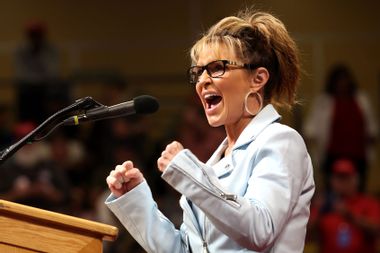
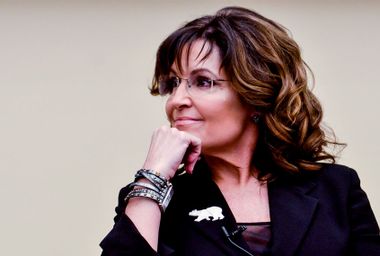
Sarah Palin's heavily publicized book tour begins in earnest this Monday, but weeks before, her ghostwritten memoir, Going Rogue: An American Life, had already vaulted into the number one position at Amazon. Warming up for a tour that will take her across Middle America in a bus, Palin tested her lines in a November 7th speech before a crowd of 5,000 anti-abortion activists in Wisconsin. She promptly cited an urban legend as a "disturbing trend," claiming the Treasury Department had moved the phrase "In God We Trust" from presidential dollar coins. (The rumor most likely originated with a 2006 story on the far-right website WorldNetDaily.)
In fact, a suggested alteration in its position on the coin was shot down in 2007 after pressure from Democratic Senator Robert Byrd. Nonetheless, Palin did not hesitate to take up this "controversy," however false, since it conveniently pits a tyrannical, God-destroying, secular big government against humble God-fearing folk. In doing so, of course, she presented herself as this nation's leading defender of the faith.
In a Republican Party hoping to rebound in 2010 on the strength of a newly energized and ideologically aroused conservative grassroots, Palin's influence is now unparalleled. Through her Facebook page, she was the one who pushed the rumor of "death panels" into the national healthcare debate, prompting the White House to issue a series of defensive responses. Unfazed by its absurdity, she repeated the charge in her recent speech in Wisconsin. In a special congressional election in New York's 23rd congressional district, Palin's endorsement of Doug Hoffman, an unknown far-right third-party candidate, helped force a popular moderate Republican politician, Dede Scozzafava, from the race. In the end, Palin's ideological purge in upstate New York led to an improbable Democratic victory, the first in that GOP-heavy district in more than 100 years.
Though the ideological purge may have backfired, Palin's participation in it magnified her influence in the party. In a telling sign of this, Congressman Mark Kirk, a pro-choice Republican from the posh suburban North Shore of Chicago, running for the Senate in Illinois, issued an anxious call for Palin's support while she campaigned for Hoffman. According to a Kirk campaign memo, the candidate was terrified that Palin would be asked about his candidacy during her scheduled appearance on the Chicago-based Oprah Winfrey Show later this month -- the kick-off for her book tour -- and would not react enthusiastically. With $2.3 million in campaign cash and no viable primary challengers, Kirk was still desperate to avoid Palin-backed attacks from his right flank, however hypothetical they might be.
"She's gangbusters!" a leading conservative radio host exclaimed to me. "There is nobody in the Republican Party who can raise money like her or top her name recognition."
During the 2008 presidential race, some Republican Party elders warned of Palin's destructive influence. They insisted she was a polarizing figure whose extremism would accelerate the Party's slide toward the political and cultural margins. New York Times columnist David Brooks, a card-carrying neocon who had written glowingly of Senator John McCain, claimed Palin represented "a fatal cancer to the Republican Party." Peggy Noonan, a former speechwriter for President Reagan and columnist for the Wall Street Journal, blasted Palin as "a dope and unqualified from the start." Last June, Steve Schmidt, the former McCain campaign chief of staff, warned that Palin's nomination as the GOP's 2012 presidential nominee would be "catastrophic."
New polling data appears to support such doomsday prophecies. According to an October 19th Gallup poll, the former governor of Alaska has become one of the most polarizing and unpopular politicians in the country. Since she quit the governorship to pursue her lucrative book deal, a move that upset many in Alaska's Republican leadership and cost the state's taxpayers almost $200,000, her unfavorability rating has spiked to 50 percent while her favorability has sunk to 40 percent, again according to Gallup's figures. (The only nationally-known politician who is less popular right now, according to the poll, is John Edwards, the former one-term senator who fathered a child out of wedlock and paid his mistress hush money while campaigning for the Democratic presidential nomination on a social justice platform.)
Queen Esther
If Palin is indeed a cancer on the GOP, why can't the Republican establishment retire her to a quiet life of moose hunting in the political wilderness? Why has her appeal only increased in the wake of her catastrophic political expeditions? Why won't she listen to, or abide by, conventional political wisdom?
The answer lies beyond the realm of polls and punditry in the political psychology of the movement that animates and, to a great degree, controls, the Republican grassroots -- a uniquely evangelical subculture defined by the personal crises of its believers and their perceived persecution at the hands of cosmopolitan elites.
By emphasizing her own crises and her victimization by the "liberal media," Palin has established an invisible, indissoluble bond with adherents of that subculture -- so visceral it transcends any rational political analysis. As a result, her career has become a vehicle through which the right-wing evangelical movement feels it can express its deepest identity in opposition both to secular society and to its representatives in the Obama White House. Palin is perceived by its leaders -- and followers -- not as another cynical politician or even as a self-promoting celebrity, but as a kind of magical helper, the God-fearing glamour girl who parachuted into their backwater towns to lift them from the drudgery of everyday life, assuring them that they represented the "Real America."
If McCain had taken his preferred choice for a running mate in 2008, he would have chosen Joseph Lieberman, the turncoat Democrat and his best friend in the Senate. But with the base of the Republican Party subsumed by a Christian right that detested the senator, his advisors urged him to choose the untested, virtually unknown Alaskan governor to bring the faithful back to him. Their gamble paid off -- at least in the short-term. When Palin was revealed as the vice presidential nominee at an off-the-record gathering of the Council for National Policy, a secretive cabal of the conservative movement's top financiers and activists, Tom Minnery of the Christian right outfit Focus on the Family recalled, "People were on their seats applauding cheering, yelling… that room was electrified."
Before her nomination, the provincial Palin had traveled outside the country only once and demonstrated little, if any, intellectual curiosity. During the campaign, she was flummoxed when CBS Evening News anchor Katie Couric simply asked what magazines she read. Yet the fact that she had such a limited understanding of the world actually recommended her to the Republican base.
The gun-toting, snowmobile-cruising former beauty queen became an instant cultural icon. Little understood by those outside this culture was her religious worldview, cultivated during the 20 years she spent worshipping at the Wasilla Assembly of God, a right-wing Pentecostal church in her hometown north of Anchorage. When I visited the church in October 2008, a pastor from Kenya, Bishop Thomas Muthee, was at the podium comparing Palin to Queen Esther, the biblical queen who used her wiles to intercede for her people. The reference was clear enough: Palin, the former beauty pageant contestant who had chosen Esther as her biblical role model when she first entered politics, would topple America's secular tyrants, leading her people, the true Christians, into the kingdom. As he concluded his sermon, Muthee gesticulated wildly and spoke in tongues, urging parishioners to "come against the spirit of witchcraft as the body of Christ."
Three years earlier, in 2005, Muthee had anointed Palin during a public ceremony at the Wasilla Assembly of God, laying his hand on her forehead while praying to protect her "against all forms of witchcraft." The bishop claimed that he had personally battled a witch in his hometown of Kiambu, Kenya, driving the evildoer from the town and thereby ending an epidemic of crime and licentiousness. The episode was later revealed as a farce by a reporter from Women's eNews who traveled to Kiambu and found the supposed witch, a local healer named Mama Jane, still living happily in her compound. In palling around with Muthee, whom she credited with helping propel her into the governor's mansion by anointing her, Palin revealed herself as an authentic religious zealot. Whatever her flaws might have been, this was what mattered to the movement in 2008 -- and what matters now.
Once Palin was nominated, her sixteen-year-old daughter Bristol (named for Bristol Bay, Alaska) became the subject of ferocious media scrutiny. She had, it turned out, been impregnated by Levi Johnston, a local eighteen-year-old jock who identified himself on his MySpace page as "a f**kin' redneck." To media outsiders, Bristol's out-of-wedlock pregnancy was particularly startling, given Palin's advocacy of abstinence-only education. In the eyes of many liberals, Palin had been revealed as but another family-values hypocrite, but to members of the Christian right, she was something quite different -- a glamorized version of themselves. As the Palin family became a staple of late-night comedy monologues, Palin fought back against the secular enemy, slamming David Letterman for "sexually perverted jokes" about her daughter. With that, the movement's adulation for her overflowed.
The culture of personal crisis
Palin's daughter's drama caught vividly a culture of personal crisis that defines so many evangelical communities across the country. That culture is described in a landmark congressionally funded study of adolescent behavior, Add Health, revealing that white evangelical women like Bristol Palin lose their virginity, on average, at age 16 -- earlier, that is, than any group except black Protestants.
Another recent study by sociologists Peter Bearman and Hannah Bruckner notes that over half of evangelical girls who have pledged to maintain their virginity until marriage wind up having sex before marriage, and with a man other than their future husband. Bearman and Bruckner also disclose that communities with the highest population of girls who attend so-called purity balls, where they vow chastity until marriage before their fathers in a prom-like religious ceremony, also have some of the country's highest rates of sexually transmitted diseases. In Lubbock, Texas, where abstinence education has been mandated since 1995, the rate of gonorrhea is now double the national average, while teen pregnancy has spiked to the highest levels in the state.
"So many families deal with the same issues Sarah Palin is dealing with, so we really can relate to what she is going through," Grace Van Diest, a middle-aged Alaskan delegate from Wasilla, told me on the floor of the 2008 Republican National Convention. Van Diest then described how each of her daughters went on "a date with their dad" to discuss their pledge to "keep themselves pure until marriage."
Palin consolidated her bond with the movement in another very personal way. She cradled her new son Trig, born with Downs Syndrome, before the klieg lights. Her husband Todd had chosen the name believing it was Norse for "strength." ("Trygg" actually means "safe" or "reliable" in Norwegian.) Palin's decision to carry the baby to term excited many evangelicals and anti-abortion activists, including James Dobson, who wrote a letter congratulating her for having what he called "that little Downs Syndrome baby." "What a way to emphasize your pro-life leanings there!" he exclaimed during a radio broadcast in which he endorsed the McCain-Palin ticket, even though he had denounced McCain as a "liberal" only weeks before.
After the market collapsed in the fall of 2008 and the McCain campaign ran off the rails, Palin untethered herself -- as her book title has it, she went "rogue" -- ignoring McCain's rules on attacking Obama. Instead, she lashed out at candidate Obama in her own distinctive way. "This is a man who launched his political career in the living room of a domestic terrorist," she insisted. "This is not a man who sees America the way you and I see America." With these two lines, apparently uttered without the permission of McCain or his top aides, Palin opened up a deep schism within the campaign, while unleashing a flood of emotions from the depths of the Party faithful.
"Kill him!" a man shouted at a campaign rally in Clearwater, Florida, when Palin linked Obama to terrorism, according to Washington Post reporter Dana Milbank.
The next time she mentioned Obama, another man cried out, "Terrorist!" "Treason!"
"Go back to Kenya!" a woman typically screamed during a Palin rally in Des Moines, Iowa.
While Obama entertained visions of a blissful post-partisan, post-racial America, Palin almost single-handedly gave birth to the birthers who would, after his inauguration, dedicate themselves to proving he was not, by birth, an American. By "going rogue," Palin instinctively and craftily propelled her ambitions beyond Election Day, and so anointed herself as the movement's magical helper in the Obama era.
Elevated by yesterday's man, Palin now represents her Party's future -- and the greatest danger it faces. Her intimate bond with the Republican grassroots has made her the indispensable woman, even if she provokes a visceral sense of revulsion from many independents and moderates. Other Republican frontrunners like former Massachusetts Governor Mitt Romney and Minnesota Governor Tim Pawlenty have a debilitating problem to face in any race for the presidency: they are viewed as inauthentic candidates by the movement -- cardboard men in suits who are only pantomiming appeals to cultural resentment.
Mike Huckabee, an ordained Baptist minister who understands the nuances of evangelical culture, nonetheless bears the burden of being a 2008 primary loser. At that time, the former governor of Arkansas had a clear field when it came to the religious right, but was unable to expand beyond his Southern bastions of support.
Palin was, after all, chosen. She never lost a primary -- and it was McCain who lost the race. If Huckabee sought to run again for the nomination, he might have to compete against her for the allegiance of the evangelical constituency.
Nor can she be easily criticized. Palin is so well positioned as the darling of the movement that any criticism of her would be experienced by believers as a personal attack on them. In this way, their identification with her through the politics of personal crisis is complete. Any Republican primary challenger assailing Palin will be seen as victimizing her, as channeling the attacks of the liberal elites, and possibly as having a secret liberal agenda. On the other hand, to embrace her is to risk losing the great American center.
For the 2010 mid-term elections, Palin's endorsement is already a coveted commodity -- as Mark Kirk's desperate bid to secure it demonstrates. The more she is attacked, the more the Republican base adores her. As she sets out on her book tour, the slings and arrows of outrageous fortune only propel her forward. Her influence on a party largely devoid of leadership is expanding. If she doesn't prove to be the Party's future queen, she may have positioned herself to be its future king-maker -- and potentially its destroyer. You betcha.
Sarah Palin’s ascent, not unlike Barack Obama’s, is an American story. The hockey mom becomes the mayor who becomes the governor who becomes the national candidate. She’s a folkloric character: Annie Oakley, Horatio Alger and Gatsby in one. Even her florid self-mythologizing is an accepted cultural tradition. She is the girl from the sticks who made it big. She is a pragmatic, can-do feminist who’s convinced, as she told Oprah, that an American woman can have it all but that “some things might have to be put on the back burner.” Say what you want about Palin or her positions (and, in the past, I have), it takes scrappiness and guts to strike back at the old-boys' network that anointed you by publishing a book, so soon after the campaign, detailing your frustrations and disillusionments. We might want to take a long breath before discounting her. As Gwen Ifill recently said on "This Week": “You can not underestimate the degree that women will be drawn to her story.” We don’t hear many real-life fairy-tales of American female success, which makes the few that exist intrinsically compelling.
But Sarah Palin’s story is also peculiarly modern and culturally apt in another, more unsettling way. As the vice-presidential candidate, she showed, despite her postgame spin, little real knowledge of matters non-Alaskan, and at least for the span of the campaign, she didn’t seem bent on acquiring much more. Her current desire for visibility, the motives for which remain unclear, suits our age of reality television, this moment in American life when fame for fame’s sake is the ultimate goal. One might argue that Palin’s ambition, which some have branded simple narcissism, allowed her to forget her own unreadiness for the presidency and accept the nomination in the first place.
Yet in her interviews the past two days with Oprah and Barbara Walters, Palin seemed wiser and more seasoned than she was just one year ago. It wasn’t only that she looked older, the creases around her mouth having deepened, it was also that, no longer under the shadow of McCain and his handlers, she came off as natural, confident, good-humored and even, at times, articulate. Though her tendency to ramble persisted, she wasn’t as awkward and garbled as in the past. She was also disarmingly honest. “It was easy to understand why a woman would feel that it's easier to just do away with some less-than-ideal circumstances, to do away with the problem,” she told Oprah, about the soul-searching she underwent on learning that Trig would be born with Down syndrome. And about that fateful interview with Katie Couric, she noted, "Of course, I’m thinking, 'If you thought that was a good interview, I don’t know what a bad interview was.’” Watching her — though I may be nearly alone here — it was almost possible to buy the narrative that McCain’s advisors, in their contempt for her, genuinely threw her off her game and then, by silencing her, conveyed the sense she shouldn’t have tried to play at all. Or at least it was possible to understand why many Palin supporters believe this. It even seemed plausible that her risible cocktail of big words and folk sayings was an attempt to ape political rhetoric that she wasn’t trained in and found intimidating. Maybe, in an earnest, rushed attempt to jam together a highfalutin idiom, to sound like the politicians on TV rather than the one she happened to be, she scrambled her own persona.
After all, as the populist governor of a state whose voters respond to plainspoken directness, she suddenly found herself a national figure addressing big-media sophisticates. She was given about seven seconds to learn her role and then, after eight seconds, patronized and mocked. The reasons she performed so poorly are the very reasons her fan base loves her. If, over the next three years, her performance improves as much as it appears to have in just the last year, the conventional rap about her rustic idiocy may come off as mean-spirited and archaic. Her foes might be wise to contemplate the notion that someone of Palin’s background and sensibilities has a right, regardless of her views, to participate in the national debate merely because she speaks (though often unclearly) for many like her. If this possibility can’t be countenanced, then government for the people by the people is an abstract idea we’ve grown too cynical to practice. Sarah Palin endures not because she’s brilliant, smooth or philosophically correct, but because hope in democracy endures, too.
Now hold your horses, you snarky, lefty, NPR-listening, New York Times-subscribing readers of Salon. I haven't jumped ship to declare Sarah Palin herself "great." I'm from California, after all; I am not a creationist, I am not pro-life, I have never shot a moose. Nor is my culinary specialty an Alaskan dish called "moose chili." Here on the Left Coast, along with our hummus, we prefer "turkey chili," which is perhaps less gamey and lower in fat but in the end, I ask you, is it really more humane? (Who killed the turkey? Was it a person or a corporation? This Trader Joe's we speak of -- is he union? Is his name actually "Joe"? And what is his relation to Big Oil's manipulation of the rising price of Bristol Bay canned fishery salmon to 27 cents a pound?) These are the complexities one ponders at night while falling asleep under the gristly if at times oddly tasty caribou stew that is Sarah Palin's new 400-plus-page memoir.
If I am giving Palin's book a thumbs up, it is qualified by the fact that, let's face it, the genre of the female political autobiography is itself in its infancy. It's like some 53rd state, housing at this moment in time only a handful of crude, wooden, lean-to outposts. These are times when former Secretary of State Madeleine Albright can do a book tour based on her pins and brooches, about which "Morning Edition's" Susan Stamberg will huskily midwife a most empathic and unironic discussion. These are times when Nancy Pelosi comes out with a memoir slender as a Hallmark card, a memoir no living person but me has apparently read, vaguely titled "Know Your Power: A Message to America's Daughters," which her publishers carefully deemed ("How shall we describe this?") a "keepsake." Then again, one understands why female political books tend toward focus group-approved mottos and tasteful brooches -- women have not been in politics for very long and, even more than the men in this rabid age, if they dare utter an opinion or take a stand, they and, weirdly, also their children get media-raped and shredded. (One curious triangulation in Palin's book is irritation with Obama's and Biden's relatively easy media rides coupled with unexpected sympathy for media-slogfested Hillary Clinton. Our bodies, ourselves! "Clinton-Palin in 2012!" Can you imagine? Neither can I.)
So what's refreshing is that Palin seems unafraid to express herself, warts and all -- informal campaign motto: "Heels on! Gloves off!" -- and the book just goes where it goes. Much has already been made of her freewheeling critiques, not just of Democrats but also of Republican Party insiders and McCain 2008 campaign managers, particularly in the gloomy waning days of the run. ("Schmidt leveled his eyes at me. 'We don't have the money Obama does and the numbers don't look good. We've got to change things up.' I AGREE. I was eager to hear a new strategy. 'So,' he continued, 'headquarters is flying in a nutritionist.'" Ba-dump-bump!) She is forthcoming enough about her personal failings. Belying her shellacked outer shell, more reminiscent to me of Anita Bryant than Tina Fey, Palin confesses a not-ready-for-prime-time horror at Trig's Down syndrome diagnosis and relates at least one fairly satisfying campaign trail fight with husband Todd. As opposed to Bush's post-Yale reinvention of himself as a Texas cowboy, Palin doesn't seem to be making this folksy stuff up. And really, who would want to? While courting Palin as a teen, Todd gave her "gold nugget earrings"; with only one phone line in the house, she and Todd yapped at night on their back porches on fishing boat radios, until they realized every commercial trucker trundling through town could hear them; the wedding rings were each $35, the post-nuptial dinner was at Wendy's. All this in the town of Wasilla, which, due to stratospheric sales of this particular product, Wal-Mart has deemed "the Duct Tape capital of the world."
In Palin's "Little House on the Tundra" (her own coinage), the very state of Alaska seems to have its own sound, its own language, its own quaint patois. There are so many more colorful sayings than that "pit bull with lipstick" quip! Things grow "faster than fireweed in July"; bench warming during sports games is known as "riding the pine." Alaskan history itself seems to be rich, so very rich in ... the letter K. "The year before Jack London arrived, Skookum Jim Mason and Dawson Charlie met up in the Yukon Territory east of the Alaska border with a gold miner who had been panning near the Klondike River," reads one particularly chunky sentence. Decades later, that same territory might be crossed by a winning Iditarod dog team, whose members had endearing names like Hobo, Lippy and Fudge! There is the truly startling tale of their neighbor Doc. A private bush pilot, he was electrocuted and fell off a ladder while hand-draping fluorescent flagging over power lines so he could more safely land his Citabria at home. Never one to give up, after the accident Doc "retrained himself to be a left-handed, one-armed dentist"! Writes Palin of her huntin' dad (who is known for palming balmy, just-removed moose eyeballs and warming fish eggs in his mouth), "So a lot of what Alaskans ate, we raised or hunted: moose, caribou, ptarmigan, and ducks. Dad and his friends became their own small-game taxidermists. Even today, my parents' living room looks like a natural history museum. And when an earthquake hits, Dad can tell the magnitude by how fast the tail wags on the stuffed cougar." As Frontier literature, I believe "Going Rogue" compares favorably to the Natty Bumpo stories of James Fenimore Cooper. And who wants to argue with me?
Indeed, by the end of this book, I thought, Never mind the hundreds of thousands of reasons the fiery Republican femme fatale is hated in, for instance, my oh-so-blue state of California. Honestly, a fair amount of what makes Sarah Palin weird is the very same stuff that makes Alaska weird. Covering one-fifth of continental North America (as Palin points out), Alaska is baffling. Alaska is ungraspable. Recall Jon Krakauer's descriptions of Alaska in "Into the Wild." On the one hand, a Palin quip about her favorite natural "organic protein" seems calculated to inflame PETA: "I love meat. I eat pork chops, thick bacon burgers, and the seared fatty edges of a medium-well-done steak. But I especially love moose and caribou. I always remind people from outside our state that there's plenty of room for all Alaska's animals -- right next to the mashed potatoes."
On the other hand, in Alaska it appears people really do eat what they hunt. They hunt in Alaska, they do: Wind chill drops to minus 60, there's no main thruway to Juneau, wolves are predators, they kill moose and caribou, so hunters shoot them, half are Native Americans, people get their heads lopped off in snowmobile accidents, oil spills destroy fisheries, thousands of jobs depend on natural pipelines, stuffed cougar tails shake in giant earthquakes, there are halibut tacos, God knows.
So when Palin writes: "The spirit of Alaska is unique, combining awe for the untamed majesty of nature, a rugged individualism, and strong traditions of mutual aid," what can you do but shrug and grudgingly concur? Sarah Palin is Alaska. She is Alaskan. (I almost bouncily want to write "AlasCan!") As for the next chapter, look for new brooches, at least in 2012.
Sarah Palin fans began gathering late Monday night for a book signing that wouldn't begin until 6 o'clock Tuesday evening. The signing fell during Michigan's two most sacred weeks -- firearm deer season. So Ken Bellhorn left his hunting camp at 1 a.m., and showed up at the Barnes & Noble in Woodland Mall still dressed in an orange camo jacket, a John Deere T-shirt, and hunting boots. He got there early enough to claim one of the 940 wristbands that guaranteed him an autographed copy.
"I already shot a small buck, but this'll be a bigger trophy," said Bellhorn, who was laid off last year from his job at a plastics firm that supplies the auto industry, and has spent some of his free time attending tea party rallies. "I think when Reagan was in office, he saved us from ourselves, and I think she's got the character and the morals to do the same thing."
Sarah Palin seemed to have an affinity with Greater Grand Rapids that she may not find anywhere else on her 31-city tour. West Michigan fits both sides of the Palin persona -- the antiabortion creationist and the moose-skinning hockey mom. It's a northern exclave of the Bible Belt, with one of the highest churchgoing rates in the nation. But unlike the rest of the Bible Belt, it's a place of deep snowfalls, ice rinks and bars with more Ski-Doos than pickups parked outside on a January night.
(In "Going Rogue," Palin thanks a Grand Rapids family for hosting her son Track during a hockey tournament.)
"There's a bond of northern women," said Jacquelyn Krug, a mother of five from Battle Creek. "She knows how to hack a winter."
Krug was waiting outside the store when the Going Rogue Express -- an enormous blue bus with a photo of Palin standing in front of a mountain landscape -- began circling the parking lot, to chants of "Sarah! Sarah!"
Palin stepped out, holding her infant son, Trig. She stepped onto a stage surrounded by red velvet ropes, then handed the baby off to an aide.
"Thank you so much for showin' up!" she crooned. "First stop on the tour. There's just somethin' about Michigan. I couldn't wait to get back to Michigan. Alaska and Michigan have so much in common, with the huntin' and the fishin' and the hockey moms and just the hardworking patriotic Americans who are here. This is the heart of industry in our country, and I would like to see for this heart of industry for you all to just see a revitalization of your economy, and to be able to see really some remarkable things happen in this part of our land, and I anticipate that good things are going to happen here."
"Palin power! 2012!" someone shouted.
"Tell the truth, Andrea Mitchell!" someone else cried -- a challenge to the NBC reporter who was broadcasting from the store.
After Palin went inside, people took turns posing for photos next to the bus, as though it were Mount Rushmore on wheels. Tomas Ojeda, a former Marine from Grand Rapids, held an American flag and a copy of "Going Rogue." He opened the cover of his book to show off a pencil sketch of a pit bull, drawn by his daughter.
"I yelled, ‘Get your pit bull on' when I saw her," he explained.
In her short speech, Palin had promised that buyers of "Going Rogue" could "read my own words -- unfiltered." If there were two common sentiments in the thousand-person line inside the mall, they were: resentment of the news media for its unfair treatment of Palin, and eagerness to use the news media to air that resentment.
Doug Till of Kalamazoo was wearing a T-shirt that identified him as a member of the Southwest Michigan Tea Party Patriots. I told him I was from Salon.
"The enemy!" he said jovially. Then he talked to me for 10 minutes, breaking off only to run to the other side of the rope line and engage a reporter for an Alaska newspaper.
"We're here because we want to show support for Sarah Palin, because we want to show her words," Till said. "She's Middle America. She's our values. When they're attacking her, they're attacking us. If they would have interrogated Barack Obama and Joe Biden as much as they did Palin, the election would have been a lot closer."
Till was glad to see Palin in Michigan, a state that had been "abandoned" by the Republican establishment. And he was glad the national cable channels had followed her here.
"I wonder if MSNBC and CNN will listen to us now," he said.
Palin sat in front of a blue screen on the second floor, scrawling "Sarah" in book after book, while country music blasted from a speaker. (The "Going Rogue" soundtrack: "Independence Day," by Martina McBride; "These Are My People," by Rodney Atkins; "How Do You Like Me Now?" by Toby Keith; and, natch, "Shuttin' Detroit Down," by John Rich.)
Jacquelyn Krug's daughter, Annalisa, got into line without a wristband, because she was wearing her Air Force ROTC uniform.
"I can't wait for you to commission me in the Air Force when you're president," Annalisa Krug told Palin. "You inspired me to join the Air Force."
"It's such an honor to hear you say that, and that you've committed to serving our country," Palin replied, sounding both pleased and taken aback.
Randy Cotton of Kentwood walked down the escalator carrying two copies of "Going Rogue." The night before, he had attended a Mike Huckabee book signing at a store just down 28th Street. It was nothing like the Palinageddon that hit Barnes & Noble on Tuesday.
"This crowd was definitely by far bigger in size," Cotton said. "I spoke to people yesterday who didn't know Huckabee was going to be there until they came in to buy the book."
The last time Grand Rapids saw a line this long, it was for another Republican, though not one Palin has to worry about facing in 2012. When Gerald Ford's casket was brought home, Grand Rapidians waited five hours in the cold to pay their respects. (Ford is buried at his museum, a pretty colorful memorial to a pretty colorless guy, with a Pet Rock, a glitter ball, and other mementos from the disco era that defined his presidency.) Ford belonged to a different Republican epoch: He was pro-choice, pro-ERA, and named Nelson Rockefeller his vice-president. He was the last representative of the moderate, Midwestern Republicanism that was upended by Ronald Reagan, in whose footsteps Palin is trying to follow.
Grand Rapids proper still enjoys the middle of the road. The city narrowly voted for Obama last year. But the surrounding region may be Palin country. West Michigan is, by far, the most conservative part of the state. It was settled by Dutch Calvinists, members of one of the country's most Republican ethnic groups. (Amsterdam may be so libertine because all the religious folks moved to Michigan.) A Republican has to do well in West Michigan to carry the state. But a Republican too closely identified with the area usually loses. Detroiters think West Michigan is sanctimonious. As a result, it has never produced a governor.
That, in a nutshell, is the problem Palin faces with America. On the back of the Going Rogue Express is a list of her book tour stops. Like Grand Rapids, most are medium-size cities in what Palin considers the "real America." She'll be signing books in Sioux Falls, S.D., Roanoke, Va., and Birmingham, Ala. She won't be signing books in New York, Chicago -- or Detroit. Those are capitals of the fake America. But the fake America elected Obama. The fake America has more votes than the real America, and it's turned off by candidates who cloak themselves in small-town values, while insisting those values are superior to big-city ways.
Palin puts on a terrific political show. Her book signings are worth the $28.99. Only Barack Obama inspires as much fervor among his followers. Except for a few nuts like a Yankee Bubba in the "Jesus Beat the Devil With an Ugly Stick" T-shirt, Palin's disciples are earnest and patriotic. But she'll likely stay a genre superstar, like the country musicians she plays at her rallies. She can sell libraries full of books that way, and she can even start a political movement, but she probably can't cross over to the White House.
Palin fan Doug Till hopes media doubters are wrong about that. He had two objectives for his encounter with Palin: He wanted to ask her to attend a fundraiser for his tea party organization. And he wanted to show her a framed photo of his 8-year-old granddaughter sitting astride a bear she had shot in the Upper Peninsula.
Spotting Till's tea party shirt, Palin said, "You're doing a great job. Keep it up." And though he wasn't allowed to bring the photo to the signing table, Palin had been told the story of Kailey's bear hunt.
"Oh, you're my hero," Palin said, shaking the girl's hand.
"You rock," Kailey responded. "I want to be just like you."
CEDAR CREEK, Texas -- Republican governors gathered outside Austin Wednesday to crow about their two newest colleagues in Virginia and New Jersey. But one of their newest ex-colleagues was also busy Wednesday, kicking off her book tour. And like anywhere in politics lately, Sarah Palin was inescapable at the Republican Governors Association meeting.
Both of the GOP candidates who won gubernatorial elections this month, Bob McDonnell in Virginia and Chris Christie in New Jersey, had avoided Palin during their campaigns. And yet the crowd she drew for a book event in Grand Rapids, Mich., made it clear that Republicans can't really afford to alienate her supporters. So McDonnell and Christie offered some wan excuses for why they hadn't embraced Wasilla High School's most famous alumna as they sought office.
"The people I asked to come in to campaign for me were either someone like Mayor [Rudy] Giuliani, who I had known for the better part of a decade, or two governors who had faced the same kind of things and could talk about those issues in an intelligent way to show how Republican ideas had fixed those fiscal problems in their states," Christie said. Those two governors were Mitt Romney, the ex-governor of Massachusetts, and Minnesota's Tim Pawlenty. Presumably, Christie didn't mean to imply that Palin wouldn't have been able to talk about issues in an intelligent way.
McDonnell said it was just a matter of the schedule. "She was in such incredible demand, frankly, for the longest time we were just not able to work out anything for her to come in," he said. "And then, after she decided to leave office [in July], we had pretty much already arranged all of the folks that we had for the home stretch for fundraisers -- including several current and former governors -- so we pretty much had our strategy set at that point." Because, you know, campaigns tend to plan everything out months in advance and not make any last-minute additions to the schedule once it's set.
The RGA, though, isn't above using Palin to raise money, even if its newest members were a little wary of how the independent voters they were trying to appeal to would respond to her. Mississippi Gov. Haley Barbour, the group's chairman, told reporters Tuesday that the RGA was happy to accept Palin's offer to sell them a number of copies of her new book, "Going Rogue," at a discounted price -- the better to auction them off to donors with.
First, let me apologize for telling you all I had Palin fatigue on Monday, and then following up by writing about Palin the next two days. I kept one promise; I've kept the term Palinpalooza out of our news coverage.
But the Palin assault keeps getting more surreal, and more intriguing. Wednesday night came the news that Palin wouldn't rule out the idea of Fox News host (and professional paranoid) Glenn Beck as a possible 2012 running mate.
Newsmax reporter David Patten says Palin "chuckled" when he broached the idea, but then gave Beck his props:
"I can envision a couple of different combinations, if ever I were to be in a position to really even seriously consider running for anything in the future, and I'm not there yet," Palin told Newsmax. "But Glenn Beck I have great respect for. He's a hoot. He gets his message across in such a clever way. And he's so bold — I have to respect that. He calls it like he sees it, and he's very, very, very effective."
Once again, I agree with Palin: Beck is indeed a "hoot" and he's very, very, very effective, at lying about President Obama and whipping his paranoid base into a deluded frenzy. So what is she doing: trying to sell books to that same base -- a nice potential book market but a sliver of the electorate -- or genuinely charting her 2012 course?
Judging by Palin's erratic behavior on this book tour, and her erratic handle on the truth within the book, it's honestly hard to tell. I think, as I said Monday, she is first and foremost about Sarah Palin Inc., becoming rich and powerful, but that may well be a path to Sarah Palin 2012. I will say it again: She will never be our president. But I can't rule out her being the 2012 Republican nominee.
When you look at the charisma-free roster of likely GOP candidates -- from 2008 has-beens Mitt Romney, Mike Huckabee and "I was for trying terrorists in NYC before I was against it" Rudy Giuliani, to that hunka-hunka burning boredom Tim "T-Paw" Pawlenty -- it's easy to see Palin creaming them. On the other hand, they might spend a lot on opposition research and/or get whatever Levi Johnston claims to have. Either way, the only person I see derailing Palin from the GOP nomination in 2012 is Palin herself.
And that's still quite possible. Whether you seriously care about policy or politics, she's a train wreck. I doubt she's silly enough to seriously consider someone as deranged as Glenn Beck as her running mate; I give her enough credit to assume that was just chicken-fried red meat for her base. But just look at her soliloquy on why her hateful and false claims about "death panels" are just like Ronald Reagan's rhetoric about the Soviet Union as an "evil empire." Here's what she told ABC's Barbara Walters, in all its syntactical, self-deluding glory. She admitted there are no death panels in Obama's plans, but goes on:
"It's kind of like what Reagan used to do, though, when he talked about, say, the ‘evil empire.' You're never going to find the evil empire on a map of the world ... And yet he talked about that, in terms that people could understand -- kind of rationing down, not complicating the issue. [Just a question, does she mean "ratcheting down?" My head hurts.]
"But he, with the issue of the evil empire at the time, used those two words to get people to shake up, wake up, find out what's going on here. Now, had he been criticized and, and mocked, and, and condemned for ever using a term that wasn't actually there on a map, or in documents, we probably would never have succeeded in, in crushing the evil empire, and winning that."
Dear Baby Jesus, where should I start? First of all, let me defend Ronald Reagan (despite global warming, hell keeps freezing over!): He did not mean the Soviet Union was literally an "evil empire" you could find on a map. It was his opinion, a turn of phrase, and well within the bounds of political rhetoric; there were many evil things about the way Soviet leaders treated dissidents, Jews, minorities, anyone who dared to differ from their dreary party line. So Palin's wrong in the way she depicts Reagan's "evil empire" argument.
Of course she's also wrong about the way the political world greeted that argument. Reagan was, in fact, widely "criticized" and "condemned" and probably even mocked for using the term; many people felt it wasn't the best way to keep peace with the Soviet Union and win them over to our side -- especially since there was a lot of evidence the Communist giant was crumbling even before Reagan's rhetorical assault (at least partly because of its Afghanistan folly; Palin's advisors might want to mention that to her!). Sunny Ronald Reagan shrugged off such criticism; Sarah Palin laps up the bile and turns into a victim and of course a self-described "pit bull," albeit with lovely lip gloss.
Whatever! Palin's book tour will be a political success; her book will sell and make her the money she brags she's never had. And Palin may well be the 2012 GOP nominee. But as she cozies up to Glenn Beck and mangles even her own party's history, it's increasingly clear she will never be our president. But trust me: She and her know-little followers will cause trouble for President Obama and the Democrats for the foreseeable future.
Here's a great video of MSNBC's Norah O'Donnell trying to ask Palin supporters in Grand Rapids, Mich., on Wednesday what she believes in. They get her position on TARP wrong (she supported it) and two of them just lapse into paranoid right-wing ranting about how she'll defend the Constitution. Nice to see O'Donnell asking real questions; scary to see how they're answered:
Sen. John McCain, R-Ariz., has been facing a conundrum lately: Sarah Palin's new book is filled with explicit criticism of his campaign staff, and in some cases even implicit criticism of him personally. But it wouldn't look good for him to lock horns with her publicly, and the Republican base clearly favors Palin anyway. Last week, McCain reportedly asked former senior staffers not to publicly respond to her charges.
On Wednesday, though, McCain gave an interview to Reuters in which he stepped up to defend the men and women who'd worked for him who are now being slammed by Palin.
"There's been a lot of dust flying around in the last few days and I just wanted to mention that I have the highest regard for Steve Schmidt and Nicolle Wallace and the rest of the team, McCain said. "I appreciated all the hard work and everything they did to help the campaign .... I think it's just time to move on."
Wallace in particular has been a favorite scapegoat for Palin and her supporters, and Schmidt got perhaps the harshest treatment of anyone in "Going Rogue."
McCain did have nice things to say about Palin. "I'm still really proud of her and the campaign she ran and I think it's pretty obvious that she has a substantial base and interest out there," McCain told Reuters.