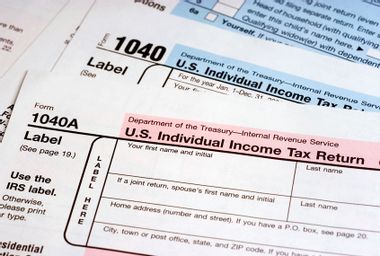
Here's the latest bold new idea for reconciling the costs of national defense with the need to avoid adding to federal deficits or raising taxes. A bipartisan coalition of "New Democrats" and moderate Republicans has proposed buying weapons for the U.S. military through the IRS rather than the Pentagon. Here's how it would work. Instead of being paid to deliver planes, missiles and tanks, defense contractors would receive "weapon supply tax credits" (WSTC). The defense contractors would be able to reduce the taxes they owed the federal government by the prices of the weapons they delivered. Because the tax credit would be refundable, if the prices exceeded a firm's annual tax liability, the IRS would send a check to the firm in the amount of the difference. In this way, the federal government could finance a massive military buildup -- and because tax credits aren't counted as part of the federal budget, for official purposes the cost of the buildup would be zero!
I had you going there for a minute, didn't I? The "weapons supply tax credit" is a joke. It was proposed some years ago by the late David Bradford, a Princeton economist who worked in the Ford and George H.W. Bush administrations. Bradford's purpose was to ridicule the growing reliance of Congresses and presidents on tax credits and other so-called tax expenditures as an alternative to ordinary spending programs funded by ordinary taxes.
The weapons supply tax credit is no crazier than the major tax expenditures that shape -- no, make that disfigure -- the political economy of early 21st century America. Instead of raising taxes to pay for universal healthcare, as many other nations do, the federal government grants a $250 billion a year tax break to employers to give them an incentive to buy healthcare for their employees. Hey, that approach really worked out well, didn't it?
And then there's America's biggest antipoverty program, the Earned Income Tax Credit (EITC). By means of the EITC, the federal government "tops up" the wages of full-time workers who are trapped in poverty. Needless to say, this is also a massive subsidy to employers who pay poverty wages to their workers, and to consumers who buy goods and services produced by poverty-wage workers. You'd think the more straightforward approach would be to ensure that anybody who works 40 hours a week doesn't need to rely on welfare, with entry-level public employment mopping up most remaining unemployment. You'd think.
Did I mention the home mortgage interest deduction? This costs the Treasury around $80 billion a year in lost tax revenue that must be paid for by other taxes if it is not to enlarge the deficit. This program, justified on the grounds that it promotes home ownership, in practice showers government subsidies chiefly on rich and upper-middle-class homeowners. Some countries like Canada that lack such a tax expenditure have higher rates of homeownership than the U.S.
The political scientist Christopher Howard calls the tax expenditure system the "hidden welfare state." It might just as well be called the Blob That Ate the Economy. If only non-business subsidies to individuals are counted, the IRS-administered subsidy sector costs around $800 billion a year. That's about 6 percent of U.S. GDP, or about a fifth of the total official expenditure of the federal, state and local governments combined.
To put that number into perspective, according to official figures the U.S. spends about 30 percent of its GDP on government at all levels -- well below the OECD average of around 36 percent and the EU average of about 39 percent. But add in the "dark matter" of tax expenditures, and federal-state-local spending goes up to around 36 percent of GDP -- close to the international average among developed countries and within range of European norms.
This is something that neither liberals nor conservatives are honest about. Liberals like to invoke official spending numbers to claim that the U.S. spends far less on social welfare purposes than other, similar industrial democracies. That implies that there is room for a massive expansion of federal spending on new purposes -- health, environment, education. But as Jacob Hacker has pointed out, when tax expenditures are factored in, U.S. welfare policies absorb far more of the U.S. economy already than many on the left want to admit. Though it is still short of the half of GDP taken by government in the Nordic democracies, the American public sector, when dark matter is included, is pretty close to Western European levels already.
But conservatives have no reason to gloat about the discovery of the tax-expenditure dark matter -- not if they believe their own rhetoric about free markets and free enterprise. The truth is that tax expenditures warp the market and corrupt private enterprise.
In a mixed economy like that of the U.S. from the Depression until the 1980s, there is a division of labor among well-defined sectors. The government provides public goods -- sometimes directly, as in the case of public K-12 education, and sometimes indirectly, through "state capitalism," by making loans to college students or paying contractors to build roads and bridges. The private sector provides most other goods, from apples to Apples. A limited nonprofit sector made up of universities, hospitals and museums rounds out the mixed economy.
In the new "subsidist" economy that both parties have created in recent decades, the distinctions among public, private and nonprofit sectors are broken down. Government becomes unlimited in ends at the same time that it becomes rigidly limited in means. The means are always the same -- a tax credit that conservatives can describe to their constituents as a "tax cut" and that liberals can describe to their constituents as a spending program. But the ends are unlimited.
Does the annoying nanny-state left want to replace French fries with asparagus spears? Then call for an individual tax credit to encourage healthy eating, and label it a "nudge" in the manner of Richard Thaler and Cass Sunstein. Does the big-government right want to expand healthcare without paying for it? Then call for a tax credit for "medical savings accounts."
Conservatives make little effort to reconcile their libertarian, anti-statist rhetoric with their defense of old subsidies and their call for new ones. For example, they claim to believe that private schools, competing in the market, can deliver better outcomes than public schools. Do they therefore demand for-profit schools that, if they fail, declare bankruptcy and go out of business like stores in a shopping mall? No. They call for government vouchers for private schools. What do government vouchers, paid for by taxpayers, have to do with the "free market" and "free enterprise" and "the private sector"?
Vouchers are also the basis of most conservative healthcare plans. Ironically, the idea of "voucher socialism" as a proposal dates back to certain groups on the left in the early 20th century. Today's "right" consists largely of voucher socialists and apologists for tax breaks for large corporations, banks and insurance companies. To judge by their actions, rather than by their words, most conservatives appear to believe that private enterprise is so congenitally deformed and feeble that it will expire of its own debility unless it is given constant intravenous injections of direct and indirect taxpayer subsidies.
Defeating the Blob may require an alliance of both ends against the middle. When it comes to the subsidy sector, we have a four-party system. Neoliberal New Democrats, like the majority of personnel in the Clinton and Obama administrations, have preferred tax credits to honest spending programs, so they can claim to be in favor of limiting the size of government. Centrist Republicans like tax expenditures for the same reason. The opponents of the ever-expanding subsidy state are found among social democrats on the left and libertarians on the right. Social democrats would prefer direct government spending for public purposes rather than subsidies to rent-seeking middlemen bribed into doing things that the public sector does in better-governed countries. Libertarians -- at least the ones who don't care about being players in the Republican Party -- oppose corporate welfare in the name of the free market.
Social democrats and reasonable libertarians might consider uniting in a grand alliance against the bloated subsidy sector. As a rule, public goods should be provided by the government and private goods by the private sector, with a small contribution from a modest nonprofit sector. Most of the 6 percent or so of GDP that is now converted into the dark matter of tax expenditures needs to be divided between a restored public sector and a restored private sector -- with a rebuilt border between them. The principled left and the principled right can argue about where the border between the public sector and the private sector should be. But at least they can agree that there should be a border, and that the no man's land of the subsidy sector needs to be erased from the map.
According to official statistics, the unemployment rate in the United States is now 9.8 percent. But those statistics understate the severity of the jobs crisis. The official statistics do not include the 875,000 Americans who have given up looking for work, even though they want jobs. When these "marginally attached" workers and part-time workers are added to the officially unemployed, the result, according to another, broader governement measure of unemployment known as "U-6," is shocking. The United States has an unemployment rate of 17 percent.
And even this may understate the depth of the problem. By adding the 3.4 million Americans who want a job but have not looked for one in over a year, businessman, philanthropist and Obama advisor Leo Hindery Jr. infers an actual unemployment rate of 18.8 percent. In other words, nearly one in five Americans is unemployed or underemployed.
The sound you hear is the sound of the social fabric in America rotting and beginning to snap. Thanks to the unemployment insurance system adopted during the New Deal years, and thanks in part to the stimulus that the Obama administration and Congress passed earlier in the year, we do not have hordes of out-of-work Americans standing in line at soup kitchens and riding the rails from town to town. Even so, the invisible decay of America's social order is just as real as the highly visible decay of abandoned McMansions in new developments that are turning into ghost towns across the continent.
Mass unemployment has yet to spawn a wave of crime or social unrest. But those possibilities cannot be dismissed. And the desperation is real, even if it is not signaled by desperate acts. The psychological toll of prolonged unemployment is devastating on individuals who have lost their roles as breadwinners or productive, self-reliant citizens. Employers prefer not to hire people who have been unemployed for long periods -- and laid-off workers today are spending an average of 26.2 weeks without jobs, the highest average since the Great Depression. And then there are the new graduates of high schools and colleges, a lost generation whose members may be crippled throughout their careers by the lack of opportunities in their youth.
The American political class, insulated by wealth and connections from the economic storm, has been slow to respond to this crisis. The Democratic majority in Washington has hoped that the stimulus would solve much of the problem. While waiting for its effects to manifest themselves, the Democrats have focused on long-term problems of structural reform -- healthcare, the environment, education. The Republican right has nothing to offer, except a contradictory message that both taxes and deficits should be drastically cut.
During the campaign, candidate Obama promised a jobs tax credit. That idea was left out of the stimulus, however. Democrats feared that employers would game the program while Republicans wanted broader tax cuts for business and individuals. Last spring, some administration officials said complacently that "employment is a lagging indicator" and that the jobs would return if we were patient enough. Now that unemployment is both worse than expected and more enduring, there is a growing recognition of the need to do something to address the sinkhole in the economic landscape into which so many individuals and communities are tumbling.
My colleagues and I at the New America Foundation's Economic Growth program have put together an expert round table featuring different proposals. Timothy J. Bartik of the W.E. Upjohn Institute for Employment Research proposes a New Jobs Tax Credit, like the one that candidate Obama favored, modeled on Carter-era precedents and an innovative state program in Minnesota. James K. Galbraith of the University of Texas proposes a major expansion of federal funding of state and local services, education, healthcare, infrastructure and energy investment. And L. Randall Wray of the University of Missouri-Kansas City proposes that the government act as employer of last resort, offering a job to anyone who wants one.
My guess is that Congress, if it does anything, will be attracted to tax credits for new jobs. In our taxophobic age, Congress always prefers tax credits to direct spending. But in the absence of demand for their goods and services, employers are not going to hire more workers, no matter what incentives are provided. For this reason, the optimal synthesis might be a combination of tax credits to lower the cost of hiring with sustained public investment in infrastructure and public services, where the government for the foreseeable future must replace the tapped-out consumer as the driver of demand in the U.S. economy for the next few years.
All of these policies would cost at least tens of billions in additional federal spending a year, for the next few years. But the costs must be kept in perspective. After the additions to the federal deficit and debt created by the stimulus and the bailouts of the banking sector, even ambitious jobs programs would add relatively little to America's long-term fiscal shortfall. And while the benefits could be estimated, the psychological and social benefits of putting Americans back to work, in terms of self-esteem and hope about the future, are literally incalculable.
Ronald Reagan was fond of saying, "Don't just do something, stand there." While this may sum up the approach of a certain kind of complacent, anti-government conservatism, the sentiment is not only politically suicidal but also unethical in a country where mass unemployment and mass foreclosures have littered the landscape with rotting houses and rotting lives. Like the New Deal Democrats, today's Democrats need to experiment ceaselessly, trying and abandoning programs until they find some that succeed in putting Americans back to work in a productive economy.
If we can bail out the employees of Wall Street, we can bail out the unemployed on Main Street. And we had better do so quickly, if we don't want that rotting sound to be followed by a sudden snap.
Our guest today is Adam Smith, a major figure of the Enlightenment who is widely considered to be the father of modern economic theory. He is a former professor at the University of Glasgow and the author of "The Theory of Moral Sentiments" (1759) and "An Inquiry into the Nature and Causes of the Wealth of Nations" (1776), his best-known book. Professor Smith joins us from Scotland.
Professor Smith, the Obama administration recently imposed tariffs on China, after companies and unions in the U.S. complained that the Chinese tire industry benefits from Chinese subsidies as well as an undervalued exchange rate. Most editorial pages and magazines in the prestige press denounced the tire tariffs as a threat to free trade. You are generally considered the patron saint of free trade. What is your view of the tariffs on Chinese tires?
The case in which it may sometimes be a matter of deliberation how far it is proper to continue the free importation of certain foreign goods is when some foreign nation restrains by high duties or prohibitions the importation of some of our manufactures into their country ... There may be good policy in retaliations of this kind, when there is a probability that they will procure the repeal of the high duties or prohibitions complained of. The recovery of a great foreign market will generally more than compensate the transitory inconveniency of paying dearer during a short time for some sorts of goods. To judge whether such retaliations are likely to produce such an effect does not, perhaps, belong so much to the science of a legislator, whose deliberations ought to be governed by general principles which are always the same, as to the skill of that insidious and crafty animal, vulgarly called a statesman or politician, whose councils are directed by the momentary fluctuations of affairs.
It will come as a great surprise to many people to learn that Adam Smith favors retaliatory tariffs in some cases. Would you make any other exceptions to the general rule of free trade?
There seem to be two cases in which it will generally be advantageous to lay some burden upon foreign [industry] for the encouragement of domestic industry. The first is when some particular sort of industry is necessary for the defence of the country ... The second case, in which it will generally be advantageous to lay some burden upon foreign [industry] for the encouragement of domestic industry is when some tax is imposed at home upon the produce of the latter. In this case, it seems reasonable that an equal tax should be imposed upon the like produce of the former. This would not give the monopoly of the home market to domestic industry, nor turn towards a particular employment a greater share of the stock and labour of the country than what would naturally go to it. It would only hinder any part of what would naturally go to it from being turned away by the tax into a less natural direction, and would leave the competition between foreign and domestic industry, after the tax, as nearly as possible upon the same footing as before it.
Interesting. Your second point brings to mind the argument that American exports are punished, because most countries in Europe and Asia impose a value-added or VAT tax on U.S. imports, and at the same time grant VAT rebates to products that they export -- penalizing American exports while subsidizing their own. Some argue that the adoption of a VAT in the U.S. could level the playing field.
It is often claimed that globalization is a force that cannot and should not be slowed down. And yet although you favor free trade in general, you argue that national economies should be opened up to foreign competition only slowly and carefully, in order to minimize economic and social disruption. Would you please explain your reasoning?
The undertaker of a great manufacture, who, by the home markets being suddenly laid open to the competition of foreigners, should be obliged to abandon his trade, would no doubt suffer very considerably. That part of his capital which had usually been employed in purchasing materials and in paying his workmen might, without much difficulty, perhaps, find another employment. But that part of it which was fixed in workhouses, and in the instruments of trade, could scarce be disposed of without considerable loss. The equitable regard, therefore, to his interest requires that changes of this kind should never be introduced suddenly, but slowly, gradually, and after a very long warning.
The minimum wage in the United States today is far below what it was a few decades ago, thanks to inflation. At the same time, in the last generation wages have stagnated while roughly half of the gains from economic growth have gone to a tiny number of rich Americans. Many conservative economists and business executives argue that companies cannot afford high wages for ordinary workers. Aren't high salaries and bonuses costs as well?
Our merchants and master manufacturers complain much of the bad effects of high wages in raising the price, and thereby lessening the sale of their goods both at home and abroad. They say nothing concerning the bad effects of high profits. They are silent with regard to the pernicious effects of their own gains. They complain only of those of other people.
One common theme of economic conservatives is that poor people in the U.S. are not really poor, compared to the truly destitute in developing countries. Many poor Americans own cars and television sets. Do you think that poverty should be measured in absolute, world-wide terms, or in relative terms, with reference to the living standards of particular societies?
By necessaries I understand not only the commodities which are indispensably necessary for the support of life, but whatever the customs of the country renders it indecent for creditable people, even the lowest order, to be without. A linen shirt, for example, is, strictly speaking, not a necessary of life. The Greeks and Romans lived, I suppose, very comfortably, though they had no linen. But in the present times, through the greater part of Europe, a creditable day-labourer would be ashamed to appear in public without a linen shirt, the want of which would be supposed to denote that disgraceful degree of poverty which, it is presumed, nobody can well fall into, without extreme bad conduct. Custom, in the same manner, has rendered leather shoes a necessary of life in England.
Many libertarians and conservatives argue that the only fair tax system would be a flat tax. In your opinion should the tax system be flat or progressive?
The necessaries of life occasion the great expense of the poor. They find it difficult to get food, and the greater part of their little revenue is spent in getting it. The luxuries and vanities of life occasion the principal expense of the rich, and a magnificent house embellishes and sets off to the best advantage all the other luxuries and vanities which they possess ... It is not very unreasonable that the rich should contribute to the public expense, not only in proportion to their revenue, but something more than in that proportion.
American labor activists and many liberals support the Employee Free Choice Act (EFCA), which would make it easier for workers to form unions. Many conservative economists argue that greater unionization would cripple the U.S., causing higher unemployment and rendering the U.S. economy less competitive. Do you agree?
We rarely hear, it has been said, of the combinations of masters, though frequently of those of workmen. But whoever imagines, upon this account, that masters rarely combine, is as ignorant of the world as of the subject. Masters are always and everywhere in a sort of tacit, but constant and uniform, combination, not to raise the wages of labour above their actual rate ... Masters, too, sometimes enter into particular combinations to sink the wages of labour even below this rate.
Speaking of combinations, here in the United States we are witnessing major lobbying campaigns by lenders to prevent Congress from creating a consumer credit protection agency and by health insurance companies that seek to defeat a public health insurance option. What do you think of organized lobbying by business interests?
People of the same trade seldom meet together, even for merriment and diversion, but the conversation ends in a conspiracy against the public, or in some contrivance to raise prices.
During the 1980s, some followers of British Prime Minister Margaret Thatcher and American President Ronald Reagan wore neckties decorated by your profile. Thatcher said, "There is no such thing as society," and Reagan said, "Government is not the solution. Government is the problem." According to free-market conservatives, government should be run like a private-sector business and the noblest figures in society are business executives and entrepreneurs. Do you agree?
The violence and injustice of the rulers of mankind is an ancient evil, for which, I am afraid, the nature of human affairs can scarce admit of a remedy. But the mean rapacity, the monopolizing spirit of merchants and manufacturers, who neither are, nor ought to be, the rulers of mankind, though it cannot perhaps be corrected may very easily be prevented from disturbing the tranquility of anybody but themselves.
Americans for Tax Reform, the outfit founded by Grover "I want to drown government in the bathtub" Norquist, has a blockbuster scoop: High taxes broke up the Beatles!
That's right, one of the greatest cultural tragedies of the 20th century was caused by big government.
The sourcing for this revelation is a bit thin: An article in praise of the Beatles' first manager, Brian Epstein, in the London Times by Daniel Finkelstein, a former Conservative Party politician. I'm not sure how seriously we should take the argument that "without Epstein there wouldn't have been the Beatles," but whatever, Finkelstein quotes Tony Bramwell, a man who has made a living off of his service as a one-time road manager for the Beatles, as the relevant authority.
In his recent book Magical Mystery Tours (a wonderful insider memoir) Bramwell argues that it was penal tax rates that helped to destroy the group's cohesion.
First told to give away vast amounts to avoid tax bills -- which they did in a series of madcap ventures, offering money to any old person who dropped by with a demo tape -- then told they had to make £120,000 in order to keep just £10,000. Soon their finances were in chaos and their energy sapped, as nutters besieged Apple HQ pressing tapes on them. They also ran a clothes shop as a tax dodge.
Now it is true that the Beatles paid some stiff income taxes in their day -- as memorialized by George Harrison's song "Taxman" with its line "there's one for you, nineteen for me," referring to Britain's sky-high 95 percent tax bracket at the time. But was that the proximate cause of the breakup? Were high tax rates really more divisive than Yoko Ono?
Luckily, we can turn to a recent Rolling Stone cover story, "Why The Beatles Broke Up," by Mikal Gilmore, for some enlightenment. Rolling Stone bills the story (which is not officially online but can be found if you are willing to Google diligently) as a year in the making and including 1,440 pages of notes. Strangely, the epic saga, which delves deeply into the psyches of John, Paul, George and Ringo, and is loaded with analysis from numerous Beatle-member interviews, never once mentions taxes.
Which is not to say that financial considerations weren't causing tension. The Beatles' record label, Apple, was hemorrhaging money, but primarily due to mismanagement, not tax liabilities. The band members also engaged in a vicious struggle over who should manage the band: Paul fiercely opposed John's choice of Allen Klein to take over the band's business affairs. There were creative differences. There was exhaustion. There was Yoko. Any honest appraisal has to concede a complex intermingling of multiple issues resulted in the breakup of the Beatles. As with any marriage gone bad, there's rarely one single reason that can be pinpointed as the prime culprit.
And what, I wonder, would Grover Norquist make of Paul McCartney's explanation of why the Beatles started their own record company, Apple, in 1968, two years after the release of "Taxman."
"We're in the happy position of not needing any more money," McCartney said in May 1968, "so for the first time the bosses aren't in it for a profit... a kind of Western communism."
I think we can all agree, neither Apple-style nor Russian communism worked very well in the end. But judging by that quote, Paul certainly doesn't sound too worried about the punitive effect of high tax rates. Sing "Taxman" all you want. I'll choose a different song, and I invite you all to sing along: All you really need is ...
I know I should be mortified by the lobbyist-organized mobs of angry Brooks Brothers mannequins who are now making headlines by shutting down congressional town hall meetings. I know I should be despondent during this, the Khaki Pants Offensive in the Great American Healthcare and Tax War. And yet, I'm euphorically repeating one word over and over again with a big grin on my face.
Finally.
Finally, there's no pretense. Finally, the me-first, screw-everyone-else crowd's ugliest traits are there for all to behold.
The group's core gripe is summarized in a letter I received that denounces a proposed surtax on the wealthy and corporations to pay for universal healthcare:
"Until recently, my family was in the top 3 percent of wage earners," the affluent businessperson fumed in response to my July column on taxes. "We are in the group that pays close to 60 percent of this nation's taxes ... Think for a second how you would feel if you built a business and contributed more than your share to this country only to be treated like a pariah."
This sob story about the persecuted rich fuels today's "tea parties" -- and I'm sure you've heard some version of it in your community.
I'm also fairly certain that when many of you run into the me-first, screw-everyone-else crowd, you don't feel like confronting the faux outrage. But on the off chance you do muster the masochistic impulse to engage, here's a guide to navigating the conversation:
What they will scream: We can't raise business taxes, because American businesses already pay excessively high taxes!
What you should say: Here's the smallest violin in the world playing for the businesses. The Government Accountability Office reports that most U.S. corporations pay zero federal income tax. Additionally, as even the Bush Treasury Department admitted, America's effective corporate tax rate is the third lowest in the industrialized world.
What they will scream: But the rich still "pay close to 60 percent of this nation's taxes!"
What you should say: Such statistics refer only to the federal income tax. When considering all of "this nation's taxes" including payroll, state and local levies, the top 5 percent pay just 38.5 percent of the taxes.
What they will scream: But 38.5 percent is disproportionately high! See? You've proved that the rich "contribute more than their share" of taxes!
What you should say: Actually, they are paying almost exactly "their share." According to the data, the wealthiest 5 percent of America pays 38.5 percent of the total taxes precisely because they make just about that share -- a whopping 36.5 percent! -- of total national income. Asking these folks to pay slightly more in taxes -- and still less than they did during the go-go 1990s -- is hardly extreme.
Stripped of facts, your conversation partner will soon turn to unscientific terrain, claiming it is immoral to "steal" and "redistribute" income via taxes. Of course, he will be specifically railing on "stealing" for stuff like healthcare, which he insists gets "redistributed" only to the undeserving and the "lazy" (a classic code word for "minorities"). But he will also say it’s OK that government sent trillions of dollars to Wall Streeters.
And that's when you should stop wasting your breath.
What you've discovered is that the me-first, screw-everyone-else crowd isn't interested in fairness, empiricism or morality.
With 22,000 of their fellow countrymen dying annually for lack of health insurance and with Warren Buffett paying a lower effective tax rate than his secretary, the me-first, screw-everyone-else crowd is merely using the argot of fairness, empiricism and morality to hide its real motive: selfish greed.
No argument, however rational, is going to cure these narcissists of that grotesque disease.
© 2009 Creators.com
In June I noted that road bikers were freaking out at the prospect that California's budget crisis would lead to the shutdown of state parks where some of the best cycling in the state could be found.
The deal, as currently realized, did not result in the closing of all of California's state parks, but there has been some collateral damage. One of the most popular, and beautiful Northern California century rides, the Marin Century (which actually includes six different rides, ranging from 50K to a Double century) sent out the following message to participants today:
Due to California budget issues, we have been unable to secure a permit to access Mt. Tamalpais State Park on August 1st. So, instead of offering all 6 course options this year, we find we must briefly reroute/divert the Mt Tam Double Century course, and transfer all riders of the Mt Tam Century to either the 200K Double Metric Course, or the Marin Century (Traditional) course.
A small price to pay for fiscal solvency, perhaps, but the descent from Mt. Tam to the Pacific Ocean is a glorious thing to do on a bicycle, and it won't happen for Marin Century riders this weekend. As always, I blame Proposition 13. Curse you, Howard Jarvis!
On the issues of climate change and support of renewable energy, Arnold Schwarzenegger's record is generally pretty good. So why did the California governor push to include expanded offshore drilling near Santa Barbara in the tentative budget deal concluded Monday night?
The obvious answer: When the economic pain gets bad enough, environmental considerations get flushed down the sewer.
The deal, writes Debra Saunders in the San Francisco Chronicle, received support from environmental groups because it only allows "Plains Exploration & Production Co. to slant-drill from existing federal offshore oil platforms into state waters." The Houston oil company has pledged to fold up its operation after 14 years.
The deal is expected to generate $1.8 billion over that 14-year period, or about $134 million a year, which might not seem like much compared to a $26 billion dollar deficit, but hey, every penny counts.
As for cuts, The Financial Times has a few more depressing details:
The agreement involves cutting nearly $6 billion from schools and community colleges and close to $3 billion from the state's university system, although Mr Schwarzenegger said education cuts would be fully "refunded."
An additional $1.3 billion will be cut from Medi-Cal, the health program for low earners and the poor.
CalWorks, the state's welfare-to-work program -- and the target of much criticism from Mr Schwarzenegger -- will have its funding cut by $528 million, while Healthy Families, a program that provides health insurance for 930,000 low-income children, will be cut by $124 million.
The state's in-home support services program for the frail and disabled will also have its funding slashed.
California's budget fix: Screw the poor, the frail, the young, the students, and the environment.