

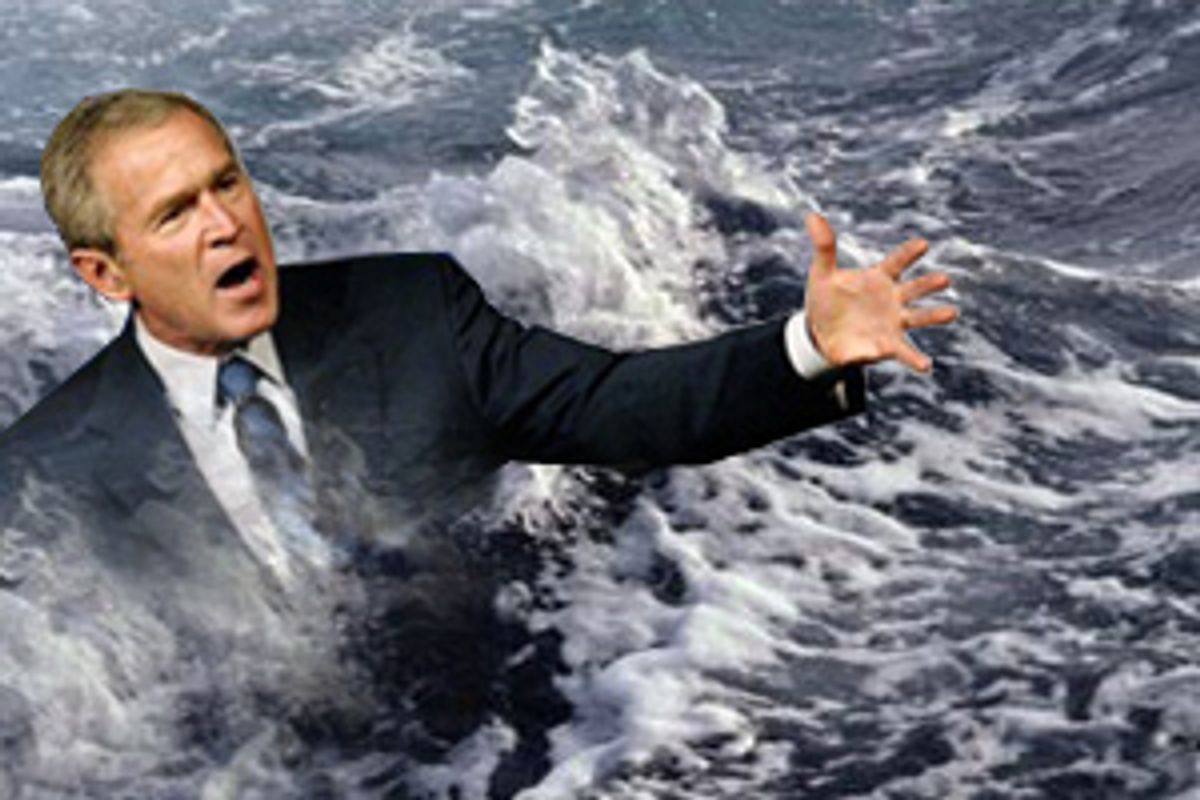
There is no one left to rescue the Republican Party from George W. Bush. He is home alone. The Republican-establishment wise men whose words were once quiet commands are shouting unheeded warnings. The Republican leaders of Congress are distracted and obsessed with their own crises of corruption.
Suspended House Majority Leader Tom DeLay is under indictment for criminal campaign practices while Senate Majority Leader Bill Frist is under investigation by the Securities and Exchange Commission for insider stock trading in his family-owned Hospital Corporation of America. The only revolt brewing in the Senate is on the right against President Bush's nomination of his White House legal counsel, Harriet Miers, to the Supreme Court; some Republican senators fear her potential for secret liberal heresy despite the president's protestations of her conservative purity.
On Aug. 7, 1974, three Republican leaders of Congress made a fateful journey down Pennsylvania Avenue to the White House. Sen. Barry Goldwater, tribune of the conservative movement; Sen. Hugh Scott, the stalwart minority leader from Pennsylvania; and Rep. John Rhodes, the minority leader in the House, informed President Richard Nixon that as a result of the Watergate scandals he must resign the presidency in the interest of the country and the Republican Party. Two days later, Nixon quit.
On Nov. 25, 1986, Attorney General Edwin Meese announced at a White House press conference that tens of millions of dollars from illegal sales of weapons to Iran had been siphoned to Contra guerrillas in Nicaragua by a far-flung conspiracy centered in the National Security Council. National Security Advisor John Poindexter immediately resigned and NSC military aide Oliver North was fired. Within the next month, President Reagan's popularity rating had collapsed from 67 to 46 percent; it did not recover until a year and a half later, in May 1988, when he negotiated an arms control treaty with Soviet leader Mikhail Gorbachev and traveled to Moscow to declare the Cold War over. After the revelation of the Iran-Contra scandal, Reagan purged his administration of right-wingers and neoconservatives in particular. The Republican establishment in all its aspects took control. Former Sen. Howard Baker, who had been the Republican leader at the Watergate hearings, became White House chief of staff; Colin Powell was named national security advisor; neocon protector and Secretary of Defense Caspar Weinberger was forced out and replaced by pragmatic bureaucratic player Frank Carlucci; and Secretary of State George Shultz was given charge of foreign policy in order to negotiate terms with Gorbachev.
The storm enveloping President Bush is a consequence of his adoption of the vicious smear tactics of the Nixon political operation, learned there by Karl Rove, who was called as a witness to testify about them before the Watergate inquiry, and of Bush's elevation to power of the neoconservatives removed by Reagan and excluded from office by Bush's father. Bush is haunted by the history he insisted on defying.
The elements of the Republican establishment that Bush brought into his first administration as a sort of symbolic tribute were gone by his second. By their nature, these people are discreet, measured and private. It is not their impulse to voice disagreement in public. Their sweeping and emotional jeremiads against what Bush has wrought are extraordinary not only in their substance but in having been made at all. Those expressing their disquiet about Bush are more than simply losers in bureaucratic struggles for primacy of place. Once representative of the heart and soul of the Grand Old Party, they are historical castaways. They stand for another Republican Party that has been supplanted by Bush's version.
Paul O'Neill, the former CEO of Alcoa, was shocked at the degradation of policymaking he witnessed as Bush's first secretary of the Treasury. He had anticipated that the councils of government under Bush would be no different from those he had experienced as an economic aide under Nixon. Nixon had rigorously insisted on objective analysis, hearing all sides and considering all options. In Cabinet meetings, O'Neill wrote in his memoir, "The Price of Loyalty," Bush was like "a blind man in a roomful of deaf people." The White House struck back at O'Neill by falsely charging him with leaking classified materials and subjecting him to an investigation, which had the desired effect of silencing him. In retrospect, the accusation of leaking classified information can only appear ironic.
Christine Todd Whitman, former Republican governor of New Jersey, was stunned by her denigration and the suppression of science when she was Bush's first director of the Environmental Protection Agency. After her resignation, she compared Bush unfavorably to Reagan, who, she said, "didn't reach out in a way that indicated that there was no room for others." Whitman's book, "It's My Party Too," was a meek plea for attention from the "social fundamentalists" she claimed had seized control of the family firm. She would not name names, as though she might have another go at riding the tiger that had already devoured her.
John Danforth, for 18 years a U.S. senator from Missouri, served briefly before resigning as Bush's ambassador to the United Nations. He did not stipulate the reasons for his departure, but he did publish an Op-Ed piece in the New York Times on March 30 of this year decrying how "Republicans have transformed our party into the political arm of conservative Christians." The GOP, he wrote, has become "a party that has gone so far in adopting a sectarian agenda that it has become the political extension of a religious movement." Danforth, an old friend of George H.W. Bush's, lamented the loss of the party's heritage: "Our current fixation on a religious agenda has turned us in the wrong direction. It is time for Republicans to rediscover our roots." Danforth was replaced at the U.N. not with a believer in old-fashioned bipartisan internationalism but with John Bolton.
Lawrence Wilkerson, the former head of the Marine War College who had served as chief of staff to former Secretary of State Colin Powell, revealed the inner struggles of the Bush administration in a speech before the New America Foundation on Oct. 19. A "Cheney-Rumsfeld cabal" ran U.S. foreign policy for a president "not versed in international relations and not too much interested." Wilkerson defined the Bush doctrine as "cowboyism." Condoleezza Rice as national security advisor was "extremely weak" and more interested in "her intimacy with the president" than in acting as an honest broker. Cleaning up after Bush's tarnishing of America's image in the world was an impossible task. "It's hard to sell shit," said Wilkerson.
Powell, Wilkerson's principal, has remained publicly quiet since his September outburst, in which he said that his speech before the United Nations arguing the case for the existence of WMD and an invasion of Iraq, which subsequently was revealed to be filled with disinformation, was a "blot" on his record and continues to be "painful now." Behind the scenes, however, Powell has been active in countering the Bush torture policy, which he opposed from the beginning. Powell sent personal letters and made telephone calls to Republican senators urging them to support the amendment to the military appropriations bill that would end the torture policy. As a result of Powell's lobbying, 90 senators voted for it. It was a stinging rebuke to Bush, who has threatened to veto the entire military appropriations package if the amendment is attached.
Brent Scowcroft, perhaps more than anyone else, personifies the realist, bipartisan Republican tradition of internationalism. He is also the former national security advisor to the elder Bush and among his closest friends. President Bush dismissed him early this year from the Foreign Intelligence Advisory Board, having ignored his advice through the first term. Scowcroft's candid views appear in an article in the current issue of the New Yorker, in which he details his rejection by Bush at length. "I don't want to go there," Scowcroft replied when asked about the difference between the father and son. He said dismissively of the Iraq policies of a leading neoconservative, former Deputy Defense Secretary Paul Wolfowitz, "He's got a utopia out there." On Cheney, Scowcroft sounded perplexed: "The real anomaly in the Administration is Cheney. I consider Cheney a good friend -- I've known him for thirty years. But Dick Cheney I don't know anymore."
But Scowcroft the foreign policy mandarin may not have been exposed to the partisan Cheney when he served as secretary of defense in the administration of Bush Sr. He may have missed Cheney's tenure as a representative in the House leadership, where he compiled a far-right voting record and, as House minority whip during the 1980s, was the hidden hand behind the rise of Newt Gingrich and his band of radicals. When he was slated to be Bush's running mate, it was widely assumed that Cheney would act as a stabilizing and moderating presence. Only those who understood his congressional career knew of his affinities with the radical right, his vengeful instincts and his mean-spiritedness. His emergence at the center of the "cabal" now under investigation by special counsel Patrick Fitzgerald should not surprise those who have penetrated his avuncular image to see the hard man beneath. Cheney was not the substitute father figure but the false father.
Bush's highhanded treatment of the few Republican moderates of his first term all but eviscerated what was left of the establishment that once controlled the party. The story of the old party's fall from grace and Bush's part in it is a well-known bildungsroman, a family saga that begins with the father.
The son of Prescott Bush, a patrician moderate Republican senator from Connecticut and a Wall Street investment banker, George H.W. Bush traveled to Texas to make his fortune in the wildcat oil industry. He was hardly a roaring success, but he took up his father's line of work, getting elected to the House from suburban Houston. It was then that he opened the negotiations of his Faustian bargain. His father had been the head of the United Negro College Fund; he and his wife were prominent members of the local chapter of Planned Parenthood. But George Bush Sr., seeking political advantage in Texas, declared his opposition to the Civil Rights Act of 1964. Bush spent the next decade advancing himself as a consummate Republican loyalist in positions ranging from chairman of the Republican National Committee under Nixon to Gerald Ford's CIA director and United Nations ambassador. After losing the Republican presidential nomination to Ronald Reagan in 1980, he swallowed his criticism of Reagan's supply-side nostrums as "voodoo economics" when he became his running mate.
The Faustian negotiations deepened. In 1988, he ran for president as Reagan's anointed successor. Faltering on his own, with unenthusiastic backing from Reagan's evangelical supporters, he ran a series of nativist and racially charged attacks on his Democratic opponent. Bush won that election with the right-wing Republican base voting for him but still doubtful of his authenticity. As president his compromises on taxation and realism in foreign policy led to their open disillusionment.
His son George lost his first campaign for the House from Texas, tainted by association with his father, who was tarnished by the right as a member of the Trilateral Commission international conspiracy. From then on, Bush was never outmaneuvered on his right flank. His political field marshal, Karl Rove, managed the right wing for his benefit. The Faustian bargain of the father became business as usual for the son.
Now the old establishment is faded. Its remnants largely consist of his father's superannuated retinue. Not even the old Texas establishment in the person of James A. Baker III, Bush's father's field marshal and the former secretary of state (among his many official posts), who managed the Florida contest that gave the presidency to the son, is welcome in this White House.
The Republican Party after Bush, minus its traditional establishment, threatens to become the party of its irreducible base, the party of the old Confederacy and the sparsely populated Rocky Mountain states. But this base, however loyal and obsequious to Bush, regardless of any crisis, does not offer statesmen to step in to handle his shaken White House.
A sharp reversal of policy and turnover in personnel are the only actions that may enable Bush to salvage the shipwreck of his presidency, as they did for Reagan. But bringing in the elders, even if they could be summoned, would be psychologically devastating to Bush, a humiliating admission that his long history of recklessness and failure, from the Texas Air National Guard to Harken Energy, with rescue only through the intervention of his father and his father's friends, has reached its culmination.
This story has been changed since it was originally published.
Shares