Throughout the anxious months before the trial of United States v. I. Lewis Libby, one of Scooter Libby's old mentors, a prominent Washington attorney and Republican with experience going back to the Watergate scandal and with intimate ties to neoconservatives, implored him repeatedly to stop covering up for Vice President Cheney and to cut a deal with the special prosecutor. Yet another distinguished Washington lawyer and personal friend of Libby's, privy to the mentor's counsel, reinforced his urgent advice and offered to provide Libby with introductions to former prosecutors who might help guide him. But Libby rebuffed them. He refused to listen. He insisted on the trial.
This Tuesday, Theodore Wells, Libby's chief defense lawyer, abruptly announced that neither Cheney nor Libby would testify on his behalf. In effect, the defense was resting. Did his own lawyers mistrust Libby on the stand? Would he lie and prompt another count of indictment? Would Cheney, indisputably the director of the campaign against former ambassador Joseph Wilson, be stepping into a perjury trap or open the door to conspiracy charges implicit from the beginning? Those questions, along with their testimony, remain moot.
According to prosecutor Patrick Fitzgerald, Libby's case amounts to an attempt at "jury nullification." Libby is charged with five counts of perjury and obstruction of justice for lying about where he learned the identity of CIA undercover operative Valerie Plame (Wilson's wife) and to whom he spread that information. Fitzgerald presented two government officials, former CIA officer Robert Grenier and State Department official Marc Grossman, who swore they were the first to inform Libby. Libby was in pursuit of that information, Fitzgerald further revealed through testimony from past and present Bush administration officials, because the vice president had tasked him to find and spread it. And Libby also passed on the information to Ari Fleischer, the White House press secretary, to get him to pass it on to the press. Two reporters, Matt Cooper (then at Time magazine) and Judith Miller (then at the New York Times), testified that Libby had conveyed to them the information about Plame. NBC's Tim Russert testified that he did not first inform Libby about her, as Libby had told the grand jury. Fitzgerald's prosecution was well honed, unadorned and a straight arrow.
Libby's defense was the legal equivalent of the fog of war. He sought to obfuscate the clarity of the prosecution's case by raising irrelevant issues, turning the jury's attention away from the charges themselves and creating doubt by getting witnesses to admit small lapses of memory, thereby underlining Libby's memory defense. So Libby's lawyers highlighted Cooper's incomplete note taking, whether Miller raised the issue of writing a piece based on Libby's information, and whether Russert followed strict journalistic protocol when he spoke freely to the FBI. Libby's team also summoned a parade of reporters to relate that Libby had not dropped Plame's name with them. By demonstrating a negative, Libby sought to dispute a positive. The intent to sow confusion among the jurors in order to raise a shadow of a doubt and produce an acquittal partly depended on their ignorance of Washington anthropology.
Fitzgerald's case elicited significant evidence of the planned and concerted attack on Wilson. Libby, along with a host of other White House aides, leaked Plame's secret identity to reporters. The methods of communications strategy were disclosed in the testimony of Cathie Martin, Cheney's deputy P.R. aide, who explained the art of talking points, and of Fleischer, among others. "It was decided that Scooter would call [reporters] to try to get into the story and correct the false information," Martin said. "That was [Cheney's] decision." Trial exhibits included the notes of Cheney's former communications advisor, Mary Matalin, who suggested that Libby call Russert to complain about MSNBC "Hardball" host Chris Matthews: "Tim hates Chris." Martin expressed awe of Matalin's skills, but Matalin's Heather-like remarks illuminated Republican Washington as "High School Confidential."
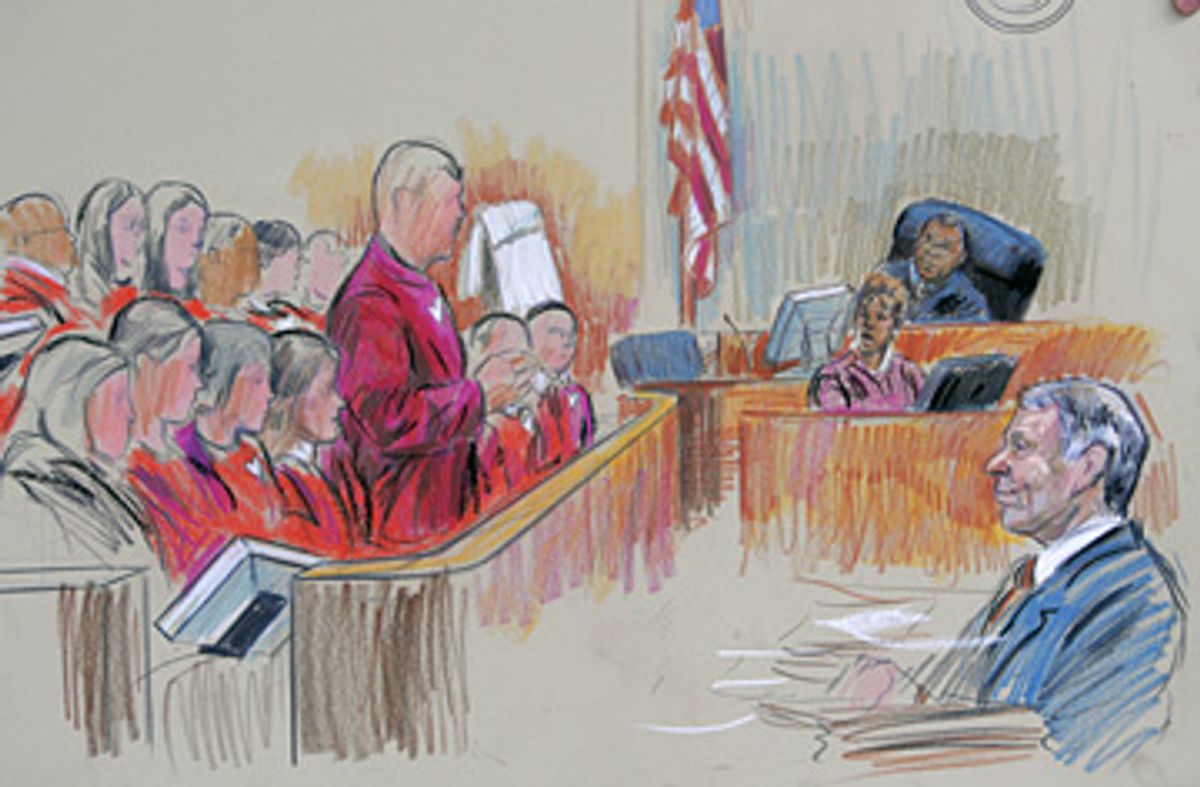
On Monday, I sat in the courtroom as the dapper, slightly built Libby took his place at the defense table, half smiling at his half-dozen attorneys while occasionally flicking his head to the side, betraying a wary glance. In the bench behind him sat his wife, Harriet Grant (herself a lawyer), and Barbara Comstock, a conservative operative hired as a P.R. specialist, playing with her BlackBerry during the testimony and chewing gum. The jurors marched to their seats were impassive; it was impossible to read anything from their immobile faces.
On that day, the busiest for the defense, the witnesses flew through the courtroom with speed. Every one called by the defense was a reporter whose presence was intended to contribute to the confusion of the jury and direct their gaze away from the actual charges. Walter Pincus of the Washington Post was the first one in the stand. He revealed that he had spoken with Libby but that it was Fleischer who disclosed to him Plame's name, as though that somehow proved exculpatory. Of course, it was Libby who told Fleischer about Plame -- "hush, hush" and "on the Q.T." Pincus is the reporter in the run-up to the invasion of Iraq who persistently wrote skeptical stories on administration claims about Saddam Hussein's possession of weapons of mass destruction. Those stories were typically buried, earning Pincus the sobriquet among his friends of Walter "A-14" Pincus.
Fleischer told Pincus about Plame as a consequence of Pincus' diligence as he sought to get to the bottom of the Wilson smear. It was Pincus who called Fleischer. Pincus was not necessarily the person whom Libby himself would trust to leak to himself. Pincus was known within the White House as a skeptic of its disinformation and as a reporter with many independent sources in the intelligence community, which the neoconservatives regarded as an adversary. Pincus was not the sort of reporter whom Libby would provide with this "hush, hush" information. But if Fleischer did so, it was a different matter. In any case, Pincus did not publish Plame's name. Unlike Bob Novak, he had compunctions about the sensitivity of exposing a CIA operative.
Next up was Pincus' colleague Bob Woodward, who explained that then Deputy Secretary of State Richard Armitage had told him about Plame. A snippet of audiotape of their conversation, recorded by Woodward as part of his research for his book "Plan of Attack," was played. This was another attempt at exculpation by showing that it was not Libby who was the source, once again trying to cloud the accusations of perjury and obstruction. Armitage, Colin Powell's best friend, had been a source for Woodward for decades. Libby would know that however useful Woodward might be as an outlet for leaks, as he demonstrated in "Bush at War," depicting President Bush and his team as decisive, prudent and courageous, he would ultimately tilt in Powell's direction. But there was another reason for Libby not to leak Plame's identity to Woodward that was even more basic. Woodward husbanded material for his bestselling books and did not dribble out his exclusives in the daily newspaper. Leaking to Woodward was pointless if one wanted to get a story published immediately.
Armitage's leak was at best mindless, at worst the trading of national security secrets to ingratiate himself with a star reporter. On the tape, Armitage's tough-guy, obscenity-spewing persona is coached along by an eager, laughing Woodward. The more Woodward laps it up, the more Armitage spills the beans. Woodward: "But why would they send him?" Armitage: "Because his wife's a fucking analyst at the agency." Woodward: "It's still weird." Armitage: It, it's perfect. This is what she does, she is a WMD analyst out there." Woodward: "Oh she is." Armitage: "Yeah." Woodward: "Oh, I see."
Armitage had learned of Plame from reading a State Department memo that conspicuously marked an "S" next to her name, indicating that her identity was top secret. Armitage, who had years of experience at high levels of government, was more intent on impressing Woodward than on keeping the secret. The tape ends with Armitage repeating with emphasis: "But his wife is in the agency and is a WMD analyst. How about that shit?" Armitage's buffoonery about "that shit" had no bearing on the charges against Libby, but Libby's lawyers hoped it would provide a tawdry distraction, as it has for numerous Washington columnists and pundits.
Novak was the next witness. He spelled his last name and then his first: "B-O-B." He explained that his sources were Armitage and Karl Rove. "I wouldn't call him a good friend. I would call him a very good source," Novak said about Rove. "I talked to him two or three times a week at that point." Unlike Rove, Libby was not a regular source. "I had no help and no confirmation from Mr. Libby on that issue," Novak said about the Plame story. Just when it appeared that Novak was done, a juror asked a question, read by Judge Reggie Walton, about whether Novak had spoken to anyone else about the information in his notorious column exposing Plame besides the two "senior administration officials" cited in it before its publication. Novak said that he had spoken with Bill Harlow, the public affairs officer at the CIA.
The judge prodded him on whether there was anyone else. Novak revealed that he gave a copy of his column to Richard Hohlt, whom he described as one of his "closest friends," and to whom he said he spoke daily. Hohlt, Novak went on, is a "lobbyist about town." (In fact, he's a little known but influential Republican lobbyist.) And, the judge wondered, did Mr. Hohlt share the column with anyone? Novak further revealed that Hohlt showed it to people at the White House. Thus, through Novak's cutout, or go-between, the White House was informed that Novak would publish Plame's identity. None of this had any bearing on Libby's guilt or innocence, but it was a fascinating glimpse at Novak's methods.
David Sanger, the chief Washington correspondent for the New York Times, followed Novak in the witness chair. What Sanger had to offer is that he had spoken with Libby but that Libby had not told him about Plame. Sanger was another bit player in the Libby defense of distraction. Indeed, there was no cause to leak to Sanger. He was not the type of reporter with whom that sort of delicate political information would be shared. Indeed, Libby was working the New York Times through Judith Miller, the past reliable outlet for disinformation on WMD stories. Libby could not know that Miller would be thwarted in getting permission to write a Plame story. Going to someone like Sanger would only have undermined his attempt to use the Times. But none of that was drawn from the witness.
The next day, instead of calling Cheney, Libby's team put John Hannah, a neoconservative Middle East policy analyst on the vice president's staff, on the stand. For two hours, Hannah held forth on Libby's forgetfulness and the overwhelming crush of his job. Hannah was Cheney's stand-in, but without Cheney's enormous potential liabilities that might be explored through cross-examination. Hannah's role was to be the first-person witness to buttress Libby's memory defense.
Yet, under cross-examination by Fitzgerald, Hannah was cracked apart in a matter of minutes. Fitzgerald asked him whether defending Cheney in the media was an important part of Libby's job. "It would be important to push back on those issues, yes," Hannah said. Fitzgerald then got Hannah to acknowledge that getting Libby to give up an hour's worth of his time, given his heavy load of work, would be difficult. Fitzgerald zeroed in on Libby's two long meetings in the St. Regis Hotel's dining room on June 23 and July 8, 2003. "So, during the time of all these threats if he gave someone an hour or two of his time ... it was something Mr. Libby would think was important, correct?" Fitzgerald asked. Hannah answered that it was. "Is it fair to say that what was important to the vice president was important to Mr. Libby?" Fitzgerald asked. "Yes, that's correct," Hannah replied.
But the demolition of Hannah was not done. A juror had a question, posed to the witness by the judge: Aside from Libby's difficulty with memory, did it lead him to have concerns about his effectiveness? "Never," said Hannah. The barbed question was a sharp indication of at least one juror's cynicism about Libby's defense.
On Wednesday, the next day, Judge Walton ruled that Libby's lawyers had misled the court into believing that Libby would testify in his own behalf. Walton, therefore, disallowed admission into court of questioning of Libby's CIA briefers, who would supposedly show how busy Libby was, another element of his effort to confuse the jury. Undoubtedly, Walton's displeasure at Libby's refusal to testify will shape the instructions he gives to the jurors.
Closing statements will occur on Feb. 20. Judge Walton will charge the jury, and they will decide Libby's fate. Libby must hope that the testimony presented by Fitzgerald has been obscured enough to prevent his conviction. Then the advice he rejected from his concerned mentor and other friends will have been proved to be a gamble he never needed to accept. If declared not guilty, Libby can return to his White House office, where he can resume the vice president's campaigns of disinformation.
Shares