
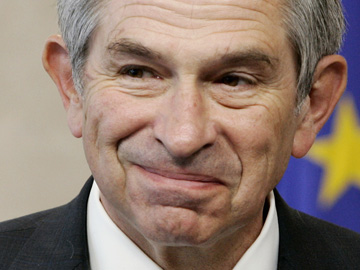

Paul Wolfowitz’s doctrines are a summa of numerous failed political dogmas of the 20th century. His notion of politics was essentially Bolshevik, but less democratic in practice than Lenin’s. Wolfowitz had no concept of mass politics. Nor did he have an idea of democratic centralism, the core of Leninism, by which the vanguard led the cells of the party. Wolfowitz believed only in the vanguard. The dutiful student of obscurantist authoritarian philosopher Leo Strauss operated as a solitary intellectual at the head of a single cell, the lone Wolfowitz. His view of international political dynamics was a strange concoction of the most heated, impassioned idea of Leon Trotsky — the permanent revolution — admixed with the most rigid, Manichaean metaphor of John Foster Dulles — the domino theory of the Cold War. Dulles’ idea, applied to Southeast Asia, was a reaction to his mistaken understanding of Communist expansion as Trotskyist in conception. From this thesis and antithesis came the synthesis of Paul Wolfowitz. Welcome to the dustbin of history.
The squalid ending of Wolfowitz’s glittering career, bickering over lies about payments to his girlfriend, submerged his grandiosity. Wheedling with the World Bank board, he appeared as a shadow of his former self, the intellectual field marshal pulverizing the opposition with the artillery of his arguments, reduced to using a Washington lawyer to make fine points. His class enemies — the CIA and the Baathists, the State Department and the McGovernites — had retreated under his barrages, but he found himself at last whining of persecution at the hands of the sort of bureaucrats he had brushed aside throughout his long rise.
Wolfowitz’s vision promised nothing less than a rupture with the entire world order. By one decisive act of will, all that existed — all — would be transformed. After a brief, very brief, interval, collective happiness and universal harmony would be ushered in. With shock and awe, change would roll in mighty waves, pounding all with its unceasing force.
He was a good boy, not a rebel. Unlike some neoconservatives who had begun on the left and swerved right, his path was straight. His mathematician father’s only complaint about him was that he had not become a mathematician. Instead, young Wolfowitz fell under the spell of one of his father’s friends, Albert Wohlstetter, an old Trotskyist turned Cold War nuclear theologian. Wolfowitz was a pupil in the most exclusive school. (Richard Perle was another acolyte of Wohlstetter’s.) Wolfowitz’s study of nuclear policy was more than a higher mathematics; it was a kind of mystical Kabbalah. Strauss’ influence on him at the University of Chicago was decidedly minor. His connection at the University of Chicago with Ahmed Chalabi, the Iraqi exile, and Zalmay Khalilzad, another neocon later to be U.S. ambassador to Iraq, was more significant than having Strauss as a teacher. His true master was Wohlstetter, master of throw-weights. Wolfowitz’s doctoral thesis was on why Israeli development of a nuclear weapon threatened Middle Eastern and world stability.
Wolfowitz’s recruitment onto the “B Team” in the late 1970s, created under the Ford administration through conservative pressure in order to discredit the CIA’s assessments of the Soviet Union’s nuclear capabilities, signaled his entrance into the sanctum sanctorum of nuclear theologians and Republican policymaking. The factual rebuttal of the B Team’s assertions was not a black mark. Conservatives were on the ascendancy and Wolfowitz was a rare young man among them with a first-class mind and education.
With the end of the Cold War the cold warrior without a mission fastened onto a new id´e fixe. As the undersecretary of defense for policy in the first Gulf War, serving under Secretary Dick Cheney, Wolfowitz had concurred in the decision not to pursue Saddam Hussein to Baghdad after expelling him from Kuwait. He had been present at the Feb. 21, 1991, meeting where that policy was approved and uttered not a skeptical or contrary word. But when the elder Bush was defeated, Wolfowitz in exile became the champion of regime change. He developed an elaborate utopian scheme based on the overthrow of Saddam — instant democracy in Iraq, inciting democratic revolutions throughout the Middle East, accompanied by the equally sudden quiescence of the Palestinians, creating peace for Israel while doing away with any negotiations involved in a peace process. And he imagined Saddam, a brutal enough tyrant, as an octopus, his tentacles manipulating nearly every horror. Even after every available piece of evidence and trials proved otherwise, he continued to insist that Saddam was behind the Oklahoma City and 1993 World Trade Center bombings.
By now Wolfowitz had compiled a distinguished foreign policy résumé marking his upward mobility — from the Arms Control and Disarmament Agency to director of State Department policy planning, from deputy assistant secretary of defense to ambassador to Indonesia — and then, as the dean of the Johns Hopkins School of Advanced International Studies, he was paired with Condoleezza Rice as tutor to Gov. George W. Bush. Unlike Rice, however, Wolfowitz did not intuitively grasp the mind of his new student. He did not have a natural facility for the art of stroking. He sought to impress through his brilliance. Being acknowledged as the smartest aide in the room was how he had gotten ahead before. His breadth of detail and depth of concepts had gained him a series of patrons, from George Shultz to Cheney, who knew how to harness his cerebral talents. But Wolfowitz was not a man for nicknames and locker-room jokes. Despite his privileged proximity to the candidate, Bush did not take to him. And between administrations Wolfowitz was almost lost in the shuffle.
Originally, Wolfowitz aspired to be deputy secretary of state. But the newly named secretary, Colin Powell, had observed Wolfowitz as a Cheney aide during the Gulf War opposing his various positions, and rejected him. Instead, he deployed Washington lawyer and former Reagan chief of staff Kenneth Duberstein, acting as his representative, to offer Wolfowitz the consolation prize of ambassador to the United Nations. Leaving the cockpit of action for a place despised by neoconservatives would have been a cruel punishment. Wolfowitz was suspended in a void. The Kremlin-like politics of the Bush transition determined his fate.
Sen. Dan Coats of Indiana, staffed by a close Cheney friend, favored by social conservatives for his hostility to gays in the military as a member of the Armed Services Committee, emerged as the first choice for secretary of defense. He was to be part of a two-for-one package. Richard Armitage, armed with Pentagon experience, would be his deputy and run the department. But after Powell eclipsed Bush in the press conference where his nomination as secretary of state was announced, Cheney immediately understood that the Coats scenario threatened his intention to become the most powerful vice president in history. While Coats was dim, Armitage was adept. And this combination empowered Powell, potentially giving him dominion over not only State but also Defense. Once this prospect loomed, Cheney, whose clashes with Powell went back to the Gulf War, sought an alternative. Meanwhile, the neoconservative press sounded the alarm. The Weekly Standard ran an article headlined: “The Long Arm of Colin Powell: Will the Next Secretary of State Also Run the Pentagon?” Coats cooperated by undermining himself. His interview with President-elect Bush was a combustible mix of bad chemistry. The dreary Coats didn’t laugh at Bush’s jibes and instead declared his skepticism about “Star Wars” missile defense and complained about Powell. Instantly, he fell through the trapdoor, shipped to Germany as ambassador.
Donald Rumsfeld, who had been secretary of defense under Gerald Ford, wanted to be director of the CIA. His longtime rival, the elder Bush, opposed his appointment to the position he himself had once held. Bad blood had flowed through their relationship since the Ford years, when Rumsfeld had systematically sidelined Bush. In 1988, Rumsfeld endorsed Sen. Bob Dole for the Republican presidential nomination against Vice President Bush. When he won, Bush cut Rumsfeld out of the administration. At dinner parties in Chicago, where Rumsfeld worked as a corporate executive, he entertained with vicious derision of Bush as a hopeless wimp, according to someone who was at several of these affairs.
With Coats out, Cheney, Rumsfeld’s former deputy, moved him in as secretary of defense, establishing a broad basis for Cheney’s empire. Rumsfeld did not want to accept Armitage as his deputy because he was Powell’s best friend, and Powell snapped up Armitage for himself. The lines were being drawn for the internal Cold War that would play out over the first term between Powell and Cheney. But where did that leave Wolfowitz?
Wolfowitz thought that he ought to be director of the CIA. But as soon as he advanced himself, his estranged wife, Clare, wrote a private letter to President-elect Bush saying that he could not be trusted. This embittered letter remained a closely guarded secret, although a former high official of the CIA told me about it. Chris Nelson also reported it on April 16 in his widely respected, nonpartisan foreign policy newsletter: “A certain Ms. Riza was even then Wolfowitz’s true love. The problem for the CIA wasn’t just that she was a foreign national, although that was and is today an issue for anyone interested in CIA employment. The problem was that Wolfowitz was married to someone else, and that someone was really angry about it, and she found a way to bring her complaint directly to the President. So when we, with our characteristic innocence, put Wolfowitz on our short-list for CIA, we were instantly told, by a very, very, very senior Republican foreign policy operative, ‘I don’t think so.’ It was then gently explained why, purely on background, of course. Why Wolfowitz’s personal issues weren’t also a disqualification for DOD we’ve never heard.” The Daily Mail of London also reported on his wife’s letter at the time that Wolfowitz was appointed president of the World Bank in 2005. Asked about it by the newspaper, Clare Wolfowitz did not deny it, saying, “That’s very interesting but not something I can tell you about.”
President-elect Bush summoned George Tenet, the holdover CIA director. “I guess this is the end,” Tenet told a colleague as he headed out the door, that colleague told me. When he returned, a surprised Tenet said, “He wants me to stay until he can find someone better.”
Cheney and Cheney’s chief of staff, I. Lewis “Scooter” Libby, who had been Wolfowitz’s Wolfowitz before he became Cheney’s Cheney — his student when Wolfowitz taught at Yale and his assistant when Wolfowitz served under Cheney at the Pentagon — intervened. Cheney guided Wolfowitz to a safe harbor as deputy to Rumsfeld. But Rumsfeld was unenthusiastic and hesitated. Wolfowitz told him to decide on the spot or he would go to the United Nations, so Rumsfeld took him.
Once in place, Wolfowitz became an indispensable node of the neoconservative cell. He brought in his coterie of neocons to staff an intelligence operation, the Office of Special Plans, outflanking the CIA by circulating its own reports around regular channels to the office of the vice president (run by Libby). Now Wolfowitz was at the center of an embedded Team B.
Despite their shared views, Rumsfeld came to distrust Wolfowitz. “Rumsfeld considered himself fully qualified to supervise the grander themes, and had no intention of ceding the role to Wolfowitz,” writes Andrew Cockburn in his biography, “Rumsfeld: His Rise, Fall, and Catastrophic Legacy.” “The net result was that neither man paid the requisite attention to routine tasks of management and decision making, although Wolfowitz did make an effort to perform both.” Always a disorganized manager, Wolfowitz handled things badly. Meanwhile, he had to call Armitage to find out what was going at Principals Committee meetings because Rumsfeld wouldn’t tell him.
Wolfowitz set to work at once to implement his master plan. He brought up overthrowing Saddam in the first National Security Council meeting with the president, eight months before 9/11. In the immediate aftermath of the terrorist attacks, Wolfowitz hammered on the idea of striking at Iraq.
Less than a month before the invasion, for which his intelligence operation had provided the justifications (later all disproved as sheer disinformation), Wolfowitz was approaching an ecstatic state of being. He could see the shape of things to come through the fog of war. On Feb. 19, 2003, in an interview with National Public Radio, he held forth on the new dawn: “But we’re not talking about the occupation of Iraq. We’re talking about the liberation of Iraq … Therefore, when that regime is removed we will find one of the most talented populations in the Arab world, perhaps complaining that it took us so long to get there. Perhaps a little unfriendly to the French for making it take so long. But basically welcoming us as liberators … There’s not going to be the hostility … There simply won’t be.”
Five months later, on July 23, 2003, after his trip to Iraq, Wolfowitz was still in an elevated state. “There is no humanitarian crisis,” he said. “There is no refugee crisis. There is no health crisis. There has been minimal damage to infrastructure — minimal war damage … So, fortunately, much of what … we planned for and budgeted for has not proved necessary.”
Wolfowitz’s girlfriend, Riza Shaha, a Tunisian-Saudi British citizen, London School of Economics educated, Arab feminist, neoconservative and intimate of the circle of favored Iraqi exile Chalabi, was his perfect partner. He had her detailed at one point to a defense contractor, SAIC, and she reported back to the World Bank, where she said that conditions were just fine in Iraq for bank loans.
But when Wolfowitz leapt to the bank presidency she could not remain there under the World Bank rules. As he drew up elaborate blueprints for the bank, he handled her transfer and compensation ineptly. Thus his usual managerial failings extended to his girlfriend problem, which proved fatal.
Bush, Cheney and the rest of the administration were left standing on the monument of Wolfowitz’s legacy in Iraq. Atop Wolfowitz’s tomb they reviewed the troops and issued brave statements about the future.
On the day Wolfowitz agreed to resign, the sedate employees of the bank surged into the corridors, celebrating the day of liberation by hoisting champagne glasses and bursting into song: “Nah, nah, nah, nah, nah, nah, nah, nah, hey hey, goodbye!”
